
代理维权

Search documents
金融监管总局、中央网信办、公安部、中国人民银行等关于警惕不法“代理维权”短视频及直播陷阱的风险提示
Xin Lang Cai Jing· 2026-02-24 09:08
Core Viewpoint - Recent reports indicate that certain organizations and individuals are using short videos and live broadcasts on social media platforms to disseminate false information regarding "full refund of insurance," "debt clearance," "debt optimization," "debt negotiation," "debt replacement," "credit repair," and "investment advisory fee refunds," misleading financial consumers and investors into hiring them for "agency rights protection" and charging high consultation fees under the guise of legal rights protection [1][9]. Group 1: Characteristics of Illegal "Agency Rights Protection" Videos and Live Broadcasts - These videos and broadcasts falsely claim that "regulatory authorities have introduced new policies," spreading misleading information about "full refund policies," "debt recovery pilot programs," and "national debt clearance plans," which confuses consumers and investors [2][10]. - They also falsely assert that financial institutions are conducting activities such as "full refund of insurance" and "deferred repayments," using visuals of financial institutions to enhance credibility [2][10]. - The content often claims to be from "professional lawyers" or "law firms," misleadingly promoting "rights protection techniques" and charging high fees for these services, while some of these so-called law firms are actually information or consulting companies [3][11]. Group 2: Misleading Marketing Tactics - The videos and broadcasts utilize provocative language, claiming that "the stock market is crashing" and using phrases like "total loss" to attract investors to contact "agency rights protection" organizations [4][12]. - They promote false narratives about financial products and services, such as "you don't have to repay loans or credit cards," which contradicts existing financial laws and regulations [4][13]. Group 3: Regulatory Response and Consumer Guidance - Financial regulatory authorities, including the Financial Regulatory Bureau and the Central Internet Information Office, have issued warnings to the public about the risks associated with these illegal "agency rights protection" activities [1][9]. - Consumers are advised to seek information through official channels and to be cautious of misleading marketing tactics that could lead to financial loss [4][14].

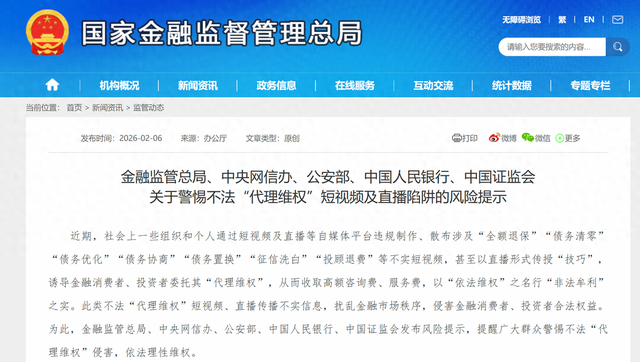
“全额退保”“债务清零”等短视频不实!五部门发布风险提示
Xin Hua She· 2026-02-09 03:29
Group 1 - The core message emphasizes the risks associated with fraudulent "agent rights protection" short videos and live broadcasts, warning consumers and investors to be cautious of misleading marketing claims such as "full refund," "no repayment for loans/credit cards," and "debt optimization" [1][2] - Recent activities involve organizations and individuals using social media platforms to disseminate false information and lure financial consumers into paying high consultation fees under the guise of "legal rights protection" [1] - The main characteristics of these fraudulent activities include false claims about new regulations from regulatory bodies and promotions from financial institutions, as well as assertions of "professional lawyers" providing rights protection [1] Group 2 - There is a significant concern regarding the collection of sensitive personal information by these fraudulent organizations, which may lead to risks such as telecom network fraud and credit card theft if such information is illegally sold or misused [2] - Financial consumers and investors are advised to resolve financial disputes through official channels provided by financial institutions or report to financial management departments, and can also seek resolution through professional mediation or legal means [2]
“全额退保”“征信洗白”不可信
Xin Lang Cai Jing· 2026-02-09 01:05
Core Viewpoint - The financial regulatory authorities in China have issued a warning regarding fraudulent "agent rights protection" schemes that exploit social media platforms to mislead consumers and investors [1][2]. Group 1: Fraudulent Activities - Some organizations and individuals are creating and disseminating misleading short videos and live broadcasts related to "full refund of insurance," "debt clearance," "debt optimization," "debt negotiation," "debt replacement," "credit repair," and "investment advisory refunds" [1][2]. - These fraudulent activities often involve claims of new policies from regulatory bodies and activities from financial institutions, misleading consumers into believing in the legitimacy of these services [1][2]. Group 2: Consumer Protection Measures - The regulatory authorities advise consumers and investors to avoid believing in rumors and to obtain information through official channels such as government websites and national customer service hotlines of financial institutions [1][2]. - Consumers are warned about potential consequences of these scams, including lawsuits for "breach of contract" and information leaks, and are encouraged to resolve financial disputes through official channels or professional mediation organizations [1][2].
别在直播间找“救星”
Bei Jing Shang Bao· 2026-02-08 15:57
Core Viewpoint - The article highlights the rise of illegal "proxy rights protection" schemes that exploit financial consumers through misleading advertisements and false promises, prompting regulatory bodies to issue warnings against such practices [1][3][10]. Group 1: Regulatory Response - On February 6, multiple regulatory bodies including the Financial Regulatory Bureau and the People's Bank of China issued a risk warning against illegal "proxy rights protection" schemes, emphasizing their disruptive impact on the financial market and consumer rights [1][3]. - Financial institutions are actively publishing warnings about illegal "proxy rights protection" to guide consumers towards legitimate channels for rights protection [10][11]. Group 2: Characteristics of Illegal Practices - The core issues of illegal "proxy rights protection" are concentrated on social media platforms, where false information and disguised professional identities are used to lure consumers into paying high consultation fees [3][6]. - Common tactics include fabricating regulatory updates and misleading claims about debt recovery and credit repair, which confuse consumers and lead them to believe in non-existent policies [3][4]. Group 3: Consumer Vulnerability - The emergence of illegal "proxy rights protection" is rooted in the information asymmetry and anxiety of financial consumers, who often seek quick solutions to disputes with financial institutions [6][12]. - Many consumers are misled by promises of "full refund" or "debt clearance," which creates opportunities for fraudsters to exploit their desperation [6][12]. Group 4: Online Evolution of Fraud - The shift from offline to online platforms has allowed illegal "proxy rights protection" schemes to scale up and diversify, utilizing short videos and live streams for broader reach and lower costs [6][10]. - These platforms enable real-time interaction and targeted persuasion, significantly enhancing the effectiveness of fraudulent marketing [6][10]. Group 5: Consumer Education and Protection - Financial consumers are urged to recognize legitimate rights protection channels and remain vigilant against illegal "proxy rights protection" traps to maintain a clear financial environment [1][10]. - Regulatory bodies stress the importance of verifying information through official channels and discourage reliance on social media "experts" or intermediaries [9][12].
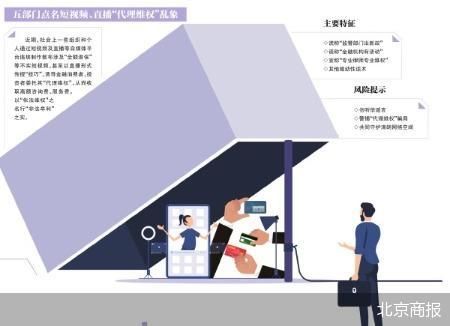
五部门发布风险提示
Xin Lang Cai Jing· 2026-02-07 21:54
Core Viewpoint - The financial regulatory authorities have issued a warning regarding fraudulent "agent rights protection" schemes that mislead consumers and investors through false claims and high fees [1][2] Group 1: Fraudulent Practices - Recent reports indicate that certain organizations and individuals are using short videos and live broadcasts to disseminate false information about "full refund of insurance," "debt clearance," and "debt optimization" [1] - These fraudulent "agent rights protection" schemes often claim to offer legal expertise and promise unrealistic financial benefits, thereby misleading consumers [1] Group 2: Risks to Consumers - The warning highlights that these fraudulent entities may collect sensitive personal information from consumers, including bank details and identification, which could lead to further risks such as telecom fraud and credit card theft [2] - Consumers are advised to seek resolution for financial disputes through official channels or professional mediation rather than engaging with these fraudulent organizations [2]
金融监管总局等五部门联合警示 起底短视频直播“代理维权”陷阱
2 1 Shi Ji Jing Ji Bao Dao· 2026-02-07 13:05
Core Viewpoint - The rise of illegal "proxy rights protection" activities in the insurance sector is being fueled by the proliferation of short video and live streaming platforms, leading to significant risks for financial consumers and investors [1][2]. Group 1: Nature of Illegal Activities - Illegal "proxy rights protection" is particularly evident in the insurance sector, where individuals and organizations exploit short video and live streaming platforms to disseminate misleading information about "full refund" policies [2][3]. - These illegal entities create deceptive narratives in their content, often misrepresenting regulatory changes and using false claims to lure consumers into paying high consultation and service fees under the guise of "legal rights protection" [2][3]. Group 2: Misleading Information and Tactics - The illegal activities often involve claims that financial institutions are offering "full refund" options, misleading consumers with fabricated scenarios and false testimonials about quick refunds [3][4]. - The content frequently misuses images of regulatory bodies and unrelated financial policies to create a false sense of credibility, further confusing consumers about their rights and available options [2][3]. Group 3: Regulatory Response and Consumer Guidance - Regulatory authorities have issued warnings about the misleading nature of "full refund" claims, clarifying that such assertions do not align with existing insurance laws, which typically only allow full refunds during a designated "cooling-off" period [4][5]. - Consumers are advised to seek information through official channels and to be cautious of non-official sources that may lead to financial loss or legal complications [4][5]. Group 4: Risks of Personal Information Exposure - The illegal organizations often collect sensitive personal information from consumers, which poses risks of identity theft and fraud if misused [5]. - Regulatory bodies emphasize the importance of using official channels for resolving financial disputes and warn against the potential legal consequences of engaging with these fraudulent entities [5].
金融监管总局、中央网信办、公安部、人民银行、证监会关于警惕不法“代理维权”短视频及直播陷阱的风险提示
Xin Lang Cai Jing· 2026-02-07 08:02
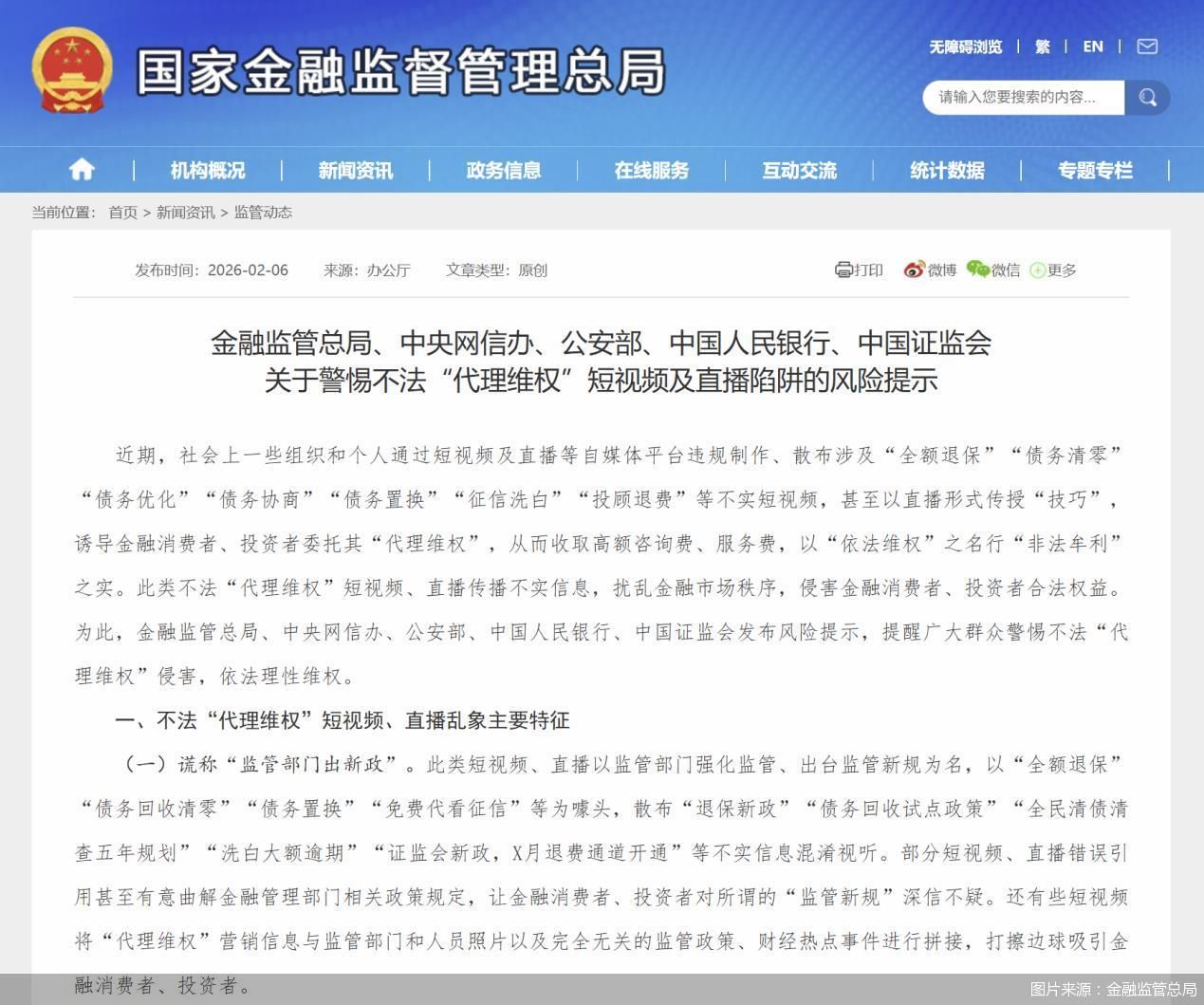
Core Viewpoint - Recent reports indicate that certain organizations and individuals are using short videos and live broadcasts on social media platforms to disseminate false information regarding "full refund of insurance," "debt clearance," "debt optimization," and other misleading claims, thereby inducing financial consumers and investors to engage in "proxy rights protection" for high fees, which disrupts the financial market order and infringes on the legitimate rights of consumers and investors [1][6] Group 1: Characteristics of Illegal "Proxy Rights Protection" Videos and Live Broadcasts - These videos and broadcasts falsely claim that "regulatory agencies have new policies," spreading misleading information about "full refund of insurance," "debt recovery," and other topics, confusing consumers and investors [2][7] - They also falsely assert that financial institutions are conducting activities such as "full refund of insurance" and "debt clearance," using visuals of financial institutions to enhance credibility [2][7] - The content often claims to be from "professional lawyers" or "law firms," misleading consumers with false legal advice and promoting high-fee "proxy rights protection" services [3][8] - Other provocative language is used to attract investors, such as claims about stock market crashes and investor losses, encouraging them to contact "proxy rights protection" organizations [4][8] Group 2: Warnings and Recommendations - Consumers and investors are advised not to believe rumors about "full refund of insurance" and similar claims, as these are inconsistent with financial laws and regulations [4][9] - There is a warning against "proxy rights protection" scams, where organizations may collect sensitive personal information from consumers, leading to potential risks such as fraud [4][9] - Consumers are encouraged to report any illegal activities related to "proxy rights protection" to regulatory authorities to help maintain a clear online space [5][10]
金融监管总局等五部门风险提示:警惕不法“代理维权”短视频及直播陷阱!
Xin Lang Cai Jing· 2026-02-07 06:21
Core Viewpoint - The financial regulatory authorities have issued a risk warning regarding illegal "proxy rights protection" schemes that exploit social media platforms to mislead consumers and investors, urging the public to be cautious and seek legitimate channels for rights protection [3][4][5]. Group 1: Characteristics of Illegal "Proxy Rights Protection" - Illegal "proxy rights protection" schemes often feature false claims about new regulations from regulatory bodies, misleading consumers into believing in non-existent policies such as "full refund of insurance" and "debt clearance" [3][4]. - These schemes utilize deceptive marketing tactics, including misrepresenting financial institutions' activities and creating a false sense of legitimacy by using images of regulatory personnel and unrelated financial policies [4][5]. - The content disseminated through these platforms often includes fabricated information that contradicts established financial laws and regulations, misleading consumers about their rights and available services [5][6]. Group 2: Risks and Recommendations - Consumers and investors are advised to avoid trusting rumors and to be vigilant against "proxy rights protection" scams, as these can lead to significant financial losses and legal complications [4][6]. - It is recommended that individuals verify information through official channels such as regulatory body websites and authorized customer service lines of financial institutions to avoid falling victim to fraudulent schemes [5][6]. - In case of financial disputes, consumers should utilize official channels or professional mediation organizations for resolution, rather than engaging with dubious "proxy rights protection" entities [6].
别在直播间里找“救星”!五部门揭秘“代理维权”骗局
Bei Jing Shang Bao· 2026-02-07 04:01
Core Viewpoint - The article highlights the rise of illegal "agent rights protection" schemes that exploit financial consumers through misleading advertisements on social media platforms, prompting regulatory bodies to issue warnings against such practices [1][6][9]. Group 1: Nature of the Problem - Illegal "agent rights protection" primarily manifests on short video and live streaming platforms, where false information and impersonation of professionals are used to lure consumers into paying high consultation fees [6][10]. - The schemes often falsely claim new regulations from regulatory bodies, promoting services like "full refund of insurance," "debt clearance," and "credit repair," which mislead consumers [6][9]. - The emergence of these schemes is attributed to the information asymmetry and anxiety among financial consumers regarding their rights, leading them to seek quick and easy solutions [9][11]. Group 2: Characteristics of the Schemes - Many self-proclaimed "rights protection" influencers use emotionally charged language to resonate with consumers in debt, presenting themselves as experienced professionals with successful case studies [7][8]. - The schemes have evolved from offline methods to online platforms, utilizing the advantages of short videos and live streams for broader reach and lower costs [9][13]. - Misleading claims often include false promotions of financial institutions offering debt relief or refund opportunities, enhancing the perceived legitimacy of these schemes [8][10]. Group 3: Regulatory Response - Regulatory bodies, including the Financial Regulatory Bureau and the Central Internet Information Office, have issued warnings about the risks associated with these illegal practices, urging consumers to recognize legitimate channels for rights protection [1][2][15]. - Financial institutions are actively publishing alerts about illegal "agent rights protection" and encouraging consumers to engage directly with them for any financial product inquiries [14][15]. - There is a call for enhanced regulatory oversight on platforms hosting these misleading advertisements, with suggestions for stricter content filtering and public education to raise awareness about these scams [16].
五部门发布风险提示:警惕不法“代理维权”侵害
Zhong Guo Jing Ying Bao· 2026-02-07 04:00
Core Viewpoint - The financial regulatory authorities in China have issued a warning about illegal "proxy rights protection" schemes that mislead consumers and investors, urging them to be cautious and to pursue legitimate rights protection methods [1]. Group 1: Characteristics of Illegal "Proxy Rights Protection" - The illegal "proxy rights protection" schemes are characterized by four main features: 1. False claims of new regulations from regulatory bodies, misleading consumers with fabricated policies such as "full refund" and "debt clearance" [2]. 2. Misleading assertions that financial institutions are conducting activities like "full refunds" and "debt relief," often using deceptive visuals to enhance credibility [2]. 3. Claims of "professional lawyers" providing rights protection, disseminating misleading information and charging high fees for services that may not be legitimate [3]. 4. Use of provocative language to incite fear and attract investors, promoting the idea that they can recover losses through these schemes [3]. Group 2: Risks Associated with "Proxy Rights Protection" - Consumers and investors are advised to be wary of these schemes, as they may incur high service fees and face legal issues if they attempt to withdraw from these agreements [4]. - There is a significant risk of personal information being collected by these fraudulent organizations, which could lead to further financial scams and identity theft [4].