仿制药竞争

Search documents
速递|专利仅剩20天!34亿+重磅减重药降价50%,国产大军群狼环伺
GLP1减重宝典· 2026-02-28 14:23
Core Viewpoint - The article discusses the impending patent expiration of Semaglutide (GLP-1 receptor agonist) in March 2026, which will lead to increased competition from generic drug manufacturers and a potential price war in the weight loss medication market [5][6]. Group 1: Patent Expiration and Market Impact - Semaglutide has gained significant market share in the weight loss drug sector due to its effectiveness in lowering blood sugar and aiding weight loss, with sales exceeding 3.4 billion yuan in the first three quarters of 2025 [8]. - The patent expiration will allow at least ten domestic pharmaceutical companies, including Jiuyuan Gene and Lizhu Group, to launch their own generic versions of Semaglutide, intensifying market competition [6][10]. - Jiuyuan Gene's biosimilar, Jikeqin®, has shown comparable efficacy and safety to the original drug in clinical trials, indicating a strong entry into the market [6]. Group 2: Competitive Landscape - Novo Nordisk, the original manufacturer of Semaglutide, is facing competition not only from generics but also from Eli Lilly's upcoming oral GLP-1RA, Orforglipron, which has demonstrated superior efficacy in clinical trials [9]. - Orforglipron is expected to achieve sales of $11.8 billion by 2032, highlighting the competitive pressure on Semaglutide as new entrants emerge [9]. - In response to competition, Novo Nordisk has announced significant price reductions for Semaglutide in the U.S. and domestic markets, with price cuts ranging from 35% to 50% [8]. Group 3: Future Outlook and Strategies - The article emphasizes the need for original drug manufacturers to accelerate new drug development or consider mergers and acquisitions to fill revenue gaps as generics flood the market [10][11]. - Domestic companies are innovating in drug formulations, with some introducing long-acting versions and even nasal spray formulations of Semaglutide to differentiate themselves [10]. - The market dynamics are shifting towards efficiency and cost-effectiveness, with companies needing to adapt to consumer preferences for quick and affordable access to medications [11].

仿制药冲击加剧 诺华制药(NVS.US)预警2026年利润将下滑
Zhi Tong Cai Jing· 2026-02-04 07:54
Core Viewpoint - Novartis reported its Q4 2025 earnings, showing a revenue of $13.34 billion, a 1.4% year-over-year increase, but $740 million below expectations. The company anticipates a profit decline this year due to generic competition impacting its blockbuster drugs like Entresto [1][2]. Group 1: Financial Performance - Q4 revenue was $13.34 billion, reflecting a 1.4% year-over-year growth, but fell short of expectations by $740 million [1]. - Non-GAAP earnings per share were $2.03, exceeding expectations by $0.03 [1]. - The company expects core operating profit to decline by a low single-digit percentage when adjusted for constant currency [1]. Group 2: Strategic Initiatives - CEO Vas Narasimhan is focusing on innovative drug strategies, which will be tested this year due to competition from generics affecting Entresto and other established drugs [1]. - Novartis is launching a new pill for autoimmune skin diseases and will soon announce key data for experimental therapies targeting heart disease and multiple sclerosis [1]. - To drive growth, Novartis agreed to acquire Tourmaline Bio for a promising therapy to reduce systemic inflammation and made a significant acquisition of Avidity Biosciences for up to $12 billion [2]. Group 3: Market Position and Future Plans - Novartis has addressed some uncertainties regarding its U.S. business by reaching an agreement with the Trump administration to avoid new industry tariffs in exchange for price reductions [2]. - The company has committed to building seven new manufacturing facilities in the U.S. as part of a $23 billion investment to expand its manufacturing capabilities, primarily focusing on radioligand therapy [2].

诺和诺德预计2026年销售额将下降 引发股价暴跌
Jin Rong Jie· 2026-02-03 18:38
Core Viewpoint - Novo Nordisk (NVO.N) shares fell over 13% after the company unexpectedly warned of a more severe decline in sales for 2026, primarily due to pricing pressures affecting its diabetes and weight loss drugs in the U.S. [1] Sales Forecast - The company anticipates a global sales decline of 5% to 13% in 2026 compared to 2025 levels, excluding currency fluctuations [1] - In contrast, the sales for 2025 are projected to grow by 10% [1] Pricing Pressure - The decline in U.S. sales is attributed to price reductions for drugs, including Ozempic and Wegovy, following an agreement with the Trump administration to lower drug prices [1] - The loss of patent exclusivity for these drugs in certain countries outside the U.S. may open the market to lower-priced generic competition [1] Market Position - This negative outlook represents a setback for a company that was previously a pioneer in the weight loss drug market [1]
21亿脑卒中市场迎来新玩家!江苏联环等12家药企打响依达拉奉右莰醇首仿争夺战
Ge Long Hui· 2026-01-07 06:21
Core Insights - Jiangsu Lianhuan Pharmaceutical has submitted a listing application for the generic drug "Edaravone and Right-Butanol Injection Solution," which has been accepted by the National Medical Products Administration (NMPA) [1][2] - This submission follows a failed application by Shanghai Kaibao Xinyi Pharmaceutical on November 14, 2025, indicating a competitive landscape for this drug [1][5] - The original drug, developed by Shensheng Pharmaceutical, was approved in July 2020 and has shown significant market performance, with sales reaching 1.4 billion yuan in 2021 and over 2.5 billion yuan in 2022 [4] Market Dynamics - The market for Edaravone and Right-Butanol Injection Solution is expected to grow due to the increasing incidence of stroke and an aging population [8] - The original product's inclusion in the national medical insurance directory has improved patient accessibility, laying a foundation for the market expansion of generics [8] - Currently, 12 domestic pharmaceutical companies, including Jiangsu Lianhuan, are competing for the first generic version of this drug, intensifying the competition [5][11] Competitive Landscape - If Jiangsu Lianhuan's application is approved, it may become the first generic producer, potentially reshaping the market dynamics and enhancing its strategic positioning in the generic drug sector [11][12] - The ongoing competition among 12 companies suggests that the market for this 21 billion yuan drug is on the verge of significant transformation [12]


印度仿制药杀到家门口,国产仿制药如何打破增长天花板
3 6 Ke· 2025-11-28 06:19
Core Insights - Indian pharmaceutical companies have made significant inroads into the Chinese market, winning multiple bids in the latest national drug procurement round, with prices drastically lower than original branded drugs, indicating a new competitive phase in the market [1][2] - The entry of Indian generics is seen as a major challenge for domestic Chinese generic drug manufacturers, who face both internal and external pressures [1][2] Group 1: Indian Pharmaceutical Companies' Market Entry - Indian companies like Hetero Labs, Cipla, Annora Pharma, and Natco Pharma have collectively won bids for seven drug varieties, marking a record for Indian firms in China's national procurement [1] - Hetero Labs' bid price of 0.215 yuan per tablet is significantly lower than AstraZeneca's original drug price of 4.36 yuan, showcasing the competitive pricing strategy of Indian generics [1] - Indian pharmaceutical firms have prepared extensively for the Chinese market, with many holding multiple registration certificates and having passed consistency evaluations for generics [2] Group 2: Competitive Advantages of Indian Generics - Indian companies benefit from lower production costs, with labor costs being 1/2 to 1/3 of those in China, and significantly lower costs for bioequivalence testing [2] - The production capacity utilization of Indian firms is around 50%, allowing them to offer competitive pricing due to excess capacity [2] - India has become the largest exporter of generics globally, supplying 20% of the world's generics and meeting 40% of the U.S. demand for generics [3] Group 3: Challenges for Chinese Generic Drug Companies - Despite having a large number of pharmaceutical companies, China struggles with quality issues, with many generics failing to meet the efficacy of original drugs [5] - Chinese generic drug companies face significant challenges from price pressures due to national procurement policies and the potential market entry of Indian generics [6] - Companies like Huahai Pharmaceutical and Kelun Pharmaceutical are already experiencing revenue declines and margin pressures due to these competitive dynamics [6] Group 4: Strategies for Chinese Pharmaceutical Companies - Chinese firms are encouraged to enhance R&D investments, focusing on complex formulations and first-generic drugs to differentiate themselves [7] - Expanding into international markets is another strategy, with companies like Ganli Pharmaceutical successfully securing large contracts in Brazil [7] - Smaller companies are advised to specialize in niche areas such as rare diseases and high-tech generics to avoid direct competition with Indian firms [7] Conclusion - The competition in the pharmaceutical market is shifting from national origin to quality, with Indian generics leveraging their scale and cost advantages [8] - The ongoing competition may lead to significant transformations within the industry, with some companies thriving while others may exit the market [8]




百济神州“首盈”背后:大单品突围,却面临仿制药潮涌与技术迭代双重夹击|创新药观察
Hua Xia Shi Bao· 2025-10-23 09:31
Core Viewpoint - BeiGene has reached a profitability turning point, reporting a net profit of 450 million yuan for the first half of 2025, marking a significant recovery from previous losses exceeding 57 billion yuan over seven years. However, the company's revenue structure raises concerns due to its heavy reliance on core products and a single market, making it vulnerable to external fluctuations [3][4]. Revenue Structure - In the first half of 2025, BeiGene achieved total revenue of 17.518 billion yuan, with its core product, Brukinsa (Zebutinib), contributing significantly to this figure. The global sales totaled 12.527 billion yuan, reflecting a year-on-year growth of 56.2% [4][5]. - The U.S. market accounted for 51.2% of the total revenue, with sales reaching 8.958 billion yuan, a 51.7% increase year-on-year. European sales grew by 81.4% to 1.918 billion yuan, while sales in China increased by 36.5% to 1.192 billion yuan [5]. Market Challenges - The company's reliance on a "single product + single market" model poses risks, particularly from potential changes in U.S. healthcare policies and increasing market competition. The company has not responded to inquiries regarding how it would maintain profitability if U.S. healthcare negotiations require price reductions [5][6]. - The competitive landscape is intensifying, especially for Brukinsa, which faces threats from new generation competitors like Eli Lilly's Pirtobrutinib, which has shown advantages in clinical trials [7][8]. Patent Expiration Risks - The first-generation BTK inhibitor, Ibrutinib, is set to have its core patent expire in the U.S. by 2027, with some extensions possible until 2028. This will likely lead to an influx of low-cost generics in the market, which could significantly impact Brukinsa's pricing and market share, especially in price-sensitive segments [9][10]. - The approval of generic versions of Ibrutinib in China further complicates the competitive landscape, as these generics may lower prices and increase accessibility for patients, potentially affecting Brukinsa's performance [10].
盐酸氨溴索原研药沐舒坦将重返中国市场
Bei Ke Cai Jing· 2025-08-26 10:55
Core Viewpoint - The return of the original brand Mucosolvan (Ambroxol Hydrochloride) to the Chinese market is anticipated in December 2025, following its exit due to registration expiration and increased competition from generic drugs [1][2]. Group 1: Company Background - Mucosolvan was originally developed by Boehringer Ingelheim and launched in Germany in 1978, entering the Chinese market in 1991 [2]. - The product achieved peak sales exceeding 8 billion yuan in China, making it a highly competitive product in the market [2]. - The original manufacturer, Boehringer Ingelheim, ceased the product's registration in China in 2020, leading to its market exit [3]. Group 2: Market Competition - The return of Mucosolvan will face competition from 367 similar drug approvals in China, including significant price competition from generics [6]. - In the 2021 centralized procurement, Boehringer Ingelheim's bid was only a 0.3% price reduction, while competitors like Yunnan Longhai offered a 93.3% reduction [4]. - The market for expectorants is crowded, with other active ingredients available, such as bromhexine and acetylcysteine, which may affect Mucosolvan's market share [6]. Group 3: Future Outlook - The product's return is now under the management of Opella, a company that became independent from Sanofi in May 2025, which retains a 48.2% stake in Opella [4]. - The ability of Mucosolvan to regain consumer trust and willingness to pay a premium in a low-price environment remains uncertain [6]. - The performance of Mucosolvan post-return will be closely monitored, especially regarding its positioning in the OTC market [6].
仿制药泛滥摧毁减肥神药!市值一日蒸发700亿美元后 巴克莱警告诺和诺德(NVO.US)面临“信誉崩塌”
Zhi Tong Cai Jing· 2025-07-30 13:33
Group 1 - Novo Nordisk's stock price has been declining significantly after issuing a profit warning and appointing a new CEO, resulting in a market value loss of $70 billion [2] - The company has lowered its sales growth forecast for 2025 from 13%-21% to 8%-14%, and its operating profit growth forecast from 16%-24% to 10%-16% [2] - Since the launch of Wegovy in 2021, Novo Nordisk's market value peaked at $615 billion but has since dropped by two-thirds due to concerns over losing competitive advantage in the weight loss drug market [2] Group 2 - The stock experienced a sharp decline of 23% on Tuesday, with an intraday drop of 30% [3] - The sales forecast downgrade is attributed to competition from compounded generic drugs that use the same active ingredients as the branded drug, which caught investors off guard [3] - Barclays downgraded Novo Nordisk's rating from "Overweight" to "Neutral," citing a significant credibility crisis regarding the company's assessment of its issues [3] Group 3 - Novo Nordisk is intensifying efforts to regain patients using compounded generics and has increased dialogue with the FDA to curb illegal compounded drugs [3] - JPMorgan maintained an "Overweight" rating but reduced the target price from 650 to 500 Danish kroner, indicating cautious optimism about a potential recovery in U.S. prescriptions [3]

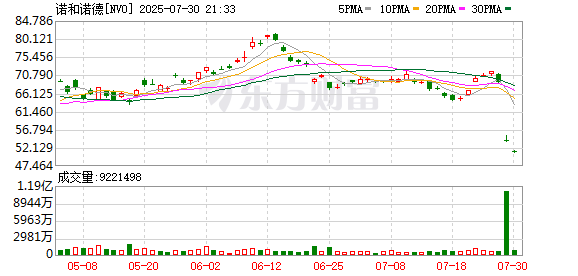
仿制药泛滥摧毁减肥神药!市值一日蒸发700亿美元后 巴克莱警告诺和诺德(NVO.US)面临“信誉崩塌“
智通财经网· 2025-07-30 12:39
Group 1 - Novo Nordisk's stock price has been declining following a profit warning and the appointment of a new CEO, resulting in a market value loss of $70 billion [1] - The company has significantly lowered its sales growth forecast for 2025, now expecting an 8%-14% increase in sales, down from a previous estimate of 13%-21% [1] - Novo Nordisk's operating profit growth forecast has also been reduced from 16%-24% to 10%-16% [1] Group 2 - The sales forecast downgrade is attributed to competition from compounded generic drugs that use the same active ingredients as the branded drug Wegovy [2] - The incoming CEO, Maziar Mike Doustdar, claimed that Wegovy's growth momentum is still strong, but the management failed to alleviate market concerns during a call with investors [2] - Barclays downgraded Novo Nordisk's rating from "overweight" to "neutral," citing a significant credibility crisis regarding the company's assessment of its issues [2]
报告下载 | 药企2025年中展望:欧美巨头们下半年谁领跑,谁承压?
彭博Bloomberg· 2025-07-03 03:45
Core Viewpoint - The outlook for large pharmaceutical companies in the US and Europe in the second half of 2025 is mixed, with concerns over US drug pricing and optimistic expectations for upcoming data releases [2]. Group 1: Patent Expiration Risks - Over $350 billion in annual sales for large pharmaceutical companies in the US and Europe face risks from patent expirations, with 133 drugs losing exclusivity between 2025 and 2030 [5]. - Approximately 40% of the revenue at risk from patent expirations comes from small molecule drugs, while biologics represent the highest share of potential sales erosion [5]. - Merck faces the greatest risk due to the patent expiration of Keytruda in 2028, with Bristol Myers Squibb also significantly impacted [5]. Group 2: Currency Impact - The recent decline of the US dollar may negatively affect non-dollar reporting pharmaceutical companies, including Sanofi, Roche, GSK, and Novo Nordisk [7]. - Conversely, companies like AstraZeneca and Novartis, which report in dollars, may benefit from favorable currency effects [7]. Group 3: Earnings Growth Projections - Eli Lilly and Novo Nordisk are expected to lead in adjusted earnings growth for 2025, with Lilly's operating margin showing significant expansion potential [8]. - AstraZeneca, Sanofi, and Novartis are projected to achieve double-digit earnings growth, with Novartis's outlook being particularly surprising given its patent challenges [8]. - Bristol Myers Squibb and Bayer are experiencing profit margin pressures due to competition from high-margin generics [8]. Group 4: Sales Forecasts - Sales forecasts for major pharmaceutical companies indicate varied growth rates, with Eli Lilly projected to grow from $45.043 billion in 2024 to $100.289 billion by 2029, reflecting a compound annual growth rate (CAGR) of 22.7% [9]. - Novo Nordisk is expected to see sales increase from $290.403 billion in 2024 to $515.458 billion by 2029, with a CAGR of 14.3% [9]. - In contrast, Pfizer's sales are projected to decline from $63.627 billion in 2024 to $53.724 billion by 2029, indicating a negative CAGR of 1.5% [9].