
创新药国际化

Search documents
谢承润:10亿美金难倒中国药企 正探索出海新方案
经济观察报· 2026-03-20 01:50
Core Viewpoint - The Chinese pharmaceutical industry is facing significant challenges in internationalization, particularly in conducting multi-center clinical trials due to high costs and funding limitations. However, it is also experiencing a shift from follower innovation to exploratory innovation, leading to increased global recognition of Chinese innovative drugs [2][3]. Group 1: Current Challenges - Chinese pharmaceutical companies are struggling to conduct Phase III clinical trials internationally due to exorbitant costs, with estimates suggesting that a large Phase III trial could cost up to $1 billion [3]. - The total investment required for a drug to go from research to global market approval is approximately $2.6 billion, with only 1 in 10 products surviving the development process, highlighting the financial risks involved [3]. - Many Chinese companies have attempted to establish R&D centers in Europe and the U.S., but failures in these ventures have severely impacted their cash flow, with one failure being detrimental and two failures nearly crippling [3]. Group 2: Opportunities and Developments - The Chinese innovative drug sector is entering an "engineer dividend era," transitioning from following Western innovations to creating their own, with the transaction scale for external licensing of Chinese innovative drugs reaching $135.655 billion in 2025, marking a historical high [2]. - China has become the second-largest country for the first listing of new molecular entities, indicating a growing global recognition of the value of domestic innovative drugs [2]. - There is a call for establishing a "multi-center clinical mutual recognition system" with markets in Japan, South Korea, the Middle East, and Southeast Asia, allowing Chinese companies to distribute cases across these regions during Phase III trials [3]. Group 3: Strategic Initiatives - The Shanghai government is supporting the establishment of an international development alliance for biopharmaceutical companies, aimed at facilitating the early market entry of Chinese drugs in Asia before expanding to Western markets [4].



创新药-继续看好国际化-政策支持和技术突破
2026-03-09 05:18
Summary of Key Points from Conference Call Records Industry Overview - The focus for pharmaceutical investments in 2026 is on ADC (Antibody-Drug Conjugates), second-generation IO (Immuno-Oncology), small nucleic acids, and weight loss sectors, with the CRO (Contract Research Organization) industry expected to see a demand turning point as global investment and financing recover [1][2]. Core Insights and Arguments Company-Specific Developments - **Kanglongda (科伦博泰)**: SKB264 is being advanced overseas by Merck with 17 Phase III clinical trials, with key data expected in 2026 for lung cancer and breast cancer indications [1][4]. - **Shiyao Group (石药集团)**: Achieved significant business development (BD) progress with AstraZeneca on the GLP-1 platform, exceeding market expectations. The EGFR ADC has received three FDA fast track designations, and multiple small nucleic acid pipelines are expected to enter IND in 2026 [1][4]. - **Kangfang Biotech (康方生物)**: Has 14 Phase III clinical trials globally for AK112, with key data readouts expected in H2 2026 for lung cancer and cholangiocarcinoma [1][4]. - **Hengrui Medicine (恒瑞医药)**: Entering a positive performance cycle with expectations of 10 innovative drug approvals in 2026 and over 20 Phase III clinical data readouts [1][8]. - **Innovent Biologics (信达生物)**: Anticipates significant revenue growth in 2026, primarily from the high-volume launch of Ma Shidu peptide and ongoing commercialization of new molecules [1][9]. - **Rongchang Biotech (荣昌生物)**: Expects to achieve breakeven in 2026, with significant overseas clinical progress for RC118 in collaboration with AbbVie [1][10]. Investment Themes - **Innovation Line**: Optimism for innovative drug investments in 2026, driven by improved global liquidity and supportive domestic policies. Key areas include ADC, second-generation IO, small nucleic acids, and weight loss therapies [2]. - **Global Expansion**: Increased market attention on companies going global, with the Chinese pharmaceutical industry gradually gaining global competitiveness. However, challenges remain in the long-term process of internationalization [2]. - **Marginal Changes**: Policy support and improvements are expected to be significant trading logic in 2026, with a focus on CRO industry recovery and opportunities arising from supply-demand improvements [2]. Clinical and Regulatory Milestones - **Clinical Trials**: Multiple companies are expected to report critical clinical data in 2026, including early data from various ADC and IO projects, with significant implications for their market positions [5][6][11]. - **Regulatory Approvals**: Companies like Hengrui and Shiyao are on track for numerous drug approvals and submissions, indicating a robust pipeline and regulatory strategy [8][4]. Other Important Insights - **Market Dynamics**: The CRO sector is highlighted as a key area for recovery, with companies like WuXi AppTec and Tigermed expected to benefit from renewed global demand [2]. - **Emerging Technologies**: The focus on innovative drug development, particularly in the context of ADC and IO, reflects a broader trend towards precision medicine and targeted therapies [1][2]. This summary encapsulates the critical developments and insights from the conference call records, providing a comprehensive overview of the pharmaceutical industry's landscape and specific company trajectories for 2026.
创新药海外授权合作密集落地 中国药企加速全球化布局
Zhong Guo Zheng Quan Bao· 2026-02-27 21:50
Core Insights - The domestic innovative pharmaceutical industry is experiencing a surge in overseas business development (BD) collaborations, with companies like Xianweida, Frontier Biotech, and HAPO Pharmaceuticals announcing significant overseas licensing agreements, indicating a shift from single product licensing to technology transfer and global collaboration [1][4] Group 1: Recent Collaborations - Xianweida and Pfizer China have entered a commercialization strategic cooperation agreement for the GLP-1 receptor agonist Enogratide, with potential payments totaling up to $495 million [2] - Frontier Biotech has signed an exclusive licensing agreement with GlaxoSmithKline (GSK) for two small RNA products, receiving an upfront payment of $40 million and potential milestone payments totaling up to $950 million [2] - HAPO Pharmaceuticals has partnered with Solstice Oncology for the exclusive development and commercialization rights of HBM4003 outside Greater China, with an upfront payment of over $105 million and potential milestone payments of up to $1.1 billion [3] Group 2: Market Trends and Growth - The overseas BD transactions for Chinese innovative drugs are projected to grow significantly, with total transaction amounts increasing from $2.562 billion in 2017 to $140.274 billion by 2025, indicating a robust growth trajectory [5] - In January 2026, several companies, including Rongchang Biotech and Shiyao Group, have already established overseas licensing agreements, showcasing the ongoing momentum in international collaborations [4] Group 3: Financial Performance and Projections - Companies like Frontier Biotech and HAPO Pharmaceuticals are expected to see improved cash flow and financial structures due to their recent collaborations, which will support core pipeline development and technology platform upgrades [5] - HAPO Pharmaceuticals anticipates a net profit between $88 million and $95 million for 2025, driven by recurring revenue from international collaborations [6] - Three Life Health reported a revenue of 4.199 billion yuan for 2025, a 251.81% increase year-on-year, largely attributed to its collaboration with Pfizer [7] Group 4: Future Trends and Strategic Focus - The internationalization of Chinese innovative drugs is driven by both demand from multinational pharmaceutical companies facing patent cliffs and the recognition of the quality of Chinese drug research and development [8] - The BD landscape in 2026 is expected to focus on unmet clinical needs, technological differentiation, and global value, particularly in oncology and metabolic disease sectors [8] - Analysts suggest that the BD transactions will evolve towards technology output combined with product licensing, platform collaborations, and global innovation, emphasizing the importance of evaluating companies' platform capabilities and clinical milestone achievements [8]

周刊:马年投资锦囊|嘉实基金杨欢:“制造业优势+科技创新”的双轮驱动逻辑依然坚实,今年四大赛道蕴含机遇
Sou Hu Cai Jing· 2026-02-12 10:30
Core Viewpoint - The dual-driven logic of "manufacturing advantages + technological innovation" remains solid, and current adjustments provide opportunities for long-term investment [1]. Group 1: Market Outlook for 2025 - The market in 2025 is divided into three phases: - The first phase from post-Spring Festival to April focuses on technology revaluation, driven by the international recognition of the DS model, with strong performances from Hong Kong internet giants and A-share tech companies [5]. - The second phase from May to September highlights accelerated AI capital expenditure and overseas expansion trends, with record-breaking collaborations in innovative drugs and enhanced competitiveness in the energy storage sector driving related stocks up [5]. - The third phase in the fourth quarter shifts towards expectations of PPI recovery due to "anti-involution" policies, benefiting cyclical sectors like chemicals [5]. - The non-ferrous metals industry is a consistent highlight throughout the year, with precious metals performing strongly in a weak dollar environment, leading to increases in industrial metals like copper and silver [5]. Group 2: Investment Opportunities for 2026 - Four key industrial tracks are identified for investment based on the "14th Five-Year Plan": - The AI industry remains central, with a focus on computing power investment as domestic internet companies are expected to significantly increase capital expenditure, benefiting the domestic computing power supply chain [6]. - The overseas expansion of the renewable energy sector, particularly in energy storage and electric vehicles, continues to be promising due to declining lithium battery costs and global energy transition demands [6]. - The commercial aerospace sector is entering an acceleration phase, supported by policy and industry resonance, with significant satellite reserves laid out for industry development [6]. - The internationalization of innovative drugs is progressing, with Chinese companies moving from licensing to direct overseas expansion, showcasing competitive R&D efficiency in large molecule drugs [6]. Group 3: Strategies for Market Volatility - Recent market volatility is attributed to rapid price increases raising demand concerns and emotional disturbances from uncertain events. A strategy of "not chasing high prices, focusing on valuation, and looking long-term" is recommended [7]. - For high-priced assets, careful evaluation of the potential for exceeding performance expectations is necessary, while solid companies with growth potential present opportunities during short-term adjustments [7]. - In managing product portfolios, dynamic adjustments are made through in-depth industry research, tracking changes in competitive landscapes, and timely adjustments to overvalued assets while focusing on undervalued companies with significant growth potential [7]. Group 4: Investment Strategy for the Year of the Horse - The overall market outlook for 2026 is optimistic, with the capital market remaining in a favorable environment. Continuous technological advancements and enhanced competitiveness in high-end manufacturing are expected to support corporate profitability and market stability [8]. - The market is anticipated to trend upward with fluctuations, necessitating a focus on rhythm and structural opportunities. Identifying certainty amid volatility through in-depth research and patient holding is expected to yield good returns [8].

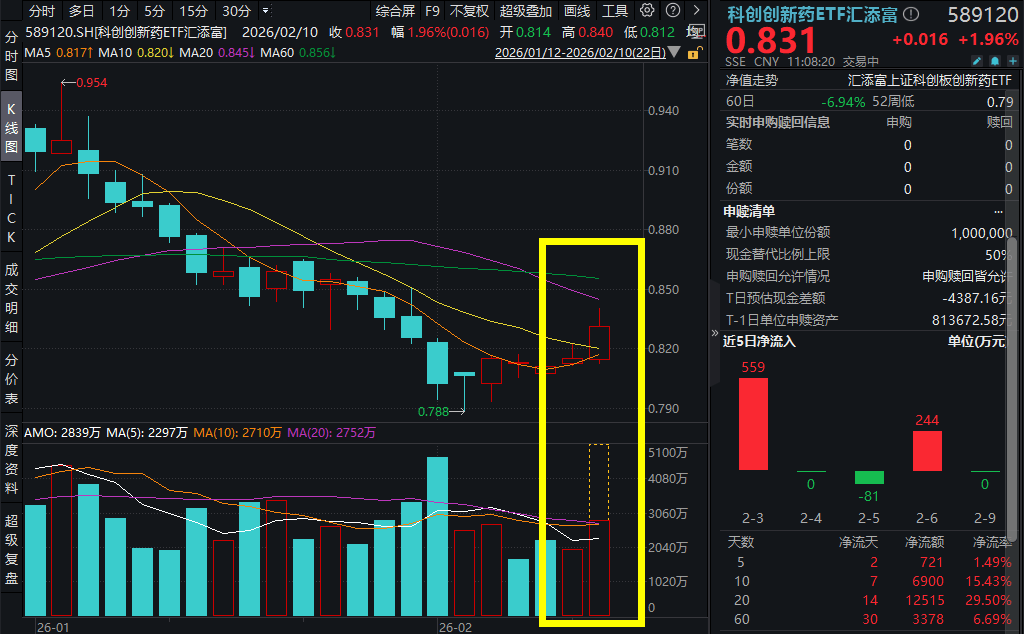
国内首款VAV1分子胶降解剂进入临床,诺诚健华涨超2%!科创创新药ETF汇添富(589120)爆量涨2%,冲击两连阳!重磅BD来袭,关注科创创新药主线
Sou Hu Cai Jing· 2026-02-10 04:05
Core Viewpoint - The A-share market is experiencing a strong upward trend, particularly in the innovative drug sector, with significant gains in the ChiNext Innovative Drug ETF [1][3]. Group 1: Market Performance - As of 11:08 on February 10, the ChiNext Innovative Drug ETF (589120) surged by 2%, marking a potential two-day consecutive rise [1]. - Major component stocks of the ETF, such as Rongchang Biopharma and Baili Tianheng, saw increases exceeding 5%, while others like Baijie Shenzhou rose over 4% [3]. Group 2: Key Component Stocks - The top ten component stocks of the ChiNext Innovative Drug ETF include: - J-Z**KD with a 4.04% increase and an estimated weight of 10.43% - Baili Tianheng with a 5.10% increase and an estimated weight of 7.89% - Rongchang Biopharma with a 5.51% increase and an estimated weight of 6.35% [4]. Group 3: Industry Developments - Innovent Biologics announced the approval of its ICP-538, a VAV1 molecular glue degrader, for clinical research, marking it as the first of its kind in China and the second globally [4]. - Baili Tianheng's recent shareholder meeting approved significant resolutions, including the issuance of debt financing tools and extending the validity of H-share issuance [5]. Group 4: Strategic Collaborations - Innovent Biologics entered a strategic partnership with Eli Lilly to advance the global development of innovative drugs in oncology and immunology, receiving an upfront payment of $350 million and potential milestone payments totaling up to $8.5 billion [5]. Group 5: Industry Growth and Trends - The Chinese innovative drug sector is transitioning from "pipeline expectations" to "performance realization," with over 70% of companies projected to achieve revenue growth by 2025 [8]. - The total value of License-out transactions for Chinese innovative drugs skyrocketed from $2.562 billion in 2017 to an estimated $140.274 billion by 2025, indicating a significant increase in global recognition [6]. Group 6: Investment Opportunities - Three key investment themes for 2026 in the innovative drug sector include: 1. Accelerated BD (Business Development) overseas, focusing on ADC, dual antibodies, and GLP-1RA [9]. 2. Policy support for innovative drug development, enhancing commercialization opportunities [9]. 3. Monitoring critical clinical data and commercialization milestones for new drugs [10].


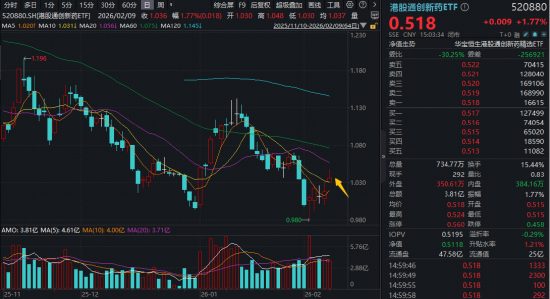
6天6阳,港股通医疗、港股通创新药正加速回暖!
Mei Ri Jing Ji Xin Wen· 2026-02-10 02:39
Group 1 - The Hong Kong stock market for pharmaceuticals and healthcare has shown a strong upward trend since February, with notable performance from ETFs such as the Hong Kong Innovation Drug ETF (520880) and the Hong Kong Healthcare ETF (159137), both achieving six consecutive days of gains [1] - The total transaction scale for China's innovative drug License-out is projected to reach a record $135.7 billion by 2025, with significant collaborations occurring in early 2026, validating the global value of domestic innovative drug pipelines [1] - The Chinese innovative drug sector is transitioning from "scale accumulation" to "value release," indicating a shift towards commercial realization of pipeline expectations, with many quality stocks showing attractive valuation ratios [1] Group 2 - The Hong Kong Innovation Drug ETF (520880) and its associated fund (025221) focus entirely on innovative drug research and development companies, with the top ten weighted stocks accounting for over 73% of the portfolio, highlighting its leading attributes [2] - The Hong Kong Healthcare ETF (159137) targets medical innovation, encompassing trending concepts such as brain-computer interfaces, AI healthcare, and online pharmacies, while also covering leading companies across the entire innovative drug industry chain [2]
震撼88.5亿美金!天价创新药BD点火,520880摸高2.75%,港股通医疗ETF(159137)五连阳!机构提示低位机遇
Xin Lang Ji Jin· 2026-02-09 11:38
Group 1 - The Hong Kong stock market experienced a comprehensive rebound on February 9, with the pharmaceutical sector continuing its recovery trend, led by Innovent Biologics, which secured an $8.85 billion BD deal, resulting in a peak increase of 8.55% and a closing rise of 7.42% [1][3] - Other leading stocks such as BeiGene rose over 3%, while CSPC Pharmaceutical, China Biologic Products, and 3SBio also saw collective gains [1][3] - The Hong Kong Stock Connect Innovation Drug ETF (520880) opened high, reaching an increase of 2.75% and closing up 1.77%, successfully maintaining an upward trend and surpassing the 10-day moving average with a total transaction volume of 381 million yuan [1][3] Group 2 - On the evening of February 8, Innovent Biologics announced a strategic partnership with Eli Lilly to advance the global development of innovative drugs in oncology and immunology, receiving an upfront payment of $350 million and potential milestone payments of up to $8.5 billion [3] - The total transaction scale for China's innovative drug License-out is expected to reach a record $135.7 billion by 2025, with significant collaborations emerging in 2026, including major deals involving CSPC and AstraZeneca ($18.5 billion) and Rongchang and AbbVie ($5.6 billion), validating the global value of domestic innovative drug pipelines [3] - According to Open Source Securities, the Chinese innovative drug sector is transitioning from "scale accumulation" to "value release," entering a commercialization harvest period, with many quality targets showing significant valuation attractiveness after nearly two quarters of correction [3] Group 3 - The Hong Kong Stock Connect medical sector showed active performance, particularly in AI medical and brain-computer interface concept stocks, with major players like JD Health, Alibaba Health, and Ping An Good Doctor all rising around 3% [3] - The AI medical sector is rapidly penetrating the consumer end, expanding application scenarios from smart consultations to chronic disease management, leading to a revaluation of internet medical platforms like Alibaba Health and JD Health [3] Group 4 - CITIC Securities noted that the overall innovation attribute of the Hong Kong medical device sector is strong, with some companies' innovative products having potential for license-out or acquisition [5] - The fundamentals of most companies in the industry are continuously improving, highlighting the investment value of low valuations [5] - It is anticipated that Mindray Medical and Caresyntax will be listed in Hong Kong this year, potentially increasing investment opportunities in the Hong Kong medical device sector [5]
医药生物行业周报:加速出海叠加商业化兑现,创新药行业持续向上
KAIYUAN SECURITIES· 2026-02-08 12:24
Investment Rating - The industry investment rating is "Positive" (maintained) [1] Core Insights - The Chinese innovative pharmaceutical industry is entering a new phase of development characterized by dual breakthroughs in commercialization and internationalization, with significant growth in License-out transactions from $2.562 billion in 2017 to $140.274 billion in 2025 [5][15] - The industry is transitioning from a phase of pipeline expectations to one of performance realization, with over 70% of companies achieving positive revenue growth in 2025 [6][23] - The innovative drug sector has seen a strong performance in early 2026, with the pharmaceutical and biological sector rising by 0.14%, outperforming the CSI 300 index by 1.47 percentage points [7][29] Summary by Sections Section 1: Breakthroughs in Commercialization and Internationalization - The period from 2017 to 2026 is crucial for the recognition of Chinese pharmaceutical companies in the global market, with a notable increase in License-out transactions [5][15] - In early 2026, significant deals were made, including a $12 billion upfront payment from CSPC to AstraZeneca, indicating the growing international competitiveness of Chinese innovative drugs [16][17] Section 2: Performance of the Pharmaceutical Sector - The pharmaceutical sector has shown robust growth, with companies like BeiGene reporting revenues exceeding 36 billion yuan, reflecting strong commercialization capabilities [6][23] - The overall industry is moving towards profitability, with companies like Innovent Biologics and Rongchang Biopharma achieving breakeven for the first time [6][23] Section 3: Market Trends and Subsector Performance - In the first week of February 2026, the Chinese pharmaceutical sector saw a 0.14% increase, with traditional Chinese medicine leading the gains at 2.56% [7][31] - The medical research outsourcing sector also performed well, increasing by 1.99%, while other subsectors like biological products and vaccines experienced declines [7][31][35]

行业周报:加速出海叠加商业化兑现,创新药行业持续向上-20260208
KAIYUAN SECURITIES· 2026-02-08 11:34
Investment Rating - The industry investment rating is "Positive" (maintained) [1] Core Insights - The Chinese innovative pharmaceutical industry is entering a new phase of development characterized by dual breakthroughs in commercialization and internationalization, with significant increases in License-out transaction values from $2.562 billion in 2017 to $140.274 billion in 2025 [5][15] - The industry is transitioning from a phase of pipeline expectations to one of performance realization, with over 70% of companies achieving positive revenue growth in 2025 [6][23] - The innovative drug sector has seen a strong performance in the first week of February 2026, with a 0.14% increase, outperforming the CSI 300 index by 1.47 percentage points [7][29] Summary by Sections Section 1: Breakthroughs in Commercialization and Internationalization - The period from 2017 to 2026 is crucial for the recognition of Chinese pharmaceutical companies in the global market, with a notable increase in License-out transactions [5][15] - In 2026, the upfront payment for License-out transactions has already exceeded 39% of the total for 2025, indicating improved quality and competitiveness of Chinese innovative drug pipelines [5][15][16] Section 2: Performance of the Pharmaceutical Sector - The innovative drug sector is experiencing rapid revenue growth, with companies like BeiGene achieving over 36 billion yuan in revenue, showcasing strong commercialization capabilities [6][23] - Major companies such as Innovent Biologics and Rongchang Biopharma have maintained robust growth due to their core products, with some companies achieving profitability for the first time [6][23][24] Section 3: Market Trends and Subsector Performance - In the first week of February 2026, the traditional Chinese medicine sector saw the highest increase at 2.56%, while other biopharmaceutical sectors experienced declines [7][31] - The medical research outsourcing sector also performed well, with a 1.99% increase, indicating a positive trend in the pharmaceutical industry overall [7][31][35]
安永吴晓颖:创新药回暖非短期炒作,三大"风向标"验证复苏成色
2 1 Shi Ji Jing Ji Bao Dao· 2025-12-24 00:17
Core Insights - The Chinese biopharmaceutical industry is showing signs of recovery in 2025, with increased license-out transactions, a rebound in primary market financing, and the return of cornerstone investors in Hong Kong biotech IPOs, suggesting a shift from a prolonged downturn to a more normalized state [1][2][4] Group 1: Market Recovery and Trends - The market is transitioning from an "extreme compression" phase to a "relatively normal" state, indicating a quality recovery rather than a full-blown boom [2][4] - The overall pharmaceutical industry saw a 16.72% increase from early 2025 to November, outperforming the CSI 300 index by 1.68 percentage points, driven by breakthroughs in innovative drugs [2][3] - License-out transactions in the innovative drug sector reached $93.7 billion in the first three quarters of 2025, a 64% increase year-on-year, surpassing the total financing amount in the primary market for the first time [3][4] Group 2: Structural Changes and Investment Logic - The core driving forces behind the industry's progress are structural changes rather than short-term stimuli, with a focus on rational project selection and differentiation in product pipelines [2][5] - Investors are increasingly prioritizing clinical data certainty, product differentiation, and global commercialization potential over chasing trends [2][4] - The competitive edge of Chinese innovative drugs has significantly improved, leading to increased cross-border licensing collaborations and the emergence of new cross-border companies [4][5] Group 3: Challenges and Future Indicators - Despite positive trends, challenges such as global interest rate changes, geopolitical uncertainties, and ongoing pressures on domestic healthcare payments remain [4][5] - Key indicators for assessing the sustainability of the recovery include the continued occurrence of high-quality license-out transactions and the ability of Hong Kong to nurture companies with solid data and commercialization capabilities [5][12] Group 4: Global Integration and Market Dynamics - The integration of Chinese innovative drugs into the global pharmaceutical ecosystem is evident, with cross-border collaborations becoming crucial for value realization [11][12] - The return of overseas investors to Hong Kong biotech IPOs reflects a long-term rebuilding of confidence, contingent on companies having globally competitive product pipelines and clear clinical data timelines [11][12] - The differentiation in market dynamics necessitates careful selection of IPO venues based on pipeline stages, funding needs, and adaptability to market rules [12][13] Group 5: Strategic Considerations for Biotech Companies - For small and medium-sized biotech firms, balancing global R&D and commercialization with solidifying the domestic market is a critical challenge [13][14] - A phased globalization approach is recommended, where early R&D aligns with international standards while domestic commercialization focuses on core areas to validate product value [13][14] - The industry's evolution emphasizes quality, differentiation, and global capability, with the 2025 recovery seen as a return to normalcy after a period of structural advantage accumulation [14]