企业过度投资

Search documents
美银调查:35%投资者担忧企业过度投资创20年新高 四分之一受访者将AI泡沫视为首要尾部风险
Jin Rong Jie· 2026-02-17 14:23
风险认知方面,四分之一受访者将人工智能泡沫视为首要尾部风险,占比位列所有尾部风险之首,30% 受访者认为科技巨头在人工智能领域的大规模资本支出,最有可能成为信贷危机的导火索。交易热度 上,做多黄金连续第二个月成为最拥挤的交易方向,占比达50%,做多美股非科技龙头位列第二,占比 为20%。 市场有风险,投资需谨慎。本文为AI基于第三方数据生成,仅供参考,不构成个人投资建议。 本文源自:市场资讯 作者:观察君 美国银行最新基金经理调查显示,投资者对企业资本支出过热的担忧触及过去二十年以来的最高水平, 同时有四分之一受访者将人工智能泡沫视为当前市场面临的首要尾部风险。 报告显示,尽管受访者的整体看涨情绪升至2021年6月以来的高位,但约35%的投资者警告企业存在过 度投资问题,这一比例创下该调查开展二十年以来的新高。受此影响,投资者正在主动缩减科技股敞 口,当前对科技股的净超配比例仅为5%,较一个月前的19%大幅回落,降幅达到2025年3月以来的最大 值。 2026年全球企业资本支出预计将迎来历史峰值,其中美国四大科技公司合计资本支出规模将达到约6500 亿美元。投资者对于资本支出的担忧,并未抵消其对全球企业盈利前 ...
全球投资者仍“极度乐观”,但警告企业正过度投资
Xin Lang Cai Jing· 2026-02-17 08:35
这项调查覆盖 162 名管理着4400 亿美元资产的基金经理。结果显示,现金持仓比例从 1 月份创纪录低 点的 3.2% 升至 3.4%;投资者仍大幅超配大宗商品与股票,同时低配债券。 宏观经济乐观情绪进一步升温,预期全球将进入 "繁荣期" 的比例升至 2022 年 2 月以来最高水平,企业 盈利增长预期超过 10%,为 2021 年以来最强。 但创纪录比例的受访者认为,企业支出过于激进,投资总监们目前更倾向于改善资产负债表,而非扩大 资本开支。 美国银行月度基金经理调查周二显示,尽管市场情绪仍处于 "极度乐观"状态、资产进一步上涨难度加 大,但全球投资者愈发担忧企业正在过度投资 。 这项调查覆盖 162 名管理着4400 亿美元资产的基金经理。结果显示,现金持仓比例从 1 月份创纪录低 点的 3.2% 升至 3.4%;投资者仍大幅超配大宗商品与股票,同时低配债券。 宏观经济乐观情绪进一步升温,预期全球将进入 "繁荣期" 的比例升至 2022 年 2 月以来最高水平,企业 盈利增长预期超过 10%,为 2021 年以来最强。 但创纪录比例的受访者认为,企业支出过于激进,投资总监们目前更倾向于改善资产负债表,而 ...
20年一遇的信号!企业过度投资首次成为共识
Jin Shi Shu Ju· 2025-11-19 02:19
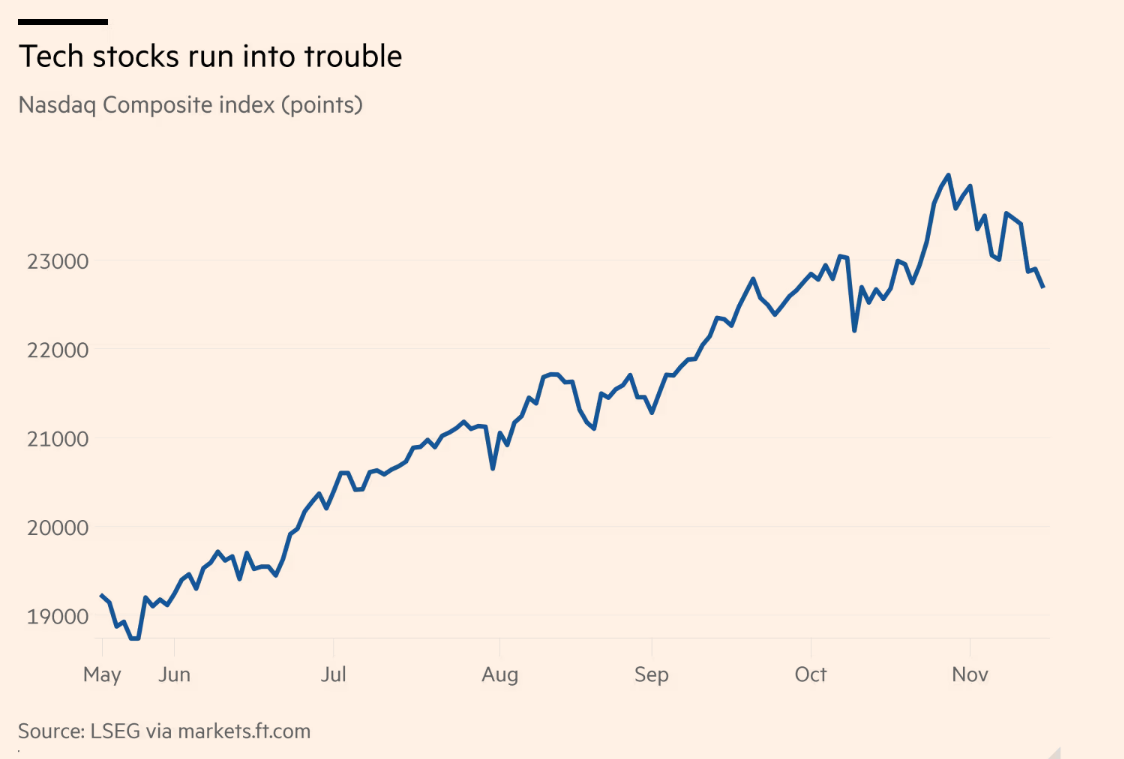
Group 1 - A majority of global fund managers believe that companies are currently over-investing, with a net 20% indicating that corporate investment spending is too high, marking the first time this view has become a consensus since records began in 2005 [1] - Concerns about the sustainability of the AI capital expenditure boom have led to a market pullback, with the Nasdaq Composite Index dropping 1.2% on Tuesday and over 5% for the month [2] - The surge in AI infrastructure investment has been a key driver of record gains in U.S. tech stocks, exemplified by Nvidia becoming the first company to surpass a $5 trillion market capitalization [2] Group 2 - Over $200 billion in bonds have been issued by U.S. companies this year to finance AI-related projects, raising concerns about potential "oversupply" in bond issuance [3] - Approximately 45% of surveyed fund managers view the AI bubble as the largest "tail risk" to the market and global economy, a significant increase from 33% the previous month [4] - Despite concerns over spending levels, a composite indicator of investor sentiment has risen to its highest level since February, indicating a potential for market downturns in the coming months [4]

20年来首现“过度投资”!美银基金经理调查:AI泡沫已成市场上最大“尾部投资”
美股IPO· 2025-11-18 13:57
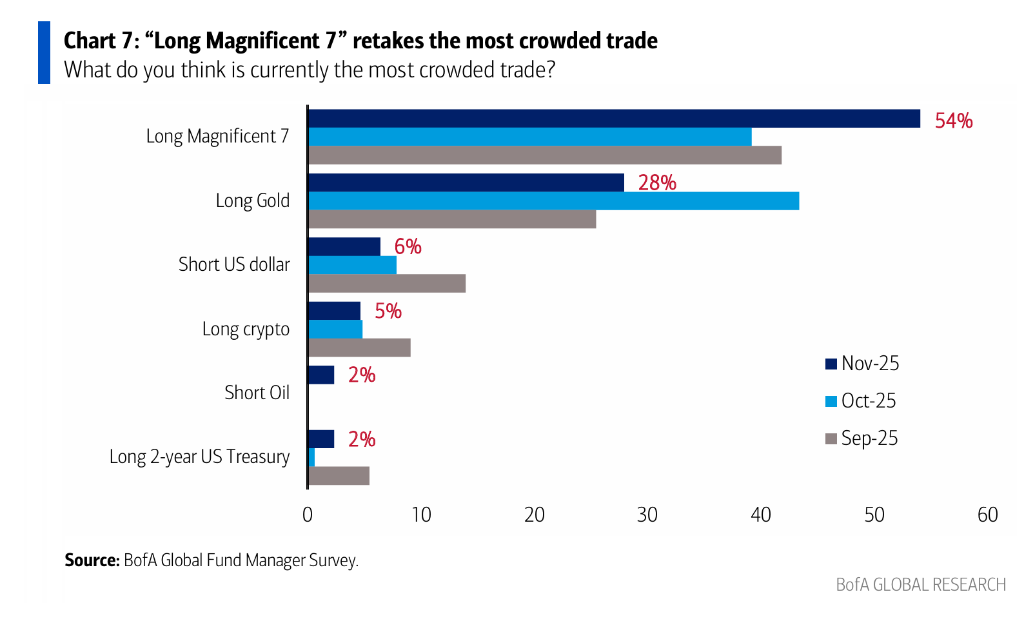
Core Viewpoint - Market sentiment is oscillating between optimism and caution, with fund managers showing increased stock allocations while cash levels have dropped to 3.7%, triggering a "sell signal" [1][2][13] Group 1: Market Sentiment and Risks - Fund managers' stock allocation has reached its highest level since February 2025, but cash holdings have decreased, raising concerns about overly bullish positions potentially hindering risk assets [2][13] - 45% of respondents view the "AI bubble" as the biggest tail risk, a significant increase from the previous month, while 54% consider "longing the seven giants" as the most crowded trade [2][8] - 63% of respondents believe current stock market valuations are too high, indicating a growing concern about the sustainability of the market rally [4][10] Group 2: Economic Outlook - Despite improved macro sentiment, with 53% of investors predicting a soft landing for the economy, there are warnings about excessive corporate investment, a phenomenon not seen in 20 years [5][10] - 43% of investors see broad AI productivity improvements as the most bullish catalyst for 2026, while 26% view a slowdown in AI capital expenditure as a significant bearish factor [10][20] Group 3: Asset Allocation Trends - In November, investors significantly increased allocations to healthcare (net 40% increase), emerging market stocks (net 36% increase), and bank stocks (net 36% increase) [17] - Conversely, UK stocks saw the fastest decline in allocation since October 2022, and consumer discretionary stocks experienced the largest monthly reduction since 2005 [17] Group 4: Future Expectations - Looking ahead to 2026, 42% of investors expect international stocks to be the best-performing asset class, with 30% anticipating the Japanese yen to perform best among currencies [19][20] - 45% of investors expect the 10-year U.S. Treasury yield to be in the 4.0%-4.5% range by the end of 2026, while 34% predict gold will trade between $4000 and $4500 per ounce [20]


20年来首现“过度投资”!美银基金经理调查:AI泡沫已成市场上最大“尾部投资”
Hua Er Jie Jian Wen· 2025-11-18 11:30
Core Insights - Market sentiment is at a delicate crossroads, with rising optimism about economic prospects but increasing concerns about an AI-driven investment bubble and excessive corporate investment, a warning signal not seen in 20 years [1][4] Group 1: Investor Sentiment and Market Positioning - A recent Bank of America survey indicates that fund managers' stock allocation has reached its highest level since February 2025, while cash holdings have dropped to just 3.7%, triggering a "sell signal" [1][14] - Despite the optimistic sentiment, 63% of respondents believe current stock market valuations are too high, reflecting a growing caution among investors [3][6] - 45% of respondents view the "AI bubble" as the biggest tail risk in the market, a significant increase from 33% the previous month [6][9] Group 2: Concerns Over AI and Corporate Investment - 53% of fund managers believe AI stocks are in a bubble, highlighting a stark contrast between market behavior and investor sentiment [6][9] - The report indicates that for the first time since August 2005, a net 20% of fund managers believe there is "excessive investment" by companies, attributed to concerns over the scale and financing of AI-related capital expenditures [9][12] - 43% of investors see broad AI productivity improvements as the most bullish catalyst for 2026, while 26% view a slowdown in AI capital spending as a significant bearish factor [9][20] Group 3: Asset Allocation and Future Outlook - In November, investors significantly changed their asset allocation, increasing holdings in healthcare (net 40% increase), emerging market stocks (net 36% increase), and bank stocks (net 36% increase) [18] - Looking ahead to 2026, 42% of investors expect international stocks to be the best-performing asset class, with 30% anticipating the Japanese yen to perform best among currencies [20] - 45% of investors expect the 10-year U.S. Treasury yield to be in the 4.0%-4.5% range by the end of 2026, while 34% expect gold to trade between $4000 and $4500 per ounce [20]