
信用违约互换

Search documents
财报后,美国四大云厂市值蒸发1万亿美元,市场甚至寻求对冲“大厂风险”
美股IPO· 2026-02-15 04:09
Core Viewpoint - The market is shifting focus from whether AI investments are worthwhile to whether the capital expenditures of major cloud companies can be sustained, as concerns over excessive spending, cash flow pressures, and rising debt levels lead to significant market value losses for the top four cloud providers [2][3][10]. Group 1: Market Reactions and Valuation - Following the latest earnings reports, the combined market value of the four major cloud companies has decreased by over $1 trillion, with Microsoft down 27%, Amazon down 21%, Meta down 16%, and Alphabet down 11% [3][10]. - Investors are increasingly worried that the rapid increase in AI spending may lead to overcapacity and elongated return cycles, prompting a reevaluation of these companies' financial health [3][10]. Group 2: Debt and Capital Expenditure Projections - Goldman Sachs predicts that capital expenditures for large-scale cloud providers will approach $1.4 trillion from 2025 to 2027, significantly up from approximately $485 billion from 2022 to 2024 [8][10]. - Microsoft’s capital expenditure is expected to rise from $76 billion in 2024 to $376 billion during 2025-2027, while Amazon, Alphabet, and Meta are projected to spend $321 billion, $304 billion, and $279 billion respectively [11]. Group 3: Credit Derivatives and Market Dynamics - The demand for credit derivatives is increasing as debt investors express concerns over the rising leverage of tech giants competing for AI capabilities, leading to an expansion in credit default swap (CDS) trading [4][13]. - The CDS contracts for Alphabet and Meta have become significantly more active, with current outstanding contracts valued at approximately $895 million and $687 million respectively [7][13]. Group 4: Cash Flow and Debt Financing - The internal cash flow of tech giants is insufficient to support their AI investment levels, with projections indicating that if capital expenditures reach $700 billion by 2026, it would nearly equal the total operating cash flow of these companies [14][16]. - Major debt issuances have set records, with Oracle issuing $25 billion in bonds and Alphabet increasing its bond issuance from $15 billion to $20 billion, reflecting strong demand [16]. Group 5: Market Divergence and Future Outlook - Despite strong current demand for bonds, there is a divergence in market sentiment, with some hedge funds viewing the demand for protection as a profit opportunity, while others warn of potential mispricing of credit risks [17]. - Goldman Sachs notes that to maintain investor return expectations, these companies would need to achieve over $1 trillion in profits annually, while the consensus estimate for 2026 profits is only $450 billion [18].






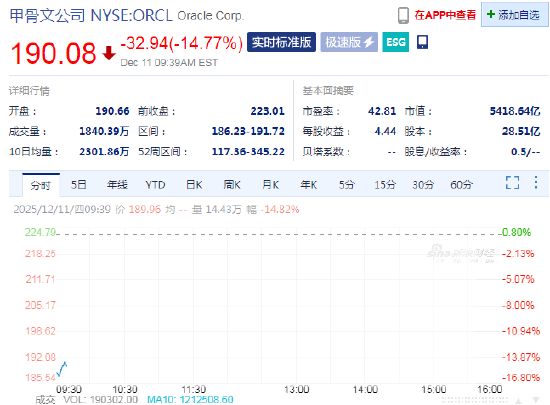
甲骨文早盘跌近15% 其信用风险升至2009年以来最高水平
Xin Lang Cai Jing· 2025-12-11 14:48
Core Insights - Oracle's credit risk indicators have reached a 16-year high, raising concerns about its ability to profit from significant AI investments due to increased spending on data centers and other equipment [2][3] - The cost of Oracle's five-year credit default swaps rose by 0.17 percentage points to approximately 1.41%, the highest level since April 2009, indicating declining investor confidence in the company's credit quality [2] - Oracle's bond spreads have widened, with the yield spread on its 6% bonds maturing in 2055 increasing by 20 basis points to 196 basis points, reflecting market concerns about rising risks in the AI sector [2][3] Financial Metrics - Oracle's debt has surpassed $100 billion, contributing to cash consumption in the recent quarter due to high capital expenditures [4] - The trading volume of Oracle's credit default swaps surged to approximately $9.2 billion over a 10-week period, significantly higher than the $410 million recorded in the same period last year [3] Management Commentary - Oracle's co-CEO expressed commitment to maintaining an investment-grade debt rating, despite rising leverage levels that could potentially lead to a downgrade to junk status [3][5] - Concerns have been raised by analysts regarding Oracle's funding needs for its expanding data center operations, with warnings that credit default swap prices could exceed 1.5% in the short term if financing strategy disclosures remain limited [5]

千亿债务堆算力,甲骨文(ORCL.US)的“AI豪赌”今夜迎来裁决时刻
Zhi Tong Cai Jing· 2025-12-10 01:44
Core Viewpoint - Oracle has experienced a tumultuous year, with a significant stock price drop in October, yet it has seen an overall increase of over 30% year-to-date, indicating investor interest in its position within the AI sector [1] Group 1: Financial Performance and Debt - Oracle's stock fell 23% in October, marking its worst monthly performance since 2001, but has rebounded with a nearly 10% increase in December [1] - The company raised $18 billion through a massive bond issuance, the largest in tech history, to fund its infrastructure plans [1] - As of August, Oracle's total debt reached $111.6 billion, up from $84.5 billion the previous year, while cash and equivalents decreased from $10.6 billion to $10.45 billion [2] - Analysts estimate Oracle will need to raise $20 billion to $30 billion in debt annually over the next three years to meet its growing capacity needs [2] Group 2: AI and Market Position - Oracle has become a key player in the AI sector, largely due to a $300 billion deal with OpenAI for computing power over the next five years [1] - The company is exploring various funding options, including off-balance-sheet financing and potential foreign investments, to support its AI initiatives [2] - Concerns have arisen regarding Oracle's ability to manage its debt while meeting the demands of clients like OpenAI [2] Group 3: Market Sentiment and Credit Risk - The rise in credit default swaps (CDS) for Oracle indicates growing investor anxiety about the company's financial stability amid its AI investments [4] - Analysts from Barclays and Morgan Stanley have recommended purchasing Oracle's five-year CDS as a hedge against risks associated with AI transactions [4] - Investors are advised to focus on companies actively adopting AI technologies rather than those merely spending on related technologies, as credit spreads are constraining capital expenditures [5] Group 4: Revenue and Growth Expectations - Analysts expect Oracle's revenue for the latest quarter to grow by 15% to $16.2 billion, with remaining performance obligations projected to exceed $500 billion, a fivefold increase from the previous year [5] - Oracle's remaining performance obligations surged by 359% to $455 billion in September, leading to a 36% stock price increase, although this gain has since been erased [5] - The core database business, which has higher profit margins, will be closely monitored to assess Oracle's flexibility in capital markets [6]
甲骨文(ORCL.US)跌逾4% 激进的资本支出或导致信用状况紧张
Zhi Tong Cai Jing· 2025-11-21 15:11
Core Insights - Oracle's stock dropped over 4% to $201.44 after issuing $18 billion in investment-grade bonds to increase AI spending, with related banks initiating a $38 billion debt issuance for Oracle's data centers [1] - Since reaching an all-time high on September 10, Oracle's stock has fallen 33% as investors reassess the impact of aggressive capital expenditures on its balance sheet and how it will finance these expenditures [1] - Oracle forecasts capital expenditures of $35 billion for the current fiscal year, primarily for its cloud business, but this spending is negatively affecting its balance sheet, with expected free cash flow of negative $9.7 billion this year [1] - The company is projected to see further declines in free cash flow over the next two fiscal years, potentially reaching negative $24.3 billion by fiscal year 2028 [1] - S&P Global Ratings has revised Oracle's outlook to "negative" due to anticipated capital expenditures and debt issuance aimed at funding accelerated growth in AI infrastructure, leading to tighter credit conditions [1] Leverage Risks - Oracle's five-year credit default swaps (CDS), reflecting leverage risk, have surged to their highest level in three years [2] - A global macro strategist noted that the rise in Oracle's CDS is not surprising given the company's significant capital expenditures financed through debt, indicating potential for greater stock volatility [2]
交易商协会完善信用违约互换信息服务
Xin Lang Cai Jing· 2025-08-04 10:54
Core Viewpoint - The China Interbank Market Dealers Association has issued a notice to enhance the information services related to credit default swaps in the interbank market, aiming to improve market pricing capabilities and transparency [1] Group 1: Enhancements to Credit Default Swap Information Services - The notice combines real transaction prices with an optimized quoting mechanism to better meet market demands [1] - It introduces transaction price information for contract-based credit risk mitigation tools and adds intention-based quotes that can be converted into actual transactions [1] - The rights and obligations of quoting institutions are clarified, enhancing business information convenience and strengthening self-regulatory requirements to improve quote quality [1] Group 2: Methodology and Operational Improvements - The curve generation method is optimized to enhance the quality of quoting curves [1] - The focus is on actual needs to reduce the burden on quoting institutions, facilitated by system improvements for quoting operations [1] Group 3: Future Developments - The association plans to continue optimizing the supporting mechanisms for the market, enhance the application of real transaction prices, and improve market transparency [1] - There is an ongoing effort to stimulate market vitality and promote the high-quality development of the credit risk mitigation tools market [1]
欧洲投资者情绪好转 欧元信用违约互换价格有所下跌
news flash· 2025-07-15 11:54
Group 1 - Investor sentiment in Europe has improved as corporate earnings reports approach, leading to a decline in euro credit default swap (CDS) prices [1] - The iTraxx Europe crossover index, which tracks eurozone high-yield bond CDS, fell by 2 basis points to 281 basis points [1] - Analyst Joshua Mahony noted that the European market showed a positive trend, moving past the tariff concerns that dominated the weekend news [1]
英伟达财报前夕 欧元信贷违约掉期(CDS)投保成本持稳
news flash· 2025-05-28 11:16
Core Insights - The cost of insuring against defaults on Euro credit default swaps (CDS) remains stable as investors exercise caution ahead of Nvidia's earnings report [1] - Nvidia's earnings report is highlighted as a key corporate event for the week, with the company set to announce its performance after the U.S. market closes [1] - The iTraxx Europe Crossover index, which tracks credit default swaps on Euro junk bonds, remains unchanged at 300 basis points [1]
