光通信技术

Search documents
Coherent在OFC 2026:光通信行业的拐点时刻
傅里叶的猫· 2026-03-19 15:19
Core Viewpoint - The article emphasizes that the optical communication industry is at a pivotal moment, driven by advancements in technology and increasing demand from AI data centers, with Coherent positioned to capitalize on this growth through innovative products and strategic partnerships [5][6][40]. Market Overview - Coherent's current business can be divided into two parts: a stable existing market worth approximately $50 billion and a new growth story projected to add over $20 billion in revenue through four innovative directions [8]. New Business Directions - **Optical Circuit Switches (OCS)**: The market for OCS has doubled from an estimated $2 billion to $4 billion due to its expanded applications in AI model training and network optimization [10][12]. - **Co-Packaged Optics (CPO)**: This segment is expected to reach $15 billion by 2030, with Coherent offering a wide range of products including silicon photonic chips and VCSEL lasers, aimed at reducing power consumption and increasing bandwidth [13][15]. - **Multi-Rail Technology**: This technology allows for quadrupling the data flow within the same physical space and power constraints, addressing the needs of large-scale data center operators [21][22]. - **Thermal Management Solutions**: Coherent's proprietary materials can convert waste heat into electricity, with a projected market size of $2 billion by 2030, starting to generate revenue in the second half of next year [23][25]. Capacity Expansion - Coherent operates four InP wafer fabs and has shipped over 500 million InP devices, with plans to double InP production capacity by the end of this year and again by the end of next year, significantly enhancing manufacturing capabilities [26][28]. Strategic Partnerships - Coherent's recent $2 billion investment from NVIDIA aims to expand InP wafer production capacity, transitioning from 3-inch to 6-inch wafers, which will increase output and reduce costs [20][18]. Timeline of Developments - Key product launches and revenue generation are expected to occur between late 2026 and 2027, with multiple new business lines set to ramp up in the near term [29][30][36]. Competitive Advantages - Coherent's broad technology portfolio, manufacturing scale, and proprietary materials create significant barriers to entry, positioning the company favorably in a competitive market [38][39].


CPO应用分歧明显:Marvell与Broadcom的立场对决
傅里叶的猫· 2026-03-08 12:10
Core Viewpoint - The article discusses the divergent perspectives of Marvell and Broadcom regarding the application prospects of Co-Packaged Optics (CPO), highlighting how their strategic positions influence market expectations [2]. Financial Performance - Marvell's stock surged by 18% following its earnings report, indicating strong investor confidence in its performance and future plans. In contrast, Broadcom's stock rose only 3%, despite its projection that AI-related revenue will exceed $100 billion by 2027 [2]. Company Positions on CPO - Marvell holds an extremely optimistic view on CPO's application prospects, expecting deployment to start in 2027 and revenue to reach $1 billion by 2029. The company believes that acquiring Celestial AI will be crucial for scaling AI [4]. - Broadcom views CPO as a future option rather than an immediate priority, preferring to extend copper cable technology to delay the transition to optical communication [4]. CEO Insights - Marvell's CEO, Matt Murphy, stated that the acquisition of Celestial AI is complete, and the company aims for annualized revenue from CPO to reach $500 million by Q4 of FY2028 and double to $1 billion by Q4 of FY2029. He anticipates the interconnect market could exceed $10 billion by 2030 [5]. - Broadcom's CEO, Hock Tan, emphasized the advantages of their existing technology, suggesting that for large language models and AI data centers, using direct attach copper cables (DAC) is the best approach due to lower latency, power consumption, and cost [6]. Strategic Focus - Marvell integrates CPO directly into its switch and XPU roadmap, aiming to create optimized end-to-end solutions [7]. - Broadcom highlights its strengths in existing DSP and SerDes technologies, downplaying CPO as a "shiny new thing" that should not be overhyped prematurely [7]. Market Impact - Marvell's stance positions it for rapid growth in the optical communication sector, while Broadcom's cautious approach may maximize the lifecycle of existing technologies, potentially lowering short-term costs but delaying the benefits of CPO such as reduced power consumption and latency [7].



海信集团分拆「纳真科技」,递交IPO招股书,拟赴香港上市,花旗、中信证券联席保荐
Sou Hu Cai Jing· 2026-03-06 06:13
Core Viewpoint - Ligent Technologies, Inc. (referred to as "Nanzhen Technology") has submitted a prospectus to the Hong Kong Stock Exchange for a main board listing, following a previous application that lapsed in August 2025. The company specializes in the research, manufacturing, and sales of optical communication and connection products, including optical modules, optical chips, and optical network terminals [1]. Company Overview - Nanzhen Technology is a global supplier of optical communication and connection products, recognized for its capabilities in both optical module and chip development and mass production [1]. - The company serves cloud service providers, telecom and network equipment suppliers, and operators worldwide, leveraging its diverse product offerings in AI, cloud computing, FTTx, transmission networks, and wireless applications [1]. Market Position - According to Frost & Sullivan, Nanzhen Technology ranks fifth globally among professional optical module manufacturers with a market share of 2.9% in 2024, and third in China with a market share of 7.2% [3]. - The company is also positioned among the top five globally in terms of data communication optical module revenue and among the top three for FTTx optical modules [4]. Product Offerings - Nanzhen Technology's product range includes optical modules, optical chips, and optical network terminal products. The company has developed and mass-produced 800G optical modules and is actively researching next-generation 3.2T optical modules [5]. - In the telecom solutions sector, the company has delivered samples of asymmetric 50G PON optical modules and is recognized as one of the first manufacturers globally to develop 50G PON optical modules [5]. Financial Performance - The company's projected revenues for the years 2023, 2024, and 2025 are RMB 4.239 billion, RMB 5.087 billion, and RMB 8.355 billion, respectively. Corresponding net profits are expected to be RMB 216 million, RMB 89 million, and RMB 873 million [13][14]. Shareholder Structure - Prior to the IPO, the major shareholders include Hisense Group, which holds 44.44%, and its wholly-owned subsidiary, Century Jinlong, which holds 4.17%, totaling 48.61% [7][9]. Management Team - The board of directors consists of nine members, including two executive directors: Dr. Hong Jin (CEO) and Ms. Wang Hui (CFO) [11][12].

英伟达豪掷40亿美元,在布局什么?丨每日研选
Shang Hai Zheng Quan Bao· 2026-03-06 01:35
Core Insights - Nvidia's recent $4 billion investment in upstream optical module manufacturers highlights the importance of optical communication technology for future AI data center interconnects [1] - The investment includes $2 billion each to Lumentum and Coherent, aimed at securing advanced optical component production capacity and technology rights [1] - This strategic move underscores the significance of the upstream supply chain in meeting the growing demand for faster AI processors [1] Industry Trends - As AI models evolve towards larger clusters, traditional data center interconnect technologies face limitations, making optical interconnect technology a necessary choice due to its lower power consumption and higher transmission efficiency [1] - Nvidia's investment signals a positive outlook for existing optical module leaders and indicates the direction of future technological advancements [2] - The anticipated introduction of multiple CPO switches based on Nvidia's Rubin platform by 2027 suggests a significant market shift towards optical I/O technology [2] Market Opportunities - Analysts recommend focusing on two main investment lines: core optical module and device manufacturers benefiting from overall industry demand, such as Zhongji Xuchuang, Xinyi Technology, Tianfu Communication, and Yuanjie Technology [3] - The second line includes companies innovating in optical technology, such as silicon photonics and optical interconnects, including the "Four Little Dragons" like Robotec, Zhishang Technology, Juguang Technology, and Jepter [3] - Potential growth is also seen in passive optical devices and fiber optic cable segments with companies like Taicheng Technology, Shijia Photon, and Hengtong Optic-Electric [3]

英伟达拟向两光学公司共投40亿美元,CPO概念获主力“加仓”近84亿元丨盘中线索
2 1 Shi Ji Jing Ji Bao Dao· 2026-03-05 02:43
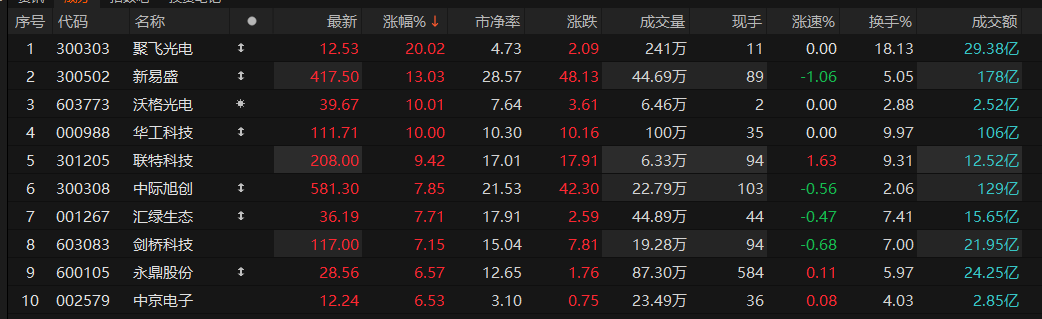
Group 1 - The CPO concept continues to strengthen, with stocks like Jufei Optoelectronics and Xinyi Technology hitting the daily limit, while New Yisheng rose over 13% [1][2] - The CPO sector has seen a net inflow of 8.396 billion yuan from major funds [2][3] - New Yisheng, a leader in the CPO sector, attracted nearly 3.069 billion yuan in net inflow from major funds, while Zhongji Xuchuang received over 1.635 billion yuan [3] Group 2 - Nvidia has agreed to invest a total of 4 billion USD in two companies developing optical technology for data centers, which is crucial for AI systems [3][4] - Lumentum and Coherent, the companies receiving investment, produce optical and photonic technology products essential for AI and cloud computing infrastructure [4] - The investment highlights the importance of optical communication technology as a core technology for future AIDC interconnects, emphasizing the significance of the upstream supply chain [4]


锐捷网络:目前公司已有LPO、CPO、NPO 等技术路线的数据中心光互联方案,尚未规模化商用落地
Mei Ri Jing Ji Xin Wen· 2026-02-27 13:44
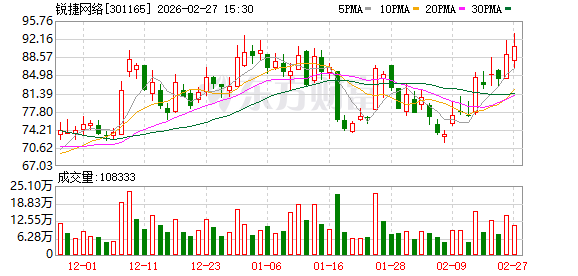
Core Viewpoint - The company is experiencing significant growth in its data center switch revenue, particularly in the high-speed segment driven by the demand for AI technology and internet industry infrastructure [2] Group 1: Company Performance - The company reported that by the third quarter of 2025, the revenue from internet data center switches will see a continuous increase in the proportion of products with speeds of 400G and above [2] - Specifically, the revenue share of 400G switches reached 67%, while 800G switches accounted for 14% [2] Group 2: Technology and Innovation - The company has developed various data center optical interconnection solutions, including LPO, CPO, and NPO technology routes, although these have not yet been commercially deployed at scale [2] - The company will continue to focus on innovations in optical communication technology to provide high-performance and low-power network interconnection solutions for large-scale intelligent computing centers [2]
德科立:2025年净利润同比下降27.16% DCI产品订单快速增长
Mei Ri Jing Ji Xin Wen· 2026-02-27 09:09
Core Viewpoint - Dekoli (688205.SH) reported a revenue of 934 million yuan for 2025, reflecting a year-on-year growth of 10.99%, while the net profit attributable to the parent company decreased by 27.16% to 73.1687 million yuan [1] Financial Performance - The company experienced a revenue increase to 934 million yuan, marking a 10.99% growth compared to the previous year [1] - The net profit attributable to the parent company was 73.1687 million yuan, which represents a decline of 27.16% year-on-year [1] Market Dynamics - The decline in net profit was influenced by a structural slowdown in demand within the telecommunications transmission market and intensified competition in certain product lines [1] - The company adjusted its pricing strategy for mature product lines, which contributed to a decrease in product gross margin [1] Growth Opportunities - Despite the challenges, the company made significant progress in the data communication market, successfully engaging with several leading enterprises on specific projects [1] - The rapid growth in orders for DCI products and the maintenance of industry-leading technology in high-speed optical modules indicate strong development potential for the company's data communication product line [1]

英伟达业绩炸裂,关注全市场规模最大的通信ETF(515880)
Mei Ri Jing Ji Xin Wen· 2026-02-26 01:56
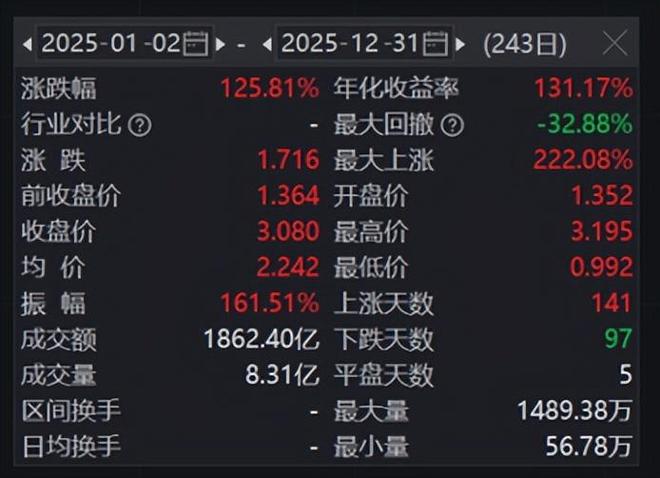
Core Viewpoint - Nvidia's Q4 FY2026 financial results exceeded market expectations, highlighting the robust demand for AI computing power and signaling a new growth cycle in the optical communication technology sector, particularly with CPO (Co-Packaged Optics) technology [1][2][3]. Financial Performance - Nvidia reported Q4 FY2026 revenue of $68.127 billion, a year-on-year increase of 73% and a quarter-on-quarter increase of 20%, surpassing market expectations of $65.912 billion [2][3]. - Net profit for the same quarter was $42.960 billion, up 94% year-on-year and 35% quarter-on-quarter, exceeding the market forecast of $36.302 billion [2][3]. - The company guided for Q1 FY2027 revenue of $78 billion (±2%), representing a year-on-year increase of 77% and a quarter-on-quarter increase of 14%, also above market expectations of $72.778 billion [2][3]. Business Segment Highlights - The data center business generated $62.314 billion, a year-on-year increase of 75% and a quarter-on-quarter increase of 22%, exceeding market expectations of $60.360 billion [3]. - Compute business revenue was $51.334 billion, up 58% year-on-year and 19% quarter-on-quarter, in line with expectations [3]. - Networking business revenue surged to $10.980 billion, a remarkable year-on-year increase of 263% and a quarter-on-quarter increase of 34%, far exceeding market expectations of $9.019 billion [3]. Technological Advancements - CPO technology is positioned to overcome the limitations of traditional optical modules, addressing issues related to power consumption and bandwidth density, thus facilitating the expansion of computing power [4][5]. - The CPO architecture significantly reduces signal loss and dependence on DSP chips by shortening electrical transmission distances, leading to a threefold increase in energy efficiency compared to traditional solutions [4]. - Nvidia's Spectrum-X Photonics solution exemplifies this advancement, with a total power consumption of only 9W for its 1.6T CPO solution, compared to 30W for traditional solutions [4]. Industry Trends - The industry is set for accelerated growth, with Nvidia planning to launch its first-generation CPO products in the second half of 2025 and a second-generation Spectrum-X platform in 2026 [5][6]. - The competition among AI models, such as Alibaba's Qwen3.5 and Google's Gemini3.1 Pro, is driving the demand for AI applications, which will further fuel the need for computing hardware [6]. - Capital expenditures from major cloud providers are expected to rise significantly, providing visibility for the entire supply chain and translating into increased orders for hardware components [6]. Investment Opportunities - The Communication ETF (515880) focuses on core hardware for computing power, with a scale exceeding $14 billion, making it a leading choice for investors looking to gain exposure to AI infrastructure [7][9]. - The ETF has shown a remarkable increase of 125.81% in 2025, ranking first among all ETFs in the market [7]. - The ETF's composition includes over 66% weight in optical modules and servers, closely tied to the demand for AI computing power [9][11].
山西证券研究早观点-20260213
Shanxi Securities· 2026-02-13 01:30
Market Trends - The domestic market indices showed mixed performance, with the Shanghai Composite Index closing at 4,134.02, a slight increase of 0.05%, while the Shenzhen Component Index rose by 0.86% to 14,283.00 [4]. Industry Commentary: Automotive - In January 2026, the average price of aluminum (A00) was 24,085.50 RMB/ton, up 20.24% year-on-year and 9.77% month-on-month. The average price of magnesium ingots (1) was 18,127.50 RMB/ton, reflecting a year-on-year increase of 1.50% and a month-on-month increase of 5.24%. The magnesium market supply was relatively balanced, leading to stable prices [6]. - The magnesium/aluminum price ratio fell to 0.75, marking a historical low, primarily due to a significant increase in aluminum prices driven by demand from emerging industries such as photovoltaics and energy storage. This trend highlights the cost advantages of magnesium alloys, which are expected to see increased application [6]. - In 2025, China's total magnesium product exports reached 447,600 tons, a decrease of 2.65% year-on-year, with export value dropping by 17.15% to approximately 1.069 billion USD. However, magnesium alloy exports grew by 4.51% year-on-year, indicating a structural shift towards high-value-added products [6]. Company Commentary: Juguang Technology (688167.SH) - Juguang Technology projected a net loss of 42 to 32 million RMB for 2025, a reduction in loss by 76.0% to 81.7% year-on-year. The company expects a net loss of 78 to 68 million RMB after excluding non-recurring items, reflecting a year-on-year reduction of 57.2% to 62.7% [8]. - The company reported a revenue increase of approximately 40% due to higher shipments in optical communication and consumer electronics, with a gross margin improvement driven by a higher proportion of high-margin products [10]. - Juguang Technology's revenue for the first three quarters of 2025 reached 613 million RMB, a year-on-year increase of 34%, with significant contributions from laser optical components and optical solutions for automotive applications [10]. Company Commentary: Aishuo Co., Ltd. (600732.SH) - Aishuo Co. announced a projected net loss of 130 to 180 million RMB for 2025, primarily due to increased investments in new technologies and the impact of currency appreciation on export profits [12]. - The company has secured a patent authorization from Maxeon for its BC solar cell technology, which is expected to enhance its competitive edge in overseas markets [14]. - Aishuo's BC components have demonstrated superior efficiency and performance, with a significant increase in sales volume and a strong order backlog, particularly in high-value markets [17]. Industry Commentary: Photovoltaic Sector - The price of polysilicon remained stable at 54.0 RMB/kg, while silicon wafer prices saw a decline, with 182-183.75mm N-type wafers averaging 1.10 RMB/piece, down 12.0% week-on-week [16]. - The market for battery cells is experiencing high prices with low transaction volumes, indicating a potential stabilization in the short term [16]. - Aishuo's BC components are priced at a premium compared to TOPCon components, reflecting their advanced technology and market demand [19].
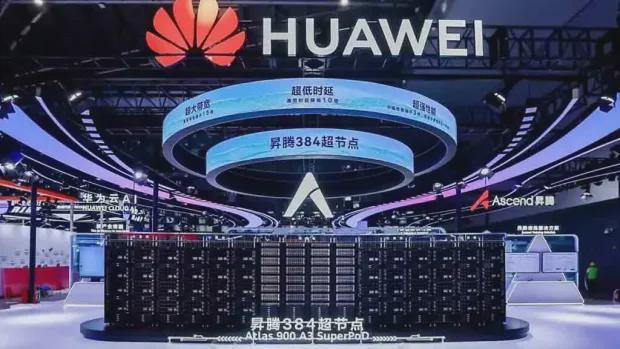
华为超节点赶超英伟达:驾驭“光”很关键
Guan Cha Zhe Wang· 2026-02-10 03:20
Core Insights - The emergence of SuperPods as a new AI computing infrastructure has become a focal point in the industry since 2025, with Huawei's Ascend 384 SuperPod leading the way in performance metrics compared to foreign competitors [1][3] - The demand for computing power is far from being met, with token consumption expected to exceed trillions daily in China, highlighting the inadequacy of simply stacking servers to address the computing gap [3][4] Group 1: SuperPod Characteristics - SuperPods are not merely about stacking chips; they represent a fundamental restructuring of traditional computing architectures, enabling equal interconnectivity among CPUs, NPUs, and memory units [4][6] - Key features of a true SuperPod include high bandwidth to eliminate communication delays, low latency, and the ability to form a logically unified system through unified memory addressing [6][7] Group 2: Efficiency and Performance - SuperPods can significantly enhance computing efficiency, with potential model utilization rates increasing from 30% to 45%, effectively a 50% improvement, which can help mitigate the limitations of chip manufacturing processes [7][8] - The architecture of SuperPods differs from traditional systems, as Huawei employs optical communication technology, allowing for greater scalability and interconnectivity compared to NVIDIA's copper-based systems [8][9] Group 3: Innovation and Ecosystem - Huawei's systematic innovation in chip design, optical components, and foundational protocols has positioned it uniquely in the market, leveraging over 20 years of experience in optical technology [9][12] - The company is also developing general computing SuperPods, with the TaiShan 950 SuperPod set to launch in Q1 2026, aimed at replacing various server applications [11][12] Group 4: Software and Community Engagement - The success of SuperPods relies not only on hardware but also on a robust software ecosystem, including open-source initiatives like CANN and openEuler, which are crucial for fostering industry collaboration [14] - Huawei has engaged a large developer community, with 3.8 million registered developers for Kunpeng and nearly 4 million for Ascend, emphasizing the importance of open-source collaboration in the AI era [14]