
免税新政

Search documents
【商道论衡】 免税新政打开文化出海新通道
Zheng Quan Shi Bao· 2025-12-22 18:02
Core Viewpoint - The new policy on duty-free shops aims to boost consumption by expanding product categories, relaxing approvals, and supporting "online booking + offline pickup," transforming duty-free shops into significant drivers of tourism consumption [1][2]. Group 1: Policy Implementation and Impact - The policy mandates that duty-free shops at ports and in cities must allocate at least 25% of their space for domestic products, granting them "quasi-export" tax exemptions, which enhances the international visibility of Chinese brands [1][2]. - The shift from a one-way shopping channel to a two-way cultural bridge allows for the promotion of Chinese cultural products alongside international brands, enhancing cultural confidence and brand competitiveness [1][3]. Group 2: Consumer Experience Enhancement - City-based duty-free shops are integrated into core commercial areas, transforming the shopping experience from hurried purchases to leisurely experiences, thus deepening the integration of shopping with cultural tourism [2]. - Innovative models like "duty-free + cultural tourism" in Hainan and "duty-free + taxable" in Tianjin upgrade shopping venues into urban social hubs, significantly exceeding the effects of tax incentives alone [2]. Group 3: Administrative Efficiency and Market Adaptation - The decentralization of approval authority to provincial levels and the negotiation of operational space enhance efficiency and adaptability, reflecting a shift in governance logic [2][3]. - The new policy reduces psychological barriers to consumption by making duty-free products more accessible in daily life, indicating that duty-free shopping is not just for privileged consumers but a service for all [3]. Group 4: Economic and Cultural Implications - The policy represents a high-level practice of openness, promoting connectivity between domestic and international markets and facilitating supply-demand matching [3]. - The execution of the policy is crucial for its success, with challenges including ensuring compliance, balancing convenience with regulation, and avoiding homogeneous competition [3].
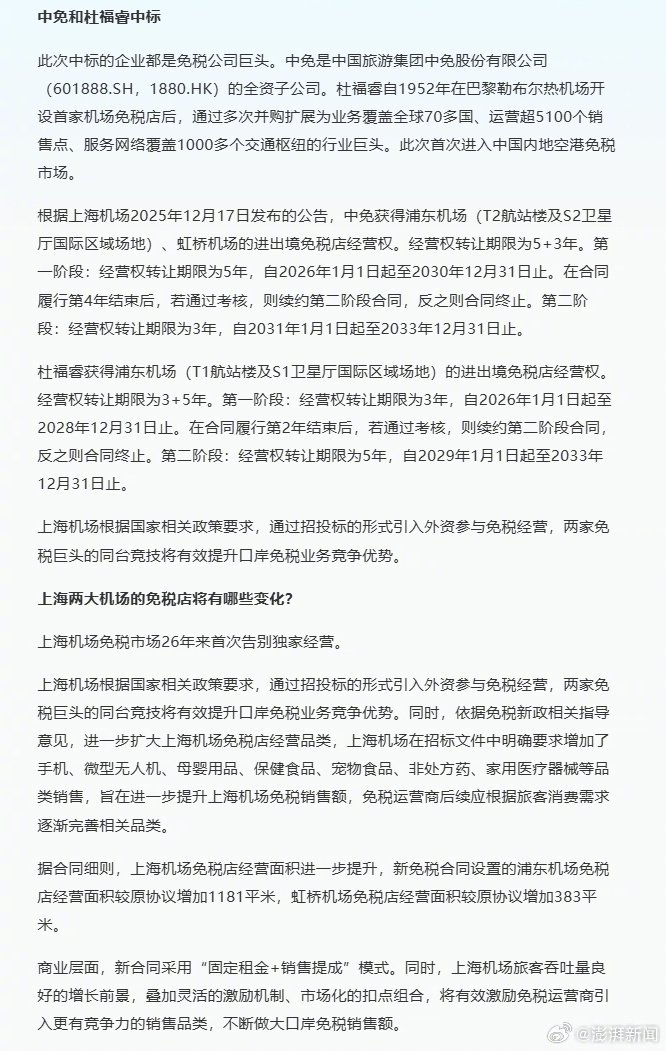
中免和杜福睿中标上海浦东虹桥机场免税店经营权
Cai Jing Wang· 2025-12-17 11:52
Core Points - China Duty Free Group and Dufry have won the operating rights for duty-free shops at Shanghai's airports, marking a significant change in the market dynamics [1][2][4] - The operating rights are divided between the two companies, with China Duty Free Group managing the T2 terminal and S2 satellite hall at Pudong Airport and the duty-free operations at Hongqiao Airport, while Dufry will operate at T1 terminal and S1 satellite hall at Pudong Airport [2][3] - This marks the first time in 26 years that Shanghai's airport duty-free market will not have a single operator, introducing competition that is expected to enhance the overall duty-free business [4] Company Summaries - China Duty Free Group is a wholly-owned subsidiary of China Tourism Group and has secured a 5+3 year operating contract for duty-free shops at key locations in Shanghai [2][3] - Dufry, a global leader in the duty-free retail sector, is entering the Chinese mainland airport duty-free market for the first time, with a 3+5 year contract for operations at Pudong Airport [3][4] Market Changes - The new contracts will increase the retail space for duty-free shops, with an additional 1,181 square meters at Pudong Airport and 383 square meters at Hongqiao Airport compared to previous agreements [4] - The new operating model will include a combination of fixed rent and sales commission, which is expected to incentivize operators to introduce more competitive product categories [4]


如何看 2025 年 10 月消费数据?
Changjiang Securities· 2025-11-16 12:35
Investment Rating - The report provides a neutral investment rating for the industry, indicating that the performance is expected to be in line with the relevant market indices over the next 12 months [48]. Core Insights - In October, the total retail sales of consumer goods reached 46,291 billion yuan, with a year-on-year growth of 2.9%. Excluding automobiles, retail sales amounted to 42,036 billion yuan, growing by 4.0% [3][6]. - The retail sector shows stable growth, with some categories experiencing a decline due to reduced national subsidies. The food and beverage sector saw a significant rebound in growth, while the automotive sector is optimistic about AI and robotics [6][11][14]. - The report highlights various sectors, including retail, food, automotive, textiles, light industry, and home appliances, each with specific growth trends and investment recommendations [6][19][21][33]. Retail Sector Summary - The overall retail growth remains stable, with offline sales showing resilience and online sales maintaining a steady share. In October, retail sales of goods grew by 2.8% year-on-year, while dining revenue increased by 3.8% [9][10]. - Essential goods continue to show robust growth, with food and daily necessities retail sales increasing by 9.1% and 7.4% respectively [10][29]. Food and Beverage Sector Summary - The food sector continued to improve month-on-month, with retail sales of grain and oil products increasing by 9.1% year-on-year. The beverage sector also saw a rise of 7.1% [27][29]. - The report notes a recovery in the liquor market, with retail sales of liquor increasing by 4.1% year-on-year in October [27][28]. Automotive Sector Summary - The automotive retail sales totaled 4,255 billion yuan in October, reflecting a year-on-year decline of 6.6%. However, wholesale passenger car sales increased by 7.5% [14][15]. - The report emphasizes the importance of AI and robotics in the automotive sector, recommending companies that focus on these technologies [14][15]. Textile and Apparel Sector Summary - In October, retail sales of clothing and textiles increased by 6.3%, indicating a recovery in the sector. The report suggests focusing on high-quality brands and those with strong operational capabilities [19][20]. Light Industry Summary - The report highlights the potential of quality enterprises in the new consumption space, particularly in the home furnishings sector, which is expected to grow steadily [21][22]. Home Appliances Sector Summary - The home appliance sector experienced a year-on-year decline of 14.6% in October, attributed to high base effects and reduced national subsidies. The report suggests focusing on companies with strong growth potential [33][40].
支持提振消费,免税店政策“升级”,港股消费ETF(513230)打开低位布局通道
Sou Hu Cai Jing· 2025-11-04 06:41
Group 1 - The Hong Kong consumer sector is experiencing downward pressure, with notable declines in stocks such as Smoore International, Pop Mart, and Li Auto, leading to a nearly 1.5% drop in the Hong Kong consumer ETF (513230) [1] - A joint notice issued by multiple government departments on October 30 outlines four core policy upgrades for duty-free shops, effective from November 1, 2025, aimed at boosting consumption and attracting foreign spending [1] - Huaxi Securities highlights that the new duty-free policies will enhance operational flexibility in four ways: expanding product categories, relaxing approval processes, providing convenient services, and supporting domestic products [1] Group 2 - The Hong Kong consumer ETF (513230) tracks the CSI Hong Kong Stock Connect Consumer Theme Index, encompassing a wide range of sectors including leading new consumption brands and major internet e-commerce players [2]