全球大放水

Search documents
全球大放水开启!2026年起全民大化债,对普通人的钱袋子有什么影响?
Sou Hu Cai Jing· 2026-01-15 16:46
Core Viewpoint - The global economic landscape is shifting, with the Federal Reserve and the Bank of Japan adopting opposing monetary policies, leading to changes in liquidity and debt management strategies across major economies [1][3][4]. Group 1: Monetary Policy Changes - The Federal Reserve is expected to lower interest rates four times from late 2025 to late 2026, making money cheaper [1]. - In contrast, the Bank of Japan has begun raising interest rates, with a current benchmark rate of 0.5%, and plans to reduce its bond purchasing by approximately 2 trillion yen monthly starting April 2026 [1][3]. - This divergence in monetary policy between the two largest economies is creating a complex global liquidity environment [3]. Group 2: Impact on Global Liquidity - The yen carry trade, where investors borrow yen at low rates to invest in higher-yielding assets, has reached a scale of over 140 trillion yen (approximately $930 billion), which is 236% of Japan's GDP [3]. - As Japanese interest rates rise and U.S. rates fall, the profitability of this carry trade is being squeezed, potentially leading to a sell-off of U.S. assets as investors return to yen [3]. Group 3: Debt Management Strategies - High debt levels are a common issue for many economies, with emerging markets and developing economies facing the highest public debt levels in over fifty years [4]. - The Eurozone's debt-to-GDP ratio reached 78.1% in July, indicating significant debt challenges [4]. - China plans to maintain an active fiscal policy with a projected fiscal deficit rate of around 4% and a slight increase in the broad fiscal deficit rate to 8.9% [4]. Group 4: Effects on Interest Rates and Inflation - Lower interest rates from central banks will likely lead to reduced loan rates, benefiting borrowers but potentially shrinking interest income for savers [5][7]. - The average mortgage rate has decreased to approximately 3.24%, which is favorable for homeowners [7]. - Global inflation is projected to decline from 4% in 2024 to 3.1% in 2026, although certain essential costs, such as services, continue to rise [7][8]. Group 5: Asset Prices and Investment Strategies - Low interest rates and increased liquidity typically drive up asset prices, with U.S. stock indices showing gains amid rate cut expectations [8]. - However, high valuations in sectors like artificial intelligence pose risks of market corrections [8]. - Governments may resort to issuing more bonds to manage debt, which could lead to lower bond prices and higher yields, impacting bond investors [8]. Group 6: Trade Policies and Economic Growth - The U.S. high tariff policies are affecting global trade, with the World Trade Organization downgrading the 2026 global goods trade growth forecast to 0.5%, significantly lower than 2.4% in 2025 [9]. - Trade difficulties may lead to increased production costs, ultimately affecting consumer prices [9]. Group 7: Recommendations for Individuals - Adjusting savings strategies is crucial in a declining interest rate environment, with a recommendation to diversify into medium- to long-term deposits [11]. - Borrowers should consider the benefits of lower interest rates on existing loans, while being cautious about increasing debt [11]. - Investment strategies should focus on diversification to mitigate risks associated with high asset valuations [11][12].


美联储再度降息,全球大放水已经来了!但川普并不满意
Sou Hu Cai Jing· 2025-12-11 04:09
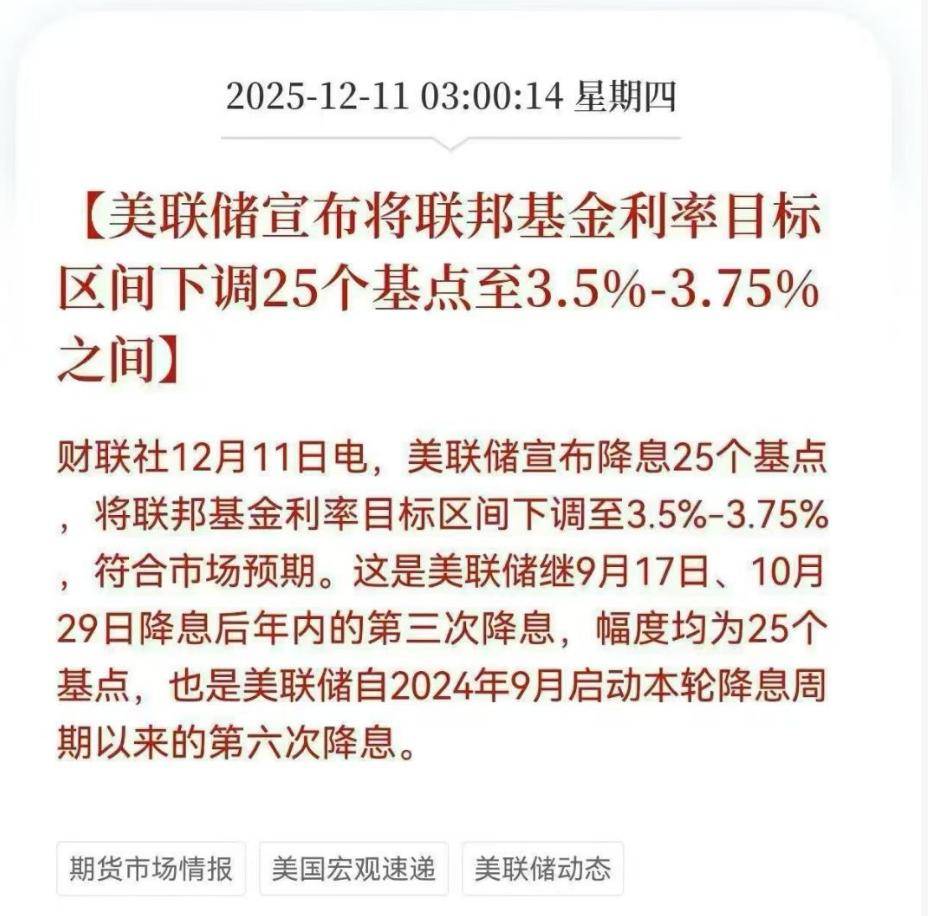
Core Viewpoint - The Federal Reserve is likely to lower interest rates again in December due to deteriorating employment data and persistent inflation concerns, indicating a potential risk of stagflation in the U.S. economy [2][4]. Group 1: Economic Indicators - The primary indicators influencing the Fed's decision on interest rates are employment and inflation. Recent U.S. employment data showed a significant decline, with a loss of 32,000 jobs in November, the largest drop in two and a half years, suggesting a weakening job market [2][4]. - The U.S. national debt is approaching $37 trillion, and a 2% reduction in interest rates could save approximately $750 billion annually in interest payments, highlighting the urgency for rate cuts to manage debt [9][11]. Group 2: Implications of Rate Cuts - A series of rate cuts is anticipated, with Morgan Stanley predicting up to seven cuts by 2026, which could alleviate the debt burden significantly [5][11]. - The potential for a weaker dollar due to rate cuts could lead to capital outflows from the U.S. to other markets, particularly benefiting China, which is becoming increasingly attractive to foreign investors [4][12]. Group 3: Asset Class Reactions - The anticipated rate cuts are expected to negatively impact low-risk, high-yield assets such as U.S. Treasury bonds and savings products, as the attractiveness of these investments diminishes with falling interest rates [23][24]. - Conversely, commodities like gold, silver, and other raw materials are likely to see price increases as the dollar weakens, creating investment opportunities in these asset classes [22]. Group 4: China's Economic Context - As the U.S. enters a rate-cutting cycle, China may also follow suit to stimulate its economy, particularly in light of its struggling real estate market and the need for lower borrowing costs [26][27]. - The current economic environment presents a critical opportunity for China to lower interest rates, which could further support its economic recovery while also impacting domestic savings and investment strategies [25][27].
懂王要炒鲍威尔鱿鱼,全球要大放水了?
Sou Hu Cai Jing· 2025-06-09 07:03
Group 1 - The core viewpoint of the article revolves around the potential impact of a global monetary easing led by the U.S. Federal Reserve, which could create significant investment opportunities, particularly in the A-share market [1][2] - The article highlights that the Federal Reserve has been slower in rate cuts compared to other central banks, which may be a strategic move to limit the economic policy space of other countries, especially China [1][2] - The discussion emphasizes that while a global easing could benefit the A-share market due to low valuations and growth potential, retail investors may struggle to capitalize on these opportunities due to rapid shifts in market trends [2][4] Group 2 - The article suggests that retail investors are often at a disadvantage in the current market environment, where institutional investors control the pace and direction of stock movements, leading to potential losses for those who follow trends without data analysis [4][6] - It introduces the concept of using quantitative data as a tool to navigate the market, emphasizing the importance of understanding institutional trading behavior rather than relying solely on price movements [6][9] - Two key data points are identified for assessing market conditions: institutional participation levels and short-covering data, which can indicate whether a price drop is a temporary dip or a more serious downturn [7][9] Group 3 - The article advocates for a shift towards data-driven investment strategies, arguing that understanding market data can help investors avoid being misled by price fluctuations and institutional manipulation [9][11] - It concludes by encouraging investors to embrace quantitative analysis as a means to enhance their investment decision-making process, ultimately leading to better outcomes in the market [11]