降息周期

Search documents
——有色金属大宗金属周报(2026/3/23-2026/3/27):锂矿供给端不确定性增强,锂价有望延续上行-20260329
Hua Yuan Zheng Quan· 2026-03-29 02:01
Investment Rating - The investment rating for the non-ferrous metals industry is "Positive" (maintained) [4] Core Viewpoints - The report highlights that the uncertainty in lithium supply is increasing, and lithium prices are expected to continue rising [3] - Copper prices are anticipated to remain under pressure due to stagflation risks, with short-term fluctuations expected [5] - Aluminum prices are projected to maintain high volatility due to overseas supply disruptions and stagflation trading [5] - The lithium market is experiencing tight supply conditions, with demand expected to grow, leading to a potential upward trend in lithium prices [5] - Cobalt prices are expected to fluctuate at high levels, driven by downstream restocking [5] Summary by Sections 1. Industry Overview - The non-ferrous metals sector has shown resilience, with the overall performance of the sector outperforming the Shanghai Composite Index by 3.87 percentage points [11] - The sector's PE_TTM is 28.04, indicating a 2.08 increase, while the PB_LF is 3.59, reflecting a 0.26 increase [20] 2. Industrial Metals Copper - London copper prices decreased by 0.11%, while Shanghai copper prices increased by 1.26% [25] - Domestic copper inventory saw a significant reduction, with a 12.64% decrease in Shanghai copper inventory [25] Aluminum - London aluminum prices fell by 1.43%, while Shanghai aluminum prices rose slightly by 0.08% [35] - The aluminum industry is facing pressure from increasing domestic inventory and potential supply expansions [5] Lithium - Lithium carbonate prices rose by 6.04% to 158,000 CNY/ton, while lithium spodumene prices increased by 8.41% to 2,230 USD/ton [69] - The lithium supply chain is experiencing disruptions, particularly from Zimbabwe and Australia, which may impact future supply [5] Cobalt - The price of MB cobalt increased by 0.38% to 26.25 USD/pound, while domestic cobalt prices decreased by 2.06% to 427,000 CNY/ton [84] - Cobalt supply is expected to improve as export quotas from the Democratic Republic of Congo are set to be lifted [5]



降息周期下烟草股收益率亮眼,进攻与防守属性兼备
Huaan Securities· 2026-03-03 10:30
Investment Rating - The industry investment rating is "Buy" [1] Core Insights - The tobacco sector demonstrates both offensive and defensive attributes, with stable earnings growth and high dividends driving stock price increases. The sector benefits from a declining interest rate environment, making high-dividend stocks more attractive [7][22][30] - Tobacco stocks have shown significant excess returns since the Federal Reserve initiated a rate-cutting cycle in September 2024, with British American Tobacco and Philip Morris International achieving cumulative returns of 110% and 96% respectively from January 2024 to February 2026, outperforming the S&P 500 [20][22] - Philip Morris International's growth is driven by regional and product diversification, with its smoke-free products accounting for 41.5% of total net revenue by 2025, effectively offsetting declines in traditional cigarette sales [5][25][26] Summary by Sections Tobacco Sector Analysis - The tobacco sector's defensive characteristics stem from its inelastic demand and strong cash flow, with dividend yields typically ranging from 5% to 7%. This stability attracts investors, especially during periods of declining bond yields [22][30] - Philip Morris International's revenue growth is attributed to its expansion in Asia and Latin America, as well as the introduction of reduced-risk products (RRP) since 2016, which have significantly contributed to its earnings per share (EPS) growth [5][25][26] Domestic Market Focus - The 2026 National Tobacco Work Conference emphasizes the development of a modern tobacco industry system and the promotion of high-quality international business growth. China Tobacco Hong Kong holds exclusive rights in the duty-free cigarette export market, enhancing its value proposition [6][29][30] - The new regulations are expected to optimize the supply chain for cigarette exports to the domestic duty-free market, potentially increasing profit margins for China Tobacco Hong Kong [30][32] Investment Recommendations - The report suggests actively monitoring companies like China Tobacco Hong Kong and Smoore International, which exhibit both growth potential and defensive characteristics in the current market environment [7][30]


石化:降息周期下的轮动
China Post Securities· 2026-03-02 02:35
Investment Rating - The industry investment rating is "Strongly Outperform the Market" and is maintained [2]. Core Viewpoints - The report highlights that the profit of the PX-PTA-polyester industry chain may see a recovery [4]. - It emphasizes the importance of monitoring OPEC+ supply through monthly meetings and notes that U.S. shale oil cost pressures may suppress further production release [6]. - The report suggests that during market defensive phases or when oil prices stabilize, investors should focus on major Chinese oil companies such as China National Petroleum, Sinopec, and CNOOC [6]. Summary by Relevant Sections Oil and Chemical - The PX-PTA-polyester industry chain is expected to experience profit recovery [4]. - The report suggests that the refining sector may see a turnaround after oil prices hit bottom, recommending attention to Rongsheng Petrochemical [6]. Key Stocks - The report recommends focusing on three major oil companies in China during defensive market phases [6]. - It also highlights the potential of PTA and polyester sectors, particularly recommending Xin Fengming due to the reversal of PTA internal competition [6]. OPEC+ Supply - OPEC+ is maintaining oil production levels as of the February JMMC meeting, prioritizing price maintenance over market share [31]. - The fiscal breakeven oil prices for major oil-exporting countries remain high, indicating a need for sustained oil prices [30]. U.S. Supply - The report notes that the complete cost of shale oil production is increasing, particularly in core areas like Midland Basin and Delaware Basin [39]. - It highlights a correlation between oil prices and the number of U.S. drilling rigs, with a lagging effect observed [43]. PTA and Polyester - The PTA processing fee is recovering from low levels, and the report indicates that the concentrated production cycle for PTA has passed [62]. - Polyester prices have increased, with significant price differences noted in the market for polyester filament yarn [63].
中信建投期货:2月27日能化早报
Xin Lang Cai Jing· 2026-02-27 01:15
Group 1: Rubber Market Insights - Domestic RSS rubber prices decreased to 16,950 CNY/ton, down by 100 CNY/ton from the previous day, while Thai mixed rubber prices also fell to 15,900 CNY/ton, a decrease of 100 CNY/ton [2][26] - As of February 23, 2026, China's natural rubber social inventory reached 1.366 million tons, an increase of 70,000 tons, or 5.4% from the previous period [2][26] - The market anticipates a significant upward pricing trend for natural rubber due to the easing of tariffs that previously suppressed growth in the tire industry, with expectations for continued demand growth [3][27] Group 2: PX Market Dynamics - The PX industry in China saw a load increase of 0.4 percentage points to 92.4%, while the Asian industry load rose by 1.2 percentage points to 84.9%, indicating a robust supply outlook [4][30] - The demand side is expected to improve significantly in April due to the recovery of downstream PTA facilities, with a notable increase in production anticipated [4][30] - Brent crude oil prices experienced fluctuations due to positive developments in US-Iran negotiations, which may impact PX pricing in the near term [5][28] Group 3: PTA and Polyester Sector - The PTA industry load increased by 1.8 percentage points to 76.6%, reaching a neutral level for the season, with downstream polyester production also expected to rise [6][30] - The market is currently cautious as downstream orders have not yet fully resumed, and there are concerns about high raw material prices affecting production recovery [6][30] - The PTA supply-demand balance is expected to improve in March, with potential price support in the 5,150-5,300 CNY range for mid-term positions [6][30] Group 4: EG Market Overview - The domestic ethylene glycol industry load increased by 2.2 percentage points to 79.0%, with a notable rise in synthetic gas production load [9][33] - The overall import dependency for ethylene glycol is approximately 27.2%, with limited impact from Iranian sources [9][33] - Short-term price movements are expected to be constrained within the 3,650-3,750 CNY range, with potential for a rebound based on low valuation logic [9][33] Group 5: Other Chemical Markets - The soda ash market is experiencing stable prices, with production slightly increasing to 791,000 tons, while inventory levels are also rising [14][39] - The glass market is facing supply pressures with an increase in inventory to 3.8 million tons, reflecting a 13.2% year-on-year rise [16][41] - The PVC market is under pressure due to high inventory levels and slow recovery in downstream production, with prices expected to fluctuate between 4,600-5,000 CNY/ton [22][47]



张尧浠:基本面因素混乱、金价持稳震荡仍待攀升
Sou Hu Cai Jing· 2026-02-27 00:23
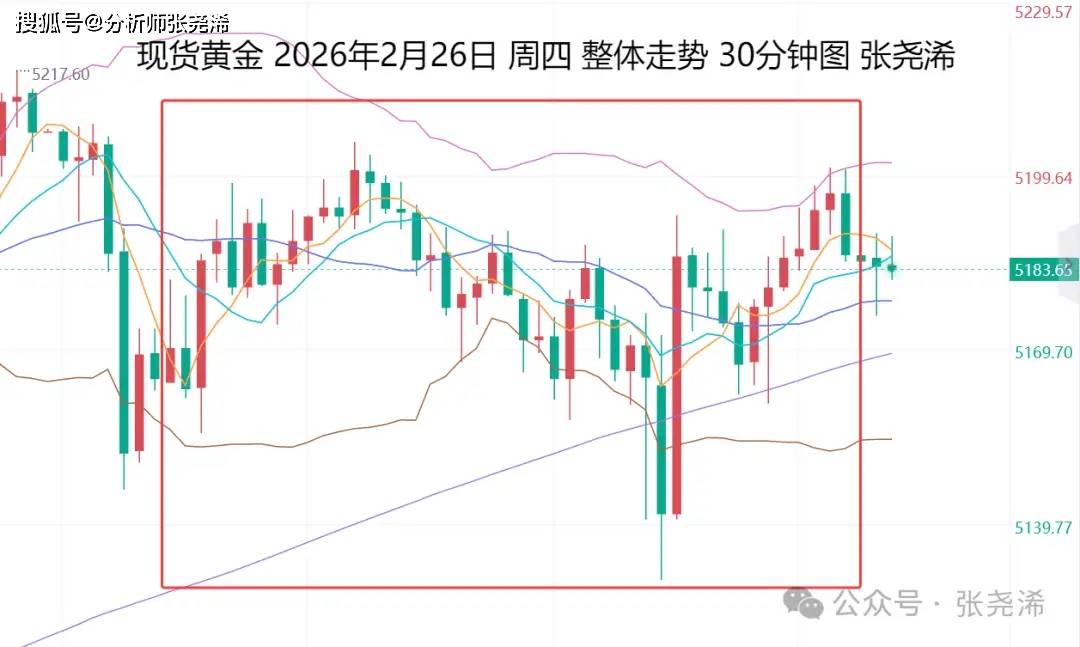
Core Viewpoint - International gold prices experienced fluctuations, unable to break through previous highs, but also did not decline significantly, influenced by major progress in US-Iran negotiations and mixed signals from the Federal Reserve regarding interest rates [1][5]. Price Movement - Gold opened at $5160.19 per ounce, reached a high of $5205.33, then fell to a low of $5130.43, before closing at $5185.13, with a daily range of $74.9 and a gain of $24.94, or 0.48% [3]. - The short-term direction of gold remains uncertain, with the dollar index showing strength, which may limit bullish momentum, but overall pressure on gold prices is expected to be limited, creating potential buying opportunities [3][5]. Economic Indicators - Key economic data to watch includes the US January PPI year-on-year and month-on-month, February Chicago PMI, and December construction spending month-on-month. A decrease in PPI is anticipated, supporting the outlook for interest rate cuts, which could be beneficial for gold prices [5]. - The recent increase in initial jobless claims in the US has led to expectations of two interest rate cuts by the Federal Reserve this year, alongside concerns over tariffs and geopolitical uncertainties [5]. Demand Insights - The SPDR Gold Trust, the world's largest gold ETF, reported an increase in holdings to 1097.62 tons, up by 3.43 tons from the previous trading day, marking the highest level since February 2021, indicating strong institutional confidence in gold's long-term value [5]. Technical Analysis - On a monthly basis, gold prices have rebounded after touching a key support level, indicating a continuation of the bullish trend, with expectations of further upward movement [7]. - Daily charts show gold in a consolidation phase, with bullish signals present, suggesting a potential for upward movement, with key support levels at $5160 and $5120, and resistance levels at $5225 and $5260 [9].
三大商品货币率先起飞,市场押注全球即将重回加息周期
Feng Huang Wang· 2026-02-25 22:23
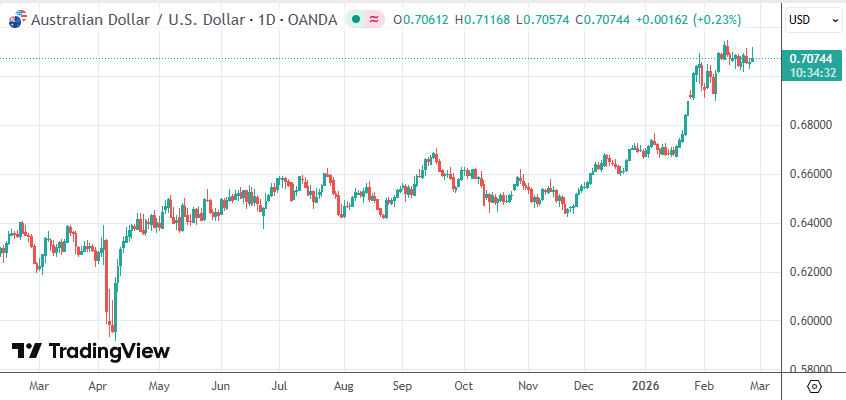
Core Viewpoint - The Australian dollar, Norwegian krone, and New Zealand dollar have significantly outperformed other major currencies this year as traders bet on a shift from interest rate cuts to hikes in global monetary policy [1][3]. Group 1: Currency Performance - The Australian dollar has appreciated over 6% against the US dollar year-to-date, reaching its highest level in nearly three years [1]. - The New Zealand dollar has risen approximately 3.7% against the US dollar this year, with expectations of an upcoming interest rate hike [3]. - The Norwegian krone has gained over 5% due to unexpectedly high inflation, leading traders to speculate on a potential small rate hike in the first half of the year [3]. Group 2: Monetary Policy Shifts - The Reserve Bank of Australia raised its benchmark interest rate by 25 basis points to 3.85%, marking its first rate hike in over two years [1][3]. - Analysts believe this could signal the beginning of a sustained tightening cycle, with expectations of one to two more rate hikes this year, each by 25 basis points [3]. - The shift in monetary policy reflects a broader trend among major economies to end years of rate cuts and focus on controlling inflation [3]. Group 3: Economic Context - The economic structures of Australia, New Zealand, and Norway are heavily weighted towards commodities, often categorizing them as "commodity currencies" [3]. - Recent increases in oil, copper, and other export commodity prices have provided additional support for these currencies [3]. - Concerns over the U.S. government's fluctuating policies and rising debt levels have led investors to seek diversification away from dollar-denominated assets, benefiting these commodity currencies [4].
利率风向突变?外汇交易员开始押注:新鹰派时代将至!
Jin Shi Shu Ju· 2026-02-25 07:21
Core Viewpoint - The foreign exchange market is experiencing a significant shift as traders bet on a transition from declining global interest rates to rising rates, with the Australian dollar, Norwegian krone, and New Zealand dollar outperforming other major currencies this year [2][3]. Group 1: Currency Performance - The Australian dollar has risen nearly 6% against the US dollar this year, reaching a three-year high, driven by the Reserve Bank of Australia's anticipated new rate hike cycle to combat inflation [2][3]. - The New Zealand dollar has increased by nearly 4%, with traders expecting the country to initiate its first rate hike in the coming months [2]. - The Norwegian krone has appreciated over 5%, spurred by unexpected inflation increases that have led traders to price in potential rate hikes in the first half of the year [2][3]. Group 2: Economic Context - Analysts suggest that these currencies are indicative of a broader hawkish shift among major economies, moving away from years of rate cuts to focus on controlling inflation [3]. - The Australian economy is at the forefront of this rate hike wave, with the trimmed mean inflation rate reported at 3.4%, exceeding analysts' expectations and increasing the likelihood of further rate hikes [3][4]. - The performance of these currencies is also supported by rising prices of commodities such as oil and copper, which are significant for their economies [3]. Group 3: Investor Sentiment - Investors are diversifying away from US dollar assets due to concerns over the unpredictable policies of the Trump administration and rising government debt [4]. - The expectation of rate hikes in other regions has contributed to the weakening of the US dollar, as higher rates elsewhere erode the support for the dollar [4]. - Despite pressure from President Trump for lower borrowing costs, most traders believe the Fed's rate cut cycle is not yet over, with expectations of two to three 25 basis point cuts this year [4]. Group 4: Fiscal Health - The Australian dollar, Norwegian krone, and New Zealand dollar are favored by investors due to the relative fiscal health of their countries, contrasting with concerns over large government deficits and rising debt in currencies like the yen, dollar, and pound [4][5]. - The top-performing G10 currencies are characterized as fiscally sound and commodity-exposed, making them attractive destinations for capital as it rotates out of the US [5][6].
科技周期领涨 高股息策略能否逆转引关注
Huan Qiu Wang· 2026-02-18 01:51
Group 1 - The technology and cyclical sectors have shown strong performance since January, with indices such as media, building materials, non-ferrous metals, and oil and petrochemicals rising over 10% as of February 13 [1] - In contrast, the dividend strategy has underperformed significantly in 2025, with the banking index down over 6% year-to-date, indicating a weak performance among low-valuation, high-dividend sectors [1] Group 2 - A report from Guojin Securities suggests that in the context of low macro risks from AI investments and a global manufacturing recovery during a rate-cutting cycle, corporate profit recovery in China could drive the stock market in 2026 [3] - The report indicates that investors may focus more on marginal changes in fundamentals rather than dividend yields, suggesting that dividend strategies may struggle to achieve excess returns this year [3] - Despite this, dividend assets are still considered a "ballast" for portfolios due to their low valuation, low volatility, and competitive yield compared to government bond rates [3] - Over 50 companies have committed to a dividend payout ratio of no less than 30% for 2025, with notable commitments from Huaihe Energy, Guangdong Expressway A, and Desso Fashion for substantial cash dividends [3] - Huaihe Energy has pledged a total cash dividend of no less than 75% of its net profit for 2025-2027, with a per-share dividend of at least 0.19 yuan (tax included) [3] - Guangdong Expressway A plans to distribute cash dividends of no less than 70% of its net profit for 2024-2026, while Desso Fashion commits to a minimum of 60% for the same period [3] - Based on the latest closing prices, Huaihe Energy has a dividend yield exceeding 5.4%, and Guangdong Expressway A is projected to have a yield over 5% based on a 70% payout ratio [3] - Eighteen stocks, including Hongcheng Environment, Sichuan Chengyu, Wantong Expressway, and China National Materials, are forecasted to have dividend yields exceeding 4% based on institutional consensus for 2025 earnings and committed payout ratios [3]

张尧浠:假期市场交易清淡、金价维持震荡调整格局
Sou Hu Cai Jing· 2026-02-17 01:14
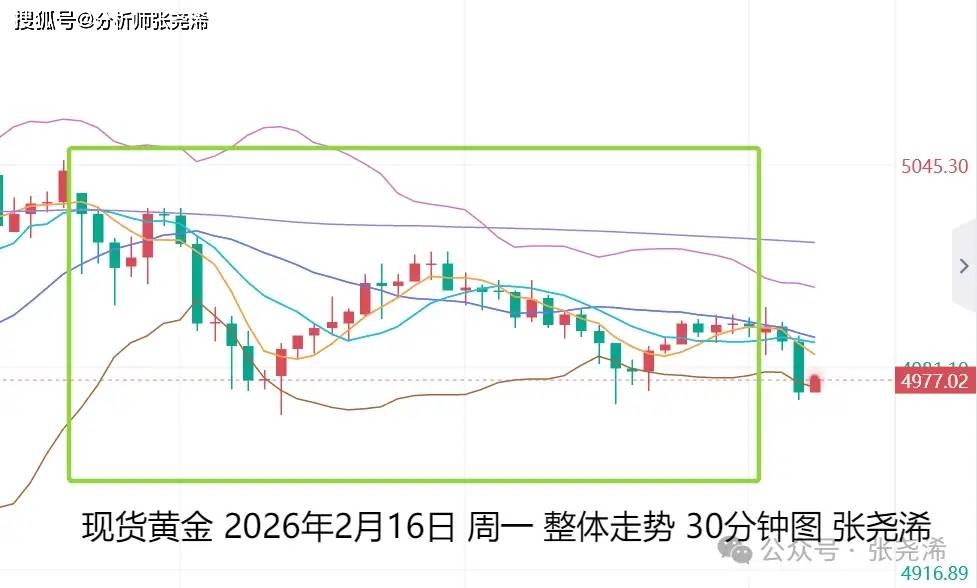
Core Viewpoint - International gold prices are experiencing fluctuations due to geopolitical negotiations and market conditions, with expectations of a short-term adjustment before potential upward movement [1][5]. Price Movement - On February 16, gold opened at $5042.31 per ounce, reached a high of $5042.31, and then declined to a low of $4965.63, closing at $4993.60, marking a daily drop of $48.71 or 0.97% [3]. - The following day, February 17, gold continued to face downward pressure, influenced by resistance from mid-range and short-term moving averages, as well as a strengthening US dollar [3]. Economic Indicators - Attention is on the upcoming US economic data, including the February New York Fed Manufacturing Index and the NAHB Housing Market Index, with mixed market expectations [5]. - Federal Reserve officials are expected to speak on artificial intelligence and its impact on the job market, which may support gold prices due to dovish sentiments [5]. Geopolitical Factors - Ongoing negotiations regarding Iran and the US, as well as the Russia-Ukraine talks, are contributing to uncertainty in the gold market, potentially increasing demand for gold as a safe haven [6]. - The US military's deployment of additional F-35 fighter jets to the Middle East adds to the geopolitical tension, which may further support gold prices [5][6]. Technical Analysis - Monthly analysis indicates that gold prices are maintaining a bullish outlook, having rebounded after touching a key support level, suggesting a potential for further upward movement [8]. - Weekly analysis shows that while gold prices rose last week, bullish momentum is weakening, with initial support at the 5-week moving average of $4960 [9]. - Daily charts indicate a period of adjustment, with expectations of a potential retest of the 30-day or 60-day moving averages for entry points into long positions [9]. Support and Resistance Levels - Key support levels for gold are identified at $4925 and $4880, while resistance levels are at $5000 and $5045 [10]. - For silver, support is noted at $74.25 and $72.40, with resistance at $77.30 and $78.90 [10].
银行理财不香了?1月规模掉1000亿,投资者“倒戈”公募、基金新开户激增169%
Sou Hu Cai Jing· 2026-02-14 03:45
Core Insights - The banking wealth management sector experienced a significant contraction in January 2026, with a total market scale reduction of over 114.2 billion yuan, contrary to the usual "opening red" season [3][4] - In contrast, public funds saw a remarkable surge, with monthly issuance reaching a three-year high and the number of new accounts doubling, indicating a shift in investor sentiment [7][10] Banking Wealth Management - January typically marks a peak for bank wealth management, but this year saw a decline in scale, with a drop of 114.2 billion yuan, leading to a total of 33.18 trillion yuan by the end of the month [3][4] - The top 14 wealth management companies reported a combined management scale of 24.59 trillion yuan, down approximately 815 billion yuan, primarily due to significant reductions from state-owned banks [4] - Factors contributing to this decline include aggressive credit issuance leading to a "funds return" to banks, a decrease in deposit rates, and increased cash flow demands ahead of the Lunar New Year [5][6] Public Fund Market - The public fund market experienced a robust performance in January, with 169 new fund products issued, marking an increase of 87 products year-on-year, and total issuance reaching 161.12 billion units, up approximately 132% [7][10] - Mixed funds led the issuance with 66.2 billion units, followed by equity funds at 36.9 billion units and bond funds at 20.4 billion units [8][9] - The surge in public funds is attributed to a "profitability effect," as some funds achieved monthly returns exceeding 30%, with three funds surpassing 50%, highlighting a stark contrast to the low returns of bank wealth management products [11]