全球科技竞赛

Search documents
重仓榜首之争:宁德仍居全市场榜首,中际旭创成主动基金第一持仓
Xin Lang Cai Jing· 2026-01-23 10:49
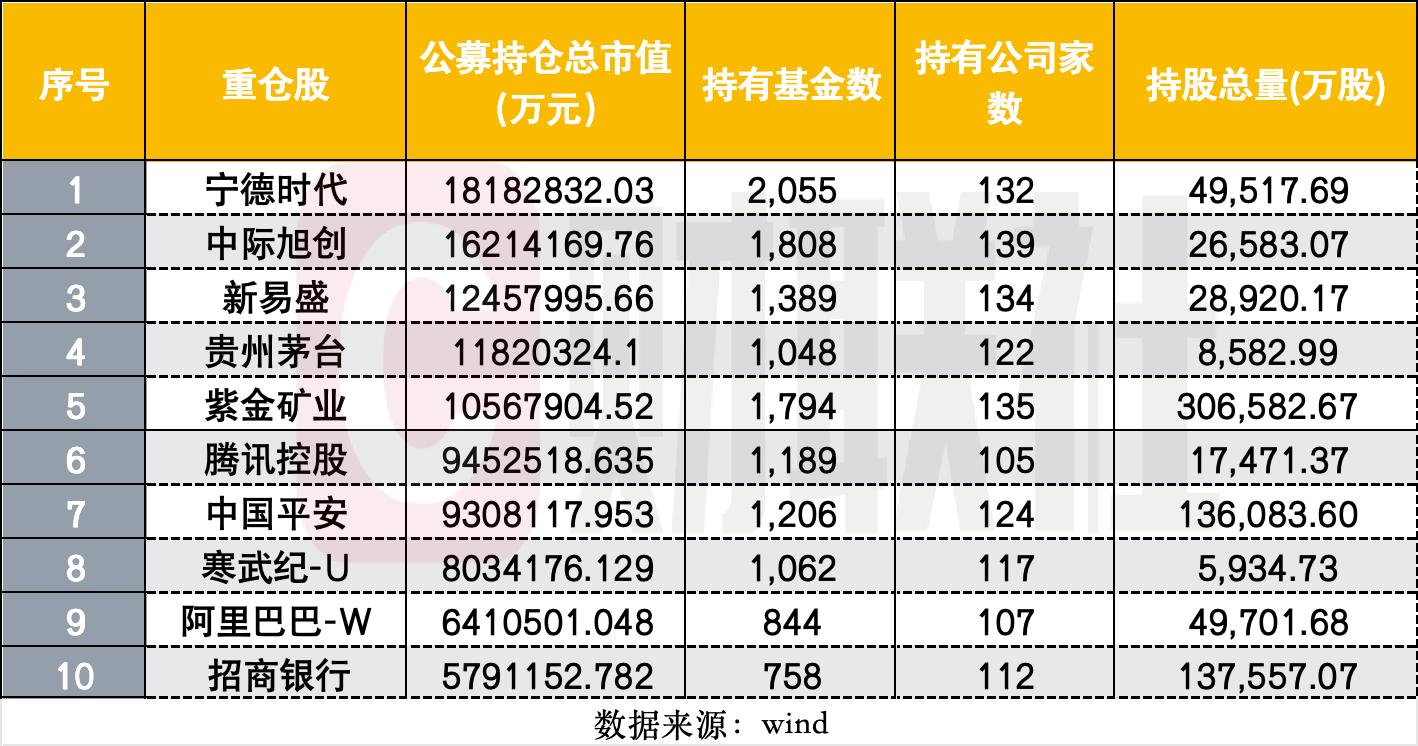
Group 1 - The core viewpoint of the article highlights the changing landscape of public fund heavyweights, with CATL maintaining its top position while Zhongji Xuchuang rapidly closes the gap [1][6] - As of the end of 2025, CATL holds a total market value of 181.83 billion yuan, while Zhongji Xuchuang has reached 162.14 billion yuan, significantly narrowing the gap from 96.01 billion yuan in the previous quarter [6][8] - The top ten heavyweights in public funds include CATL, Zhongji Xuchuang, Xinyi Semiconductor, Kweichow Moutai, Zijin Mining, Tencent Holdings, China Ping An, Cambricon Technologies, Alibaba-W, and China Merchants Bank, with total market values ranging from 57.91 billion yuan to 181.83 billion yuan [6][10] Group 2 - In the active fund category, Zhongji Xuchuang has overtaken CATL to become the top heavyweight, with a total market value of 82.54 billion yuan, while CATL's value is 69.18 billion yuan [3][10] - The active funds show a preference for technology and cyclical stocks, with significant increases in rankings for Xinyi Semiconductor and Zijin Mining, while Tencent Holdings and Alibaba-W have seen declines [3][12] - The top ten heavyweights in active funds include Zhongji Xuchuang, CATL, Xinyi Semiconductor, Tencent Holdings, Zijin Mining, Alibaba-W, Cambricon Technologies, Luxshare Precision, Kweichow Moutai, and Dongshan Precision, with market values ranging from 25.61 billion yuan to 82.54 billion yuan [10][11] Group 3 - The public fund's top ten increased holdings are dominated by "Chinese-character" stocks, focusing on the financial and energy sectors, with notable increases in Industrial Bank, China Cinda, and Industrial and Commercial Bank of China [4][15] - The financial sector saw significant increases in holdings, primarily driven by broad-based ETFs, while the energy sector also experienced collective increases from dividend ETFs [4][15] - The top ten stocks with the largest reductions in holdings are concentrated in the financial, media technology, and traditional cyclical sectors, with Oriental Fortune and Focus Media being the most significantly reduced [5][16] Group 4 - In the fourth quarter, Oriental Fortune and Focus Media were the only two stocks that saw reductions exceeding 60,000 shares, indicating a consensus among institutions to withdraw from these stocks [5][16] - The reduction in Oriental Fortune was primarily driven by multiple broad-based ETFs, while Focus Media faced significant reductions from several well-known active fund managers [5][16] - The reduction list also includes Agricultural Bank of China, Nanjing Steel, and China CITIC Bank, which were primarily affected by dividend-themed ETFs [17]



刚刚!中国股票,突传利好
Zhong Guo Ji Jin Bao· 2025-11-17 11:23
Core Viewpoint - Morgan Stanley forecasts a moderate increase in the Chinese stock market in 2026, with key challenges including corporate earnings quality, deflationary pressures, and global macroeconomic uncertainties [1][2]. Group 1: Market Projections - The target levels for major indices by December 2026 are set at 27,500 for the Hang Seng Index, 9,700 for the State-Owned Enterprises Index, and 4,840 for the CSI 300 Index, indicating potential upside of approximately 4%, 4%, and 5% respectively from the closing levels on November 17 [1]. - The CSI 300 Index has risen about 17% year-to-date, suggesting a second consecutive year of growth, driven by optimistic investor sentiment towards China's technological development [1]. Group 2: Investment Strategy - Morgan Stanley emphasizes the importance of stock selection, recommending an overweight position in high-quality internet and technology leaders while reducing exposure to real estate, consumer staples, and energy sectors [3].
刚刚!中国股票,突传利好
中国基金报· 2025-11-17 11:20
Core Viewpoint - Morgan Stanley expects a moderate increase in the Chinese stock market in 2026, with key indices set at 27,500 for the Hang Seng Index, 9,700 for the State-Owned Enterprises Index, and 4,840 for the CSI 300 Index, representing potential upsides of approximately 4%, 4%, and 5% respectively compared to the closing levels on November 17 [2]. Group 1 - The report highlights that 2026 will be a stabilization period following significant gains this year, with the CSI 300 Index having risen about 17% year-to-date, indicating a potential for a second consecutive year of growth [2]. - Factors influencing market performance include the quality and sustainability of corporate earnings, ongoing deflationary pressures, and global macroeconomic uncertainties [2]. - The report emphasizes that for the market to break current levels, it must address concerns regarding corporate earnings quality, limited room for further valuation expansion, and increased global macroeconomic uncertainties [2]. Group 2 - Despite short-term challenges, Morgan Stanley anticipates a stable and sustainable growth trend for the Chinese market in 2026 [3]. - The MSCI China Index has risen over 10% since the upgrade of the outlook in March [3]. - Stock selection will be crucial, with recommendations to overweight high-quality internet and technology leaders while reducing exposure to real estate, consumer staples, and energy sectors [3].

A股5400多家上市公司 谁最舍得搞研发?
Sou Hu Cai Jing· 2025-09-01 11:26
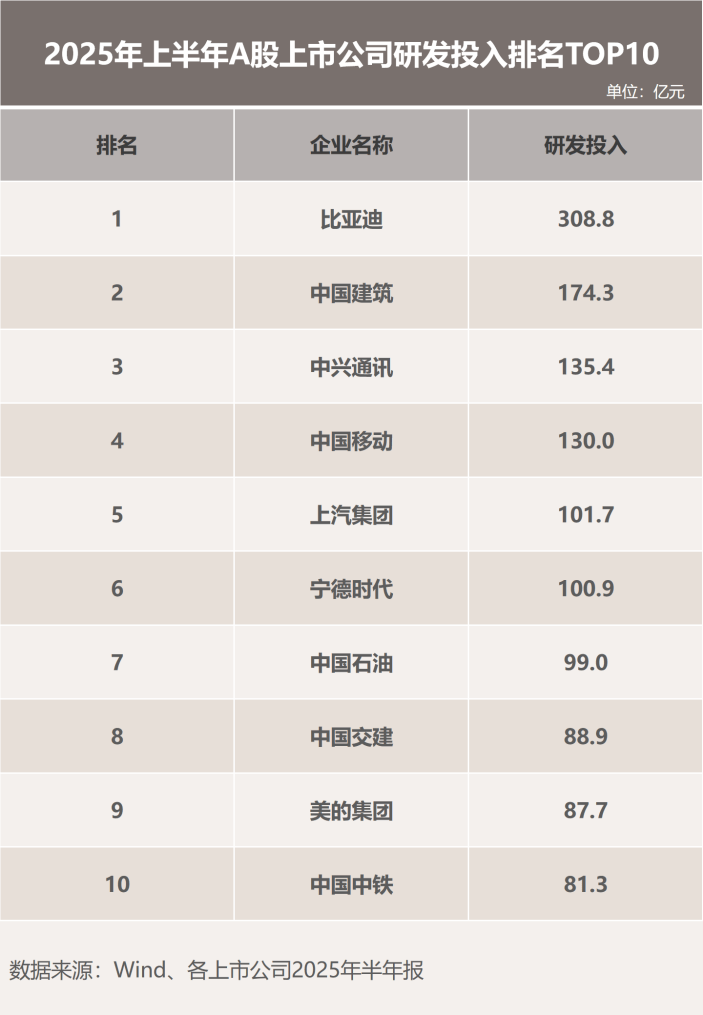
Core Insights - The global technology competition is intensifying, with companies increasing investments to secure leadership in cutting-edge technologies [1] - In the first half of this year, A-share listed companies in China saw a 3.27% year-on-year increase in R&D spending, with BYD leading the way with an investment of 30.9 billion yuan, a 53% increase compared to the previous year [1][2] - BYD's R&D investment for 2024 is projected to reach 54.2 billion yuan, marking a 36% increase, and it has cumulatively invested over 210 billion yuan in R&D since 2011 [3] R&D Investment Rankings - In the first half of 2025, the top 10 companies in A-share for R&D investment are as follows: 1. BYD: 30.88 billion yuan 2. China State Construction: 17.43 billion yuan 3. ZTE: 13.54 billion yuan 4. China Mobile: 13 billion yuan 5. SAIC Motor: 10.17 billion yuan 6. CATL: 10.09 billion yuan 7. China Petroleum: 9.9 billion yuan 8. China Communications Construction: 8.89 billion yuan 9. Midea Group: 8.77 billion yuan 10. China Railway: 8.13 billion yuan [2] Comparison with Peers - In comparison to other major domestic automotive companies, BYD's R&D investment of 54.2 billion yuan for 2024 is significantly higher than its peers, with Geely holding 26.67 billion yuan, SAIC at 21.81 billion yuan, and others trailing behind [6][9] - BYD's R&D spending is nearly equivalent to the combined R&D investments of four other major car manufacturers [6] Technological Advancements - BYD's commitment to R&D is reflected in its development of groundbreaking technologies such as the fifth-generation DM, the "Tian Shen" driver assistance system, and the "Super e-platform" [9] - The company has also made a unique commitment to comprehensive safety in smart parking, showcasing its confidence in its technological capabilities [9] Sales Performance - BYD's substantial R&D investment has contributed to a significant increase in sales, with global sales reaching 2.49 million units in the first seven months of 2025, a 27.4% year-on-year growth [9] - The overseas market has shown remarkable performance, with over 550,000 units sold outside China, reflecting a growth of over 130% compared to the previous year [9]