
公私合作伙伴关系

Search documents
毛里塔尼亚正处于经济和制度深度变革期
Shang Wu Bu Wang Zhan· 2025-12-06 01:55
Core Insights - Mauritania is undergoing significant economic and institutional reforms, with improving macroeconomic stability and sustained economic growth over the past three years [1] - The government is focused on enhancing the investment environment, implementing public-private partnership (PPP) laws, and increasing transparency through asset declaration and anti-corruption measures [1] - Mauritania's development vision is guided by the "Accelerated Growth and Shared Prosperity Strategy" (SCAPP 2016-2030), emphasizing economic diversification, human capital development, reducing inequality, and enhancing climate resilience [1] - The country has engaged with several OECD mechanisms, including the Global Forum on Transparency and Exchange of Information for Tax Purposes and the Inclusive Growth Initiative [1] - Joining the OECD Development Centre is a crucial step for Mauritania to integrate into OECD's analytical and regulatory frameworks, benefiting from experiences in energy transition, digital economy skills development, and innovation [1] Summary by Sections - **Economic Growth and Stability** - Mauritania's macroeconomic stability is improving, with public debt decreasing and foreign exchange reserves covering over six months of imports [1] - **Government Initiatives** - The government is actively working to improve the investment climate and implement PPP laws, alongside enhancing transparency in governance [1] - **Development Strategy** - The SCAPP 2016-2030 outlines a clear political commitment to building a modern, competitive economic system through various strategic focuses [1] - **OECD Engagement** - Mauritania's participation in OECD initiatives highlights its commitment to global standards in tax transparency and inclusive growth [1][2] - **Benefits of Joining OECD Development Centre** - Membership will allow Mauritania to leverage OECD's expertise in key areas, while the OECD will benefit from Mauritania's experiences as a reforming nation connecting North Africa and Sub-Saharan Africa [1]
10万亿算力订单根本hold不住?Altman偷递11页“要钱申请”,还嘴硬 “不求联邦”,白宫直拒:谁都不救
3 6 Ke· 2025-11-11 04:02
Core Viewpoint - OpenAI is facing scrutiny and accusations of dishonesty regarding its financial strategies and public statements, particularly concerning its requests for federal support and its ambitious revenue projections [1][2][3]. Financial Projections - OpenAI CEO Sam Altman stated that the company expects to reach an annual revenue of $20 billion by the end of the year and potentially several hundred billion by 2030 [1][8]. - The company has signed infrastructure agreements exceeding $1.4 trillion to secure the computational power needed for future models [7]. Federal Support Controversy - CFO Sarah Friar's comments about seeking federal support for funding significant investments in chips and infrastructure sparked backlash, with critics arguing against taxpayer funding for a high-risk private enterprise [2][3]. - Following the controversy, Altman clarified that OpenAI does not seek government guarantees for its data centers, attempting to distance the company from the contentious remarks made by Friar [4][5]. Public Relations Response - OpenAI leadership quickly moved to control the narrative, with Friar issuing a clarification that her comments were misinterpreted and intended to emphasize the need for strong public-private partnerships [3][5]. - The White House AI director David Sacks reiterated that the government would not provide federal aid for AI, emphasizing competition over intervention [3]. Strategic Partnerships and Contracts - OpenAI's recent agreements include a $38 billion cloud services deal with Amazon Web Services and a renegotiated partnership with Microsoft involving an additional $250 billion in Azure services [7][8]. - The company is under pressure to manage its substantial commitments and may need to renegotiate contracts with cloud service providers to ensure financial viability [9].

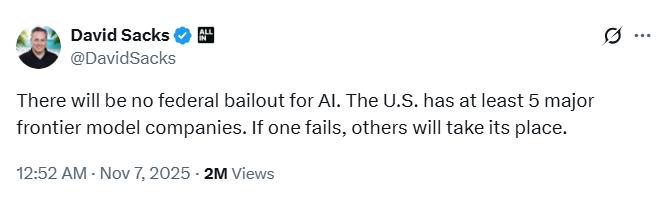
10万亿算力订单根本hold不住?Altman偷递11页“要钱申请”,还嘴硬 “不求联邦”,白宫直拒:谁都不救!
AI前线· 2025-11-10 06:54
Core Viewpoint - OpenAI is facing scrutiny and controversy over its financial strategies and statements regarding federal support for its infrastructure investments, amidst claims of potential dishonesty from its leadership [2][3][4]. Financial Statements and Projections - OpenAI CEO Sam Altman projected that the company's revenue will reach $20 billion by the end of the year and could grow to hundreds of billions by 2030 [2][10]. - The company has signed over $1.4 trillion in infrastructure agreements to secure the computational power needed for future models [9]. Controversial Statements and Reactions - CFO Sarah Friar's comments about seeking federal support for funding raised concerns about taxpayer money being used for a private enterprise [4][5]. - Following backlash, Friar clarified her statements, emphasizing the need for strong public-private partnerships rather than direct government aid [5]. Government Response - White House AI director David Sacks stated that the government would not provide federal aid for AI companies, reinforcing a belief in competition over intervention [5][6]. - Altman later denied seeking government guarantees for OpenAI's data centers, attempting to distance the company from the controversy [6]. Internal Conflicts and Contradictions - A letter from OpenAI's Chief Global Affairs Officer revealed requests for federal support, contradicting Altman's public denials [6][8]. - The letter outlined specific policy proposals for government assistance, including grants and loan guarantees to enhance the AI industry [7][8]. Financial Viability and Future Outlook - OpenAI's ambitious financial commitments raise questions about its ability to sustain such expenditures without federal assistance or significant revenue growth [10][11]. - Analysts suggest that OpenAI must achieve substantial revenue increases to justify its infrastructure investments, with projections indicating a need for a nearly 2900% revenue growth by 2029 [10].

Cigna(CI) - 2025 Q3 - Earnings Call Transcript
2025-10-30 13:32
Financial Data and Key Metrics Changes - The company reported revenues of $69.7 billion and adjusted earnings of $7.83 per share for Q3 2025, reflecting sustained growth despite a dynamic market environment [8][31]. - A net after-tax special item benefit of $61 million or $0.23 per share was recorded during the quarter [4]. Business Line Data and Key Metrics Changes - Evernorth Health Services generated revenues of $60.4 billion, with pre-tax adjusted earnings of $1.9 billion, in line with expectations [31]. - Specialty and care services revenues increased by 10% to $26.3 billion, with pre-tax adjusted earnings up 11% to $928 million, driven by strong specialty volume growth and increased biosimilar adoption [32]. - Pharmacy benefit services revenues were $34.1 billion, with pre-tax adjusted earnings of $1 billion, reflecting ongoing investments to improve patient experience [32]. Market Data and Key Metrics Changes - The company noted that generic drugs account for 90% of all prescriptions in the U.S., with prices being one-third cheaper than in other countries [10]. - Brand name medications continue to see significant price increases, with the median price for new FDA-approved drugs projected at approximately $390,000 for a treatment course in 2025 [11]. Company Strategy and Development Direction - The company is focusing on a new rebate-free model for pharmacy benefits, aimed at improving healthcare affordability and patient experience [9][15]. - Strategic investments, such as the acquisition of Shields Health Solutions, are intended to expand the company's capabilities in the specialty market [8][22]. - The company aims to transition at least 50% of its business to the new pharmacy benefits model by the end of 2028 [16]. Management's Comments on Operating Environment and Future Outlook - Management expressed confidence in sustaining growth despite challenges, reaffirming an adjusted EPS outlook of at least $29.60 for 2025 [18][34]. - The company anticipates margin pressure in the pharmacy benefit services segment over the next two years due to strategic investments and contract renewals [17][28]. - Management highlighted the importance of public-private partnerships and innovation in addressing healthcare challenges [75][78]. Other Important Information - The company reported a debt to capitalization ratio of 44.9% as of September 30, 2025, primarily due to debt issuance related to the investment in Shields Health Solutions [35]. - The company expects strong cash flow from operations in the fourth quarter, consistent with previous patterns [35]. Q&A Session Summary Question: Clarification on pharmacy business and renewal pricing - Management confirmed that the new rebate-free model is designed to be transparent and fee-based, aligning with regulatory priorities, and that the long-term growth algorithm for Evernorth remains intact despite short-term challenges [41][42]. Question: Magnitude of expected decline in pharmacy benefit services - Management indicated that the expected decline in pharmacy benefit services income is due to large client renewals and transitional investment costs, with the decline being more than half attributable to the new margin profile from these renewals [56]. Question: Profitability of large contracts - Management clarified that while large contracts may have lower margins compared to the overall portfolio, they do not operate at a loss and are strategically important for the company [66][68]. Question: Adoption of the new pharmacy benefits model by employers - Management expressed confidence in the new model's appeal to employers, emphasizing its potential to simplify costs and improve employee satisfaction [62][63].

Codelco公司CFO:将专注于公私合作伙伴关系 以提高产量
Wen Hua Cai Jing· 2025-06-12 00:41
Core Insights - Codelco, the world's largest copper producer, is focusing on public-private partnerships to improve its financial situation and enhance its ability to develop new projects, aiming to increase production amidst rising global demand for copper and lithium during the energy transition [1][2] Group 1: Strategic Focus - The company emphasizes that public-private partnerships will be a "pillar of growth" rather than for major repairs or existing operations, adhering to nationalization regulations that prevent private funding in its mines [2] - Codelco's greenfield projects are considered a key part of its growth strategy and an opportunity for collaboration with third parties, which will also help diversify risks [2] Group 2: Partnerships and Collaborations - Codelco has established partnerships with Freeport-McMoRan at the El Abra mine and holds a 20% stake in Anglo American's resources, while also acquiring a 10% stake in Quebrada Blanca resources from Enami [2] - Recent agreements with Rio Tinto and BHP aim to explore new potential copper mines, with promising prospects reported [2] Group 3: Investment in Exploration - The company plans to increase its exploration budget to an average of $83 million per year for 2023 and 2024, and to $150 million per year from 2025 to 2029 [3] - Codelco announced a joint operation with Anglo American to manage nearby copper mines, projecting an annual increase of 120,000 tons over 21 years [3] Group 4: Resource Utilization - Collaborations with third parties are seen as a way to better utilize resources, complementing the company's own projects [4]
以患者为中心,医院如何制胜AI数字化时代
科尔尼管理咨询· 2025-04-15 03:45
研究显示,亚太地区的医院经历了从稳步扩张、大流行冲击、上坡恢复到持续增长等阶段。在每个阶段, 我们都分析了医院收入、手术数量和病床占用率与 GDP 同比增长率的关系。 在新冠之前,该地区的医院通过收购和提供更多服务不断扩张。这使得医院收入稳定增长5%至10%,手 术数量增长 10%至 15%,病床占用率稳定在65%至70%,与该地区 4%至 5%的 GDP 增长率保持一致。 尽管医院规模稳步扩大,但大流行病暴露了医院系统的严重弱点,导致收入减少,病床占用率因可用病床 短缺而上升。手术也被推迟或取消,因为病人为了尽量减少接触病毒的风险而回避医院。 后新冠时代,虽然没有了集中性的疾病冲击,医院正面临着一系列趋势和挑战。为了解整个亚太地区目前 的医院经营环境,科尔尼公司在 2022 年至 2024年期间调研了25位医院高管和150多位患者。 与此同时,运营更加灵活的医院能够迅速做出调整。例如,新加坡陈笃生医院(Tan Tock Seng Hospital) 将膝关节置换手术转变为采用增强型术后恢复(ERAS)模式的非卧床手术,将住院时间从六天缩短为一 天。 随着疫苗接种率超过人口的40%,选择性手术出现反弹,到 2 ...