养老经济

Search documents
京东调整七鲜小厨扩展模式,计划今年覆盖所有二线城市
Di Yi Cai Jing Zi Xun· 2026-02-07 08:45
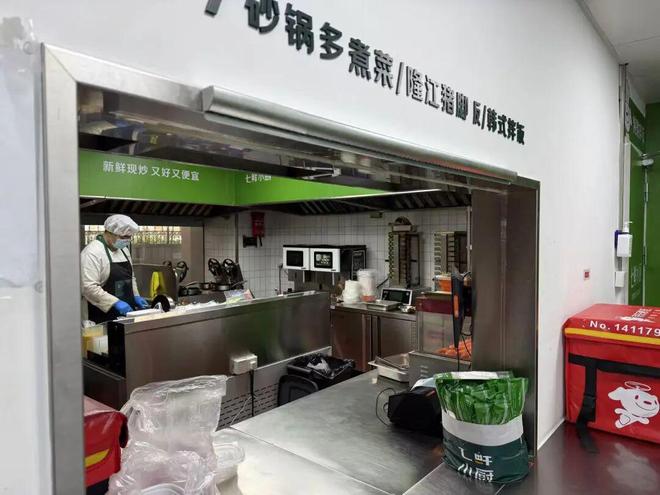
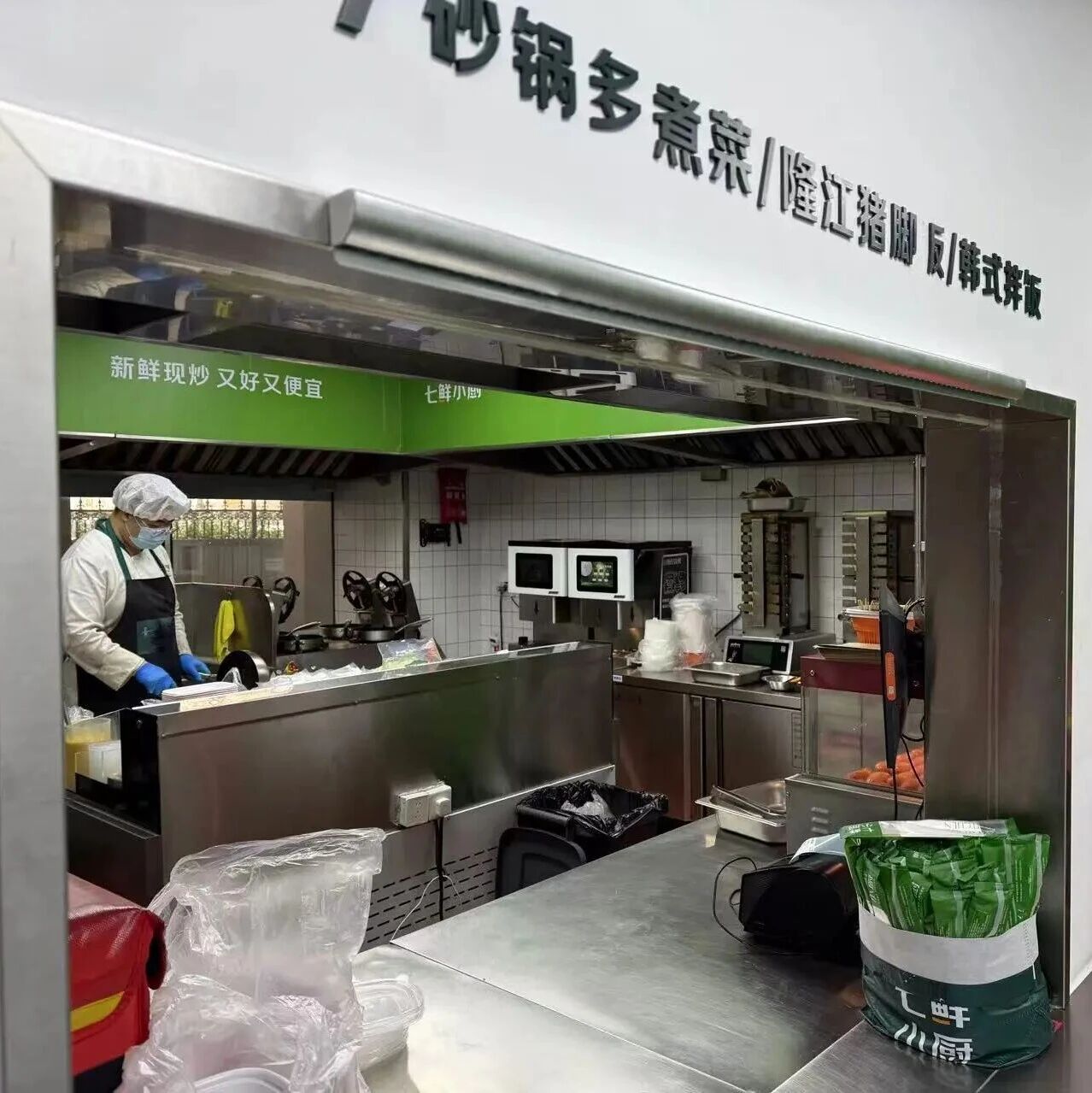
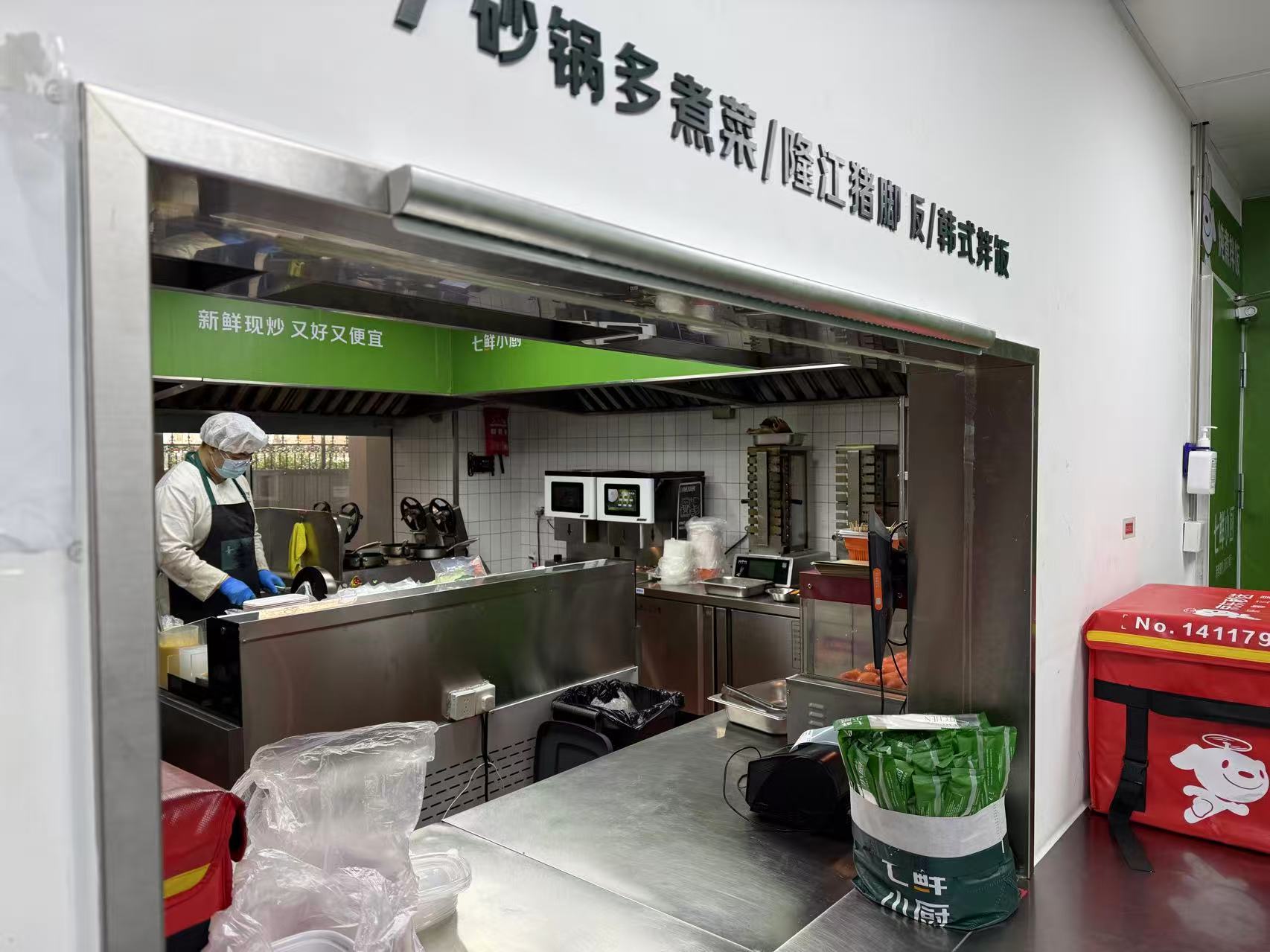
Core Viewpoint - JD's subsidiary, Seven Fresh Kitchen, has made significant progress in its expansion strategy, launching in five cities and planning to cover all second-tier cities by 2026 [3][4]. Group 1: Expansion Strategy - Seven Fresh Kitchen has launched in Beijing, Shanghai, Guangzhou, Shenzhen, and Harbin, with plans for further expansion in 2026 [3]. - The company has initiated a nationwide partner recruitment plan, focusing on key regions such as Beijing-Tianjin-Hebei, Yangtze River Delta, and Pearl River Delta [3][4]. - The shift in operational model allows for quicker store openings and reduces financial and human resource risks by adopting a light-asset model [4]. Group 2: Operational Adjustments - The operational model has transitioned from JD managing overall operations to a focus on supply chain and standards, with partners responsible for local operations [4]. - The company has updated its product offerings, including becoming the first online provider of elderly meal services in Beijing and planning to expand services to hospitals and schools [5]. Group 3: Performance Metrics - After six months of operation, the efficiency of the first store has improved significantly, with a reduction in staff needed to handle peak hours [6]. - The store has seen a 30% increase in orders since joining platforms like Meituan and Taobao [6].


京东调整七鲜小厨扩展模式,计划今年覆盖所有二线城市
第一财经· 2026-02-07 08:35
Core Viewpoint - JD's Qixian Kitchen has made significant progress in its expansion strategy, adapting its business model to facilitate rapid growth and local partnerships, while also diversifying its product offerings to meet market demands [4][5][6]. Group 1: Expansion and Business Model - Qixian Kitchen has launched in five cities: Beijing, Shanghai, Guangzhou, Shenzhen, and Harbin, with plans for further expansion in 2026 to cover all second-tier and above cities [4]. - The company has initiated a nationwide partner recruitment plan, focusing on three core regions: Beijing-Tianjin-Hebei, Yangtze River Delta, and Pearl River Delta, allowing for quicker store openings [4][5]. - The business model has shifted from direct management to a partnership approach, where Qixian Kitchen provides supply chain support and operational standards, while partners handle local operations [5]. Group 2: Product Development and Market Adaptation - Qixian Kitchen has introduced new product offerings, including a dedicated "Elderly Zone" for senior meal services, becoming the first online meal provider for elderly care in Beijing [6]. - The company is exploring service expansions into hospitals and schools, indicating a strategic direction towards community-focused dining solutions [6]. - The integration of supply chain capabilities into the food service sector is seen as a potential growth area, leveraging the booming elderly economy and the necessity of campus dining [6]. Group 3: Operational Efficiency - After six months of operation, Qixian Kitchen has improved its efficiency significantly, with adjustments made to production and workflow processes [8]. - The store has optimized its staffing, reducing the number of employees needed to handle peak hours while maintaining high output, with 600 meals served during lunch peaks [8]. - The company has seen a 30% increase in orders since joining platforms like Meituan and Taobao, indicating successful market penetration and customer engagement [8].
京东调整七鲜小厨扩展模式,计划26年覆盖所有二线城市
Di Yi Cai Jing· 2026-02-07 07:07
Core Insights - JD's Qixian Kitchen has launched a nationwide partner recruitment plan to facilitate rapid expansion and has already established operations in five cities: Beijing, Shanghai, Guangzhou, Shenzhen, and Harbin, with plans to cover all second-tier cities by 2026 [1][2] Group 1: Business Model and Expansion - The shift to a light-asset model allows for quicker store openings and reduces financial and human resource risks for JD [2] - Qixian Kitchen will focus on supply chain management and standardization, while partners will handle local operations and site selection [1][2] - The recruitment plan targets key regions including Beijing-Tianjin-Hebei, Yangtze River Delta, and Pearl River Delta, with a goal to extend to other economically active second-tier cities [1][2] Group 2: Product and Service Development - Qixian Kitchen has updated its product offerings, including becoming the first online provider of meals for elderly care in Beijing and launching a "Senior Zone" in some stores [2] - Plans are underway to expand meal services to hospitals and schools, indicating a focus on community-oriented dining solutions [2] Group 3: Operational Efficiency - After six months of operation, Qixian Kitchen has improved efficiency significantly, with the ability to handle 600 meal orders during peak lunch hours [4][5] - The store has adjusted its workflow and staffing, reducing the number of employees needed to manage operations effectively [5] - Orders from platforms like Meituan and Taobao have increased by 30% since joining, reflecting growing demand [4]
平安好医生大涨,领涨互联网医疗板块
Ge Long Hui· 2026-01-05 06:12
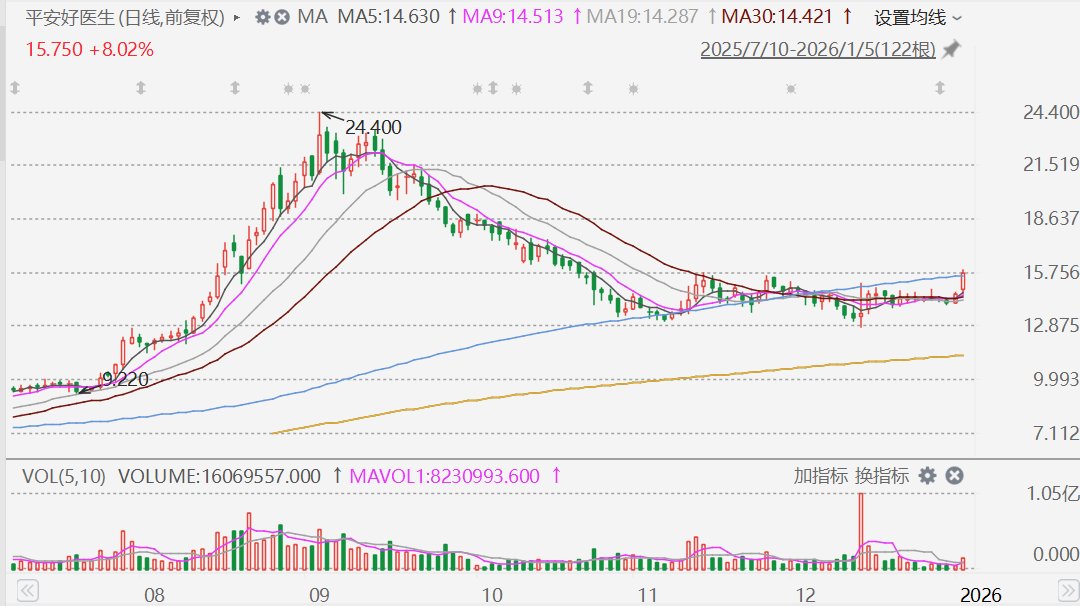
Core Viewpoint - China Ping An's stock price surged to a five-year high, positively impacting the Hong Kong market, particularly Ping An Good Doctor (1833.HK), which saw a significant increase of 9%, reaching its highest level since October 2025 [1] Group 1: Company Performance - Ping An Good Doctor is a key player in the "value re-evaluation" process, benefiting from its strategic position within the Ping An ecosystem, particularly in health and elderly care services [1] - The stock price increase of Ping An Good Doctor reflects a broader trend in the internet healthcare sector, indicating strong investor confidence [1] Group 2: Analyst Insights - Morgan Stanley's report from December 2025 highlighted Ping An's potential to capitalize on growth opportunities in personal finance, healthcare, and elderly care, raising its target price to 89 HKD [1] - Analysts suggest that Ping An Good Doctor is positioned to experience a "Davis Double Play" in terms of performance and valuation, particularly within the context of China's aging economy narrative [1]
港股异动丨平安好医生大涨9%,领涨互联网医疗板块
Ge Long Hui A P P· 2026-01-05 03:19
Core Viewpoint - China Ping An's stock price surged to a five-year high, positively impacting Ping An Good Doctor's stock, which rose by 9% during trading, reaching a new high since October 2025 [1] Group 1: Company Performance - Ping An Good Doctor led the internet healthcare sector with significant stock price growth, reflecting strong market interest and investor confidence [1] - Morgan Stanley's report in December 2025 highlighted Ping An's potential to capitalize on key growth opportunities in wealth management, healthcare, and elderly care, raising its target price to HKD 89 [1] Group 2: Strategic Positioning - Ping An Good Doctor is positioned as a strategic component within Ping An's healthcare services, aiming to create a differentiated advantage through synergy with comprehensive financial services [1] - The company is seen as a critical anchor in the "value re-evaluation" process, contributing to the overall growth narrative in China's aging economy [1]
还在拼命攒钱养老?研究表明“用不着”
3 6 Ke· 2025-11-28 03:39
Core Insights - The aging population in China is projected to exceed 400 million by around 2035, raising questions about the sustainability of traditional retirement savings and the mindset of the elderly towards aging and consumption [1] - The concept of "DIE WITH ZERO" challenges the traditional view of accumulating wealth for retirement, suggesting that experiences and memories are more valuable than leaving behind an inheritance [2][4] - The silver economy faces a structural imbalance, focusing primarily on the active elderly while neglecting the needs of those in the "No-go" phase, which is where the real challenges lie [5][6] Economic Trends - The elderly's spending habits can be categorized into three stages: "Go-go years," "Slow-go years," and "No-go years," with the majority of economic focus on the first two stages [5] - Innovative service models in the elderly care sector are emerging, such as "Papa Pals" and health management systems that prioritize the real needs of the elderly [6] - In China, the silver economy's growth hinges on effectively reaching and building trust with the elderly, emphasizing simple and understandable solutions over high-tech offerings [8] Market Dynamics - The Chinese elderly market shows a preference for localized services over luxury experiences, with products like "farmhouse day trips" resonating well with their needs [9] - The elderly care industry faces significant challenges in financing and exit strategies, with a lack of clear profitability paths hindering investment [10][12] - The "reverse mortgage" model has faced difficulties in China due to familial and societal resistance, highlighting the need for financial innovation that respects cultural values [12] Social Considerations - The well-being of the elderly is closely tied to societal values, emphasizing the importance of treating them with respect and care as a reflection of societal health [12][13] - Acceptance of aging and a shift in expectations are crucial for the elderly to lead fulfilling lives, focusing on simplicity and reducing burdens on family and society [13]