内存市场超级周期

Search documents
“一盒内存条可买上海一套房”
Guan Cha Zhe Wang· 2026-01-07 09:12
Core Insights - The price of high-capacity DDR5 server memory modules has surged dramatically, with some units exceeding 40,000 yuan, leading to comparisons with real estate prices in Shanghai [1] - The ongoing AI boom is driving a "super cycle" in the global memory market, with significant price increases observed in DRAM products [8][10] Price Trends - Hynix and Samsung's 256G DDR5 6400MHz server memory modules are priced above 40,000 yuan, with some listings reaching 49,999 yuan per unit [1] - The average price of new homes in Shanghai is approximately 58,524.58 yuan per square meter, indicating that a box of 256G DDR5 server memory could purchase an 80 square meter apartment [1] Market Dynamics - Since February 2025, DRAM prices have been on the rise, with some segments increasing by over 100% [8] - The price of DDR5 memory chips has surged by 307% since September 2025, while DDR4 chips have seen a 158% increase [8] - Major manufacturers like Samsung and SK Hynix are shifting production capacity towards AI server memory, tightening supply in other markets [8][10] Future Projections - DRAM contract prices are expected to increase by 55-60% in Q1 2026, driven by high demand from cloud service giants [9][10] - The price hikes are anticipated to affect other sectors, with smartphone and PC manufacturers facing increased costs, leading to price increases for new devices [10] Industry Impact - Companies like Xiaomi, OPPO, and Dell have already raised prices on new products due to rising memory costs, with increases ranging from 100 to 600 yuan [10] - The global smartphone shipment is projected to decline by 2.1% in 2026, while PC manufacturers are also planning price hikes, with Dell announcing increases of 10% to 30% [10] - Analysts predict that the current "super cycle" in memory pricing may last until 2027 [10]


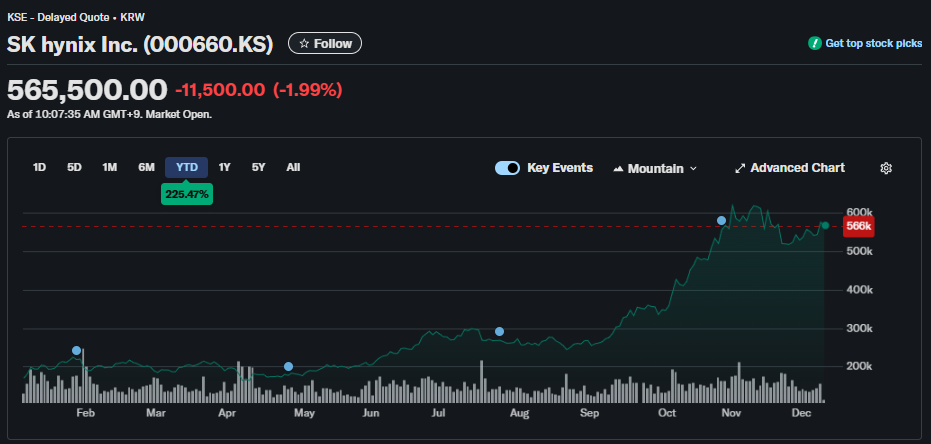
年内涨超两倍引过热担忧!SK海力士逾一月内第二次遭韩国交易所警示
Zhi Tong Cai Jing· 2025-12-09 01:57
Core Viewpoint - The recent surge in SK Hynix's stock price has raised concerns about potential overheating, prompting the Korea Exchange to issue an "investment warning" for the second time within a month, indicating that investors should exercise caution [1][3]. Group 1: Stock Performance and Warnings - The Korea Exchange issued a one-day "investment warning" for SK Hynix due to significant price fluctuations, which does not halt trading but signals caution for investors [1]. - SK Hynix's stock rose by 6.1% on Monday amid speculation about a potential issuance of American Depositary Receipts (ADRs), although the company stated that no confirmation has been made regarding ADRs [3]. - Following the investment warning on November 3, SK Hynix's stock experienced a decline of 5.3% on November 4, highlighting the impact of regulatory alerts on stock performance [3]. Group 2: Financial Performance and Market Demand - SK Hynix reported record sales of 24.5 trillion KRW and an operating profit of 11.4 trillion KRW in Q3, driven by increased demand for memory due to the AI infrastructure boom [4]. - The company plans to invest more in capacity expansion next year to meet the unprecedented demand driven by major players like OpenAI and Meta, and will begin supplying next-generation HBM4 components this quarter [4]. - SK Hynix's executives indicated that HBM chips have been sold out since 2023, with supply expected to remain tight until 2027, marking a structural change in memory demand [4]. Group 3: Long-term Market Outlook - Many investors and tech companies believe that the emergence of AI will trigger a "super cycle" in the memory market, particularly for HBM chips essential for AI accelerators and services like ChatGPT, which is favorable for SK Hynix [5]. - Projections indicate that SK Hynix's sales and profits will significantly increase by 2026, driven by demand for DRAM and NAND chips, with DRAM demand expected to grow over 20% next year [5]. - NAND sales volume is also anticipated to rise substantially, with a projected growth of 17%-19% in demand by 2026, which could enhance sales prices and boost profits for SK Hynix [5].
SK海力士利润创新高,HBM4将全面出货
半导体行业观察· 2025-10-29 02:14
Core Viewpoint - The article highlights the significant growth in demand for High Bandwidth Memory (HBM) driven by the booming artificial intelligence (AI) market, with SK Hynix leading the sector and achieving record quarterly performance in Q3 2023 [2][5]. Financial Performance - SK Hynix reported a consolidated operating profit of 11.3834 trillion KRW in Q3 2023, a 62% increase year-over-year, with an operating margin of 47% [5]. - The company's revenue for Q3 2023 reached 24.4489 trillion KRW, marking a 39% increase compared to the same period last year [5]. - Net profit for the quarter was 12.5975 trillion KRW, with a net profit margin of 52% [5]. Market Dynamics - The demand for memory products is surging as clients increase investments in AI infrastructure, particularly for high-value products like HBM3E and server-oriented DDR5 [2][5]. - The shift in the AI market towards inference workloads is expected to broaden the demand for various memory products, including high-performance DDR5 and enterprise SSDs [6][7]. Product Development and Supply Chain - SK Hynix has completed negotiations for HBM supply with major clients for the upcoming year, with HBM4 development completed in September and mass production set to begin in Q4 2023 [3][6]. - The company plans to accelerate the transition to its advanced 10nm-class sixth-generation (1c) process technology to enhance its DRAM product line across server, mobile, and graphics applications [3][6]. Future Outlook - SK Hynix anticipates that the strong demand for AI memory will continue, ensuring that all DRAM and NAND production meets customer needs for the upcoming year [7]. - The company is expected to increase its investment in response to market conditions, reflecting a commitment to its investment strategy [7]. - Analysts predict that SK Hynix's Q4 2023 performance will surpass Q3, driven by robust HBM sales and rising DRAM prices, with projected revenue of 26.6 trillion KRW and operating profit of 13.3 trillion KRW [9].