内存涨价

Search documents
手机将迎涨价潮?记者实探
财联社· 2026-03-04 01:59
Core Viewpoint - The rising prices of memory chips are expected to impact the smartphone market, leading to potential price adjustments and altering consumer purchasing behavior in 2026 [4][5]. Group 1: Market Predictions - IDC forecasts a significant decline in global sales for personal computers and smartphones in 2026, with a projected drop of 11.3% for PCs and 12.9% for smartphones [5][12]. - The first quarter of 2026 is expected to see a 6.8% decrease in smartphone shipments, with a notable decline starting from the second quarter [12]. Group 2: Consumer Behavior - Consumers are currently experiencing a psychological battle regarding whether to purchase smartphones now or wait for potential price increases, with some opting to lock in prices early [4][9]. - Reports indicate that some consumers are already expressing concerns about future price hikes, leading to increased inquiries and early purchases [6][10]. Group 3: Price Adjustments - While current models have not yet received price increase notifications, new models are anticipated to be priced higher due to rising component costs [8][9]. - Specific products, such as the Honor MagicBook Art 14, have already seen price increases, indicating a trend that may extend to smartphones [8]. Group 4: Supply Chain Challenges - The memory supply challenges are expected to persist into 2026 and possibly 2027, driven by structural factors such as increased demand from AI infrastructure and competition for DRAM and NAND flash capacity [13]. - Despite potential relief from increased memory production and new suppliers, the overall shortage is unlikely to be resolved, continuing to affect the market dynamics for PCs and smartphones [13].

魅族第一个停更!内存涨价潮下手机厂商承压
Xin Lang Cai Jing· 2026-02-27 06:01
Group 1 - Meizu announced a strategic transformation, pausing the development of new domestic smartphone hardware projects and seeking third-party hardware partners, while existing operations remain unaffected [1] - The decision comes amid fierce competition in the domestic smartphone market and rising memory prices, which have made the commercialization of new products increasingly difficult [1][2] - The Meizu 23 smartphone, originally planned for release in mid-2026, has been halted, with the company shifting focus from hardware to AI-driven software products and the Flyme open ecosystem [2] Group 2 - The smartphone industry is facing pressure due to rising memory and chip prices, with storage chip procurement costs reportedly increasing by over 80% compared to the previous year [2] - Lenovo's CEO noted that component prices, particularly for storage chips, continue to rise, with a 40% to 50% increase in the last quarter and potential further increases [2][3] - Other smartphone manufacturers are considering halting new product launches to avoid losses, while leading brands are planning significant price adjustments for new products due to rising storage costs [3]
手机产业链全线走低 12月手机销量同比下滑20% 内存涨价或抑制手机出货量
Zhi Tong Cai Jing· 2026-02-02 04:06
Core Viewpoint - The smartphone supply chain is experiencing a significant downturn, with major companies seeing declines in stock prices and forecasts indicating a drop in smartphone sales in China by approximately 20% year-on-year by December 2025 [1] Group 1: Company Performance - QiuTai Technology (01478) shares fell by 5.91%, trading at HKD 8.75 [1] - BYD Electronics (00285) shares decreased by 4.13%, trading at HKD 32.02 [1] - GoerTek (01415) shares dropped by 3.76%, trading at HKD 29.14 [1] Group 2: Market Forecasts - China's smartphone sales are projected to reach approximately 21 million units by December 2025, reflecting a year-on-year decline of about 20% [1] - Goldman Sachs has revised its global smartphone shipment forecasts for 2026/27 down by 6% and 5% to 1.2 billion units for both years, indicating a year-on-year change of -6% and +2% respectively [1] Group 3: Market Share - The top five smartphone brands in China by market share are Huawei (20%), OPPO (17%), Honor (14%), Vivo (14%), and Apple (13%) [1]

iPhone卖爆了!苹果营收创纪录新高,库克回应内存涨价
Sou Hu Cai Jing· 2026-01-30 02:15
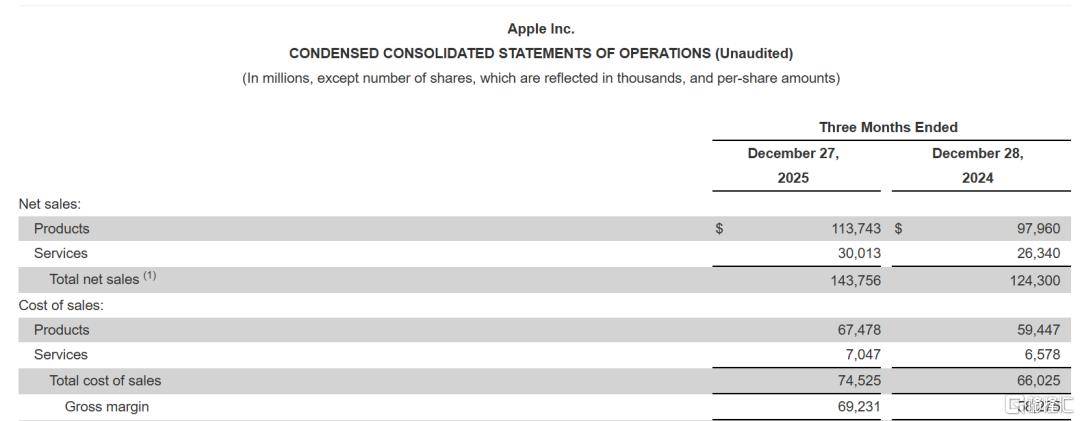
Core Insights - Apple reported record-breaking financial performance for Q1 FY2026, with revenue reaching $143.8 billion, a 16% year-over-year increase, significantly exceeding expectations [1][3] - The iPhone business achieved its best quarterly performance ever, driven by unprecedented market demand, with revenue of $85.3 billion, a substantial 23% increase [7] - CEO Tim Cook indicated that rising memory prices are expected to impact profit margins in Q2 [1][10] Financial Performance - Total revenue for the quarter was $143.8 billion, up 16% from $124.3 billion in the same quarter last year [3][6] - Net profit reached $42.1 billion, a 15.9% increase year-over-year, with diluted earnings per share at $2.84, up 18.3% [3][6] - Gross margin for the quarter was $69.2 billion, reflecting strong sales performance [6] Business Segment Analysis - iPhone revenue accounted for $85.3 billion, representing 59.3% of total revenue, with a year-over-year growth of 23% [7] - iPad revenue was $8.6 billion, a 6.3% increase, while Mac revenue declined by 6.7% to $8.39 billion [7] - Wearables, home, and accessories revenue was $11.49 billion, down 2.2% [7] Regional Performance - Greater China saw a remarkable 38% revenue growth, reaching $25.53 billion, driven by strong sales of the iPhone 17 series [8] - The Americas, Europe, and Japan experienced revenue growth of 11%, 13%, and 5%, respectively, indicating a significant disparity compared to Greater China [9] Supply Chain and Cost Management - Tim Cook noted that the company is facing tight inventory levels due to high demand for the latest iPhone series [10] - Rising prices of memory chips and storage chips are anticipated to have a more significant impact on gross margins in the current quarter [11] - The company is considering various options to mitigate cost pressures, including supply chain optimization and product pricing strategy adjustments [12]

iPhone18又要卖爆了!苹果爆料一哥带来新消息,库克无视内存涨价
Sou Hu Cai Jing· 2026-01-28 03:03
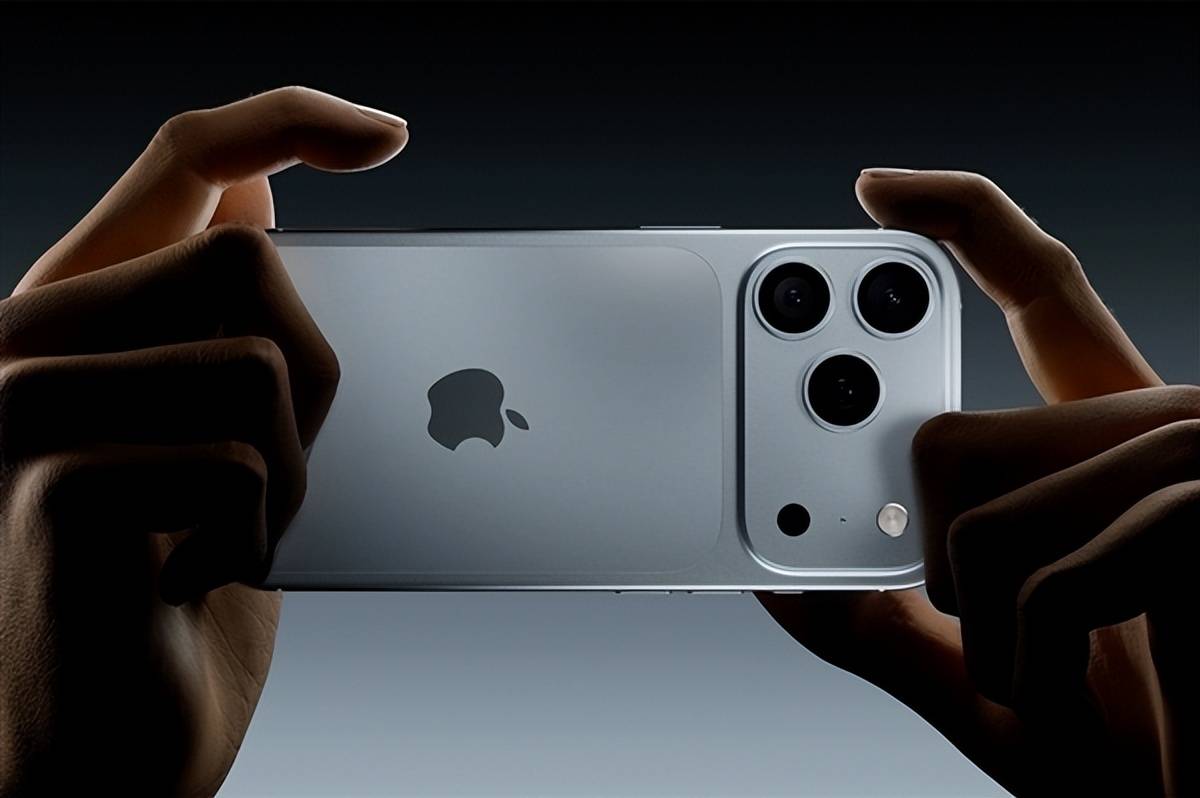
Core Viewpoint - The rising storage prices are becoming an unavoidable challenge for the consumer electronics industry, affecting even major players like Apple, which is facing significant cost increases [1]. Group 1: Memory Price Increases - According to TrendForce's latest report, Samsung plans to raise the price of LPDDR memory used in iPhones by over 80% quarter-on-quarter, while SK Hynix's increase is close to 100%. This price adjustment primarily targets the supply for the first quarter of 2026 [3]. - Industry insiders reveal that Apple, which typically signs long-term supply agreements, has only finalized prices for the first half of this year due to the current tight supply and demand for memory. Prices may rise further with the release of new models in the second half of the year [3]. Group 2: Apple's Procurement Strategy - Despite the price increases, Apple's strong purchasing power keeps its actual procurement prices for LPDDR relatively low. This price adjustment is seen as a significant step in alleviating long-standing pricing conflicts between Apple and memory suppliers [5]. - Analyst Ming-Chi Kuo notes that the increase in memory and flash storage costs directly pressures iPhone profit margins, but Apple has chosen to absorb this cost increase for now, planning to offset hardware profit losses through its services business [7]. Group 3: Pricing Strategy for iPhone 18 Series - Apple aims to maintain the starting price of the iPhone 18 series without increasing it, despite rising costs. The pricing strategy is to keep the entry-level price unchanged while potentially increasing storage options without raising prices [7][10]. - The price gap between high storage and entry-level storage in iPhones has historically been much larger than that of other smartphone manufacturers, allowing Apple to manage pricing effectively [8]. Group 4: Upcoming Product Releases - The release schedule for the iPhone product line is set for significant adjustments, with the iPhone 17e expected in the first half of 2026, followed by the iPhone 18 series and the first foldable iPhone later in the year [12]. - The iPhone 18 Pro series is anticipated to feature significant upgrades, including a variable aperture and enhanced imaging capabilities, with expected prices for the iPhone 18 Pro starting at 8,999 yuan for 256GB [14]. Group 5: Market Impact - The iPhone 18 series is likely to see strong sales due to the strategy of not raising prices despite increased storage costs, which positions Apple favorably in the market [16].
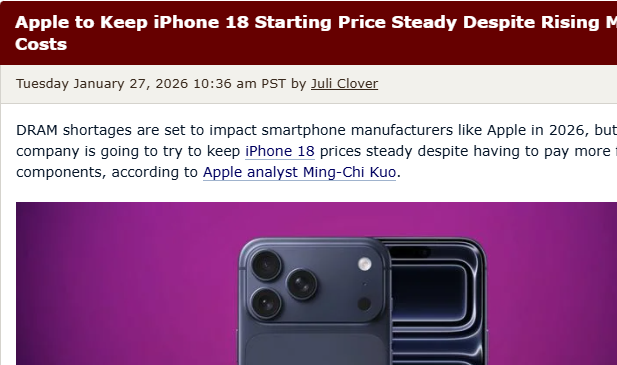
内存成本上涨10%-25%,苹果计划维持iPhone 18起售价
Huan Qiu Wang· 2026-01-28 02:40
Core Viewpoint - The smartphone industry, particularly Apple, is expected to face challenges due to a DRAM memory shortage in 2026, but Apple plans to maintain stable pricing for the iPhone 18 series despite rising component costs [1][4]. Group 1: Memory Pricing and Supply - Apple and memory suppliers are using a quarterly pricing model, with a new round of memory price increases expected in Q2 2026, similar to Q1 [4]. - Current memory prices have risen by 10% to 25% compared to the same period last year, which will directly impact the gross margin of iPhones [4]. - Apple has secured stable supply agreements, allowing it to absorb some of the increased costs due to its industry influence [4]. Group 2: Strategic Positioning - Apple's strategy is to leverage market fluctuations to gain a competitive edge, secure chip supplies, and absorb cost pressures to expand market share [4]. - The company aims to maintain its pricing strategy for the iPhone 18, avoiding price increases despite the memory shortage driven by AI industry demand [4]. - Apple plans to compensate for profit losses through its services business, indicating a clear and defined strategic approach [4].
郭明錤:iPhone内存价格一季度暴涨八成,苹果先保供、再靠服务赚钱
Feng Huang Wang· 2026-01-28 00:10
Core Insights - Apple is facing a significant increase in memory costs for iPhones, with reports indicating that Samsung and SK Hynix may raise LPDDR memory prices by over 80% quarter-on-quarter in Q1 [1][2] - The company is negotiating memory prices on a quarterly basis, which is a shift from the previous semi-annual discussions, suggesting further price increases in Q2 that may be similar to Q1 [2] Group 1 - The rise in memory prices is expected to impact Apple's iPhone gross margins, but the company aims to secure supply and absorb costs to enhance market share during this turbulent period [2] - Apple plans to leverage its service business to recover costs associated with the increased memory prices in the future [2] - The upcoming earnings report will likely focus on the implications of rising memory costs, which may have a more significant impact on stock prices across other industries than on Apple itself [2] Group 2 - For the iPhone 18 set to launch in the second half of the year, Apple intends to maintain its pricing strategy by keeping the starting price unchanged, which could benefit marketing efforts [2] - Apple is aware that other components may also face supply shortages due to the influence of the AI server industry, following the trends seen with memory and T-type glass [2]
卢伟冰:“内存涨价”逼迫各品牌或涨价或降配 动摇终端机“性价比”根基
Feng Huang Wang· 2026-01-26 07:31
Group 1 - The core message of the article highlights the upcoming launch of Xiaomi's new product, Turbo 5 Max, scheduled for January 29 at 19:00 [1] - Xiaomi's President, Lu Weibing, indicates that the K series will be upgraded in 2025, with the Turbo series taking over the 2000-3000 price range [1] - The industry is facing challenges, particularly due to rising memory prices, which may force brands to either increase prices or reduce specifications, threatening the value proposition of mid-range devices [1] Group 2 - Despite industry challenges, the Turbo series aims to maintain a strong presence in the mid-range market, ensuring competitive offerings in the 2.5K price segment [1] - The Turbo 5 Max will feature the Dimensity 9500s processor with a benchmark score of 3.61 million, a 9000mAh battery, and high-end features such as dual speakers and full waterproofing [1]


多品牌集体涨价!“下午刚报价,晚上就调价”,“后面还要涨”,消费者傻眼:预算不够了
Xin Lang Cai Jing· 2026-01-12 03:34
Core Insights - The rapid development of AI has led to significant price increases in memory, hard drives, and graphics cards, impacting hardware prices across various brands [1] - Major PC manufacturers are responding to rising costs by increasing product prices, with some models seeing price hikes of 10%-30% [3] Price Increases in Hardware - Global PC manufacturers are experiencing price adjustments due to rising memory costs, with examples including Lenovo's Y7000 model increasing from 6980 CNY to 7400 CNY within days [2] - The price of a 16GB memory module has surged from around 800-900 CNY to over 2700 CNY on major e-commerce platforms, while solid-state drive prices have nearly doubled [2] Manufacturer Responses - HP, Acer, and Asus have all indicated that they will raise prices due to ongoing memory shortages and cost increases, with Dell raising commercial computer prices by 10%-30% [3] - Lenovo has adjusted prices for several mid-to-high-end models, increasing prices by 500 to 1500 CNY [3] Impact on Consumer Behavior - The price increases have led to a decline in consumer enthusiasm, with market research indicating a downward revision in global laptop and smartphone shipment forecasts for 2026 [4] - Consumers are postponing purchases due to higher prices, with many opting to wait for better deals despite government subsidies [4][5] Market Trends - The memory semiconductor's share of smartphone material costs has risen from 10%-15% to over 20%, becoming a key driver of smartphone price increases [3] - Some consumers are engaging in "downgrade" strategies, selling high-value memory components in the second-hand market and opting for lower-cost alternatives [5]

内存太贵了?国产手机从淘汰8GB到重回8GB
Guan Cha Zhe Wang· 2026-01-10 08:49
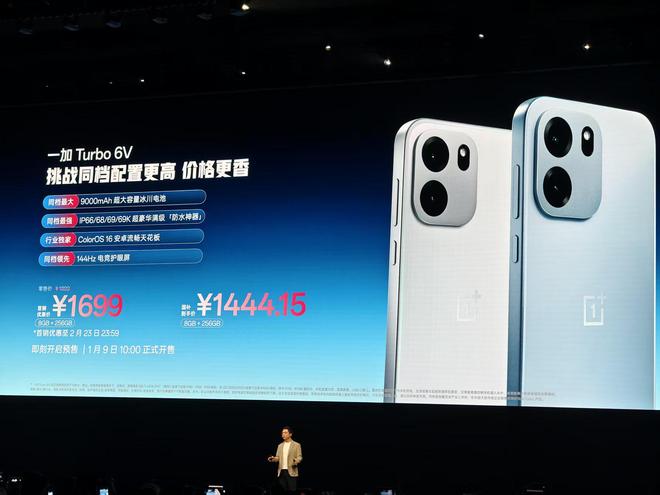
Group 1 - OnePlus has launched the Turbo 6 series smartphones, priced starting at 1699 yuan, marking its entry into the 1000-2000 yuan segment after the digital and Ace series [1] - The Turbo 6 series features notable specifications, including the fourth-generation Snapdragon 8s chip, a 9000mAh battery, and a unique 165Hz gaming experience [1] - The introduction of the 8GB+256GB version of the Turbo 6V highlights the pressure on OnePlus to maintain competitive pricing amid rising memory costs [1][5] Group 2 - The memory price surge is affecting multiple industries, with DRAM prices expected to rise by 55%-60% and NAND flash prices by 33%-38% in Q1 2026 [3] - Major companies like Samsung and SK Hynix are planning significant price increases for server DRAM, which will impact the pricing strategies of PC and smartphone manufacturers [3] - The trend of reducing specifications or delaying upgrades is becoming necessary for balancing costs in the smartphone and laptop markets [4] Group 3 - The merger of realme back into OPPO will impact OnePlus's product strategy, as realme will operate under the same umbrella, potentially leading to resource optimization [8][9] - OnePlus is expected to focus on the domestic and select overseas online markets, while realme and OPPO will handle other international markets [8] - The integration aims to streamline operations and reduce overlap in product lines, which has been a challenge in the competitive smartphone market [9][10]