
再通胀资源品

Search documents
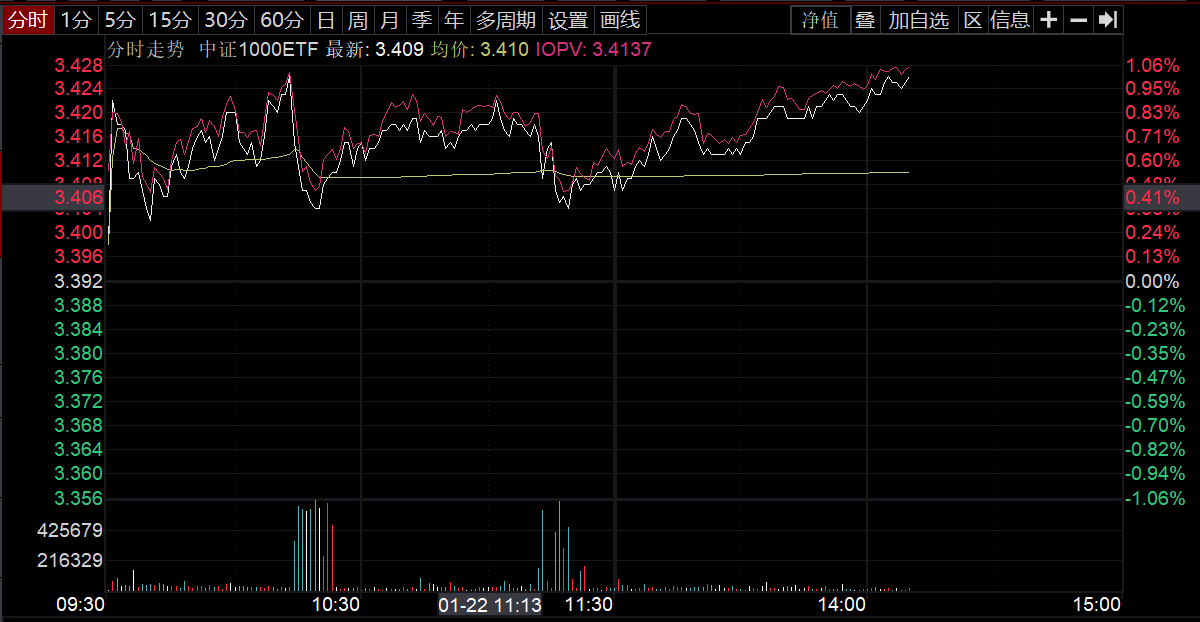
中证1000ETF(159845.SZ)上涨1.09%,盘中成交额达40亿元
Mei Ri Jing Ji Xin Wen· 2026-01-22 06:25
Market Performance - The A-share market saw all three major indices rise, with the Shanghai Composite Index increasing by 0.16% as of 14:10 on January 22 [1] - The CSI 1000 ETF (159845.SZ) rose by 1.09%, while the SSE 50 index fell by 0.35%, the CSI 300 index increased by 0.08%, and the CSI 500 index rose by 0.46% [1] Individual Stock Performance - Among the top 50 weighted stocks in the CSI 1000 ETF, notable gainers included Yuanjie Technology with a rise of 6.98%, Huicheng Environmental with an increase of 4.24%, Jingda Shares up by 2.54%, and Zhongtung High-tech up by 2.52% [3] - Conversely, Xinyuan Micro and Jingfang Technology experienced declines of 3.72% and 3.47%, respectively [3] Sector Performance - In terms of sector performance within the CSI 1000 ETF, the electronics sector rose by 0.06%, while the power equipment sector fell by 0.13%, and the pharmaceutical and biological sector decreased by 0.42% [3] - The computer sector increased by 0.78%, and the machinery equipment sector rose by 0.15% [3] Fund Flow and Liquidity - The CSI 1000 ETF (159845.SZ) experienced a net outflow of 17.167 billion yuan over the last five trading days and a net outflow of 16.891 billion yuan over the last ten trading days, with a current scale of 37.054 billion yuan [3] - The intraday trading volume reached 4 billion yuan, with an average daily trading volume of 5.441 billion yuan over the past week, indicating good liquidity [3] Financial Data Insights - Financial data for December 2025 showed a social financing scale increment of 22.08 billion yuan, which was 64.57 billion yuan less than the previous year [3] - The total social financing scale for the year 2025 reached 35.6 trillion yuan, an increase of 3.34 trillion yuan compared to 32.3 trillion yuan in 2024, supported by proactive fiscal policies and a broad fiscal deficit [3] Market Outlook - Huaxin Securities indicated that the previously mentioned cross-year spring market has already started, with structural overheating in some sectors leading to regulatory pressure that guides a "slow bull" market, maintaining a mid-term upward trend [4] - The spring market is expected to see a second wave from before the festival to the Two Sessions period, with a strategic focus on AI competition and re-inflation resource themes [4]

FOF和配置月报:春季行情初现,坚守主线-20260121
Huaxin Securities· 2026-01-21 15:37
- The report suggests a "barbell combination" of major assets, focusing on dollar depreciation, China-US AI competition, and re-inflation of resource commodities[5] - The A-share market is expected to reach new heights in 2026, driven by macro policies and a shift from valuation-driven to profit-driven growth[5] - The report recommends continuing to allocate to AI competition and re-inflation resource commodities as core strategies[5] - The Hang Seng Index and Hang Seng Technology Index both showed significant recovery, with the Hang Seng Index up 3.64% and the Hang Seng Technology Index up 3.38%[10] - The US stock market saw all three major indices record gains, with the Dow Jones Industrial Average up 2.03%, the S&P 500 up 1.71%, and the Nasdaq up 1.44%[10] - The report highlights the importance of the "spring agitation" phenomenon in the stock market, which typically occurs from January to March, driven by policy expectations, seasonal liquidity changes, and institutional rebalancing[65] - The report's rotation strategy model, which selects effective signals from single-factor tests, achieved an annualized return of +18.04%, with an excess annualized return of +11.86% compared to the performance benchmark[55] - The report suggests a 40:60 allocation between dividends and growth based on the current composite score[55] - The report indicates that small-cap stocks have a higher probability of outperforming in February and March, while large-cap stocks are favored in January and October[58][61] - The report identifies "technology growth" and "non-ferrous cycles" as the main market opportunities, with a focus on AI, energy storage, and industrial metals such as copper, aluminum, tin, rare earths, and lithium[69]
FOF和资产配置月报:风险逐级探明,布局春季行情-20251224
Huaxin Securities· 2025-12-24 08:09
- The report does not contain any specific quantitative models or factors for analysis. It primarily focuses on macroeconomic trends, asset allocation strategies, and market observations[1][2][4]. - The report discusses the performance of various asset classes, including equities, bonds, commodities, and currencies, but does not provide detailed quantitative factor construction or modeling processes[10][11][12]. - It highlights the seasonal effects and market trends, such as the spring rally in Hong Kong and A-shares markets, but does not delve into quantitative factor testing or modeling[38][39][63]. - The report mentions a rotation timing model for high-growth and dividend strategies, which uses indicators like term spreads, social financing growth, CPI, PPI, U.S. bond rates, and fund flows. However, it does not provide detailed formulas or construction processes for these indicators[59]. - The rotation strategy achieved an annualized return of +17.54%, outperforming the benchmark by +11.77%, with a current allocation recommendation of 60% dividend and 40% growth[59]. - Seasonal effects are noted, such as small-cap stocks outperforming in February and March, while large-cap stocks dominate in April and December[63]. - The report provides market sentiment analysis, including institutional buying intentions and external capital flows, but does not include quantitative factor testing or modeling[51][54]. - Industry performance is discussed, with a focus on sectors like TMT, AI, and industrial metals, but no quantitative models or factors are detailed[64][67]. - The report includes valuation metrics for indices like the S&P 500, Nasdaq, and Shanghai Composite, but does not provide quantitative factor construction or testing[26][47][48]. - The report does not contain specific quantitative models or factors for analysis, nor does it provide formulas or detailed construction processes for any mentioned strategies or observations[1][2][4].