美元贬值交易

Search documents
老溉邓白银,史诗级暴跌!黄金,40年最大跌幅!-美股-特朗普-美元指数-沃什-收盘_新闻
Sou Hu Cai Jing· 2026-02-05 09:41
Group 1 - The core point of the news is the significant drop in precious metal prices, with gold experiencing its largest single-day decline in 40 years and silver hitting a historic intraday drop of 36% [1][2][4] - On January 31, spot gold prices fell over 12%, reaching a low of $4682 per ounce, while closing down 9.25% at $4880 per ounce [2][4] - Spot silver prices dropped to a low of $74.28 per ounce, closing down 26.42% at $85.259 per ounce [4][8] Group 2 - The sell-off in precious metals was triggered by the strengthening of the US dollar, following the announcement of Kevin Walsh as the new Federal Reserve Chairman, which raised concerns about the Fed's independence [4][6][7] - The dollar index saw a significant increase, marking its largest single-day rise since July of the previous year, which negatively impacted investor confidence in gold and silver [4][5] - The market was already experiencing a demand for a correction, and the combination of factors, including the Fed chair nomination and broader capital flow dynamics, acted as a catalyst for profit-taking [4][6] Group 3 - The broader US stock market also faced declines, with major indices closing lower due to uncertainties surrounding Federal Reserve policies, inflation pressures, and geopolitical risks [5] - The gold sector saw substantial losses, with major companies like Barrick Gold and AngloGold experiencing declines of over 10% [5] - The sell-off in precious metals was characterized by panic selling and profit-taking, particularly among leveraged positions, which exacerbated market volatility [8][12]


沃什终结“美元贬值交易”?币圈周末继续重挫,比特币跌破8万美元大关
Hua Er Jie Jian Wen· 2026-02-01 01:52
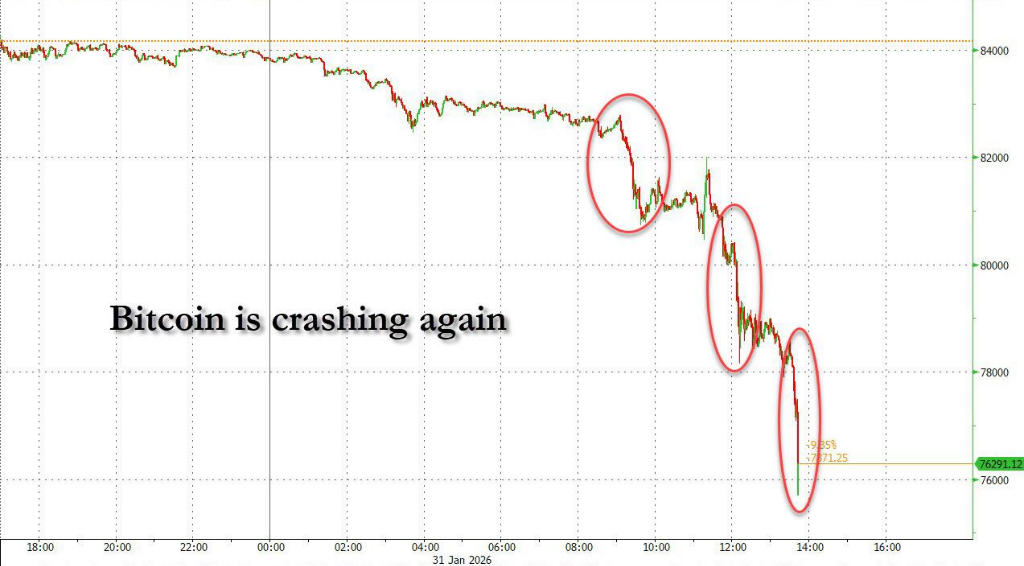
Core Viewpoint - The cryptocurrency market experienced a significant sell-off over the weekend, with Bitcoin dropping below $80,000 to its lowest level since April of the previous year, continuing a month-long downward trend. This sell-off was triggered by the nomination of Waller as the next Federal Reserve Chairman, negatively impacting both cryptocurrencies and precious metals like gold and silver, as market bets on dollar depreciation began to unravel [1][9]. Group 1: Market Performance - Bitcoin's price fell sharply, reaching a low of $75,709.88, with a one-day drop of 10% [1]. - Ethereum and Solana saw even steeper declines, with drops of 17% and over 17%, respectively [1]. - The total market capitalization of cryptocurrencies decreased by approximately $111 billion within 24 hours [1]. Group 2: Market Dynamics - The sell-off occurred in a context of thin liquidity and limited buying interest, leading to a total decline of over 30% for Bitcoin [3]. - Approximately $1.6 billion in long and short positions were liquidated, primarily in Bitcoin and Ethereum, with most liquidations happening in the last four hours [4][3]. - Retail investor interest is reported to be extremely low, with trading volumes expected to remain subdued for the next one to two quarters [6]. Group 3: Regulatory and Geopolitical Factors - The geopolitical tensions between Israel and Iran may also influence Bitcoin prices, as recent events have raised concerns in the market [9]. - Delays in new regulatory frameworks for the cryptocurrency industry have further weakened interest in digital assets, as the Senate committee shifted focus away from cryptocurrency legislation [9]. - Despite Waller's previous positive remarks about Bitcoin, his nomination appears to have reversed the upward momentum in both precious metals and cryptocurrencies [9]. Group 4: Investment Sentiment - Traditional safe-haven assets like gold and silver have regained favor among investors concerned about fiat currency, while Bitcoin has failed to attract significant inflows despite the recent surge in gold prices [7]. - The lack of buying interest highlights the challenges Bitcoin faces in its role within broader investment portfolios, as it struggles to serve as both a momentum trade and a hedge against currency depreciation [8].
白银一度重挫35%,贵金属狂潮是否已经见顶
Xin Lang Cai Jing· 2026-01-31 05:00
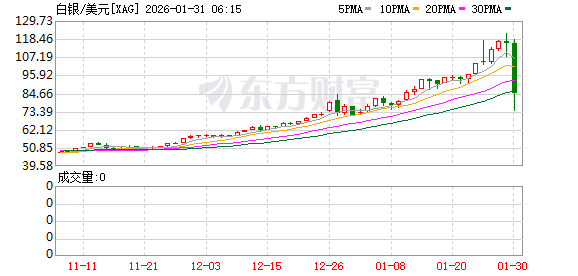
Group 1 - The market's concerns about the independence of the Federal Reserve have eased following President Trump's nomination of Kevin Warsh as the next Fed Chair, leading to a rise in the dollar and a significant drop in precious metals prices [1] - COMEX silver prices fell over 35%, reaching a low of $74 per ounce, while COMEX gold prices dropped more than 10%, nearing $4700 [1] - The sell-off extended to the entire precious metals market, with LME platinum and palladium futures both declining over 15%, entering a technical bear market alongside silver [1] Group 2 - The market is trading on the expectation of a "hawkish" stance from Warsh, which has contributed to a stabilization of the dollar and a reduction in the asymmetric risk of a continued significant dollar depreciation, causing the sharp declines in gold and silver prices [2] - The recent market movements are characterized by forced selling, as precious metals had become popular among day traders, leading to a buildup of leveraged positions that were liquidated during the price drop [2][3] - The World Gold Council reported that global gold demand reached a record high, with total demand projected to exceed 5000 tons by Q4 2025, valued at $555 billion, marking a 45% year-over-year increase [4] Group 3 - Analysts suggest that the recent price drop in precious metals may be a reassessment of concentrated holding risks, similar to the situation in tech stocks, where a high concentration of positions can lead to significant sell-offs [3] - The demand for gold has shifted from central banks to various investors, with a notable increase in ETF holdings, indicating a strong investment interest despite a slowdown in central bank purchases [4][5] - A hypothesis from JPMorgan suggests that if private investors increase their gold allocation from 3% to 4.6%, gold prices could theoretically rise to between $8000 and $8500 per ounce, although short-term risks of profit-taking exist [6]

惊魂跳水!白银一度重挫35% 贵金属狂潮已见顶?
Di Yi Cai Jing· 2026-01-31 01:18
Core Viewpoint - The nomination of Kevin Warsh as the next Federal Reserve Chairman by President Trump has alleviated market concerns regarding the independence of the Federal Reserve, leading to a rise in the dollar and a significant drop in precious metals prices [2][4]. Market Reaction - The COMEX silver price for February delivery plummeted over 35%, reaching a low of $74 per ounce, while COMEX gold for February fell more than 10%, nearing $4,700 [2]. - The sell-off extended to the entire precious metals market, with LME platinum and palladium futures both declining over 15%, entering a technical bear market alongside silver [2]. Analysis of the Sell-off - Analysts attribute the panic selling to profit-taking and overcrowded trading positions, with leveraged positions exacerbating market volatility [2][4]. - Krishna Guha from Evercore ISI noted that the market is trading on "Warsh's hawkish expectations," which has contributed to the stabilization of the dollar and the subsequent decline in gold and silver prices [4]. - Matt Maley from Miller Tabak indicated that the current market behavior has lost rationality, suggesting that the recent drop is likely due to "forced selling" as silver has been a popular asset among day traders [4]. Investor Sentiment and Positioning - Richard Hunter from Interactive Brokers highlighted that the previous bets on dollar depreciation have shown signs of solidification, catching investors seeking safe-haven assets off guard [4]. - Federico Manicardi from JPMorgan pointed out that precious metals had previously risen in tandem with global economic recovery expectations and benefited from a reallocation of funds towards major U.S. tech stocks [4]. Market Dynamics - The World Gold Council reported that global gold demand reached a record high last year, with a shift in buying power from central banks to various investors, contributing to the historic price surge [8]. - The report projected that global gold demand would exceed 5,000 tons by Q4 2025, valued at $555 billion, marking a 45% year-on-year increase [8]. - Despite a slowdown in central bank purchases, the need for diversification in foreign exchange reserves remains, driven by concerns over U.S. trade policies [8]. Future Projections - JPMorgan's quantitative analyst proposed that if private investors increase their gold allocation from 3% to 4.6%, gold prices could theoretically rise to between $8,000 and $8,500 per ounce [9]. - However, the analyst cautioned that the current overbought status of gold and silver suggests a risk of profit-taking and price reversion in the short term [9]. - Long-term bullish logic for gold remains intact, with $5,000 per ounce seen as a reasonable support level for adjustments [9].
惊魂跳水!白银一度重挫35%,贵金属狂潮已见顶?
第一财经· 2026-01-31 01:13
Core Viewpoint - The market's concerns regarding the independence of the Federal Reserve have eased following President Trump's nomination of Kevin Warsh as the next Fed Chair, leading to a significant rise in the dollar and a sharp decline in precious metals prices [3][4]. Market Reaction - The COMEX silver price plummeted over 35%, reaching a low of $74 per ounce, while COMEX gold fell more than 10%, nearing $4,700. This sell-off extended to the entire precious metals market, with LME platinum and palladium futures dropping over 15%, entering a technical bear market [3][4]. - Analysts attribute the panic selling to profit-taking and crowded trading positions, exacerbated by leveraged positions being liquidated, which amplified market volatility [3][5]. Investor Sentiment - The market is currently trading on "Warsh's hawkish bias" expectations, which has contributed to a stabilization of the dollar and a reduction in the asymmetric risks of a prolonged dollar depreciation, thus causing the significant drop in gold and silver prices [4][5]. - The recent market behavior is characterized as irrational, with the precious metals market being a popular asset for day traders and short-term investors, leading to a buildup of leveraged positions that were vulnerable to price drops [5][6]. Precious Metals Demand - Over the past 12 months, various factors such as market volatility, dollar depreciation, geopolitical tensions, and concerns over the Fed's independence have driven precious metal prices upward. However, the recent decline may reflect a reassessment of concentrated holding risks in the market [6][9]. - The World Gold Council reported that global gold demand reached a record high, with total demand surpassing 5,000 tons in 2025, valued at $555 billion, marking a 45% year-on-year increase. However, central bank purchases have decreased, indicating a shift in the primary drivers of gold demand from central banks to various investors [8][9]. Future Projections - Analysts suggest that if private investors increase their gold allocation from 3% to 4.6% by reducing long-term bond holdings, gold prices could theoretically rise to between $8,000 and $8,500 per ounce. However, the current overbought status of gold and silver suggests a risk of profit-taking and price corrections in the short term [10]. - The long-term bullish outlook for gold remains intact, with $5,000 per ounce seen as a reasonable support level for adjustments [10].

惊魂跳水,白银一度重挫35%,贵金属狂潮是否已经见顶
Di Yi Cai Jing· 2026-01-31 00:11
Core Viewpoint - The nomination of Kevin Warsh as the next Federal Reserve Chairman has alleviated market concerns regarding the independence of the Fed, leading to a rise in the dollar and a significant drop in precious metal prices [1][3]. Group 1: Market Reactions - The COMEX silver price for February delivery plummeted over 35%, reaching a low of $74 per ounce, while COMEX gold fell more than 10%, nearing $4,700 [1]. - The sell-off extended to the entire precious metals market, with LME platinum and palladium futures both declining over 15%, entering a technical bear market alongside silver [1]. - Analysts attribute the panic selling to profit-taking and crowded trading positions, with leveraged positions exacerbating market volatility [1][3]. Group 2: Investor Sentiment - The market is trading on expectations of a "hawkish" Warsh, which has contributed to a stabilization of the dollar and a reduction in the asymmetric risks of continued dollar depreciation, leading to the sharp declines in gold and silver prices [3]. - The current market trend is described as irrational, with forced selling likely due to the high levels of leverage in the silver market, prompting margin calls [3][4]. - The sentiment among retail investors has been a significant driver of recent silver price volatility, indicating a crowded trade in precious metals [4]. Group 3: Demand and Supply Dynamics - The World Gold Council reported that global gold demand reached a record high, with total demand projected to exceed 5,000 tons by Q4 2025, valued at $555 billion, marking a 45% year-over-year increase [6]. - The increase in gold ETF holdings by 801 tons represents the second-highest annual growth, while central bank purchases have decreased, with a total of 863.3 tons bought in the year [6]. - The demand for gold is driven by a mix of risk aversion and asset diversification, with price movements also influencing investment demand [6]. Group 4: Future Projections - Analysts suggest that if private investors increase their gold allocation from 3% to 4.6%, gold prices could theoretically rise to between $8,000 and $8,500 per ounce, although this path may be fraught with volatility [8]. - The current overbought conditions in gold and silver markets indicate potential risks of profit-taking and price corrections in the short term [8]. - Long-term bullish logic for gold remains intact, with $5,000 per ounce seen as a reasonable support level for adjustments [8].
惊魂跳水!白银一度重挫35%,贵金属狂潮是否已经见顶
Di Yi Cai Jing· 2026-01-30 23:44
Core Viewpoint - The recent significant drop in precious metals prices, including gold and silver, is attributed to market reactions to Kevin Warsh's nomination as the next Federal Reserve Chairman, which has alleviated concerns about the Fed's independence and strengthened the dollar [1][2]. Group 1: Market Reactions - The COMEX silver price plummeted over 35%, reaching a low of $74 per ounce, while COMEX gold fell more than 10%, nearing $4700 [1]. - Platinum and palladium futures on the London Metal Exchange (LME) also saw declines exceeding 15%, entering a technical bear market alongside silver [1]. - Analysts suggest that the panic selling was driven by profit-taking and crowded trading positions, with leveraged positions exacerbating market volatility [1][2]. Group 2: Investor Sentiment - The market is currently trading on "hawkish" expectations regarding Warsh's nomination, which is stabilizing the dollar and reducing the asymmetric risks of a significant dollar depreciation, leading to the sharp declines in gold and silver prices [2]. - The recent market behavior is characterized as irrational, with the drop likely resulting from "forced selling" due to the accumulation of leveraged positions in precious metals [2][3]. - Retail investor sentiment has been identified as a significant driver of recent silver price fluctuations, indicating a potential for profit-taking [3]. Group 3: Demand and Supply Dynamics - The World Gold Council reported that global gold demand reached a record high last year, with total demand projected to exceed 5000 tons by Q4 2025, valued at $555 billion, marking a 45% year-on-year increase [4][5]. - The increase in gold ETF holdings by 801 tons represents the second-highest annual growth, with a notable surge in Q4 [4]. - Despite a slowdown in central bank gold purchases, the demand for gold as a hedge and for portfolio diversification remains strong, influenced by geopolitical tensions and economic policies [5][6]. Group 4: Future Projections - A hypothesis suggests that if private investors increase their gold allocation from 3% to 4.6%, gold prices could theoretically rise to between $8000 and $8500 per ounce, although this path may be fraught with challenges [6]. - The current overbought status of gold and silver indicates a risk of profit-taking and price corrections in the short term, but the long-term bullish outlook for gold remains intact [6].
贵金属暴跌推动美元录得5月以来最大涨幅 贬值交易前景不明
Xin Lang Cai Jing· 2026-01-30 22:35
Core Viewpoint - The significant drop in gold and silver prices has negatively impacted currencies from Australia to Sweden, leading to the largest increase in the US dollar since May of the previous year, marking a turbulent start to the year [1][2]. Group 1: Currency Impact - The Bloomberg Dollar Spot Index rose by 0.9% on Friday, strengthening against all major currencies [3]. - The decline in precious metal prices, along with President Donald Trump's decision to appoint Kevin Warsh as the head of the Federal Reserve, has driven this market movement [3]. - Despite the dollar's recent strength, the index lost approximately 1.3% in January, marking its largest decline since August of the previous year [3]. Group 2: Market Sentiment - Market sentiment remains tense, with XTB research director Kathleen Brooks noting that while dollar depreciation trades have been temporarily shelved, it does not indicate an end to such trends [3]. - Following Trump's announcement of Warsh's nomination to replace Jerome Powell as Fed Chair, the dollar surged, as traders believe Warsh is more inclined to guard against inflationary pressures, potentially supporting a stronger dollar policy [3]. Group 3: Precious Metals and Speculation - Currencies heavily influenced by precious metal prices, such as the Australian dollar, Swiss franc, and Swedish krona, have led the decline among G10 currencies [3]. - Silver prices experienced the largest single-day drop in history, while gold's upward momentum halted, with its retracement being the largest since the early 1980s [3]. - There are indications that traders remain bearish on the dollar's outlook, with the Commodity Futures Trading Commission reporting that speculators increased their dollar short positions by nearly $7.8 billion, the highest since August 2024 [3].
美元创7月来最大单日涨幅 金银暴跌拖累大宗商品货币
Xin Lang Cai Jing· 2026-01-30 20:06
Core Viewpoint - The US dollar experienced a significant increase, marking its largest single-day gain since July, while precious metals like gold and silver plummeted, affecting the exchange rates of currencies from the Australian dollar to the Swiss franc [1][2]. Group 1: Market Performance - The US Dollar Index (DXY) ended the month with an approximate 0.9% increase, despite a decline of about 1.4% in January, which was the worst performance since August [1][2]. - The rebound of the dollar was attributed to the drop in precious metal prices and the appointment of Jerome Powell as the Federal Reserve Chairman [1][2]. Group 2: Currency Impact - The decline in precious metals has led to significant depreciation in currencies such as the Australian dollar, Swiss franc, and Swedish krona, which are heavily influenced by precious metal prices [1][2]. - Silver prices recorded the largest single-day drop in history, while gold prices experienced their largest decline since the early 1980s, ending a previous upward trend [1][2].
Gold, Silver Continue Wild Swings
Youtube· 2026-01-30 16:25
Market Overview - Recent volatility in gold prices saw a spike above 5500 before dropping below 5000, driven by speculative trading and external factors such as Fed nominations and a rallying dollar [1][2] - The current sell-off is viewed as a healthy correction within a long-term bull market for precious metals and commodities, indicating a potential commodity supercycle in the coming years [3] ETF Performance - The ETF celebrating its one-year anniversary reported a 100% return, reflecting successful positioning in gold, silver, and mining stocks [4] - The portfolio is actively managed, with significant themes including geopolitical and fiscal risks, energy, and various mining sectors [5][6] Investment Strategy - The company has shifted its focus from being overweight in energy to reallocating towards gold and silver, while still maintaining a significant portion of the portfolio in these assets due to ongoing geopolitical and fiscal risks [7] - The strategy remains flexible, allowing for potential shifts to other assets as market conditions evolve [8] Dollar Dynamics - The dollar is experiencing a rebound, but the long-term outlook suggests a continued bear market for the dollar, which may take years to fully materialize [9][11] - Historical analysis indicates that the current dollar bear market aligns with past trends, suggesting that short-term fluctuations may occur within a broader bearish context [10]