
利率双向波动

Search documents
保险业资产负债管理需提升
Jing Ji Ri Bao· 2025-12-23 22:58
Core Viewpoint - The National Financial Supervision Administration has released a draft for public consultation on the "Asset-Liability Management Measures for Insurance Companies," emphasizing the importance of effective asset-liability management for sustainable operations in the insurance industry [1] Group 1: Regulatory Framework - Since 2018, multiple regulatory rules have been established to create a framework for asset-liability management and supervision tailored to the characteristics of the domestic insurance industry [1] - Insurance companies are required to take primary responsibility for asset-liability management, adhering to principles of comprehensive coverage, reasonable matching, prudent management, and coordinated planning to mitigate asset-liability mismatch risks [1] Group 2: Management Practices - Insurance companies must define their asset-liability management policies and procedures, develop management plans, and enhance asset-liability linkage in business planning, product development, and major investments [1] - Regular stress testing and back-testing should be conducted, with timely adjustments made to asset-liability management strategies based on periodic reports [1] Group 3: Market Conditions - The dual fluctuations in interest rates are crucial for effective asset-liability management, as these fluctuations significantly impact both the asset and liability sides of insurance companies [2] - The past decade has seen increased frequency and magnitude of interest rate fluctuations globally, necessitating dynamic adjustments in asset-liability structures to lower costs and enhance returns [2] Group 4: Risk Management - As the asset scale of the insurance industry continues to rise, the correlation between insurance assets and those of banks and non-bank financial institutions is increasing, leading to higher credit risks due to lower transparency and greater volatility in underlying asset quality [2] - Regulatory measures are needed to strengthen capital requirements for solvency and leverage constraints on large risk exposures to prevent insurance companies from blindly increasing risk appetite for short-term gains [2] Group 5: Industry Collaboration - Effective asset-liability management requires dedication and expertise from management, as well as wisdom and responsibility from industry regulators [3] - In light of external environmental changes and the internal demands for high-quality development, a collaborative approach is necessary to innovate theories, improve systems, and clarify regulations [3]
肖远企提示利率双向波动 险企如何应对更大挑战
Bei Jing Shang Bao· 2025-12-10 02:05
Core Viewpoint - The insurance industry is facing complex challenges due to the transition from a long-term low-interest environment to one characterized by high-frequency and significant interest rate fluctuations, necessitating a dynamic balance between assets and liabilities [1][2][3] Group 1: Current Interest Rate Environment - Recent trends show a rebound in interest rates in several countries, prompting heightened attention from industry professionals [2] - The Federal Reserve has raised the federal funds rate from 0%-0.25% to a range of 5.25%-5.5% over 11 increases since 2022 to combat rising inflation [2] - Japan's new 10-year government bond yield has risen to 1.970%, the highest level in approximately 18.5 years, indicating a significant shift in the interest rate landscape [2] Group 2: Challenges for the Insurance Industry - The dual fluctuations in interest rates present a greater challenge than the previously experienced low-rate environment, as companies must adapt to potential short-term shifts in rates [3] - High interest rates may lead consumers to prefer more flexible investment options, such as bank deposits and government bonds, which could pressure the sales of long-term insurance products with lower guaranteed rates [3] - Increased interest rates could also heighten the risk of policy surrenders, as consumers may opt to withdraw from policies in favor of higher-yielding opportunities [3] Group 3: Strategic Adjustments Required - The insurance industry must strategically adjust its operational logic to align with the new normal of interest rate fluctuations, focusing on dynamic asset-liability management [4] - Companies are encouraged to promote participating insurance products, which allow for flexible dividend distribution based on investment performance, thus sharing investment risks with clients [4] - The sale of flexible yield products, such as universal life and investment-linked insurance, should be increased to better manage interest rate risks [4] Group 4: Product Development and Customer Engagement - The industry should develop more products that are less sensitive to interest rate fluctuations, such as health and accident insurance, to stabilize liabilities [5] - Introducing products with flexible yield adjustment mechanisms, like variable annuities, can enhance attractiveness and meet consumer needs [5] - Improving customer service and communication is essential for building trust and reducing surrender risks associated with interest rate volatility [5] Group 5: Investment Strategy Adaptation - Insurance companies need to reduce reliance on long-term fixed-income assets and explore alternative investments, such as infrastructure and private equity, which are less correlated with interest rates [6] - Focusing on high-dividend blue-chip stocks can provide stable returns and consistent dividend income in a fluctuating interest rate environment [6]


肖远企提示利率双向波动 险企如何应对更大挑战
Bei Jing Shang Bao· 2025-12-10 02:04
Core Viewpoint - The insurance industry is facing complex challenges due to the transition from a long-term low-interest environment to one characterized by high-frequency and significant interest rate fluctuations, necessitating a dynamic balance between assets and liabilities [1][2][3] Group 1: Challenges Faced by the Insurance Industry - The recent rebound in interest rates in various countries has heightened concerns among professionals regarding the management of interest rate fluctuations [2] - Historically, many regions experienced a prolonged low-interest environment, leading insurance companies to adopt risk management strategies based on a single-directional interest rate trend [2][3] - Since 2022, the Federal Reserve has significantly raised the federal funds rate from 0%-0.25% to a range of 5.25%-5.5% over 11 increases, with other major economies also maintaining higher interest rates [2][3] Group 2: Impact of Interest Rate Fluctuations - The dual-directional interest rate fluctuations present a greater challenge than the previously low-interest environment, as companies must adapt to potential short-term shifts in interest rates [3] - Higher interest rates may lead consumers to prefer more flexible investment tools, such as bank deposits and government bonds, which could pressure the sales of long-term insurance products with lower preset rates [3] - Rising interest rates could also increase the risk of policy surrenders, as consumers may opt to withdraw from insurance products in favor of higher-yielding opportunities [3] Group 3: Strategic Adjustments Required - The insurance industry must strategically adjust its operational logic to align with the new normal of interest rate fluctuations, focusing on dynamic asset-liability management [4] - The promotion of participating insurance products is a response to these fluctuations, as they allow for flexible dividend distribution based on investment performance [4] - Companies are encouraged to enhance the sales of flexible products like universal life insurance and investment-linked insurance, which can adjust returns based on market conditions, thereby transferring some interest rate risk to customers [4][5] Group 4: Product Development and Customer Engagement - The insurance sector should develop more products that are less sensitive to interest rate changes, such as health and accident insurance, to stabilize liabilities [5] - Introducing products with flexible yield adjustment mechanisms, like variable annuities, can enhance attractiveness and meet consumer needs [5] - Improving customer service and communication is essential for increasing customer loyalty and reducing surrender risks associated with interest rate volatility [5][6] Group 5: Asset Management Strategies - Insurance companies need to reduce reliance on long-term fixed-income assets and explore alternative investments, such as infrastructure and private equity, which are less correlated with interest rates [6] - Focusing on high-dividend blue-chip stocks can provide stable returns and dividends in a fluctuating interest rate environment [6]
利率双向波动 险企需平衡资债两端
Bei Jing Shang Bao· 2025-12-09 15:44
Core Viewpoint - The insurance industry is facing complex challenges due to the transition from a long-term low-interest environment to one characterized by high-frequency and significant interest rate fluctuations, necessitating a dynamic balance between assets and liabilities [1][3][4] Group 1: Interest Rate Environment - The recent trend shows a rebound in interest rates after a prolonged period of low rates, with the U.S. Federal Reserve raising the federal funds rate from 0-0.25% to a range of 5.25%-5.5% over 11 increases since 2022 [3][4] - Japan's 10-year government bond yield recently reached 1.97%, the highest level in approximately 18.5 years, indicating a significant shift in the global interest rate landscape [3][4] Group 2: Challenges for Insurance Companies - The dual fluctuations in interest rates present a greater challenge than the previous low-rate environment, as companies must adapt to potential short-term shifts in interest trends [4][5] - High interest rates may lead consumers to prefer more flexible investment options, such as bank deposits and government bonds, which could pressure the sales of long-term insurance products with lower guaranteed rates [4][5] Group 3: Strategic Adjustments - Insurance companies need to adjust their operational logic strategically to align with the new interest rate dynamics, focusing on dynamic asset-liability management to reduce costs and enhance returns [5][6] - The promotion of participating insurance products is a response to the need for flexibility in managing interest rate risks, allowing for adjustments in dividend payouts based on investment performance [5][6] Group 4: Product Development and Customer Engagement - Companies are encouraged to diversify their product offerings to include more flexible products like universal life insurance and investment-linked insurance, which can adjust returns based on market conditions [6][7] - There is a call for insurance products to return to their core functions of compensation and protection, with an emphasis on developing products that are less sensitive to interest rate fluctuations, such as health and accident insurance [6][7] Group 5: Investment Strategy - Insurers should reduce reliance on long-term fixed-income assets and explore alternative investments, such as infrastructure and private equity, which are less correlated with interest rates and can provide stable cash flows [7] - Focusing on high-dividend blue-chip stocks is recommended as they tend to perform more steadily in fluctuating interest rate environments, providing consistent dividend income [7]

肖远企提示利率双向波动,险企如何应对比低利率更大的挑战
Bei Jing Shang Bao· 2025-12-09 13:25
Core Viewpoint - The insurance industry is facing complex challenges due to the transition from a long-term low-interest environment to one characterized by high-frequency and significant interest rate fluctuations, necessitating a dynamic balance between assets and liabilities [1][4]. Group 1: Challenges Faced by the Insurance Industry - The recent rebound in interest rates in various countries has heightened concerns among professionals regarding the management of interest rate fluctuations [3]. - Historically, many economies experienced a prolonged low-interest environment, leading insurance companies to adopt risk management strategies based on a unidirectional interest rate trend [3][4]. - Since 2022, the Federal Reserve has significantly raised the federal funds rate from 0%-0.25% to a range of 5.25%-5.5% in response to rising inflation, with other major economies also maintaining higher interest rates [3][4]. Group 2: Strategic Adjustments Required - The insurance industry must adjust its operational logic to accommodate the dual fluctuations in interest rates, which significantly impact both the asset and liability sides of insurance companies [5]. - The promotion of participating insurance products is a strategic response to manage interest rate fluctuations, as these products allow for flexible dividend distribution based on investment performance [5][6]. - Insurers are encouraged to enhance the sales of flexible products such as universal life insurance and investment-linked insurance, which can dynamically adjust returns based on market conditions [6]. Group 3: Product Development and Customer Engagement - The insurance sector should focus on developing more protection-oriented products, such as health and accident insurance, which are less affected by interest rate changes and can meet basic consumer needs [7]. - Implementing products with flexible yield adjustment mechanisms, like variable annuities, can enhance product attractiveness and customer retention [7]. - Improving customer service and communication is essential for building trust and reducing the risk of policy lapses due to interest rate volatility [7]. Group 4: Investment Strategy Adaptation - Insurance companies need to reduce reliance on long-term fixed-income assets and explore alternative investments, such as infrastructure, real estate, and private equity, which are less correlated with interest rates [8]. - Focusing on high-dividend blue-chip stocks can provide stable returns and consistent dividend income in a fluctuating interest rate environment [8].

事关保险业多项挑战,肖远企最新发声
Guo Ji Jin Rong Bao· 2025-12-09 12:42
Core Viewpoint - The insurance industry is facing multiple challenges, including interest rate fluctuations, climate change, and the sustainability of business models, which require strategic adjustments and regulatory focus [1][4]. Group 1: Interest Rate Management - Insurance companies must manage interest rate fluctuations as a fundamental operational logic, especially given the recent significant increases in rates by central banks to combat inflation [1][2]. - Historically, interest rates have been subject to continuous adjustments influenced by economic growth and inflation, indicating that a long-term unidirectional interest rate trend is unrealistic [2]. Group 2: Climate Change Impact - Climate change presents dual challenges for the insurance industry, necessitating recalibration of actuarial assumptions and pricing of coverage and investment assets, which requires extensive data and model improvements [2]. - The industry may face supply-demand imbalances due to reduced supply, leading to coverage gaps, while reliance on reinsurance markets may increase as a risk diversification strategy [2][3]. Group 3: Business Opportunities from Climate Change - If the insurance sector can effectively manage the risks associated with climate change, it may also uncover new business opportunities and growth points, particularly in health management within life insurance [3]. - Government investments in climate change mitigation can further support the growth of the insurance industry by reducing losses and stabilizing growth [3]. Group 4: Non-Bank Financial Asset Investment - The correlation between insurance investments and non-bank financial assets has increased, with the global private credit market exceeding $2 trillion, presenting both opportunities and heightened credit risks for insurance companies [3]. - Insurance companies, as significant capital providers, can enhance their asset-liability structures and yield, but they also face challenges due to the complexity and opacity of these asset classes [3]. Group 5: Regulatory Considerations - Stricter regulatory frameworks for banking and insurance institutions necessitate higher standards for customer and investment asset ratings, which can lead to intertwined risks that are harder to manage [4]. - Regulatory focus on capital requirements and risk exposure limits is crucial to prevent insurance companies from pursuing short-term high returns at the expense of asset stability [4]. Group 6: Sustainable Business Model Assessment - The sustainability of insurance companies' business models should be a regulatory priority, emphasizing the need for long-term strategic alignment and adaptability to external variables [4][5]. - Key areas for evaluation include the alignment of company strategy, asset-liability matching, and the support of internal and external resources to ensure a robust business model [5][6]. - Companies must maintain operational flexibility to adapt to changing environments while ensuring their business models remain stable and resilient [6].
货币市场日报:12月8日
Xin Hua Cai Jing· 2025-12-08 13:44
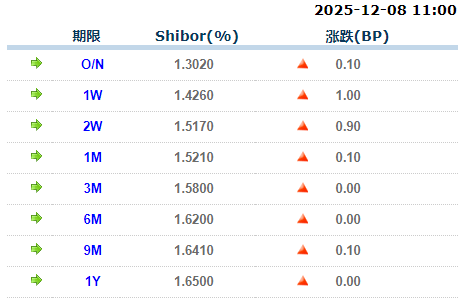
Group 1 - The People's Bank of China conducted a 122.3 billion yuan 7-day reverse repurchase operation on December 8, maintaining the operation rate at 1.40%, resulting in a net injection of 14.7 billion yuan after 107.6 billion yuan of reverse repos matured on the same day [1] - The Shanghai Interbank Offered Rate (Shibor) for short-term maturities saw a slight increase, with overnight Shibor rising by 0.10 basis points to 1.3020%, 7-day Shibor increasing by 1.00 basis points to 1.4260%, and 14-day Shibor up by 0.90 basis points to 1.5170% [1][2] Group 2 - In the interbank pledged repo market, most rates experienced slight increases, with DR001 and R001 weighted average rates rising by 0.2 basis points and remaining stable at 1.3022% and 1.3718%, respectively. Transaction volumes decreased by 149.6 billion yuan and 47.7 billion yuan [4] - The weighted average rates for DR007 and R007 increased by 0.8 basis points and decreased by 0.2 basis points, settling at 1.4459% and 1.494%, with transaction volumes increasing by 10.2 billion yuan and 39.2 billion yuan [4] Group 3 - The funding environment on December 8 was balanced, with overnight transactions around 1.48% and 7-day transactions in the range of 1.49%-1.50%. Cross-year funding transactions were noted at around 1.62% for pledged rates and 1.67%-1.68% for credit transactions [6] - By the end of the day, the overnight funding transaction rates had slightly decreased to around 1.40% [6]
肖远企:管理利率双向波动是保险公司应遵循的基本经营逻辑
Bei Jing Shang Bao· 2025-12-08 10:03
Core Viewpoint - The management of interest rate fluctuations is a fundamental operational logic that insurance companies should adhere to, as it significantly impacts both the asset and liability sides of their operations [1][2]. Group 1: Interest Rate Environment - For nearly 20 years prior to 2022, many countries and regions experienced a prolonged low-interest-rate environment, with some economies even facing zero or negative interest rates [1]. - Since 2022, the Federal Reserve has significantly raised the federal funds rate from a range of 0%-0.25% to 5.25%-5.5% through 11 increases, leading to higher and more volatile interest rates globally [1]. Group 2: Asset and Liability Management - Insurance companies must dynamically adjust their existing asset-liability structures to reduce costs and enhance returns, although adjusting liabilities is more challenging than adjusting assets [1]. - When allocating new assets and liabilities, insurance companies must adapt to the norm of dual-direction, high-frequency, and significant interest rate fluctuations, posing greater challenges for newer companies [1]. Group 3: Duration Sensitivity - Insurance companies, particularly life insurers, have longer asset and liability durations compared to other financial sectors, making them more sensitive to interest rate changes [2]. - Historically, interest rates have continuously adjusted based on factors like economic growth and inflation, indicating that there is no long-term, one-sided interest rate that perfectly matches the long-duration insurance assets and liabilities [2].