同业存单

Search documents
逆回购余额降至低位
HUAXI Securities· 2026-03-21 14:08
Group 1: Market Liquidity - The reverse repurchase balance has dropped to a low of 116 billion yuan, marking the 2nd percentile since 2025, indicating a resilient liquidity environment[1] - Despite the low reverse repurchase balance, the overnight interest rate (R001) remains stable at 1.40%[1] - The 7-day funding rate is reported at 1.48%, showing minimal fluctuation in the liquidity market[1] Group 2: Certificate of Deposit (CD) Trends - The issuance rate for 1-year state-owned bank CDs has decreased from 1.56%-1.58% to 1.52%-1.53% due to supply-demand mismatches[2] - The net financing scale for CDs has been negative, with a net repayment of 414.6 billion yuan this week[2] Group 3: Future Outlook - CD rates are expected to remain low, with a potential lower limit around 1.50%[3] - The upcoming week (March 23-27) may see slight liquidity fluctuations due to government bond payment pressures, with an estimated net payment of 606.4 billion yuan[5] Group 4: Market Operations - A total of 6,923 billion yuan will mature in the open market from March 23-27, including 2,423 billion yuan in reverse repos, which is below the historical median of 9,559 billion yuan since 2025[4] - The MLF (Medium-term Lending Facility) is set to mature at 4,500 billion yuan, with expectations for a regular rollover on March 25[4] Group 5: Bill Market Dynamics - The 1-month bill rate has decreased by 5 basis points to 1.55%, while the 3-month and 6-month rates have also declined[6] - Major banks have net purchased 7.9 billion yuan in bills during the period from March 16-19, with a total net purchase of 18.4 billion yuan for March[6]
流动性与机构行为周度跟踪260307:3M买断式缩量对冲外生投放央行记者会延续当前基调-20260308
Huafu Securities· 2026-03-08 02:48
Group 1: Monetary Market Overview - The central bank conducted a net liquidity withdrawal of 1.3634 trillion yuan this week, with an 800 billion yuan 3M reverse repo operation on Friday, which was a reduction of 200 billion yuan compared to the same maturity's maturity [1][15] - Despite the large liquidity withdrawal, the demand for funds at the beginning of the month was relatively limited, and the net payment of government bonds was low, maintaining a loose liquidity environment [1][15] - The DR001 rate fell below 1.3% mid-week but rose to 1.32% by Friday, indicating a slight tightening of liquidity conditions [1][15] Group 2: Repo Market Activity - The volume of pledged repos surged significantly after the month-end, reaching a historical high of 9.18 trillion yuan on Thursday, with an average daily volume increase of 1.93 trillion yuan to 8.64 trillion yuan for the week [2][23] - Large banks' net financing approached 6 trillion yuan on Thursday, with a slight decline on Friday, while the overall net financing from banks increased significantly [2][23] - Non-bank rigid financing saw a substantial drop in the first half of the week but stabilized afterward, with significant declines in money market funds and other products [2][23] Group 3: Government Bond Issuance and Financing - The net payment of government bonds this week was 282 billion yuan, with expectations for next week’s issuance to be around 4.32 trillion yuan [4][39] - The issuance of local government bonds in seven regions is expected to total 135.5 billion yuan, with various types of bonds being issued [4][39] - The average issuance term for local bonds decreased from 17.2 years in February to 15.4 years in the second week of March [4][39] Group 4: Interest Rate and Yield Trends - The central bank indicated that a 10-year government bond yield stabilizing around 1.8% is reasonable, and the buying scale of government bonds decreased to 50 billion yuan in February [4][36] - The central bank's operations are expected to create space for interest rate cuts, with the possibility of further easing measures being discussed [4][35] - The overall bond yield curve showed a downward trend, with short-term credit spreads widening and mid-to-long-term spreads narrowing [9]
每日债市速递 | 央行公开市场单日净回笼3690亿
Wind万得· 2026-03-04 23:11
Market Overview - The central bank conducted a 7-day reverse repurchase operation of 40.5 billion yuan at a fixed rate of 1.40% on March 4, with a net withdrawal of 369 billion yuan for the day due to 409.5 billion yuan in reverse repos maturing [3][4] - The interbank market remains loose, with the weighted average rate of DR001 slightly rising to 1.26%, while DR007 decreased by over 3 basis points [5][7] - The latest transaction for one-year interbank certificates of deposit is around 1.557%, down less than 1 basis point from the previous day [8] Bond Market - The closing prices for government bond futures showed a slight decline for the 30-year contract by 0.03%, while the 10-year, 5-year, and 2-year contracts increased by 0.05%, 0.08%, and 0.05% respectively [14] Key Events - The Fourth Session of the 14th National People's Congress will open on March 5 and close on March 12, with a total of 11 agenda items including the review of the government work report and the examination of the 15th Five-Year Plan draft [15] - The State Council Information Office will hold a press conference on March 5 to interpret the government work report [15] - China's official manufacturing PMI for February is reported at 49.0%, a decrease of 0.3 percentage points, while the non-manufacturing PMI is at 49.5%, an increase of 0.1 percentage points [16] Global Macro - South Korea's financial regulatory agency plans to implement a market stabilization plan of 100 trillion won if market volatility escalates [18] - The Iranian Supreme Leader election may be postponed, with high-level security measures in place for the upcoming meeting [18] Bond Events - The China Development Bank will auction up to 12 billion yuan of 3-year green financial bonds on March 5 [20] - The Shenzhen real estate market shows signs of recovery, with the average transaction price of second-hand homes stabilizing for three consecutive months [20]


每日债市速递 | 央行公开市场单日净回笼755亿元
Wind万得· 2026-02-02 22:39
Market Overview - The central bank conducted a 750 billion yuan reverse repurchase operation with a fixed rate of 1.40% on February 2, resulting in a net withdrawal of 755 billion yuan for the day [3][4]. - The interbank market remains stable, with the weighted average rate of DR001 rising over 3 basis points to approximately 1.36% [5][6]. - The latest one-year interbank certificates of deposit (CDs) traded around 1.60%, showing a slight decline from the previous day [7][8]. Bond Market - The yield on major interbank bonds showed mixed movements, with the 30-year contract rising by 0.18%, while the 10-year and 5-year contracts fell by 0.03% and 0.02%, respectively [12]. - The Ministry of Finance plans to issue 300 billion yuan in 28-day discount treasury bonds on February 3 [17]. - Agricultural Development Bank will issue up to 100 billion yuan in financial bonds on February 3 [17]. Regulatory Updates - The Ministry of Finance and the State Administration of Taxation announced new tax deduction measures for long-term assets, effective from January 1, 2026 [13]. - The central government approved a spatial coordination plan for the Beijing-Tianjin-Hebei urban system, aiming to enhance the capital's influence and optimize urban structure [13]. Risk Monitoring - Recent non-standard asset risks in urban investment include several defaults and risk alerts related to various investment plans and trust products [19].

货币市场日报:1月30日
Xin Hua Cai Jing· 2026-01-31 01:38
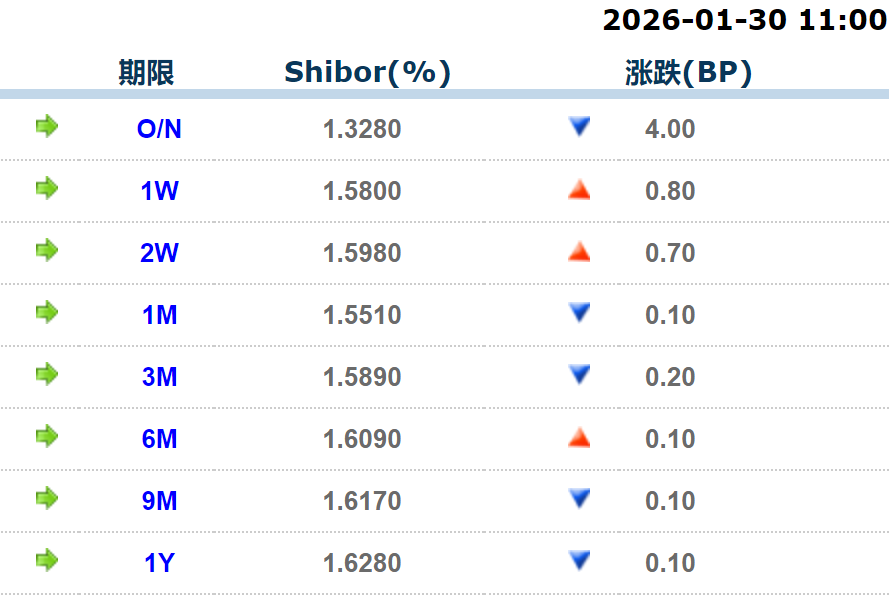
Group 1 - The People's Bank of China conducted a 7-day reverse repurchase operation of 477.5 billion yuan at an interest rate of 1.40%, maintaining the previous rate, resulting in a net injection of 352.5 billion yuan after 125 billion yuan of reverse repos matured on the same day [1] - This week, the People's Bank of China performed a total of 1.7615 trillion yuan in reverse repos, with a net injection of 324.5 billion yuan due to the maturity of 1.181 trillion yuan in 7-day reverse repos and 200 billion yuan in 1-year Medium-term Lending Facility (MLF) [1] - The overnight Shanghai Interbank Offered Rate (Shibor) decreased by 4.00 basis points to 1.3280%, while the 7-day and 14-day Shibor rates increased slightly by 0.80 and 0.70 basis points, respectively [1] Group 2 - In the interbank pledged repo market, only DR001 saw a decline, while other products experienced increases, with R007 and R014 continuing to be inverted [3] - The weighted average rates for DR001 and R001 decreased by 3.4 basis points and increased by 7.1 basis points, respectively, with transaction volumes decreasing significantly [3] - The weighted average rates for DR007 and R007 increased by 0.2 and 1.6 basis points, respectively, with transaction volumes also showing a decrease [3] Group 3 - The money market rates on January 30 showed a mixed trend, with various tenors experiencing slight declines in yield [9] - The 1-month national bank stock ended at approximately 1.50%, down about 0.35 basis points from the previous close, while the 3-month and 6-month rates remained stable [9] - The yield spread between 1-year and 1-month increased to 9.75 basis points, reflecting a widening trend [9] Group 4 - The funding environment was tight in the morning but shifted to a more relaxed state in the afternoon, with overnight rates fluctuating between 1.65% and 1.70% [8] - After the open market operations, the overnight rates slightly eased, with the lowest transaction prices dropping to around 1.46% by the end of the trading day [8]
公募基金 2025 年四季报规模点评:ETF 规模继续扩张,固收加和 FOF 产品市场认可度提升
GUOTAI HAITONG SECURITIES· 2026-01-23 05:47
Report Industry Investment Rating No relevant content provided. Core Viewpoints of the Report - In Q4 2025, after excluding ETF-linked funds and duplicate holdings of internal funds, the scale of equity, bond, commodity, domestic other, QDII equity-mixed, QDII bond, QDII other, and FOF funds increased compared to the previous quarter, while the scale of hybrid and MOM funds decreased [1][6]. - As of December 31, 2025, the total public fund management scale (excluding money market funds) was approximately 22.66 trillion yuan, an increase of about 0.65 trillion yuan compared to September 30, 2025. After excluding the scale of ETF-linked funds invested in ETFs and holdings of internal funds, the total public fund scale (excluding money market funds) was about 21.68 trillion yuan, an increase of about 0.54 trillion yuan compared to September 30, 2025 [4][6]. Summary by Relevant Catalogs Index Funds - As of the end of Q4 2025, excluding commodity and domestic other types of funds and the part of ETF-linked funds invested in ETFs, the total passive management product volume of fund companies was about 7.16 trillion yuan. Among them, the passive management scale of equity (including QDII) was about 5.48 trillion yuan, an increase of about 131.116 billion yuan compared to the end of Q1; the passive management scale of fixed income was about 1.68 trillion yuan, an increase of about 231.211 billion yuan compared to the end of Q1 [4][6]. - **Equity**: In Q4, 183 index equity funds were established in the public fund market, with a total issuance scale of about 81.679 billion yuan and an average issuance scale of about 446 million yuan, showing a significant decline in both the number and scale of new issuances compared to Q3 2025. In the top ten new products in terms of fundraising scale in Q4, 4 were broad-based funds, 3 were thematic index funds, and 3 were strategic index funds. In the Q4, ETF products tracking the CSI A500 index were favored by investors, and the scale of thematic ETF products tracking popular themes also increased rapidly [7]. - **Fixed Income**: In Q4 2025, 4 index bond funds were issued, with a total fundraising scale of 12.549 billion yuan, a significant decline compared to the previous quarter. In Q4, the scale of ongoing index bond funds increased against the trend, with over 57% of funds achieving positive growth. Some科创 bond ETF products and medium - and short - term policy financial bond products saw significant scale expansion [8]. Active Equity - Mixed Funds - As of December 31, 2025, the total scale of active equity - mixed funds in the market after excluding FOF products was about 4.40 trillion yuan, a decrease of about 156.297 billion yuan compared to the end of the previous quarter [4][9]. - **Newly Issued Funds**: In Q4 2025, 106 active equity funds were established, with a total fundraising scale of about 60.218 billion yuan, accounting for 42.44% of equity funds. Since 2025, the active equity new - issuance market has continued to strengthen [9]. - **Ongoing Funds**: Currently, investors' investment sentiment towards active equity - mixed funds remains low. In Q4, only about 25% of active equity - mixed funds achieved scale expansion. Among high - position products, thematic products with clearer investment goals were more popular, and some stable - performing dividend - value style products or cycle - themed products also saw significant scale growth [9][10]. Active Bond Funds - As of December 31, 2025, the scale of active bond funds after excluding FOF products reached 9.31 trillion yuan, an increase of about 158.803 billion yuan compared to the end of the previous quarter [4][11]. - **Newly Issued Funds**: In Q4 2025, 57 new products were issued, with a total fundraising scale of about 62.486 billion yuan. The top five active bond funds in terms of fundraising scale were all partial - bond products, and the fundraising scale of the top 5 did not exceed 5 billion yuan [11]. - **Ongoing Funds**: Since 2025, with the bull market in the equity market, the market recognition of fixed - income plus products has been significantly improved. In Q4, the scale growth of ongoing active fixed - income funds still mainly came from fixed - income plus products [11]. FOF - As of December 31, 2025, after excluding the duplicate part of FOF's holdings of internal funds, the scale of FOF in Q4 2025 was about 17.2836 billion yuan, continuing the growth trend compared to the previous quarter, but the scale growth still mainly came from newly issued products [4][12]. - **Newly Issued Funds**: In Q4 2025, 42 FOFs were established, an increase of 25 compared to Q3. The total fundraising scale was about 45.246 billion yuan, a significant increase of about 38.714 billion yuan compared to the previous quarter. The average fundraising scale in Q4 was about 1.077 billion yuan, an increase of 693 million yuan compared to the previous quarter [12]. - **Ongoing Funds**: High - performing medium - and low - position FOF products were still more popular among investors. The low - position ordinary FOF product Guotai Ruiyue 3 - month Holding under Guotai had the largest scale growth in Q4, with a growth of 2.619 billion yuan [12]. Other Products - As of December 31, 2025, after excluding the scale of ETF - linked funds invested in ETFs and holdings of internal funds, the total scale of other types of products in Q4 2025 was about 66.9156 billion yuan, an increase of about 12.5121 billion yuan compared to the previous quarter [4][13]. - Gold - themed ETF products and ETF - linked funds continued to rise significantly in Q4 due to the continuous increase in international gold prices. Silver - themed products also saw a significant increase in scale in Q4. In addition, inter - bank certificate of deposit products continued to attract investors' attention, with a total scale growth of 2.6553 billion yuan in Q4 [13].
每日债市速递 | 本周央行公开市场将有9515亿元逆回购到期
Wind万得· 2026-01-18 23:55
Group 1: Open Market Operations - The central bank conducted a 7-day reverse repurchase operation of 867 billion yuan at a fixed rate of 1.40% on January 16, resulting in a net injection of 527 billion yuan for the day after accounting for 340 billion yuan in reverse repos maturing [2] - For the week, a total net injection of 812.8 billion yuan was achieved [2] - Upcoming reverse repos of 9.515 billion yuan are set to mature from January 19 to 23, along with 1.5 billion yuan in treasury cash deposits maturing on the 23rd [2] Group 2: Funding Conditions - The interbank market is gradually becoming more relaxed, with the weighted average rate of DR001 dropping over 4 basis points to around 1.32% [4] - Overnight rates in the anonymous click (X-repo) system have also decreased to approximately 1.30%, with supply around 100 billion yuan [4] - Non-bank institutions are borrowing overnight against pledged credit bonds at rates concentrated around 1.45% [4] Group 3: Interest Rates and Yields - The yield on major interbank bonds has generally declined [6] - The latest one-year interbank certificates of deposit are trading around 1.63%, showing a slight decrease from the previous day [7] - Government bond futures closed mostly higher, with the 10-year main contract rising by 0.01% [11] Group 4: Regulatory Developments - The China Securities Regulatory Commission (CSRC) emphasized maintaining stability in the market and preventing large fluctuations, while also promoting reforms in the ChiNext and STAR Market to enhance refinancing convenience [12] - The State-owned Assets Supervision and Administration Commission (SASAC) is focusing on optimizing the layout and structure of state-owned enterprises in 2026 [12] Group 5: Global Macro Insights - The Bank of Japan is increasingly concerned about the risks of inflation due to a weakening yen, potentially leading to an upward revision of economic growth and inflation expectations for the fiscal year 2026 [14] - Barclays analysts project that U.S. corporate bond issuance will reach $2.46 trillion in 2026, an 11.8% increase from 2025, driven by demand in the artificial intelligence sector [14] Group 6: Bond Market Events - Fitch Ratings upgraded the long-term credit rating of Dalian Wanda Commercial Management Group from RD to CC [16] - Goldman Sachs plans to issue bonds to raise $16 billion, setting a record for Wall Street banks [16] - U.S. overseas investors increased their net holdings of U.S. Treasury bonds by $85.6 billion in November 2025 [16]

流动性与同业存单跟踪:如何理解R007加权利率
ZHESHANG SECURITIES· 2026-01-18 08:06
Report Industry Investment Rating The provided content does not mention the report industry investment rating. Core Viewpoints - The current weighted average rate of R007 is around 1.50%. Its pricing includes DR007, representing the central bank's desired pricing, and the "bank - non - bank" liquidity friction (the spread between R007 and DR007). It's not advisable to hold overly optimistic expectations [1]. - The R007 weighted average rate around 1.50% is reasonably priced. DR007 is unlikely to deviate significantly below the central bank's 7 - day reverse repurchase rate, and 1.40% effectively forms the lower limit of DR007. The spread between R007 and DR007 is at a low level. Considering the increase in the large - scale current deposit rate of non - legal person products, R007 should not be lower than 1.50%. This also means that the current yield levels of inter - bank certificates of deposit and short - term credit bonds are reasonable [2][3]. Summary by Related Catalogs 1 R007 weighted average rate 1.50% high? - R007 is a key indicator for measuring the cost of funds for non - bank institutions and products in the inter - bank market. Its pricing consists of DR007 and the "bank - non - bank" liquidity friction. DR007 reflects the central bank's expected management and fluctuates around the central bank's 7 - day reverse repurchase rate. R007 is generally higher than DR007, and the friction varies with market liquidity [11]. - In the past week, the R007 weighted average rate around 1.50% is reasonably priced. DR007 is unlikely to deviate significantly below the central bank's 7 - day reverse repurchase rate, with 1.40% as the lower limit. The spread between R007 and DR007 is low. From the perspective of opportunity cost, R007 should not be lower than 1.50%. The current yield levels of inter - bank certificates of deposit and short - term credit bonds are also reasonable [12][13]. 2 Narrow - sense liquidity 2.1 Central bank operations - Short - term liquidity: The central bank conducts short - term liquidity operations to smooth out peaks and troughs. In the week from January 12 to January 16, 2026, the net short - term liquidity injection was 8128 billion yuan [14]. - Medium - and long - term liquidity: The central bank actively injects medium - and long - term liquidity [15]. 2.2 Institutions' funding inflow and outflow situation - Fund supply (lenders): The net lending of large - scale banks remains at a seasonal high [18]. - Fund demand (borrowers): The absolute financing balance is high, but the relative leverage ratio is low [27]. 2.3 Repurchase market trading situation - Fund volume and price: The trading volume increases while the price remains stable [36]. - Fund sentiment index: It tightens first and then eases [39]. 2.4 Interest rate swaps Interest rate swaps decline slightly [41]. 3 Government bonds 3.1 Next week's net payment of government bonds The net payment of government bonds will increase slightly next week. In the past week, the total net payment was - 485 billion yuan, while in the coming week, it is expected to be 2065 billion yuan [49]. 4 Inter - bank certificates of deposit 4.1 Absolute yield The provided content does not elaborate on the absolute yield of inter - bank certificates of deposit. 4.2 Issuance and stock situation - As of January 16, 2026, the total issuance of inter - bank certificates of deposit was 5536 billion yuan, with different proportions for different maturities and banks. - The total stock balance of inter - bank certificates of deposit was 191068.1 billion yuan, with different proportions for different types of banks and maturities [55][56]. 4.3 Relative valuation The spread between the 1 - year AAA - rated inter - bank certificate of deposit and R007 is at the 28% quantile since 2020; the spread between the 1 - year AAA - rated inter - bank certificate of deposit and DR007 is 18bp, at the 23% quantile; the spread between the 10 - year treasury bond and the 1 - year AAA - rated inter - bank certificate of deposit is 22bp, at the 57% quantile [58].
1月大税期,三种情景
HUAXI Securities· 2026-01-17 15:05
Group 1: Liquidity Overview - From January 12 to 16, the liquidity showed unexpected fluctuations, with R001 rising from 1.35% to 1.49% and R007 exceeding 1.60% due to a lack of buyout reverse repos[1] - As of January 16, the bank's lending scale returned to over 5 trillion yuan, providing some support to the liquidity[3] - The expected liquidity gap for the upcoming tax period is approximately 2 trillion yuan, compounded by 1.1 trillion yuan of public market expirations and 0.25 trillion yuan of government debt payments, totaling over 3.3 trillion yuan[2] Group 2: Market Trends and Projections - The liquidity rates are expected to remain loose, similar to January 2024, due to structural interest rate cuts and a relatively late Spring Festival this year[2] - Historical trends show three liquidity patterns in January: tight (2021, 2025), slight convergence (2023), and relatively loose (2022, 2024)[2] - The central bank is likely to increase liquidity injections during the tax period to maintain market stability, with a reference to a net liquidity injection of about 1.5 trillion yuan in January 2024[3] Group 3: Public Market and Government Debt - From January 19 to 23, a total of 11.015 trillion yuan will expire in the public market, including 9.515 trillion yuan in reverse repos[4] - The estimated net payment for government bonds from January 19 to 23 is 2.465 trillion yuan, significantly higher than the previous week's -0.485 trillion yuan[8] - The government bond issuance is accelerating, with a planned issuance of 7.066 trillion yuan for the week, compared to 2.818 trillion yuan the previous week[41] Group 4: Interbank Certificates of Deposit - The pressure from maturing interbank certificates of deposit is decreasing, with 6,799 billion yuan maturing from January 19 to 23, down from 8,339 billion yuan the previous week[50] - The weighted issuance rate for interbank certificates of deposit increased to 1.65%, with significant contributions from state-owned and joint-stock banks[48]
货币市场日报:1月14日
Zhong Guo Jin Rong Xin Xi Wang· 2026-01-14 11:38
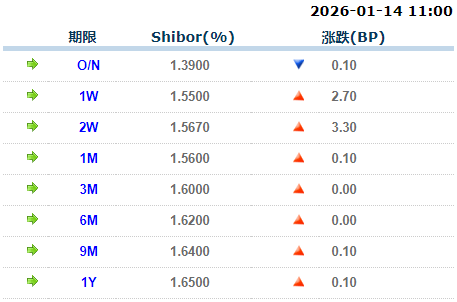
Group 1 - The People's Bank of China conducted a 7-day reverse repurchase operation of 358.6 billion yuan at an interest rate of 1.40%, resulting in a net injection of 342.4 billion yuan after 16.2 billion yuan of reverse repos matured on the same day [1] - The overnight Shanghai Interbank Offered Rate (Shibor) slightly decreased by 0.10 basis points to 1.3900%, while the 7-day and 14-day Shibor rates increased by 2.70 basis points and 3.30 basis points, respectively, reaching 1.5500% and 1.5670% [1] - In the interbank pledged repo market, all rates continued to rise, with R007 and R014 both surpassing 1.6%. The weighted average rates for DR001 and R001 increased by 0.1 basis points and 1.9 basis points, respectively, while transaction volumes decreased significantly [4] Group 2 - The overall funding situation on January 14 was tight, with some easing in the afternoon. The overnight pledged rates for deposits fell to a range of 1.50%-1.55% by the end of the trading day [8] - In the secondary market for negotiable certificates of deposit, trading sentiment was generally weak due to tightening liquidity, with short-term yields rising noticeably. The 1-month and 3-month rates ended at approximately 1.57% and 1.61%, respectively, with slight increases compared to the previous day [9] - The People's Bank of China announced a fixed quantity, interest rate tender, multi-price bidding method for a 900 billion yuan reverse repurchase operation scheduled for January 15, 2026, with a term of 6 months [11]