
制度风险

Search documents
美联储独立性再入市场定价视野,“抛售美国”逻辑是否回归
Di Yi Cai Jing· 2026-01-14 00:50
Core Viewpoint - Concerns regarding the independence of the Federal Reserve are emerging as a new uncertainty factor that could impact the risk premium of U.S. dollar assets in the long term [1][3]. Group 1: Market Reactions - Gold futures on COMEX reached a historical high of $4,640 per ounce, while the U.S. dollar index experienced its largest single-day drop in about three weeks, indicating a strong safe-haven buying interest in precious metals [2]. - The current market response is relatively restrained, reflected in a slight steepening of the yield curve and a weaker dollar, suggesting a marginal repricing of risk premiums related to institutional uncertainty rather than a substantial reassessment of the Federal Reserve's policy path [2][3]. Group 2: Institutional Perspectives - If the debate over the Federal Reserve's independence continues, it may elevate the risk compensation required for U.S. assets in the medium to long term, providing a rationale for global investors to diversify away from dollar and U.S. Treasury allocations [3]. - Investment professionals believe that the limited volatility in the dollar and U.S. Treasuries indicates that investors do not view the current events as a direct threat to monetary policy but rather as a potential institutional risk that has yet to materialize [3]. Group 3: Historical Context and Future Implications - The discussion of "selling America" resurfaced, reminiscent of the market volatility triggered by tariffs last year, where major U.S. stock indices saw significant declines, with the S&P 500 dropping approximately 4.8% in a single day [4]. - Even if U.S. assets face higher risk premium demands, it is suggested that capital may not exit rapidly but rather undergo gradual adjustments in allocation structures [4][5]. Group 4: Broader Economic Factors - Concerns about the Federal Reserve's independence are providing investors with another reason to diversify away from dollar assets, despite ongoing support for U.S. assets from factors such as economic resilience, easing inflation pressures, and momentum from AI-related capital investments [5]. - Fitch Ratings emphasized that the independence of the Federal Reserve is a crucial factor supporting its AA+ sovereign credit rating for the U.S. [5].
ATFX:美联储权威遭遇前所未有挑战 黄金突破4600美元只是开始还是终极警告
Sou Hu Cai Jing· 2026-01-13 09:33
Group 1 - The core viewpoint of the article highlights a significant surge in gold prices, driven by a rare systemic risk event in the global financial market, with gold surpassing the $4600 mark, indicating a re-evaluation of "trust in the financial system" rather than traditional inflation or recession drivers [1] - The primary catalyst for this surge is the heightened concern regarding the potential impact on the independence of the Federal Reserve, particularly in light of the controversy surrounding Chairman Powell, which has amplified investor fears of political interference in monetary policy [1] - The weakening of the US dollar index reflects a structural shift towards safe-haven assets, with investors actively reducing dollar exposure and turning to gold as a hedge against systemic risk and policy uncertainty [1] Group 2 - Geopolitical risks, including instability in the Middle East, domestic unrest in Iran, political variables in Latin America, and uncertainties in US foreign policy, contribute to a high-volatility, low-predictability global environment, leading to a sustained demand for safe assets like gold [2] - From a technical perspective, gold is currently in a clear upward channel, with recent price movements indicating a high-level consolidation phase rather than a reversal signal, suggesting that the upward trend remains intact [5] - The mid-term support for gold remains strong, as the market perceives interest rates to be near neutral levels, with expectations for rate cuts prevailing while the space for rate hikes is limited, which continues to exert downward pressure on real interest rates, benefiting non-yielding assets like gold [5] Group 3 - The $4600 level is viewed as a "risk warning line" rather than the end of a bull market, with potential for short-term fluctuations but a sustained bullish logic for gold in the face of ongoing systemic uncertainty, geopolitical risks, and policy expectations [6] - The article emphasizes that the key focus for the market should not be on short-term price corrections but rather on whether this trust and risk reassessment has fundamentally altered gold's long-term positioning in global asset allocation [7]

ATFX:美联储权威遭遇前所未有挑战,黄金突破4600美元只是开始,还是终极警告?
Sou Hu Cai Jing· 2026-01-13 08:44
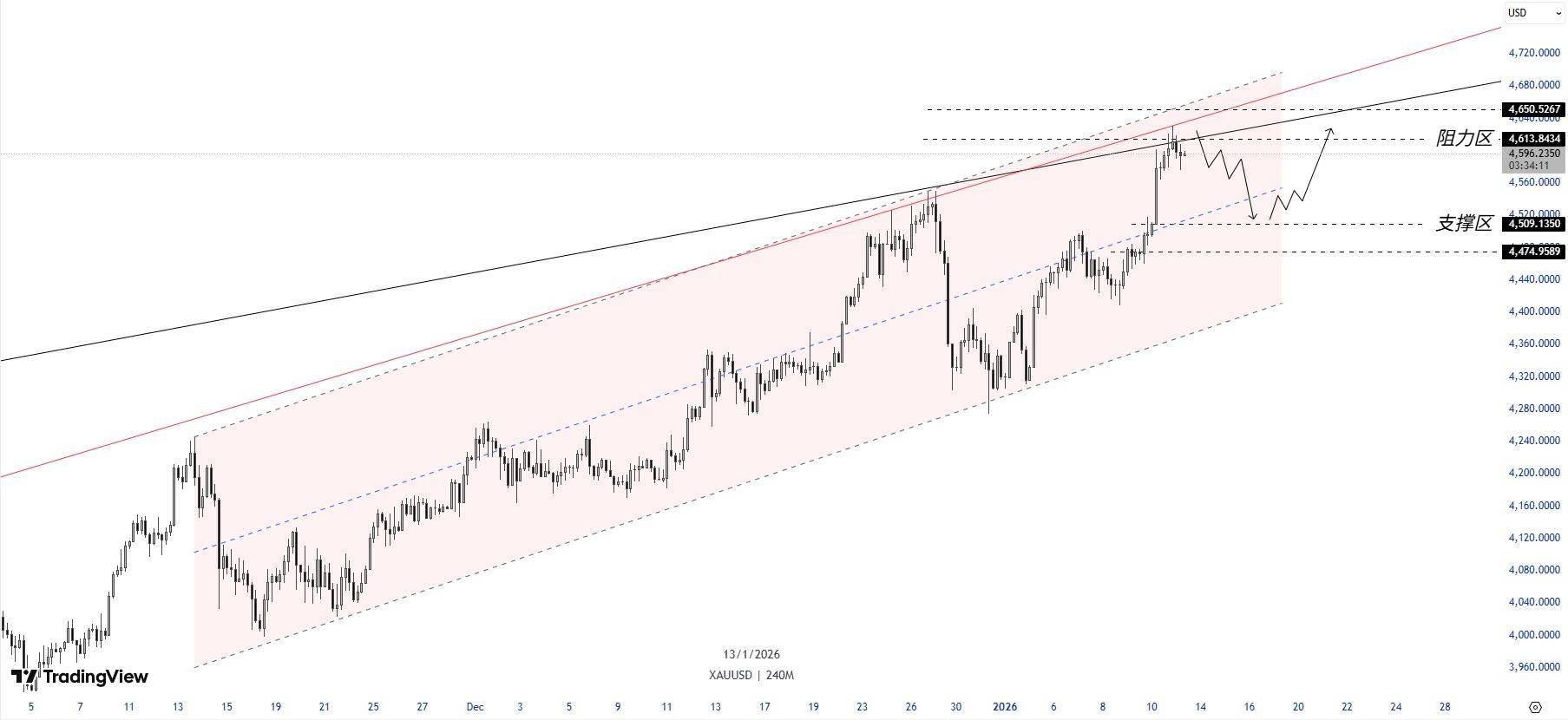
Core Viewpoint - The global financial market is experiencing a significant institutional risk event, leading to a surge in gold prices, which have surpassed the $4600 mark, driven by a reassessment of "trust in the financial system" rather than traditional inflation or recession concerns [1] Group 1: Market Dynamics - The primary catalyst for the current gold price surge is heightened market sensitivity to potential threats to the independence of the Federal Reserve, particularly due to the investigation surrounding Chairman Powell, which has amplified concerns about political interference in monetary policy [1] - The weakening of the US dollar index reflects a structural shift towards risk aversion, with investors actively reducing dollar exposure and reallocating to gold and other non-credit assets for hedging purposes [1] Group 2: Geopolitical Factors - Ongoing geopolitical risks, including instability in the Middle East, domestic unrest in Iran, political variables in Latin America, and uncertainties in US foreign policy, contribute to a high-volatility, low-predictability global environment [2] - The demand for safe-haven assets has evolved from short-term emotional reactions to more sustained strategic allocations, which is a key reason for gold's strength at elevated price levels [2] Group 3: Technical Analysis - Current gold price movements align closely with macroeconomic conditions, showing a clear upward trend within a defined channel, with recent price action indicating high-level consolidation without clear reversal signals [4] - Key resistance levels are identified between $4613 and $4650, while support is found around $4509 and $4474, suggesting that as long as prices remain above these support levels, the upward trend is intact [4] Group 4: Monetary Policy Implications - The medium-term support for gold remains robust, as the Federal Reserve is expected to maintain interest rates at neutral levels, with a prevailing bias towards rate cuts rather than hikes, which continues to suppress real interest rates and favor non-yielding assets like gold [4] Group 5: Long-term Outlook - The $4600 mark is viewed as a "risk warning line" rather than the end of a bull market, with potential for short-term fluctuations; however, the underlying logic for a medium-term bull market in gold remains intact due to ongoing institutional uncertainties, geopolitical risks, and policy expectations [5]
黄金破4400美元!大涨真相:全球111万亿债务高悬,钱不香了?
Sou Hu Cai Jing· 2026-01-05 05:48
Group 1 - The core argument is that the surge in gold prices is driven by a shift from traditional inflation hedging to a focus on systemic risk protection, with gold prices skyrocketing from over $3,000 in March 2025 to nearly $4,600 by year-end, marking the largest annual increase since the 1979 oil crisis [1][3] - The first key driver of this surge is the overwhelming global debt, with the U.S. national debt surpassing $38 trillion by late October 2025, indicating a severe strain on national credit and prompting investors to seek gold as a debt-free asset [3][5] - Central banks have significantly increased their gold reserves, with gold's share in global central bank reserves rising to 20% as of June 2025, surpassing the euro's 16%, and averaging over 1,000 tons of net purchases annually for three consecutive years, providing a structural support for gold prices [3][5] Group 2 - The second core engine of gold's rise is the declining trust in the U.S. dollar, with its share in global foreign exchange reserves dropping from over 70% at the beginning of the century to around 58% recently, leading to a natural shift towards gold as a more reliable asset [5] - The role of gold has evolved from merely a hedge against inflation to a safeguard against systemic risks, as countries increasingly purchase gold to protect their assets from potential freezes during financial sanctions [5][7] - The Federal Reserve's interest rate cuts, which began in September 2024 and continued into 2025, have lowered the opportunity cost of holding non-yielding gold, further driving global investment into the gold market [5][7] Group 3 - The gold rally has also positively impacted other precious metals, with silver prices exceeding $80 per ounce in 2025, reflecting a 150% increase, and platinum futures reaching historical highs, indicating strong market demand across the precious metals sector [7] - In domestic markets, even during brief corrections in international gold prices, there has been a notable increase in consumer interest in gold bars, with many buyers seeking gold as a form of wealth preservation rather than for adornment [7] - The surge in gold prices serves as a reflection of the growing skepticism towards the existing monetary system amidst a backdrop of significant global debt, highlighting a long-term reconstruction of trust in financial systems [7]
美联储敲响警钟!!!
Sou Hu Cai Jing· 2025-11-23 02:56
Group 1 - The core argument of the article is that even with a new Federal Reserve chairman appointed by Trump, the desire for interest rate cuts next year is unlikely to be realized due to a significant shift in the Federal Reserve's power structure, debunking the misconception that a change in chairmanship equates to rate cuts [2] - The December meeting may witness three or more dissenting votes, indicating a potential unprecedented decision-making process within the Federal Reserve that relies solely on majority votes [2] - The historical stability of the Federal Reserve has been based on consensus and unified communication, but the emergence of dissenting votes suggests a loss of this consensus, making it difficult for the new chairman to unilaterally decide on rate cuts [2] Group 2 - The article introduces the "7:5" voting model, where 7 votes are in favor and 5 against, highlighting the potential instability in decision-making as the Federal Open Market Committee (FOMC) requires a simple majority of 7 votes out of 12 [3] - Increased volatility in financial markets is anticipated as the predictability of policies and decision-making paths becomes uncertain, leading to heightened market reactions to Federal Reserve communications [3] - The article warns of institutional risks as the market focuses on immediate economic indicators while overlooking the potential for significant changes in the Federal Reserve's structure and decision-making processes [3]
印度创下一个历史新低,这块短板藏不住了
Zhong Guo Xin Wen Wang· 2025-08-05 07:18
Group 1 - India's net foreign direct investment (FDI) fell to a historical low of $3.53 billion for the fiscal year 2024-2025, a 96.5% decrease from nearly $10 billion in the previous fiscal year [1] - The gross FDI in India increased by 13.7% year-on-year to $81 billion, but significant capital outflows and profit repatriation led to a near-zero net value [1] - Domestic companies in India accelerated their overseas investments, with outbound direct investment rising from $17 billion to $29 billion, indicating a dual outflow of capital [1] Group 2 - The Reserve Bank of India's statement suggests that the growth in gross FDI indicates the attractiveness of the Indian market, while the high withdrawal rate reflects increased market liquidity [2] - However, this perspective is challenged by the ongoing perception of India as a "graveyard for foreign capital," with many foreign companies facing substantial fines and regulatory challenges [3] - Compared to India, countries like Vietnam and Indonesia have maintained stable foreign investment inflows, attributed to a more favorable regulatory environment and higher economic freedom index scores [3] Group 3 - There are concerns regarding new regulatory measures by the Indian government aimed at foreign investments, which could significantly impact sectors like e-commerce and pharmaceuticals [4] - Despite India's large population, rapid GDP growth, and potential in sectors like digital economy and green energy, the sustainability of foreign capital attraction depends on the stability and credibility of its market [4] - The ability of India to transition from being a "transit point" for capital to a "destination" relies on establishing a stable and trustworthy institutional framework [4]
印度创下一个历史新低 这块短板藏不住了
Zhong Guo Xin Wen Wang· 2025-08-05 06:41
Group 1 - The core issue in India's foreign direct investment (FDI) landscape is not a lack of investment but rather a rapid withdrawal of capital, with net FDI dropping to $3.53 billion in the 2024-2025 fiscal year, a 96.5% decrease from nearly $10 billion in the previous year [1] - Despite a 13.7% year-on-year increase in gross FDI to $81 billion, the outflow of foreign capital and profit repatriation has surged, leading to a near-zero net value [1][2] - The acceleration of capital withdrawal is attributed to a significant cash-out trend following popular IPOs, with total private equity and venture capital exits reaching $26.7 billion in the 2025 fiscal year [2] Group 2 - Indian companies are increasingly investing abroad, with outbound direct investment rising from $17 billion to $29 billion, reflecting a shift towards global market diversification [2] - The Indian central bank's stance is that the growth in gross FDI indicates market attractiveness, while high withdrawal rates suggest increased liquidity, although this perspective is contested [2][3] - Concerns about regulatory uncertainty and institutional risks are driving foreign investors to exit quickly, contrasting with the more stable foreign investment environments in countries like Vietnam and Indonesia [3] Group 3 - The Indian government is reportedly planning to tighten regulations on foreign investments, which could significantly impact sectors such as e-commerce and pharmaceuticals [4] - Despite India's large population, rapid GDP growth, and active consumer potential, the sustainability of attracting foreign capital hinges on the ability to retain investors long-term [4] - A stable institutional framework is essential for transforming India from a temporary investment stopover to a long-term investment destination [4]