区域贸易协定

Search documents
联合国贸发会议报告指出——贸易政策深刻影响全球出口格局
Jing Ji Ri Bao· 2026-02-26 22:03
Core Insights - The UNCTAD report highlights that changes in trade policies are reshaping the global export competition landscape, particularly due to recent tariff changes in the US, which have made market access stricter and uneven [1][2] Trade Policy Changes - Tariff adjustments, regional trade agreements, and preferential programs are altering demand conditions and relative prices in domestic and international markets, significantly impacting the competitive position of countries and companies [1] - The report notes that the average applicable tariff in the US has increased by nearly 15 percentage points, with significant disparities in tariffs among different suppliers [2] Impact on Export Competitiveness - Increased tariffs directly raise the cost of imported goods, leading to higher domestic prices and reduced competitiveness. For instance, US tariffs on South African wine have increased its price by approximately 17 percentage points compared to other wine-exporting countries, diminishing its competitiveness [1] - Conversely, reduced tariffs on Italian rice have made it more competitive in the US market [1] Regional Trade Agreements and Preferential Programs - Regional trade agreements typically include tariff reduction clauses, facilitating freer trade among member countries and lowering transaction costs. They also often standardize technical regulations and certification processes, further enhancing member countries' competitiveness [2] - Preferential programs provide specific countries or regions with special tariff treatments below the most-favored-nation rate, enhancing their competitiveness. For example, the African Growth and Opportunity Act (AGOA) offers eligible sub-Saharan African countries preferential access to the US market, significantly boosting their competitiveness in certain goods like textiles and apparel [2] Geopolitical Factors - The report indicates that the recent escalation of global trade tensions and the rise of protectionism underscore the increasing importance of geopolitical factors in future trade dynamics. Trade policies may increasingly be influenced by political objectives rather than purely economic considerations [3] Opportunities from Trade Environment Changes - Changes in the trade policy environment create new export opportunities, with differentiated tariff structures leading to niche market opportunities. Some developing countries may become alternative export hubs due to tariff advantages [4] - The restructuring of global value chains is driving regional optimization, with a notable increase in nearshoring and friendshoring. Trade policy uncertainties may prompt importers to seek lower-tariff alternative suppliers when tariffs are imposed on certain products [4] - The differentiated treatment of tariffs may provide opportunities for high-end manufacturing products to enter the US market, especially for countries offering cost-competitive products. This shift may also lead to growth in service trade, such as technical support and after-sales services [4]
《国际经贸规则观察报告(2025)》发布
Sou Hu Cai Jing· 2025-12-13 12:48
Group 1 - The report titled "International Trade Rules Observation Report (2025)" was released during the Fourth Customs and National Security Annual Conference in Shenzhen, highlighting the ongoing adjustments and restructuring of the global trade rules system [1][3] - The report emphasizes that despite challenges in multilateral trade negotiations, there are significant developments, such as the establishment of the "E-commerce Agreement" and China's leadership in the "Investment Facilitation Agreement for Development" [3][4] - The report notes a shift in regulatory focus from "border" measures to "post-border" measures, indicating the increasing complexity of agreements and the importance of aligning with high-standard international trade rules for promoting high-level openness and quality development [4] Group 2 - China has decided to grant zero-tariff treatment on 100% of product categories to all least developed countries that have diplomatic relations with China, including several African nations, showcasing China's commitment to leveraging its large market to promote global economic integration and inclusive trade [4]


中央经济工作会议解读:2026年高水平对外开放划重点
Yin He Zheng Quan· 2025-12-12 00:29
Group 1: Key Signals for 2026 Opening Up - The overall keyword shifts from "stability" to "diversity" and "win-win" in international cooperation[2] - Emphasis on institutional opening, particularly in the service sector and free trade pilot zones, transitioning from "quantitative" to "qualitative" changes[9] - "Integration" in trade and investment is identified as the future development direction[11] Group 2: Key Support Points for Implementation - Strengthening the construction of Hainan Free Trade Port as a new high ground for institutional opening, with a focus on financial and trade investment openness[18] - Promoting synchronization of domestic and foreign trade policies, standard recognition, and smooth capital flow to facilitate integrated development[19] - Enhancing the level of China's service industry while reasonably reducing opening restrictions to promote service trade and exports[19]
稀土不是真正底牌!美方封锁加码,中国反手翻盘,美国彻底被打脸
Sou Hu Cai Jing· 2025-10-25 04:45
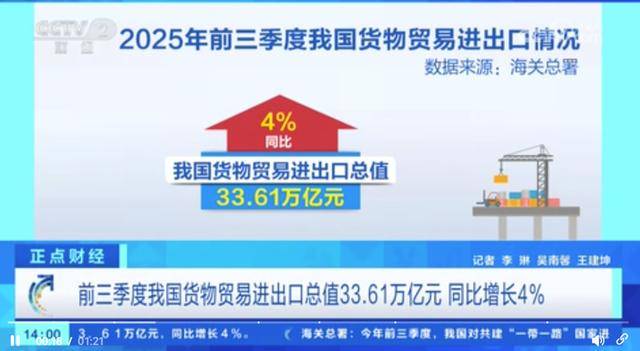
Core Insights - The significant increase in tariffs on Chinese exports to the U.S. has led to a shift in China's export markets, with ASEAN and the EU becoming major trading partners, reflecting a strategic pivot in trade relationships [1][3]. Group 1: Trade Performance - China's total goods trade volume reached 33.6 trillion yuan in the first three quarters, showing a year-on-year increase of 4% despite high tariffs [1]. - Exports to ASEAN rose by 14.7%, while exports to the EU surged by 28.3%, together accounting for 23.4% of total exports [3]. Group 2: Market Adaptation - The decline in U.S. market share for Chinese exports has dropped to 10.4%, nearly halving since 2018, with a 27% decrease in exports in September alone [5]. - The transition to new markets was facilitated by prior regional trade agreements and established supply chains, allowing for a swift response to changing trade dynamics [7]. Group 3: Product Quality and Innovation - The composition of Chinese exports has shifted from labor-intensive goods to high-tech products, with general machinery exports increasing by 24.9%, integrated circuits by 32.7%, and automotive exports by 10.9% [8][10]. - The focus on providing comprehensive solutions, such as building charging networks for electric vehicles, has enhanced profit margins compared to traditional hardware sales [10][12]. Group 4: R&D Investment - China's manufacturing R&D investment intensity reached 2.6% in the first half of 2025, an increase of 0.8 percentage points since 2020, indicating a commitment to innovation and quality improvement [10]. - The shift from a volume-driven model to a quality-driven approach has made Chinese exports more resilient against tariff pressures, as customers are willing to pay for comprehensive solutions rather than just products [12].
招商港口(001872) - 001872招商港口投资者关系管理信息20250901
2025-09-01 15:02
Financial Performance - The company achieved operating revenue of CNY 8.468 billion, a year-on-year increase of 6.2% [2] - The net profit attributable to shareholders reached CNY 2.627 billion, marking a historical high with a growth of 3.1% [2] - The net profit excluding non-recurring items was CNY 2.519 billion, up 16.4% year-on-year, indicating improved economic efficiency [2] Business Operations - Container throughput reached 101.207 million TEUs, an increase of 5.7% year-on-year [2] - Bulk cargo throughput was 630 million tons, slightly down by 0.7% [2] - Domestic port projects achieved container throughput of 79.189 million TEUs, up 6.2% [2] - Overseas port projects completed container throughput of 19.209 million TEUs, a growth of 5.0% [2] Strategic Initiatives - The company aims to become a world-class comprehensive port service provider, focusing on global expansion, lean operations, and innovation [2] - The company operates 51 ports across 26 countries on six continents, actively seeking acquisition opportunities in fast-growing regions [3] Market Trends and Challenges - The international shipping rates fluctuated in the first half of 2025, with a cautious outlook for rate increases in 2026 [3] - The company is focusing on enhancing core competencies and operational efficiency to adapt to market changes [3] - The impact of U.S. tariffs on goods transiting through Southeast Asia is being monitored, with a strategy to mitigate risks through diversified market engagement [4] Digital Transformation - The company is advancing its digital transformation with the launch of three major service platforms, enhancing operational efficiency and customer service capabilities [5] - Automation and smart technologies are being integrated, with significant improvements in operational efficiency, achieving over 80% efficiency in automated operations [5] Shareholder Value Enhancement - The company has initiated a share buyback plan, aiming to repurchase shares worth between CNY 195 million and CNY 389 million by October 28, 2025 [7] - A commitment to distribute at least 40% of profits as dividends annually from 2024 to 2026 has been established [7]

关税对欧盟出口冲击有多大?欧洲出口型优势是否仍在|全球贸易观察
Di Yi Cai Jing· 2025-08-21 10:27
Group 1 - The core viewpoint is that while the US remains an important trade partner for Europe, there is a need for Europe to diversify its trade relationships and leverage its export-oriented economy [1][5] - EU exports to the US have significantly slowed down, with a 10% year-on-year decline in June, reaching a low of approximately 40 billion euros (about 46.8 billion USD) [1][3] - Germany's trade surplus with the US has decreased by 12.8% year-on-year, attributed to the competitive pressure from US tariffs [1][3] Group 2 - The EU's trade surplus has narrowed primarily due to weak chemical exports, a key sector for many European economies [3] - The introduction of various tariffs, including a 15% tariff on most EU goods, has negatively impacted Germany's automotive and machinery exports, which fell by 8.6% and 7.9% respectively in the first half of the year [4] - The US's recent expansion of tariffs to include 407 product categories, such as wind turbines and heavy machinery, complicates the pricing and competitiveness of European exports [4] Group 3 - The European Central Bank's President, Lagarde, indicated that the eurozone's economic growth is expected to slow down in the third quarter due to the impact of US tariffs [5] - The Oxford Economics report noted a significant decline in EU exports to the US since April, with current import levels from the EU falling below the average for 2024 [5] - Despite the challenges, the eurozone showed resilience with a 0.1% growth in the second quarter, although future export recovery remains uncertain due to a strong euro and overall market volatility [6] Group 4 - The EU is actively seeking to diversify its trade relationships by initiating or reviving trade negotiations with developed and emerging markets, including the UAE and New Zealand [6] - There are ongoing discussions for a free trade agreement with India, aiming for a balanced and mutually beneficial deal by the end of the year [6] - The need for regional cooperation in response to rising US trade barriers is emphasized, particularly in industries like semiconductors, where global collaboration is essential [7]