医疗出海

Search documents
2026中国创新医疗图景:源头活水何在,产业生态又将如何重塑?
Xin Lang Cai Jing· 2026-01-26 06:56
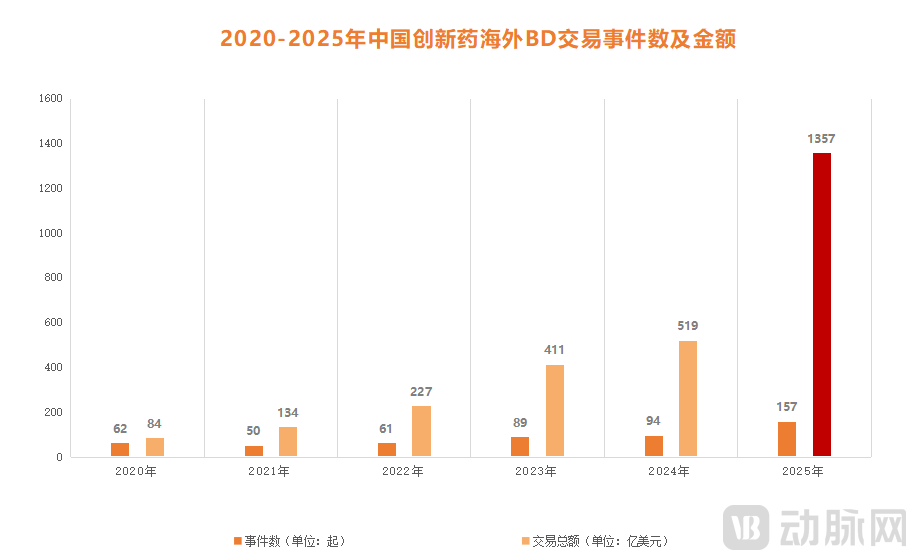
Core Insights - The Chinese healthcare industry experienced a significant surge in 2025, marked by a record number of innovative medical devices and drugs approved for market entry, indicating a growing focus on innovation in the sector [1][3] - The total value of overseas business development (BD) transactions for innovative drugs reached $135.7 billion in 2025, accounting for 49% of the global total, surpassing the United States for the first time [3] - The IPO market for healthcare companies in China saw a revival, with 37 companies successfully listed in 2025, doubling the number from 2024, reflecting strong investor interest in the sector [7] Innovation in Medical Devices and Drugs - In 2025, 109 innovative medical devices were approved, with a 19.67% year-on-year increase in Class III devices, while 76 innovative drugs were approved, focusing on advanced fields like oncology and autoimmune diseases [1] - The rapid growth in innovative drug approvals and medical device registrations highlights China's increasing capabilities in healthcare innovation [1][8] Business Development and Market Dynamics - The number of overseas BD transactions for innovative drugs reached 157 in 2025, with a total transaction value of $135.7 billion, both figures representing historical highs [3] - The increasing recognition of Chinese innovative drugs by global pharmaceutical companies is evident, particularly as they face pressures from patent expirations and global competition [8] IPO Activity and Market Sentiment - The healthcare sector in China saw a resurgence in IPO activity, with 37 companies going public in 2025, compared to 17 in 2024, indicating a robust market sentiment [7] - Over 60 healthcare companies are currently in the IPO pipeline on the Hong Kong Stock Exchange, reflecting sustained investor enthusiasm for the healthcare sector [7] Challenges and Industry Landscape - Despite the growth, challenges persist, including difficulties in financing and market entry for medical companies, exacerbated by domestic healthcare cost controls and intensified competition [7] - The industry is undergoing significant consolidation, presenting both opportunities and challenges for companies navigating this complex landscape [7][11] AI Integration in Healthcare - AI technology is increasingly integrated into the healthcare sector, enhancing the efficiency and safety of medical devices and drug development processes [10] - The shift towards data-driven, proactive healthcare solutions is transforming traditional practices, with AI expected to play a crucial role in future clinical pathways [10] Investment Trends and Future Outlook - The investment landscape in the healthcare sector is shifting towards high-tech, innovative companies, with a notable decrease in the number of financing events but an increase in total investment amounts [16] - The next 5-10 years are anticipated to be a golden period for innovation in Chinese healthcare, with a focus on projects that address unmet clinical needs [17]


年度扭亏盈喜发布,微创医疗(00853)股价冲高回落也是“赚钱信号”?
Zhi Tong Cai Jing· 2026-01-26 01:40
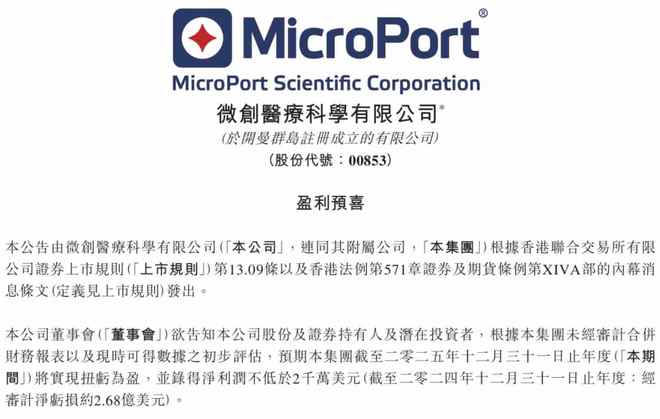
Core Viewpoint - MicroPort Medical (00853) expects to turn a profit in 2025, projecting a net profit of at least $20 million, driven by continuous revenue growth, particularly from overseas business, which has seen approximately 70% year-on-year growth [1] Financial Performance - The company anticipates a turnaround primarily due to sustained revenue growth, with overseas business contributing significantly [1] - Despite facing downward pressure on product prices from domestic industry policies, the company has improved its gross margin by 2-3 percentage points year-on-year through cost optimization measures [1] - Operating expenses have decreased by approximately 10-11% year-on-year during the reporting period [1] - The disposal of subsidiary companies has also contributed positively to MicroPort Medical's financial performance [1] Stock Market Reaction - Following the earnings announcement, MicroPort Medical's stock price opened high on January 23, reaching a peak increase of 12.84% before closing with a gain of less than 4% [3] - The trading volume on that day reached 77.07 million shares, setting a new record since October of the previous year, indicating significant investor activity [3] Historical Stock Performance - Since peaking at 16.28 HKD on October 8, the stock has experienced a two-month downtrend, with a maximum fluctuation of 39.80%, dropping to a low of 9.80 HKD [5] - The stock underwent a technical correction, moving from the upper to the lower Bollinger Band over a month, indicating a bearish market sentiment [5][6] Investor Sentiment and Trading Patterns - The stock's decline was characterized by low trading volumes, suggesting a lack of market support and internal disagreements among shareholders [5] - On November 24, the stock began a rebound after reaching a technical bottom, with subsequent trading showing a recovery trend [6][8] Institutional Investment Trends - Recent trading data indicates that Hong Kong Stock Connect funds have increased their holdings in MicroPort Medical, reversing previous trading strategies [9][11] - The average holding cost for these funds is 11.23 HKD, with an overall profit margin of 15.46% [9] Future Outlook - Analysts have raised profit forecasts for MicroPort Medical, reflecting improved operational efficiency and a focus on core business areas [12] - The company aims to achieve specific financial targets for 2025 and 2026, including a net profit of at least $45 million in the first half of 2026 [12]
港股异动 | 微创医疗(00853)涨超11% 预计去年净利润不少于2000万美元 同比扭亏为盈
智通财经网· 2026-01-23 01:48
Core Viewpoint - MicroPort Medical (00853) is expected to turn a profit by the end of 2025, projecting a net profit of no less than $20 million, driven by continuous revenue growth, particularly from overseas business [1] Group 1: Financial Performance - The company anticipates achieving profitability due to sustained revenue growth, with overseas business contributing approximately 70% year-on-year growth [1] - The gross profit margin is expected to increase by 2-3 percentage points year-on-year, despite downward pressure on product prices from domestic industry policies [1] - The operating expenses are projected to decrease by about 10-11% year-on-year due to ongoing lean management initiatives [1] Group 2: Market Reaction - Following the announcement, MicroPort Medical's stock surged over 11%, with a current increase of 9.39%, trading at HKD 13.63 and a transaction volume of HKD 260 million [1] Group 3: Strategic Initiatives - The company has implemented cost optimization measures that have positively impacted its financial performance [1] - The disposal of subsidiaries has also contributed positively to the group's earnings [1]
爱博医疗(688050)公告点评:拟收购德美医疗51%股权 切入运医培育新增长点
Xin Lang Cai Jing· 2026-01-22 10:30
Core Viewpoint - Aibo Medical has signed a Letter of Intent with Demei Medical to acquire at least 51% of its shares, with an estimated valuation of Demei Medical not exceeding 1 billion yuan, indicating a stable profit growth commitment from 2026 to 2028 [1][2] Acquisition Details - The acquisition is expected to be financed through a combination of self-funds and bank loans [1] - Demei Medical's preliminary valuation corresponds to a price-to-earnings (PE) ratio of approximately 22X, 18X, and 15X for the years 2026, 2027, and 2028 respectively [1] - Demei Medical's net profit commitments for 2026, 2027, and 2028 are projected to be 45 million, 55 million, and 65 million yuan, representing year-on-year growth rates of +28.5%, +22.2%, and +18.2% respectively [1] Company Profile - Demei Medical, established in 2015, is a leading brand in China's sports medicine sector, offering a comprehensive range of products including imaging equipment, surgical tools, implantable consumables, and rehabilitation devices [1] - The company has achieved significant breakthroughs in core technologies and has established a full industry chain layout, making it a representative manufacturer of sports medicine in China [2] Financial Performance - Demei Medical's projected revenues for 2023, 2024, and 2025 are 178 million, 236 million, and 286 million yuan, with year-on-year growth rates of +32.6% and +21.4% [2] - The adjusted net profits for the same years are expected to be -7.08 million, 9.29 million, and 23.60 million yuan, indicating a significant increase in profitability [2] International Expansion - Demei Medical has developed strong international capabilities, with a sales network covering over 50 countries and regions, and plans to participate in more than 10 international exhibitions and academic exchanges in 2025 [2] - The collaboration with Aibo Medical is expected to enhance its overseas business, which accounted for 5.5% of total revenue in the first half of 2025 [2] Profit Forecast and Investment Outlook - Aibo Medical is projected to achieve revenues of 1.572 billion, 1.823 billion, and 2.173 billion yuan from 2025 to 2027, with year-on-year growth rates of +11.5%, +16.0%, and +19.2% respectively [3] - The expected net profits for the same period are 414 million, 476 million, and 575 million yuan, with growth rates of +6.7%, +14.9%, and +20.7% respectively [3] - The current stock price corresponds to PE ratios of 29X, 25X, and 21X for the years 2025, 2026, and 2027 [3] Rating - The company maintains a "recommended" rating [4]

帮主郑重:美股狂欢夜!中概股起舞,波音坠落,三幕大戏谁主沉浮?
Sou Hu Cai Jing· 2025-08-13 01:55
Group 1: US Stock Market Performance - The US stock market reached new historical highs, with the Nasdaq and S&P 500 both setting records, and the Dow Jones soaring by 483 points, with all three major indices rising over 1% [3] - The primary driver was the US July CPI, which came in at 2.8% year-on-year, lower than expected, and a core CPI of 3.1%, indicating manageable inflation [3] - Market expectations for a Federal Reserve rate cut in September surged to 94.4%, with traders optimistic about a favorable economic environment [3] Group 2: Chinese Concept Stocks Divergence - Chinese concept stocks saw a mixed performance, with the Nasdaq Golden Dragon Index rising by 1.49% due to a 90-day tariff extension [4] - Winners included Tencent Music, which surged by 11.85% driven by policy benefits and a resurgence in performance, while Alibaba and JD.com also saw gains of 3% [5] - Losers included NIO, which plummeted by 8.86%, and XPeng, down 6%, due to intensified competition in the electric vehicle sector and rising costs [6] Group 3: Boeing's Challenges and Competition - Boeing faced significant challenges, with July deliveries plummeting by 27% year-on-year to only 43 aircraft, impacted by supply chain issues and quality control crises [7] - The company is losing market share to Airbus, which is set to deliver 766 aircraft to China in 2024, and the domestic C919 aircraft is also gaining traction [8] Group 4: Tech Giants' Competition - Elon Musk criticized Apple's exclusion of X and Grok from its "essential apps" list, accusing the company of monopolistic practices [9] - This conflict highlights a broader struggle for control over AI and platform transparency, especially in light of the EU's Digital Markets Act [9] Group 5: Oil Market Dynamics - OPEC raised its 2026 demand forecast while increasing production by 548,000 barrels per day in August, primarily to pressure US shale oil producers [10] - Despite a brief drop, oil prices rebounded, establishing a new support level at $65 per barrel due to geopolitical tensions and supply chain issues [10] Group 6: Investment Strategies - Companies are advised to increase allocations to rate-sensitive stocks, particularly in technology and regional banks, while also considering opportunities in aviation maintenance due to Boeing's crisis [11] - Focus on consumer recovery and domestic alternatives in the Chinese market, while avoiding pitfalls in the electric vehicle sector and data security controversies [12] - Energy stocks should be positioned with a focus on the $65 per barrel oil price floor [12]



600111,今日A股“唯一”
Zhong Guo Zheng Quan Bao· 2025-08-07 08:57
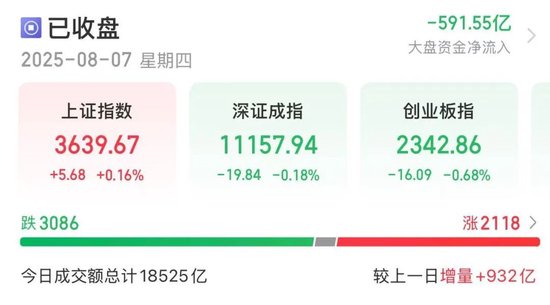
Market Overview - The Shanghai Composite Index closed at 3639.67 points, reaching a new high for the year, while the Shenzhen Component Index and the ChiNext Index experienced slight declines [5][6] - The total market turnover was 185.25 billion yuan, an increase of 93.2 billion yuan compared to the previous trading day [6] Sector Performance - Semiconductor, medical devices, and rare earth permanent magnet sectors showed strong gains, while CRO and innovative drug sectors faced adjustments [3][8] - Notably, Northern Rare Earth (600111) saw a 6.01% increase in share price, with a trading volume of 14.849 billion yuan, making it the only stock in the market to exceed 10 billion yuan in turnover today [3] Financing and Market Sentiment - The A-share margin trading balance reached 2 trillion yuan, marking a ten-year high, with the financing balance at 1.986 trillion yuan [6] - Analysts suggest that the current market sentiment has room for improvement, especially if policy measures are intensified [6][7] Rare Earth Sector Insights - The rare earth permanent magnet sector is experiencing a rebound, driven by rising prices of rare earth materials, with praseodymium and neodymium oxide prices increasing by 18.9% in July compared to June [10] - The demand for high-performance rare earth permanent magnets is expected to grow due to advancements in humanoid robots and eVTOL (electric vertical takeoff and landing) aircraft [10] Logistics Sector Developments - The logistics sector showed positive movement, with companies like Yunda Express reaching their daily limit [11] - The logistics industry maintained expansion, with a logistics business activity index of 50.5% in July, indicating stable growth despite adverse weather conditions [12] Policy and Industry Outlook - The State Post Bureau held discussions to address issues in the express delivery industry, aiming for high-quality development [13] - Analysts believe that the e-commerce and express delivery sectors will continue to grow, driven by increasing online shopping penetration and the rise of live commerce [13]