医药政策

Search documents
医药板块,后续怎么走?
券商中国· 2025-11-30 23:25
Core Viewpoint - The pharmaceutical sector has experienced a slowdown in its upward momentum after a strong rally earlier in the year, with the number of "doubling funds" significantly decreasing [1][2]. Group 1: Market Performance - As of November 28, only two pharmaceutical-themed funds, Zhongyin Hong Kong Stock Connect Pharmaceutical A and Chuangjin Hexin Global Pharmaceutical Biotechnology A, maintained doubling returns, with gains of 107.69% and 100.32% respectively, indicating a notable contraction compared to previous performance [3]. - In the third quarter, multiple pharmaceutical funds saw significant net value increases, but by the end of November, the average return for pharmaceutical-themed funds had retreated approximately 10% from their September peak [3]. - Major pharmaceutical ETFs, including the CSI 300 Pharmaceutical and Health Index and the CSI All Share Pharmaceutical and Health Index, have also seen a decline in scale over the past three months, reflecting a shift in investor sentiment from aggressive buying to cautious observation [3]. Group 2: Policy Environment - The policy landscape is viewed as a stabilizing factor for the pharmaceutical sector, with institutions focusing on policy and industry dynamics to gauge future trends [4]. - The National Healthcare Security Administration and the National Health Commission have issued measures to support the high-quality development of innovative drugs, providing comprehensive support across research, access, clinical application, and payment mechanisms [5]. - Regulatory improvements, such as the implementation of ICH guidelines and encouragement of real-world studies for drug safety assessments, are expected to enhance the efficiency and scientific rigor of drug approvals [5]. Group 3: Valuation and Investment Outlook - The pharmaceutical industry has ranked relatively low in terms of valuation over the past four years, suggesting significant potential for upward movement as valuations have been sufficiently digested [6]. - Following a period of correction, the relative value of the pharmaceutical sector is becoming more apparent, with a shift in investment logic from short-term trading to valuation recovery [6]. - Positive signs of recovery are emerging in the pharmaceutical sector's fundamentals, with improved performance reported in the third quarter and expectations for accelerated business development in the fourth quarter [6]. - The Federal Reserve's interest rate cuts are anticipated to facilitate a recovery in pharmaceutical financing, alongside improvements in the domestic capital market, which will likely enhance new drug research and development spending [7].


巩固英股“第一大权重股”地位,医药巨头阿斯利康股价创新高
Hua Er Jie Jian Wen· 2025-11-11 13:52
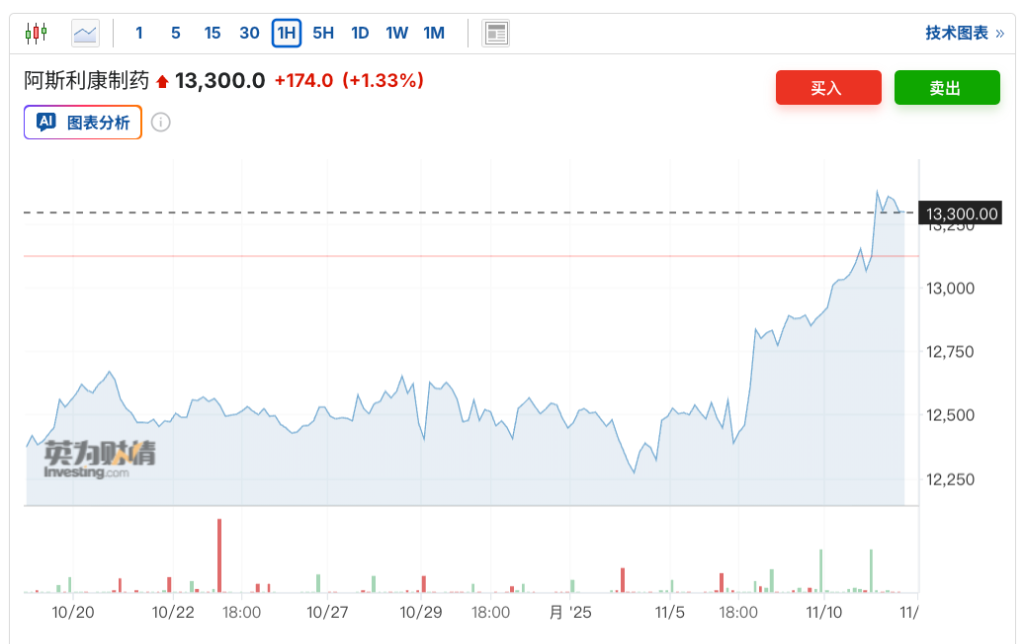
Core Viewpoint - AstraZeneca's stock price reached a historic high of £134.6, with a market capitalization nearing £210 billion ($282 billion), solidifying its position as the largest weight in the FTSE 100 index [1]. Group 1: Stock Performance - AstraZeneca's strong performance significantly boosted the FTSE 100 index, which rose by 1.1% to also reach a historic high, driven by improved UK employment data and expectations of interest rate cuts by the central bank [2]. - The stock price increase of AstraZeneca by 2.5% during intraday trading reflects investor confidence and market optimism [1]. Group 2: Financial Results - The recent stock surge is primarily supported by AstraZeneca's better-than-expected earnings report, which showed an 11% year-over-year increase in total revenue for the first three quarters, and a 15% growth in core earnings per share [4]. - All business segments and major regional markets of AstraZeneca demonstrated robust growth, indicating a strong operational performance [4]. Group 3: Market Environment - The recent agreement on drug pricing in the U.S. has alleviated market concerns regarding uncertainties in U.S. pharmaceutical policies, providing additional support for AstraZeneca's stock price [4]. - The U.S. market, contributing over 40% of AstraZeneca's total sales, plays a crucial role in the company's revenue generation and stock performance [4].
《纽约时报》报道“特朗普政府拟对中国药品进行限制”
Tianfeng Securities· 2025-09-14 12:45
Investment Rating - Industry Rating: Outperform the Market (maintained rating) [5] Core Viewpoints - The Trump administration is considering strict restrictions on medicines from China, which could significantly impact the American pharmaceutical industry and the availability of various treatments [10][11] - The proposed executive order draft includes mandatory reviews of acquisitions by U.S. pharmaceutical companies of experimental drugs from Chinese firms and stricter scrutiny of clinical trial data from China [15][10] - Major pharmaceutical companies like Pfizer and AstraZeneca oppose these restrictions, as they benefit from cost-effective Chinese biotech assets [2][4] - The likelihood of the executive order being enacted is low due to its early discussion stage and the lack of positive feedback [3][5] - Even if the order is implemented, there are various countermeasures available, and the overall impact is expected to be manageable [5] Summary by Sections Section 1: Proposed Restrictions - The draft executive order aims to impose strict controls on Chinese medicines, requiring mandatory reviews for acquisitions and higher scrutiny on clinical data from China [10][15] - The order is seen as a response to concerns about national security and the competitive threat posed by China's biotech sector [11][10] Section 2: Industry Reactions - Major pharmaceutical companies are lobbying against the proposed restrictions, emphasizing the benefits of collaboration with Chinese biotech firms [2][4] - The lobbying efforts highlight a divide between investors tied to the Trump administration and established pharmaceutical companies [10][11] Section 3: Feasibility and Impact - The report suggests that the executive order's implementation is unlikely due to political and practical challenges [3][5] - The pharmaceutical industry is expected to adapt to any potential restrictions, maintaining a focus on global collaboration and innovation [5]
北京初一女生HPV疫苗免费接种全面启动;赛诺菲创新药在华获批
2 1 Shi Ji Jing Ji Bao Dao· 2025-09-08 00:42
Group 1: Pharmaceutical Companies and Products - 63 pharmaceutical companies have been exposed for serious credit violations, with 63 companies rated as "particularly serious" or "serious" by the National Medical Insurance Administration [1] - Junshi Biosciences announced positive results from a Phase III clinical trial of JS005 for moderate to severe plaque psoriasis, planning to submit a marketing application soon [1] - Sanofi's teplizumab injection has been approved in China for delaying the progression of type 1 diabetes in patients aged 8 and above [2] Group 2: Corporate Actions - Yingke Medical adjusted its share repurchase price limit from RMB 26.51 to RMB 41.88 per share, effective from September 8, 2025, with a total repurchase fund of RMB 80 million to 120 million [3] - Qidi Pharmaceutical plans to change its name to "Guhan Health Industry Group Co., Ltd." and will revise its articles of association accordingly [4] - Jiuan Medical intends to cancel 9.77 million shares, which is 2.06% of its total share capital, as part of a strategy to enhance shareholder returns [5] Group 3: Market Movements and Regulations - Xiangrikui is planning to acquire controlling stakes in Xi Pu Materials and 40% of Beid Pharmaceutical, leading to a temporary suspension of its stock [6] - Beijing has launched a free HPV vaccination program for new first-year junior high school girls, aiming to increase vaccination rates [7][8] - Two studies on iza-bren (EGFR×HER3 dual antibody ADC) have been selected for the official news release program at the 2025 WCLC, highlighting its clinical significance [9] Group 4: Shareholder Actions - Chengda Pharmaceutical announced that a shareholder plans to reduce their stake by up to 7.27% within three months [10] - Kangchen Pharmaceutical's controlling shareholder plans to reduce their stake by up to 3% between September 29 and December 28, 2025, due to personal funding needs [11]

美国商务部长卢特尼克:贸易顺差意味着美国被“出卖”了。欧盟同意协议是因为制药和汽车产业。欧盟不希望我们把制药公司从欧洲赶出去。特朗普将在未来两周内宣布医药政策。如果药品不在美国生产,将征收“巨额”关税。
news flash· 2025-07-29 12:54
Group 1 - The U.S. Secretary of Commerce, Gina Raimondo, stated that a trade surplus indicates that the U.S. is being "sold out" [1] - The European Union agreed to the deal primarily due to the pharmaceutical and automotive industries [1] - The EU does not want the U.S. to drive pharmaceutical companies out of Europe [1] Group 2 - Former President Trump is expected to announce a new pharmaceutical policy within the next two weeks [1] - A significant tariff will be imposed if drugs are not produced in the U.S. [1]
医药流通2024A&2025Q1业绩综述:账期持续承压,看好盈利修复
ZHESHANG SECURITIES· 2025-05-11 05:23
Investment Rating - The industry investment rating is "Positive" [1] Core Views - The report highlights that the pharmaceutical distribution sector is under pressure but is expected to see a recovery in profitability [3][6] - The report emphasizes the importance of new business models such as CSO and health device distribution, which are anticipated to support revenue growth [7] Summary by Sections Market Review - From January 1, 2025, to May 8, 2025, the pharmaceutical distribution index declined by 2.44%, underperforming the pharmaceutical and biotechnology index by 3.73 percentage points [4] - The market capitalization of pharmaceutical distribution in Q1 2025 was 1.5 billion, accounting for 0.05% of the total A-share fund holdings, showing a decrease from the previous quarter [4][20] Financial Analysis - Revenue growth for 2024 is projected at an average of 0.52%, a significant decline of 9.04 percentage points year-on-year. Major companies like China National Pharmaceutical and China Medicine are expected to experience negative growth [5][24] - In Q1 2025, the average revenue growth rate for key companies in pharmaceutical distribution was -0.11%, but this represents an improvement of 1.31 percentage points year-on-year [5][24] - The average net profit growth rate for key companies in Q1 2025 was 4.83%, an increase of 13.95 percentage points compared to the previous year [29][40] - The average gross profit margin for Q1 2025 was 8.33%, down 0.32 percentage points year-on-year, continuing a downward trend influenced by centralized procurement and drug pricing policies [32][40] Investment Recommendations - The report recommends focusing on leading companies in the pharmaceutical distribution sector, particularly those with strong capabilities in hospital payment recovery and innovative distribution channels. Key recommendations include Shanghai Pharmaceuticals, Jiuzhoutong, Baiyang Pharmaceuticals, and Zhongyao Holdings, with a watch on China National Pharmaceutical, Guoyao Holdings, and Liuyao Group [7][55]