半导体战略转型

Search documents
越南芯片,乘机崛起
半导体芯闻· 2026-01-07 07:46
Core Insights - Vietnam is shifting its semiconductor strategy from low-cost assembly and testing to higher-value chip design and advanced packaging, driven by global manufacturers seeking to diversify supply chains away from China [1] - The semiconductor market in Vietnam is projected to reach $10.16 billion by 2025, reflecting broader efforts by Southeast Asian economies to capture more value in the global chip industry amid geopolitical and supply chain risks [1] Group 1: Industry Transformation - Vietnam has historically played a backend role in the semiconductor industry but is undergoing a structural "upstream transformation" led by industrial giants and local leaders [1] - Companies like Nvidia and FPT are investing $200 million to build an AI chip factory, while Intel, Arm, Micron, and Samsung are expanding their substrate production and advanced packaging facilities [1] - Domestic firms such as Viettel and FPT Semiconductor are actively entering the 5G and power management chip design sectors, supported by a talent pool of over 6,000 design engineers cultivated over 20 years [1] Group 2: Challenges and Opportunities - There is a severe shortage of "chip architects," the senior engineers responsible for defining system architecture and making key IP decisions, with only a handful currently available in Vietnam [2] - Experts suggest that Vietnam should avoid direct competition with established companies like TSMC and Samsung in cutting-edge processes (3nm or 5nm) and instead focus on niche areas such as security cameras, 5G/6G communications, and ASIC/SoC for electric vehicles and industrial IoT [2] - The Vietnamese government has elevated the semiconductor industry as a national priority through the "1018 Strategy," aiming to train 50,000 to 100,000 engineers by 2030, with over 137,000 students already registered in related fields as of the 2025 enrollment cycle [2] Group 3: Policy and Infrastructure Development - The establishment of the Da Nang Free Trade Zone enhances policy support, designed as a "logistics-manufacturing hybrid" park to provide specialized warehousing and seismic storage facilities for the chip industry [3] - The government aims to establish the country's first semiconductor manufacturing plant by 2026, indicating a strong commitment to developing the sector [3] - Despite the early-stage nature of venture capital activity in Vietnam's tech industry, analysts believe that if the government can coordinate decision-making across sectors, Vietnam could transition from a manufacturing base to a trusted global technology partner [3]

华源控股(002787) - 002787华源控股投资者关系管理信息20251209
2025-12-09 07:08
Group 1: Semiconductor Strategy and Talent Acquisition - The company has established a clear and complementary talent layout for its semiconductor strategic transformation, led by Dr. Zhang Jian, who has extensive experience in the semiconductor industry [2][3] - The independent director, Professor Chen Wei, provides authoritative academic guidance on the company's technology route and innovation breakthroughs [2] - A specialized and international execution support system has been formed, integrating talent from Taiwan and Singapore [2] Group 2: Investment and Business Development - The company has acquired a 46% stake in Wuxi Nuanchip Semiconductor Technology Co., Ltd. for 46 million RMB, with a performance commitment of an average net profit of no less than 10 million RMB for the years 2025, 2026, and 2027 [5] - The company plans to further increase its stake in Wuxi Nuanchip to achieve control in the future [5] - The strategic goal is to elevate Wuxi Nuanchip to a core enterprise in the domestic chiller sector within 3-5 years, focusing on major clients in the logic and memory chip fields [6] Group 3: Technology and Innovation - The company has over 400 authorized patents, including more than 70 invention patents, showcasing its commitment to technological innovation in packaging [8] - The company has established an advanced technology R&D center and invested significantly in upgrading production equipment and processes [8] Group 4: Share Buyback and Investor Relations - The company recently completed a share buyback plan worth 39.9 million RMB, aimed at enhancing investor confidence and increasing shareholder returns [8] - The planned buyback will utilize self-owned and raised funds, with an estimated range of 30 million to 60 million RMB [8] Group 5: International Market Expansion - The company is actively seeking growth opportunities in overseas markets, particularly in Southeast Asia, through its subsidiary in Singapore [8] - The client base primarily consists of international companies and global leaders, indicating a strong focus on global market expansion [8]

聚焦半导体战略转型 苏大维格终止光学级板材项目
Zheng Quan Shi Bao Wang· 2025-12-07 10:03
Core Viewpoint - The company has decided to terminate the optical-grade sheet project due to changes in the downstream industry environment, reallocating approximately 154 million yuan of remaining raised funds to enhance liquidity and operational efficiency [1][2][3]. Group 1: Project Termination - The optical-grade sheet project, managed by Yancheng Wei Wang, was initiated in 2020 and had achieved a production capacity of approximately 30 million light guide plates per year and 6.5 million square meters of PMMA sheets and high-brightness diffusion plates [2]. - The decision to terminate the project is based on the shift in the display panel industry towards refined operations, leading to a misalignment between market expansion and initial project plans [2][4]. - The company aims to avoid inefficient capital allocation during the industry's downturn and improve resource utilization [2][3]. Group 2: Fund Reallocation - The remaining raised funds of approximately 154 million yuan will be permanently allocated to Yancheng Wei Wang's daily operations, covering essential areas such as raw material procurement, production line maintenance, market expansion, and employee salaries [3]. - This reallocation is expected to reduce financial costs, enhance market responsiveness, and improve product profitability [3]. Group 3: Strategic Shift - The termination of the optical-grade sheet project aligns with the company's strategic transition towards the semiconductor sector, focusing on high-end laser direct writing lithography machines and nano-imprint lithography machines [4][5]. - The company has approved a 510 million yuan acquisition of a 51% stake in Changzhou Weipu Semiconductor Equipment Co., which will help establish a complete industrial layout from mask manufacturing to detection equipment [4]. - The semiconductor equipment sector presents higher technical barriers, broader market potential, and stronger profitability, making it a key area for the company's high-quality development [4][5].

沈新佳临危受命,闻泰科技迎法学背景总裁
Guo Ji Jin Rong Bao· 2025-11-03 10:13
Core Viewpoint - The appointment of Shen Xinjia as the new president of Wentech Technology marks a significant leadership change during a critical phase of the company's strategic transformation and challenges, particularly in the semiconductor sector [1][2]. Group 1: Leadership Change - Shen Xinjia, with a legal background and over 15 years of experience in corporate governance and compliance, has been appointed as the president of Wentech Technology [1]. - Her previous roles at Anshi Semiconductor and Wentech Technology have established her as a key figure in the company's management [1]. - The board's unanimous decision reflects confidence in her ability to navigate the company's strategic direction [1]. Group 2: Strategic Transformation - Wentech Technology has completed the divestiture of its ODM business, focusing entirely on its semiconductor operations centered around Anshi Semiconductor [2]. - The company's revenue for the first three quarters of the year was 29.769 billion, a 44% decrease year-on-year, primarily due to the divestiture [2]. - Despite the revenue decline, net profit attributable to shareholders reached 1.513 billion, a significant increase of 265.09% year-on-year, driven by the semiconductor business [2]. Group 3: Business Performance - The semiconductor segment reported a revenue of 4.3 billion in the third quarter, marking a year-on-year growth of 12.20% with a gross margin of 34.56% [2]. - The Chinese market contributed 49.29% of the total revenue, achieving a quarterly historical high [2]. - Specific product lines, such as MOSFETs and logic and analog chips, saw revenue growth exceeding 13% and 15%, respectively [2]. Group 4: Challenges and Market Impact - A recent "black swan" event has disrupted the positive momentum of the company's transformation, with the Dutch government imposing restrictions on Anshi Semiconductor due to national security concerns [3]. - Anshi Semiconductor's decision to halt wafer supplies to its Dongguan factory has led to production stoppages at major automotive manufacturers, including Volkswagen [4]. - The ongoing dispute between Anshi Netherlands and Anshi China over payment conditions has further complicated the situation, with Anshi China asserting it has no contractual violations [4][8].


闻泰科技突遭“黑天鹅”,核心半导体子公司控制权被暂时架空
Guo Ji Jin Rong Bao· 2025-10-12 13:45
Core Viewpoint - The unexpected "black swan" event has significantly impacted Wentech Technology's (600745.SH) efforts to transition into the semiconductor industry, as its key subsidiary, Anshi Semiconductor, faces dual control from Dutch authorities and courts, temporarily undermining Wentech's control over Anshi [1][2] Group 1: Regulatory Actions - The Dutch Ministry of Economic Affairs and Climate Policy issued a ministerial order preventing Anshi from making any adjustments to its assets, intellectual property, business, or personnel for one year [1] - The Amsterdam Court of Appeal granted emergency measures, including suspending Wentech's actual controller Zhang Xuezheng from all board positions at Anshi and entrusting the management of Anshi's shares to an independent third party [2][5] Group 2: Company Background and Acquisition - Anshi Semiconductor, previously part of NXP Semiconductors, was acquired by a consortium led by Beijing Jianguang Asset Management for $2.75 billion (approximately 18.1 billion) in 2016 and was established as an independent entity in 2017 [3] - Wentech Technology's acquisition of Anshi, valued at over 25 billion, was one of the largest semiconductor deals in the A-share market, completed by September 2020, resulting in Wentech holding 100% of Anshi's shares [3] Group 3: Financial Performance and Strategic Shift - Anshi Semiconductor has shown significant financial improvement since its acquisition, with revenue reaching €2.36 billion in 2022 and gross margin increasing from 25% in 2020 to 42.4% in 2022 [6] - Wentech is undergoing a strategic shift towards semiconductors, having announced the sale of several subsidiaries for 4.389 billion to focus entirely on semiconductor operations [4][6] Group 4: Company Response and Market Implications - Wentech has expressed strong opposition to the court's ruling, emphasizing its commitment to protecting shareholder rights and calling for respect for commercial rules and the global semiconductor industry's interdependence [5] - The company highlighted that despite the operational challenges posed by the regulatory actions, its economic rights as a shareholder remain unaffected [5]
闻泰科技(600745):战略调整,全面聚焦半导体业务
Ping An Securities· 2025-08-31 09:04
Investment Rating - The report maintains a "Recommendation" rating for the company, indicating an expectation that the stock will outperform the market by 10% to 20% over the next six months [13]. Core Insights - The company has strategically shifted its focus entirely to the semiconductor business, selling off its product integration business assets. In the first half of 2025, the company achieved revenue of 25.341 billion yuan, a decrease of 24.56% year-over-year, while net profit attributable to shareholders was 474 million yuan, an increase of 237.36% year-over-year [4][8]. - The semiconductor business generated revenue of 7.825 billion yuan in the first half of 2025, reflecting a year-over-year growth of 11.23%, with a gross margin of 37.89% and a net profit of 1.261 billion yuan, up 17.05% year-over-year [8][9]. - The company plans to continue increasing R&D investment in its semiconductor business, focusing on high-power discrete devices and new product development to meet growing market demands [8]. Financial Performance Summary - For the fiscal year 2025, the company is projected to have a revenue of 62.558 billion yuan, a decrease of 15.0% year-over-year, with a net profit of 1.797 billion yuan, representing a growth of 163.4% year-over-year [7][11]. - The gross margin is expected to improve from 9.8% in 2024 to 17.0% in 2025, while the net margin is projected to turn positive at 2.9% in 2025 [11]. - The company’s total assets are estimated to be 74.138 billion yuan in 2025, with total liabilities of 37.733 billion yuan, resulting in a debt-to-asset ratio of 50.9% [10][11]. Cash Flow and Investment - The operating cash flow for 2025 is projected to be 5.691 billion yuan, with a net profit of 1.640 billion yuan [12]. - The company plans to maintain capital expenditures at 1.5 billion yuan annually for the next few years to support its semiconductor business growth [12].
华虹半导体Q2营收同比增长18.3%,产能利用率创近几个季度新高|财报见闻
Hua Er Jie Jian Wen· 2025-08-07 13:11
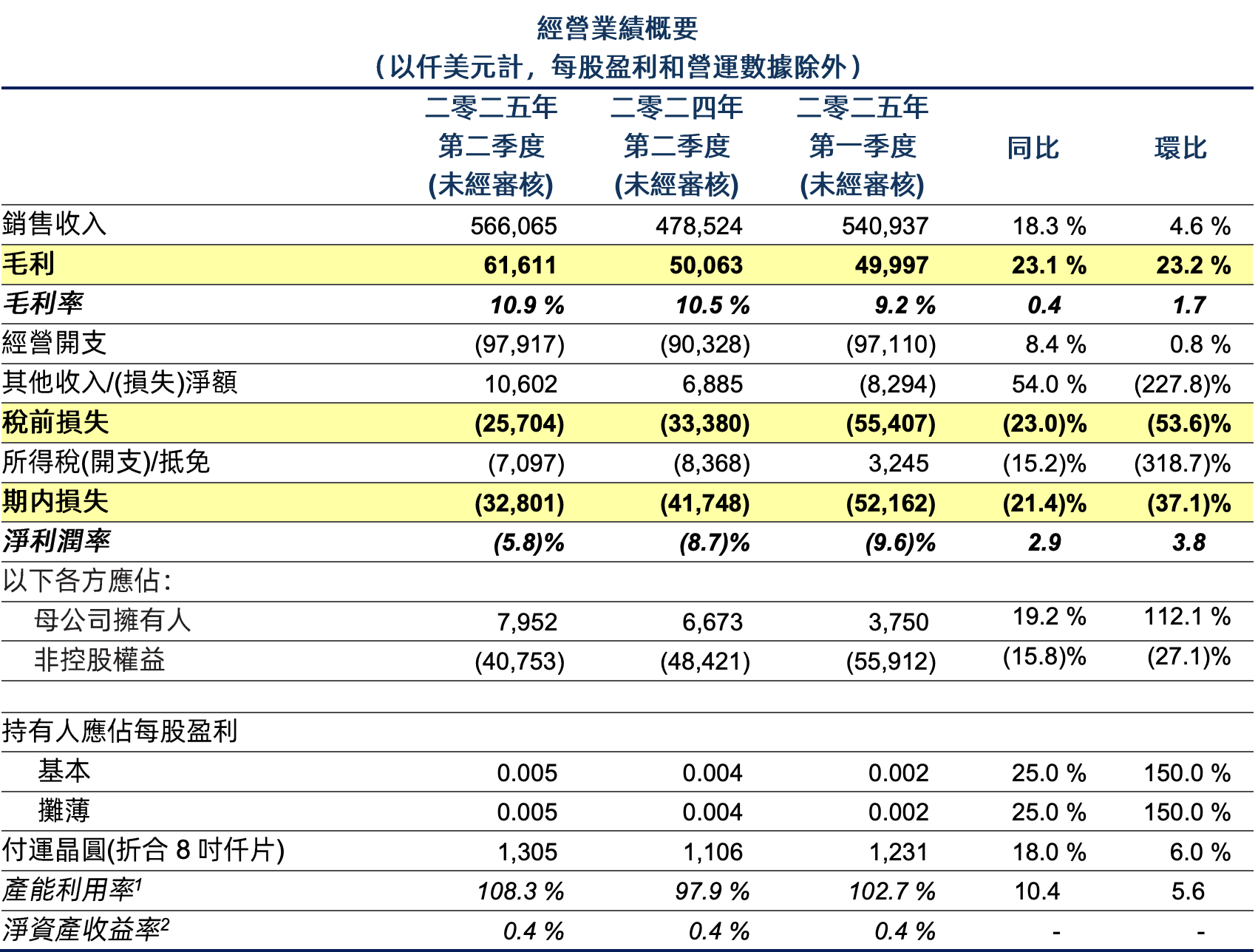
Core Insights - Huahong Semiconductor reported a strong year-on-year revenue growth in Q2, driven primarily by the 12-inch wafer business, while net losses narrowed [1][3]. Financial Performance - Revenue reached $566.1 million, an 18.3% increase year-on-year and a 4.6% increase quarter-on-quarter [2][9]. - Gross margin was 10.9%, up 0.4 percentage points year-on-year but down 1.7 percentage points quarter-on-quarter [1][9]. - Net loss was $32.8 million, a reduction of 21.4% compared to the previous year [1][9]. Capacity and Operations - Monthly capacity for 8-inch wafers was 447,000 pieces with a utilization rate of 108.3% [1][2]. - Monthly capacity for 12-inch wafers was 1.305 million pieces, a year-on-year increase of 18% [1][2]. - Overall capacity utilization remained high, indicating stable demand [1]. Revenue Breakdown - The 12-inch wafer business became the main growth driver, contributing $333.8 million, which is 59% of total revenue [4][5]. - The 8-inch wafer revenue was $232.3 million, down 5.4% year-on-year, accounting for 41% of total revenue [4][5]. Process Node Performance - The 90-95nm process node showed significant growth with revenue of $145.4 million, up 52.6% year-on-year [5]. - The 65nm process also performed well with revenue of $125.5 million, a 27.4% increase [5]. - Mature process nodes saw declines, with 0.11-0.13μm down 6.8% and 0.15-0.18μm down 4.7% [5]. End Market Distribution - Consumer electronics remained the largest segment, accounting for 63.1% of revenue, growing 21.8% year-on-year [6][7]. - Communication applications saw a significant increase of 59.3%, reaching $161.2 million, with its share rising to 28.5% [6][7]. - Industrial and automotive applications grew more modestly, at 16.6% and 9.4% respectively [6]. Cash Flow and Investment - Operating cash flow improved significantly to $169.6 million, a 75.1% increase year-on-year [8]. - Capital expenditures were high at $385.6 million, exceeding operating cash flow, indicating ongoing capital investment needs [8][9]. - Free cash flow was negative at $216 million, highlighting the need for continued external financing [9].