南向资金流向

Search documents
基金周报(20260316-20260320):上周南向资金净流入超500亿港元-20260316
Caixin Securities· 2026-03-16 10:09
Market Overview - The A-share market showed mixed performance last week, with the Shanghai Composite Index rising by 0.19% while the CSI 500 fell by 1.44% and the STAR 50 dropped by 2.88%. The ChiNext 50 index increased by 2.62% [7][9] - In the H-share market, the Hang Seng Index decreased by 1.13%, while the Hang Seng Tech Index rose by 0.62% [7][9] - Major overseas equity markets experienced declines, with the S&P 500 down by 1.60% and the NASDAQ 100 down by 1.06% [7][9] Bond Market - The yield on China's long-term bonds increased, with the 30-year, 10-year, and 1-year government bond yields reported at 2.3665%, 1.8143%, and 1.2768% respectively, reflecting changes of 8.53 basis points, 3.33 basis points, and -0.90 basis points compared to the previous week [10] - U.S. Treasury yields also rose, with the 30-year, 10-year, and 1-year yields at 4.90%, 4.28%, and 3.66% respectively, each increasing by 13 basis points [10] Commodity Prices - Gold prices fell, with COMEX gold futures closing at $5021 per ounce, down 2.27%, and Shanghai gold closing at 1131.25 RMB per gram, down 0.63% [11] - Copper prices also declined, with LME copper settling at $12758 per ton, down 0.39% [11] - In contrast, crude oil prices increased, with WTI crude at $98.71 per barrel, up 8.59%, and Brent crude futures at $103.14 per barrel, up 11.27% [12][14] Fund Market Activity - The total number of public funds in the market reached 13,845, with a total net asset value of approximately 37.14 trillion RMB. In the week of March 16-20, 24 new funds were launched, including 4 actively managed equity funds and 8 passive index equity funds [16][18] - Southbound capital saw a net inflow of approximately 5430.55 million HKD last week, reversing the previous week's outflow of over 80 million HKD [15]
负债行为跟踪:两融先降后升,ETF流出可控
ZHONGTAI SECURITIES· 2026-03-08 09:02
1. Report Industry Investment Rating - Not provided in the content 2. Core View of the Report - This week, the global risk - averse sentiment has increased, and global risk assets have declined in resonance. The A - share market has also fallen but shows stronger resilience. The short - term decline does not mean the end of the bull market, and the "Spring Rally" is currently in the third stage [4][13] 3. Summary by Relevant Catalogs 3.1 Market Overview - **Global Market**: Affected by the US - Iran conflict, global stock markets generally declined this week, with South Korean and European stock markets experiencing significant drops. US, Japanese, and German government bond yields rose significantly, while Chinese bond yields slightly declined by 0.7bp. Global commodities saw precious metals fall, and crude oil and natural gas prices rise significantly. The US dollar index rose, and most other currencies depreciated [16] - **A - share Market**: Except for the dividend index, most broad - based indices fell this week, with the Science and Technology Innovation 50 leading the decline at - 4.9%. The trading volume of broad - based indices decreased, with the daily average trading volume of Wande A - share dropping from over 3 trillion on Monday and Tuesday to below 2.5 trillion from Wednesday to Friday. The weekly average trading volume of Wande A - share increased from 2.4 trillion to 2.6 trillion [22][25] 3.2 Industry Performance - **Industry Trends**: This week, the media sector led the decline at - 6.38%, while the top five rising industries were petroleum and petrochemicals (9.06%), coal (7.11%), public utilities (5.77%), agriculture, forestry, animal husbandry and fishery (4.23%), and banks (1.64%) [32] - **Technology Sector**: Since February, sectors such as optical communication, high - frequency PCB, high - speed copper connection, solid - state batteries, and liquid cooling have had excess returns. Since March, only optical modules, optical communication, and controllable nuclear fusion have had certain excess returns. From Wednesday to Friday, sectors such as storage, robots, and commercial aerospace rose with reduced trading volume [33][36] 3.3 Fund Flows - **ETF Funds**: The outflow speed of representative broad - based ETFs has changed little. From January 14th to the end of January, the average daily net outflow of CSI 300 ETF was over 14 billion, and since February, it has slowed to about 1 billion. Since February, the average daily net outflow of SSE 50 ETF has been less than 1 billion, compared with over 5 billion previously. The outflows of SSE Composite, Science and Technology Innovation 50, and CSI 1000 ETFs have slowed down compared with last week, while those of CSI 300, SSE 50, and CSI 500 ETFs have slightly accelerated [40][43] - **Leveraged Funds**: The proportion of margin trading turnover has decreased from 10.08% to 9.23%, and the margin trading balance has decreased from 2.67 trillion to 2.65 trillion. However, there were improvement signals on Thursday. Most industries have de - leveraged, but transportation, petroleum and petrochemicals, coal, food and beverages, textile and apparel, and non - ferrous metals have increased leverage. Stocks of all market - cap gradients have de - leveraged, with large - cap stocks having a larger de - leveraging amplitude. Hot stocks in transportation, petroleum and petrochemicals, non - ferrous metals, and storage have mostly increased leverage [44][52][56] - **Quantitative Funds**: Since March, the excess return of CSI 500 quantitative index enhancement has continued to rise, with a median of 1.5%, while that of CSI 1000 quantitative index enhancement has fallen to - 0.01% [67] - **Main Funds**: From Monday to Wednesday, the main funds in CSI 300, ChiNext, and the Science and Technology Innovation Board had net outflows, with a large outflow on Tuesday. On Thursday, the main funds turned into net inflows, and on Friday, there was a slight net outflow. Overall, the sentiment of the main funds improved after Thursday [74][78] - **North - bound Funds**: This week, the total trading volume of north - bound funds has increased, with the average daily trading volume rising from 323.8 billion to 344.3 billion, and the proportion of A - share trading volume dropping from 13.3% to 13.0%, but still remaining at a relatively high level above 13%. The median of the weekly performance of the top 50 heavy - holding stocks of north - bound funds has risen from - 0.35% to 0.79%, indicating a possible net inflow of north - bound funds [12][82][86] - **South - bound Funds**: This week, the average daily trading volume of south - bound funds has increased from 224.4 billion to 230.6 billion, and the proportion has risen from 47.8% to 52.8%. The average daily net purchase amount has decreased from 460 million to - 140 million. The inflow of south - bound funds into the electronics, communication, computer, medicine, and commerce and retail industries has decreased, while the inflow into the banking, media, and non - bank sectors has increased [90][92][93]
南向资金单日净卖出创纪录,什么情况?
证券时报· 2026-03-06 04:26
Core Viewpoint - The recent fluctuations in southbound Hong Kong Stock Connect funds have drawn market attention, showcasing extreme trends of significant net buying and record sell-offs [2][4]. Group 1: Fund Flow Dynamics - On March 5, southbound Hong Kong Stock Connect funds recorded a net sell-off of 27.735 billion HKD, setting a historical record for single-day net selling [4]. - Prior to this, from February 27 to March 2, there were two consecutive trading days with net buying exceeding 10 billion HKD [4]. - In February 2026, the cumulative net buying of southbound Hong Kong Stock Connect funds reached approximately 90.6 billion HKD, with notable single-day net buying exceeding 10 billion HKD on multiple occasions [4]. Group 2: Market Reactions and Influences - The market lacks a unified perspective on the recent volatility of southbound fund flows, which may be influenced by heightened risk aversion due to geopolitical tensions, fluctuating expectations of Federal Reserve interest rate cuts, and the offshore characteristics of the Hong Kong market [6]. - On the day of the record sell-off, several stocks such as Alibaba, Zijin Mining, and Meituan saw significant reductions in holdings by southbound funds, with Alibaba's holdings decreasing by approximately 8.8395 million shares, translating to a reduction of around 1 billion HKD [6][7]. Group 3: Divergence in Stock Performance - Despite the significant net sell-off, certain stocks like Tencent Holdings, China Petroleum, and BYD received increased investments from southbound funds, indicating a divergence in stock performance within the market [7].


智通港股通资金流向统计(T+2)|2月24日
智通财经网· 2026-02-23 23:32
Core Insights - The top three stocks with net inflows of southbound funds are Yingfu Fund (02800) with 3.77 billion, Alibaba-W (09988) with 2.38 billion, and Tencent Holdings (00700) with 2.33 billion [1] - The top three stocks with net outflows are China Pacific Insurance (02601) with -282 million, CICC (03908) with -162 million, and China Gold International (02099) with -152 million [1] - In terms of net inflow ratios, Huaxia Hang Seng Technology (03088) leads with 879.94%, followed by Southern East-West Select (03441) with 591.15%, and Southern Hong Kong-US Technology (03442) with 309.32% [1] Net Inflow Rankings - Yingfu Fund (02800) had a net inflow of 3.77 billion, representing a 45.74% increase, closing at 27.480 (+0.37%) [2] - Alibaba-W (09988) saw a net inflow of 2.38 billion, with a 28.67% increase, closing at 160.100 (-0.25%) [2] - Tencent Holdings (00700) experienced a net inflow of 2.33 billion, with a 17.95% increase, closing at 548.000 (-0.54%) [2] Net Outflow Rankings - China Pacific Insurance (02601) had a net outflow of -282 million, with a -69.02% decrease, closing at 38.920 (-2.70%) [2] - CICC (03908) experienced a net outflow of -162 million, with a -52.09% decrease, closing at 21.960 (+0.83%) [2] - China Gold International (02099) saw a net outflow of -152 million, with a -46.72% decrease, closing at 201.000 (+3.40%) [2] Net Inflow Ratio Rankings - Huaxia Hang Seng Technology (03088) had a net inflow ratio of 879.94%, with a net inflow of 65.88 million, closing at 6.965 (+0.72%) [3] - Southern East-West Select (03441) recorded a net inflow ratio of 591.15%, with a net inflow of 57.37 million, closing at 11.650 (+0.52%) [3] - Southern Hong Kong-US Technology (03442) achieved a net inflow ratio of 309.32%, with a net inflow of 4.71 million, closing at 8.850 (+0.45%) [3]


南向资金追踪|流入趋势中断净卖出近19亿港元 大举加仓腾讯减持快手
Xin Lang Cai Jing· 2026-02-09 10:29
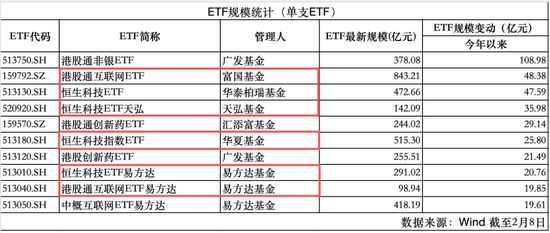
Core Viewpoint - Southbound funds experienced a net outflow of approximately 18.87 billion HKD today, ending a seven-day inflow trend, despite the overall Hong Kong stock market showing signs of recovery [2][3]. Southbound Fund Activity - Today's southbound trading volume reached about 1004.32 billion HKD, an increase of approximately 120 billion HKD compared to the previous day, accounting for 39.37% of the total turnover of the Hang Seng Index [2]. - The net outflow from the Shanghai-Hong Kong Stock Connect was about 16.44 billion HKD, while the Shenzhen-Hong Kong Stock Connect saw a net outflow of approximately 2.42 billion HKD [2]. ETF Performance - The two major ETFs, the Tracker Fund of Hong Kong (盈富基金) and the Hang Seng China Enterprises Index ETF (恒生中国企业), faced net sell-offs of 45.54 billion HKD and 10 billion HKD, respectively, indicating a short-term trading style favoring "buy low, sell high" [2]. Individual Stock Performance - Tencent Holdings (腾讯控股) saw a significant net buy of 18 billion HKD and an increase in stock price by 2.28%, with a five-day accumulation of 913,000 shares [2][4]. - Longi Green Energy (长飞光纤光缆) experienced a net buy of 1.69 billion HKD and a price increase of 15.31%, with a five-day accumulation of 143,000 shares [2][4]. - Semiconductor Manufacturing International Corporation (中芯国际) had a net buy of 1.48 billion HKD and a price increase of 4.07%, although it remained primarily in a net outflow position over the short term [3][4]. - Kuaishou Technology (快手-W) faced a net outflow of 5.67 billion HKD and a price drop of 2.74%, with a five-day reduction of 802,000 shares [3][4]. - China Mobile (中国移动) saw a net outflow of 2 billion HKD and a price decrease of 2.12%, despite a five-day accumulation of 585,000 shares [3][4].





布局港股!南向资金,连续7日净流入
Xin Lang Cai Jing· 2026-02-08 23:37
Core Insights - Southbound capital has been consistently flowing into the Hong Kong stock market since the beginning of 2026, with a net inflow of 56.6 billion yuan as of February 8, marking seven consecutive trading days of net buying [1] - The trend indicates a shift in investment focus from traditional high-dividend sectors to technology growth sectors, with Hong Kong tech leaders attracting significant attention due to their low valuations and high growth potential [2][4] Group 1: Southbound Capital Inflows - As of February 8, southbound capital has recorded a net buying amount of 56.6 billion yuan, with the last three trading days seeing net purchases exceeding 10 billion yuan each [1] - On February 5, the net buying amount reached a recent high of 22.206 billion yuan, indicating strong investor interest [1] - The trend of inflows is supported by the performance of various ETFs, particularly those focused on technology and consumer sectors [1][2] Group 2: ETF Performance - Several cross-border ETFs have seen significant growth, with the top performers including the Hang Seng Technology ETF and the Hong Kong Stock Connect Consumer ETF, reflecting investor enthusiasm for Hong Kong stocks [1][2] - The newly launched Hong Kong Stock Connect Technology ETF by Ping An Fund has also gained traction, increasing by 862 million yuan since its inception [1] Group 3: Market Valuation and Future Outlook - The Hang Seng Technology Index is currently trading at a price-to-earnings ratio of 22.38, which is lower than major global market indices, suggesting potential for valuation recovery [3] - Analysts believe that the valuation and earnings of Hong Kong stocks may see moderate expansion in 2026, driven by improved economic growth and corporate profitability [4] - There is a growing consensus among foreign investors regarding the investability of Chinese assets, with a notable shift of long-term capital from Europe and the U.S. towards the Chinese market [4]
南向资金追踪|净买入超9亿港元 大举加仓腾讯减持中芯国际和阿里
Xin Lang Cai Jing· 2026-02-03 10:32
Core Viewpoint - Southbound funds in Hong Kong experienced a decrease in trading volume, with a total of approximately HKD 126.4 billion, down by HKD 11.9 billion from the previous day, representing 37.72% of the total turnover of the Hang Seng Index, marking a short-term low [2]. Group 1: Southbound Fund Flow - Southbound funds recorded a net inflow of approximately HKD 0.952 billion today, with the Shanghai-Hong Kong Stock Connect seeing a net inflow of about HKD 1.733 billion, while the Shenzhen-Hong Kong Stock Connect had a net outflow of HKD 0.781 billion [2]. - The largest ETF, the Tracker Fund of Hong Kong (盈富基金), faced a net sell-off of HKD 3.762 billion, indicating continued outflows from certain funds [2]. Group 2: Individual Stock Performance - Tencent Holdings (0700.HK) saw a significant net buy of HKD 1.955 billion, despite a price drop of 2.92% [2][4]. - China Mobile (00941.HK) experienced a net buy of HKD 0.408 billion, with a slight price increase of 0.38% [2][4]. - Meituan-W (03690.HK) had a net buy of HKD 0.241 billion, with a price decline of 1.74% [2][4]. - Notable net outflows included Semiconductor Manufacturing International Corporation (00981.HK) at HKD 1.577 billion, Alibaba-W (09988.HK) at HKD 1.199 billion, and Kuaishou-W (01024.HK) at HKD 0.368 billion [2][4]. Group 3: Recent Trading Trends - Over the past five trading days, Tencent Holdings saw an increase of 663,000 shares, indicating continued short-term inflow [3]. - In contrast, China Mobile and Meituan-W experienced reductions in holdings of 4.164 million shares and 655,000 shares respectively, suggesting a trend of outflow [3]. - Kuaishou-W had an increase of 424,000 shares, indicating a short-term inflow despite a price drop of 4.61% [3].


净卖出超34亿港元 加仓腾讯减持阿里及紫金矿业
Xin Lang Cai Jing· 2026-01-28 10:20
Core Viewpoint - Southbound capital saw a significant increase in trading volume today, reaching approximately HKD 137.85 billion, but still experienced a net outflow of about HKD 34.27 billion, marking a continuous outflow trend over the past four trading days totaling approximately HKD 64.88 billion [2][3]. Trading Activity - Southbound trading accounted for 38.13% of the total turnover of the Hang Seng Index today, with a notable net outflow from the Shanghai-Hong Kong Stock Connect of approximately HKD 47.72 billion and a net inflow from the Shenzhen-Hong Kong Stock Connect of about HKD 13.45 billion [2]. - Major stocks with significant net inflows included Tencent Holdings (HKD 1.21 billion), Pop Mart (HKD 734 million), Yangtze Optical Fibre (HKD 298 million), and CloudWalk Technology (HKD 74 million) [3]. - Conversely, stocks with substantial net outflows included Alibaba (HKD 945 million), Zijin Mining (HKD 854 million), China Mobile (HKD 748 million), and SMIC (HKD 379 million) [3]. Stock Performance - Tencent Holdings increased by 2.31%, with a cumulative reduction of approximately 80,000 shares over the past five days, but has seen a return of capital in the last three days [4]. - Pop Mart surged by 7.03%, with an increase of 19.44 million shares over the past five days, indicating a continued inflow trend [5]. - Yangtze Optical Fibre rose by 15.43%, despite a reduction of 6.78 million shares in the previous five days, suggesting a short-term outflow [5]. - CloudWalk Technology experienced a significant increase of 73.79%, with an addition of 440,000 shares over the past five days, indicating accelerated inflow [5]. - Alibaba saw a rise of 2.12%, with an increase of 27.08 million shares over the past five days, maintaining a short-term inflow trend [5]. - Zijin Mining increased by 3.13%, but has seen a reduction of 49.81 million shares over the past five days, indicating a short-term outflow [5]. - China Mobile rose by 3.06%, with a reduction of 21.9 million shares over the past five days, continuing the outflow trend [5]. - SMIC increased by 3.52%, with an addition of 44.02 million shares over the past five days, indicating a short-term inflow trend [5].

平安好医生(01833.HK):1月23日南向资金增持113.43万股
Sou Hu Cai Jing· 2026-01-23 19:24
Group 1 - The core viewpoint of the news highlights the recent trading activity of Ping An Good Doctor (01833.HK), indicating a net increase in holdings by southbound funds on January 23, with an increase of 1.1343 million shares [1] - Over the past five trading days, there were three days of net reductions by southbound funds, totaling a net decrease of 4.9908 million shares [1] - In the last twenty trading days, southbound funds increased their holdings on fifteen days, resulting in a cumulative net increase of 18.4475 million shares [1] - Currently, southbound funds hold 477 million shares of Ping An Good Doctor, accounting for 22.04% of the company's total issued ordinary shares [1] Group 2 - Ping An Health Medical Technology Co., Ltd. operates in the healthcare sector, providing medical and health services through mobile platforms and offline resources [2] - The company conducts its business through two segments: the medical services segment, which includes online consultations, referrals, appointment scheduling, hospitalization arrangements, disease diagnosis, and related sales of pharmaceuticals and medical devices [2] - The health services segment offers a variety of standardized health service packages that integrate services from medical health institutions, addressing user health needs across multiple categories such as physical examinations, elderly care, dental services, anti-aging, and general health [2]

净买入逾52亿港元 加仓阿里及小米流出中移动
Xin Lang Cai Jing· 2026-01-22 11:55
Core Viewpoint - Southbound capital continues to flow into Hong Kong stocks, with a net inflow of approximately 52.39 billion HKD today, marking the fifth consecutive trading day of inflows [2][3]. Group 1: Market Overview - Today's southbound trading volume was about 931.59 billion HKD, a decrease of approximately 158 billion HKD from the previous day, accounting for 39.68% of the total turnover of the Hang Seng Index, falling below 40% [2]. - The Hong Kong stock market exhibited a mixed performance, with the three major indices showing varied results [2]. Group 2: Stock Performance - Significant net buying by southbound capital included: - Alibaba-W (09988.HK): 14.13 billion HKD - China National Offshore Oil Corporation (00883.HK): 5.92 billion HKD - Kuaishou-W (01024.HK): 4.79 billion HKD - China Life (02628.HK): 4.45 billion HKD - Pop Mart (09992.HK): 3.74 billion HKD - Xiaomi Group-W (01810.HK): 4.47 billion HKD [3]. - Major net outflows included: - China Mobile (00941.HK): 8.74 billion HKD - Tencent Holdings (0700.HK): 6.69 billion HKD - Horizon Robotics-W (09660.HK): 1.21 billion HKD [3]. Group 3: Individual Stock Insights - Alibaba-W increased by 0.98%, with a net accumulation of 2.042 million shares over the past five days, indicating a short-term focus on inflows [4]. - China National Offshore Oil Corporation rose by 2.52%, but saw a reduction of 836,000 shares over the past five days, suggesting a prevailing trend of outflows [5]. - Kuaishou-W experienced a slight increase of 0.38%, with a reduction of 401,000 shares over the past five days, indicating a slowdown in outflows [5]. - China Life decreased by 3.82%, with a net accumulation of 3.234 million shares over the past five days, showing a trend of inflows [5]. - Pop Mart surged by 5.97%, with a net accumulation of 196,000 shares over the past five days, indicating sustained inflows [5]. - Xiaomi Group-W fell by 0.51%, with a net accumulation of 917,000 shares over the past five days, continuing the trend of inflows [5]. - China Mobile declined by 0.25%, with a reduction of 4.235 million shares over the past five days, indicating a continued trend of outflows [5]. - Tencent Holdings dropped by 0.83%, with a net accumulation of 470,000 shares over the past five days, suggesting a slowdown in inflows [5]. - Horizon Robotics-W fell by 4.31%, with a reduction of 1.004 million shares over the past five days, indicating a signal of outflows [5].