卡尔达舍夫等级

Search documents
马斯克xAI再失联合创始人,12人创始团队已有6人离场
机器之心· 2026-02-11 08:34
Core Insights - xAI, co-founded by Elon Musk and 11 others in 2023, has seen a significant turnover with 6 out of 12 founding members leaving the company, raising concerns about its stability and future direction [1][4]. Group 1: Leadership Changes - Jimmy Ba, a co-founder, announced his departure from xAI, marking his last day at the company and expressing pride in the team's achievements [2]. - Wu Yuhua, another co-founder, also left xAI shortly before Jimmy Ba, indicating a trend of leadership changes within the company [3]. - The departures are part of a broader internal restructuring, with responsibilities being redistributed among remaining co-founders [4]. Group 2: Company Context and Challenges - The departures of founding members are occurring against the backdrop of xAI's impending IPO and the completion of SpaceX's acquisition, which may create pressure for performance and talent retention [8]. - Recent issues with xAI's flagship product, the Grok chatbot, including erratic behavior and potential internal tampering, have raised concerns about the technical team's cohesion and the company's operational stability [8]. - The company faces significant scrutiny as it prepares for its IPO, with the need to deliver on ambitious plans and keep pace with competitors like OpenAI and Anthropic [8][9].


马斯克念念不忘的“火星梦”,为什么突然转向月球了?
3 6 Ke· 2026-02-10 11:37
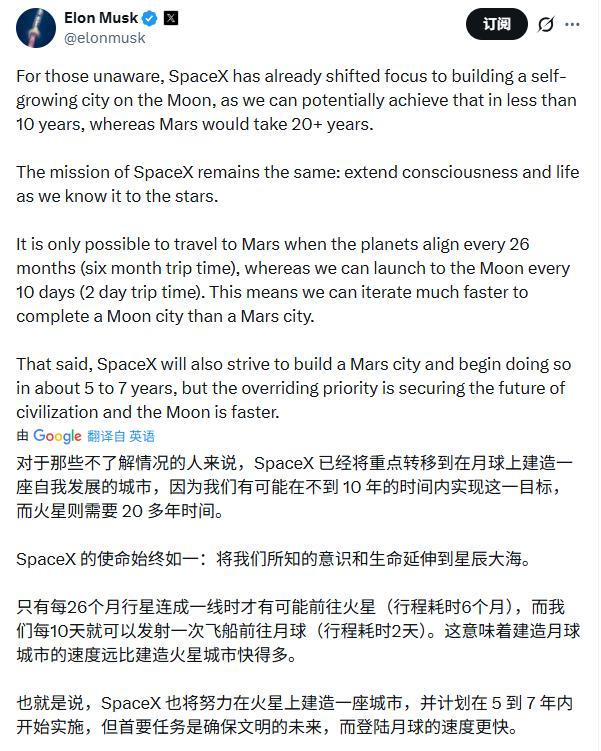
Core Viewpoint - Elon Musk announced a strategic shift for SpaceX, prioritizing the construction of a self-sustaining city on the Moon over the long-term goal of Mars colonization, citing concerns over potential supply disruptions from Earth due to natural or man-made disasters [1][3][5]. Group 1: Strategic Shift - The decision to focus on the Moon is based on the need for speed, as reaching Mars involves long wait times for rescue and supplies, making it less viable for initial colonization [3][4]. - The Moon offers more frequent launch windows (approximately every 10 days) and shorter travel times (around 2 days), allowing for quicker emergency responses and better survival prospects for initial bases [4][5]. - Musk estimates that a self-sustaining lunar city could be developed in less than 10 years, while a Martian city would take over 20 years due to longer iteration cycles [5]. Group 2: Lunar City Blueprint - The proposed lunar city, likely named "Alpha Lunar Base," is expected to be located near the Moon's south pole, where water ice may be found, crucial for supporting life and fuel production [6][9]. - The base will not be a temporary camp but designed for self-expansion and long-term survival, featuring modular habitats and energy solutions, potentially including nuclear power [6][7]. Group 3: SpaceX's Role and Partnerships - SpaceX is deeply integrated into NASA's plans for lunar exploration, having been selected to develop the crewed landing system for the Artemis III mission, with a contract worth nearly $3 billion [10]. - The development of the Starship rocket system is critical for transporting large modules and equipment to the Moon, with the potential for significant cost reductions due to its reusability [10][11]. - Other companies, such as Blue Origin, are also competing for lunar contracts, indicating a competitive landscape for lunar exploration and development [12]. Group 4: Future Technologies and AI Integration - Musk's vision includes relocating AI computational infrastructure to space, with plans for solar-powered data centers in orbit, potentially utilizing the Moon as a manufacturing base for AI satellites [15][16]. - This initiative could lead to a significant leap in energy utilization levels, as envisioned by the Kardashev Scale, with the potential to produce substantial computational power from lunar resources [16][18].
马斯克,100万颗卫星申请获受理
3 6 Ke· 2026-02-05 07:35
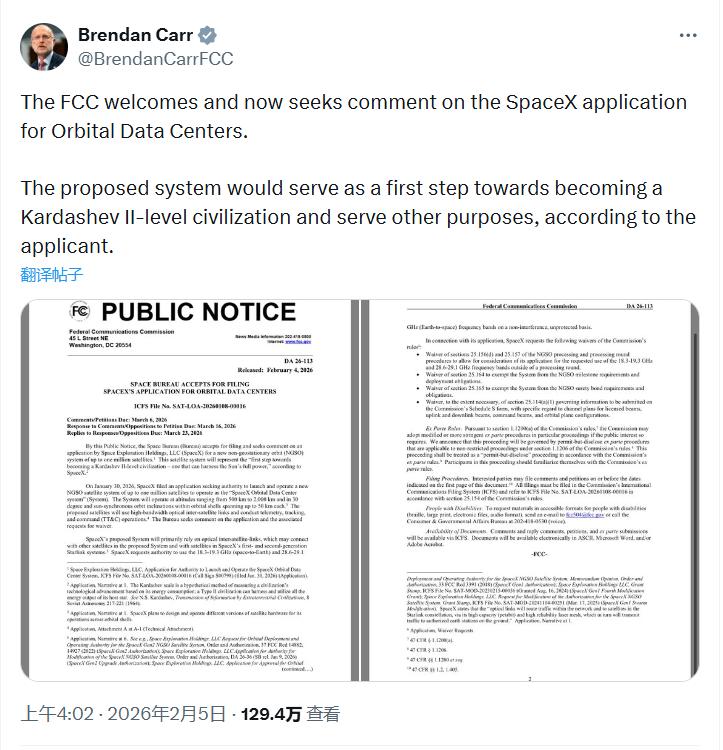
Core Viewpoint - SpaceX is advancing its vision of transforming the night sky into a solar-powered AI brain by proposing a satellite system that could deploy up to one million satellites to support AI computing needs in space [1][8]. Group 1: FCC Application and Approval - The Federal Communications Commission (FCC) has accepted SpaceX's proposal for a "non-geostationary satellite system" aimed at relocating high-energy AI computing to space [2]. - The FCC is seeking public comments on the application, with a deadline set for March 6, 2026 [4]. Group 2: Technical Details of the Satellite System - The proposed satellite system will operate at altitudes between 500 kilometers and 2000 kilometers, utilizing a sun-synchronous orbit to maximize solar energy [9]. - The network will connect with SpaceX's existing Starlink system, allowing for data routing and processing in orbit before transmission to ground stations [10]. Group 3: Strategic Implications and Future Plans - SpaceX's satellite project is described as a step towards achieving a "Type II Kardashev civilization," which involves harnessing energy from a star system [11]. - The project is also a key driver for SpaceX's potential initial public offering (IPO), which could raise billions of dollars [11].
马斯克设想:每年发射1百万吨AI卫星
财联社· 2025-12-08 05:24
Core Viewpoint - The next significant leap in artificial intelligence may occur in space rather than on Earth due to infrastructure and energy supply bottlenecks [1][3]. Group 1: Elon Musk's Vision - Elon Musk proposed that localized AI computing satellites in low-latency sun-synchronous orbits could become the most cost-effective way to transmit AI data within three years [2][3]. - Musk envisions launching 1 million tons of satellites annually, each equipped with 100 kW of power, which could add 100 GW of AI computing capacity each year without operational or maintenance costs [3]. - The concept includes building satellite factories on the Moon and using mass drivers to accelerate AI satellites to escape velocity, potentially achieving over 100 TW of AI computing capacity annually [3][4]. Group 2: Challenges in AI Development - The rapid growth in AI model sizes and demand is putting significant pressure on existing data centers, fiber networks, and power systems [5]. - There is a need for new energy sources to keep pace with the increasing demand, while also considering factors like latency, climate risks, and political obstacles [5]. Group 3: Competing Projects - Google's "Project Suncatcher" aims to create orbiting computing nodes powered by continuous solar energy, which could operate machine learning models more efficiently than ground-based data centers [6]. - Amazon's "LEO" project seeks to establish a global broadband network of low Earth orbit satellites, potentially providing edge computing services for AI tasks in underserved areas [7]. - Musk is also conceptualizing an "orbital computing farm" for xAI and SpaceX, which would not only run AI models but also train them, addressing the challenges of continuous energy supply and resource consumption [7].
前端危,Gemini 3内测结果获网友一致好评,“有史以来最强前端开发模型”
3 6 Ke· 2025-10-13 23:51
Core Insights - Google's next-generation flagship model, Gemini 3, has gained significant attention even before its official release due to its impressive capabilities [1] - Users have shared positive feedback on Gemini 3's performance, particularly in front-end development and multi-modal tasks [1][3] Group 1: Model Features - Gemini 3.0 Pro utilizes a MoE architecture with trillions of parameters, activating only 15-20 billion parameters per query, and has expanded its context window from 1 million to several million [4] - The model includes a deep thinking mode and supports multi-modal inputs such as video, images, and audio [4] - In a challenging general intelligence test, Gemini 3.0 achieved an accuracy rate of nearly 35%, outperforming other models which scored below 20% [6] Group 2: Performance Highlights - User tests indicate that Gemini 3.0 excels in programming and multi-modal tasks, particularly in front-end and interface design [9] - The model successfully generated a visually appealing website for an ancient art museum and handled complex tasks related to the Kardashev scale [9] - In the "HLE benchmark," considered one of the toughest tests, Gemini 3.0 scored 32.4%, surpassing GPT-5 and Grok 4 [10] Group 3: Visual and Creative Capabilities - Gemini 3.0 demonstrated significant improvements in rendering images, producing high-quality game backgrounds, and creating intricate SVG graphics [12][15] - The model effectively understood physical principles and accurately counted objects in images, showcasing its advanced reasoning capabilities [21] Group 4: Anticipated Release - There are speculations about the release date of Gemini 3.0, with rumors suggesting it may launch on October 22, following earlier incorrect predictions [23][24] - Internal documents allegedly leaked from Google have fueled these release date discussions [24]