名义增速

Search documents
刷新纪录!美国GDP第一次突破30万亿,中国占比却卡在六成?
Sou Hu Cai Jing· 2026-02-22 11:07
Group 1 - The core point of the article is the comparison of GDP between the United States and China, highlighting that while the US is projected to reach a GDP of $30 trillion by 2025, China is at approximately $19.6 trillion, representing about 63% of the US figure [1][10][28] - The growth rates are crucial, with the US maintaining a growth rate of around 2% while China is between 4% and 5%, suggesting that if this trend continues, the GDP ratio could change over the years [3][10] - The quality of growth is emphasized, with the US focusing on high-profit sectors such as chips, operating systems, and cloud services, which provide significant pricing power globally [3][5] Group 2 - The revenue models of leading global companies, predominantly American, rely on long-term subscriptions and patent royalties, resulting in slower expansion but higher profits [5] - China's economy is characterized by a solid manufacturing base and a complete industrial chain, with sectors like new energy and high-end manufacturing on the rise [5][22] - Research and development investments in China are increasing, but the country still lacks full control over core technologies and standards, which are essential for determining profit distribution [6][20] Group 3 - Historical context shows that major power competition is often determined by industrial waves rather than single-year performances, with current key areas being artificial intelligence and clean energy [8][26] - The nominal GDP figures can be misleading due to inflation and exchange rate fluctuations, with nearly $900 billion of the US GDP growth attributed to price increases rather than actual production [12][18] - The purchasing power parity (PPP) perspective indicates that China's GDP may already surpass that of the US, although nominal values are often used for international rankings [14][18] Group 4 - The US dollar's dominance in global trade and finance gives it significant pricing power, affecting how GDP is calculated and perceived internationally [16][20] - The structural differences in industry and development stages between the US and China are highlighted, with the US being a high-income society and China still transitioning towards that status [24][26] - The potential for China to convert its manufacturing advantages into technological and brand advantages is crucial for future growth and profit margins [26][28]

显微镜下的中国经济(2025年第31期):增长数据下滑为何未影响资产价格走势
CMS· 2025-08-18 15:38
Economic Data Trends - Industrial added value growth in July was 5.7% year-on-year, slowing by 1.1 percentage points from June[1] - Fixed asset investment growth was 1.6% year-on-year, down 1.2 percentage points from the first half of the year[1] - Retail sales of consumer goods increased by 3.7% year-on-year, a decline of 1.1 percentage points from June[1] Market Performance - The Shanghai Composite Index surpassed 3700 points, increasing by 1.7% week-on-week[1] - Daily trading volume in the two markets consistently exceeded 2 trillion yuan[1] - The 10-year government bond yield approached 1.80%, indicating a downward trend in bond prices[1] Factors Influencing Asset Prices - The slowdown in economic growth is not a new marginal change, as weak investment and consumption have been anticipated by the market[1] - Nominal growth may have replaced real growth as a key driver of market trends, with CPI and PPI showing signs of improvement on a month-on-month basis[1] - Increased market risk appetite is evident, with advancements in AI and biomedicine reducing perceived risks from U.S.-China trade disputes[1] Monetary Policy and Foreign Investment - Expectations for a U.S. Federal Reserve rate cut in September may support the appreciation of the yuan, attracting foreign investment in RMB-denominated assets[1] - The positive feedback loop between currency appreciation and foreign capital inflow could sustain a moderate upward trend in A-shares[1] Risks to Consider - Geopolitical risks, domestic policy implementation falling short of expectations, and global recession concerns remain potential threats to market stability[1]
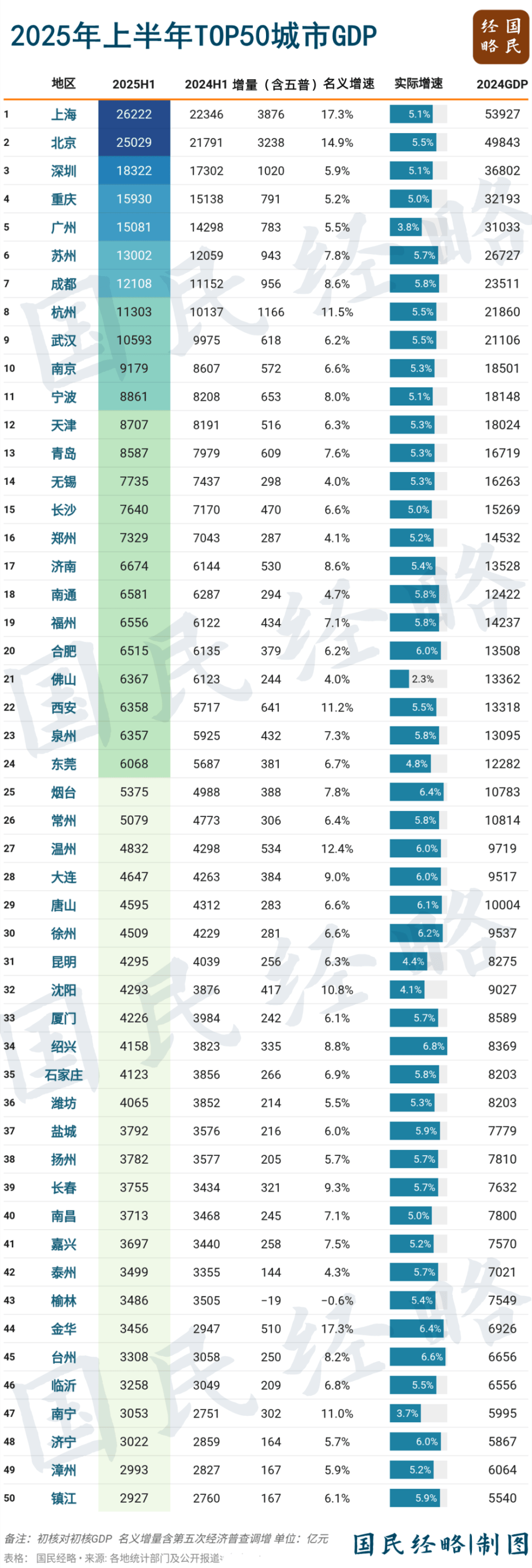
最新GDP公布!全国50强城市,又变了
Sou Hu Cai Jing· 2025-08-01 07:50
Group 1 - The core viewpoint of the article emphasizes the competitive landscape among cities, highlighting the impact of geopolitical shifts, tariff wars, and national strategies on urban economic performance [1] - The top 10 cities by GDP remain unchanged, with Guangzhou showing signs of recovery, narrowing the gap with Chongqing, while Hangzhou has increased its lead over Wuhan [3][5] - Emerging cities like Ningbo and Qingdao are closing the gap with established cities, indicating a competitive race for the 10th largest city status [3][16] Group 2 - Guangzhou's GDP for the first half of 2025 reached 1.5 trillion yuan, with a year-on-year growth of 3.8%, marking a V-shaped recovery [11][12] - The city's industrial output has rebounded, with significant growth in new energy vehicles and other emerging sectors, indicating a shift from traditional industries [13][14] - The article notes that while resource-dependent cities like Yulin and Ordos have high per capita GDP, they are experiencing nominal GDP declines due to falling commodity prices, highlighting the risks of over-reliance on single industries [23][26] Group 3 - The article discusses the competition for the 10th largest city status, with Nanjing, Tianjin, Ningbo, and Qingdao as key contenders, emphasizing Ningbo's rapid growth due to its port advantages and resilient private economy [20][21] - The external trade dependency of cities like Ningbo is highlighted, with a trade dependency rate of 80%, raising concerns about vulnerability to external economic fluctuations [20][22] - The article concludes that cities must diversify their economies to mitigate risks associated with reliance on specific industries, particularly in the face of global market volatility [26]