
商品市场情绪回暖

Search documents
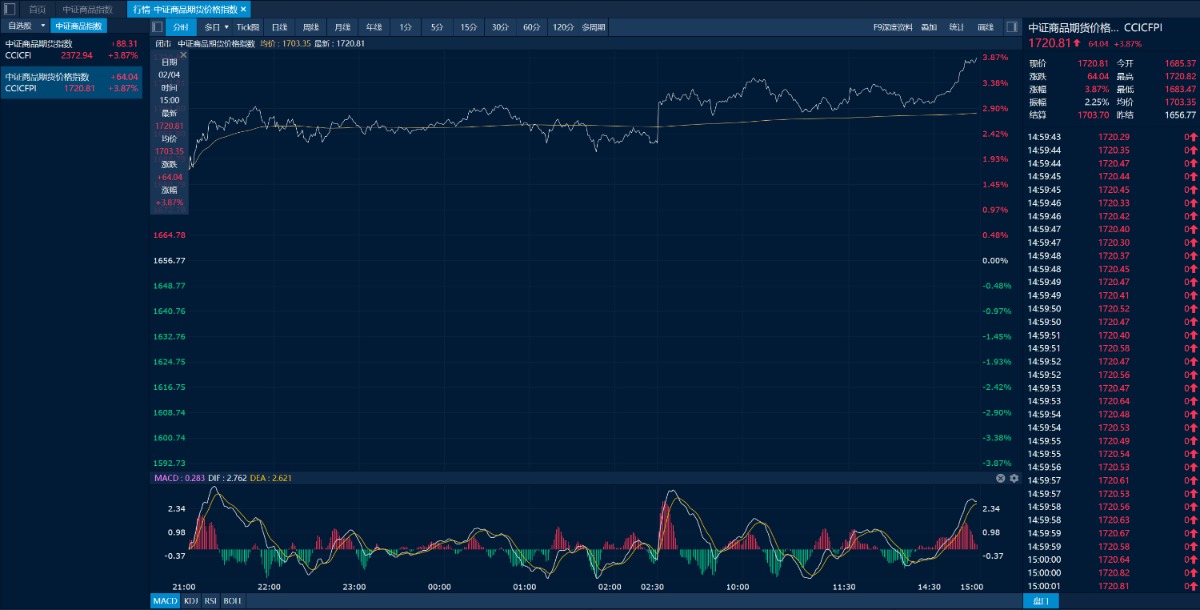
商品日报(2月4日): 商品情绪全面回暖 沪银大涨超11%
Xin Hua Cai Jing· 2026-02-04 12:02
Group 1: Market Overview - The domestic commodity futures market experienced widespread gains on February 4, with notable increases in various sectors, including silver rising over 11% and gold over 7% [1][2] - The China Securities Commodity Futures Price Index closed at 1720.81 points, up 64.04 points or 3.87% from the previous trading day [1] Group 2: Precious Metals - Precious metals and non-ferrous metals are seeing a resurgence, with silver and gold leading the recovery as market panic subsides [2] - The rise in precious metals is supported by ongoing buying interest and geopolitical tensions, particularly regarding Iran, despite the risks of misjudgment and military conflict [2] Group 3: Tin Market - Tin futures surged due to concerns over supply stability following an earthquake in Myanmar, a major tin-producing country [3] - The supply issues are critical, as Myanmar's core production area contributes 90% of the country's tin output, and current production is constrained by tight supply [3] Group 4: Other Commodities - The polysilicon futures continued to rise, recording a 4.25% increase driven by favorable supply and demand dynamics [3] - The energy and chemical sectors also strengthened, with high and low sulfur fuel oil contracts rising over 3% and other commodities like SC crude oil and styrene increasing by over 2% [3] Group 5: Weakness in Soybean Meal - Soybean meal and rapeseed meal continued to decline, with respective decreases of 0.88% and 0.48%, marking the fourth consecutive day of losses [4] - The market is under pressure from expectations of abundant soybean harvests in Brazil, which may exacerbate the supply-demand imbalance [4] Group 6: Caustic Soda Market - Caustic soda saw a slight rebound during the day but ultimately closed down 0.75% due to weak fundamentals [5] - The market remains pressured by high inventory levels and weak demand, particularly from the alumina sector, which has seen a drop in operating rates [5]

宝成期货:焦煤追高需谨慎
Qi Huo Ri Bao· 2026-01-09 00:48
Core Viewpoint - Coking coal futures prices have surged at the beginning of the year, with a significant increase in trading volume and a notable drop in the auction failure rate, although prices have only slightly risen [1] Group 1: Market Dynamics - Coking coal futures prices rose sharply due to a recovery in commodity market sentiment, with strong performance in non-ferrous metals, precious metals, and new energy metals since October 2025 [1] - The current supply-demand dynamics in the coking coal market have not shown substantial improvement, with domestic supply increasing steadily as many coal mines in major production areas resume operations [1] Group 2: Supply Analysis - From January 1 to 5, 2026, 49 coal mines resumed production, involving a capacity of 75.05 million tons, indicating a potential month-on-month increase in output [1] - As of January 8, 2026, the capacity utilization rate of 523 coking coal mines was 85.3%, with an average daily output of 1.899 million tons, reflecting significant month-on-month increases of 5.7 percentage points and 127,000 tons respectively [1] - The average daily customs clearance volume at the Ganqimaodu port for Mongolian coal was 191,100 tons last month, showing month-on-month and year-on-year increases of 6.14% and 130% respectively [1] Group 3: Demand Analysis - Steel mills have begun to resume production, with an average daily pig iron output of 2.2743 million tons reported by 247 sample steel mills as of January 7, 2026, marking a slight increase from previous lows [2] - Despite some improvement in raw material demand, uncertainties remain due to ongoing losses in long-process steel mills and high inventory levels in the downstream market, which may limit the ability to absorb increased supply from steel mills [2] - Overall, while there is some improvement in coking coal demand, the growth potential appears limited, necessitating close monitoring of the winter storage replenishment pace and intensity by downstream steel and coking plants [2]
瑞达期货锰硅硅铁产业日报-20250514
Rui Da Qi Huo· 2025-05-14 09:08
1. Report Industry Investment Rating - No information about the report industry investment rating is provided in the content. 2. Core Viewpoints - On May 14, the manganese - silicon 2509 contract closed at 5864, up 0.62%. The spot price of Inner Mongolia silicon - manganese remained stable at 5600. After the Sino - US Geneva economic and trade talks, the commodity market sentiment improved. The supply side has production losses, and the enthusiasm for spot production is low. The port inventory of imported manganese ore has increased by 231,000 tons this period, and the overall arrival of manganese ore in May is expected to increase month - on - month. The downstream hot metal production shows signs of peaking and falling, and price fluctuations may increase after the demand falls. The steel mills' procurement is cautious, and the tender quantity has decreased month - on - month. Technically, the 4 - hour cycle K - line is between the 20 and 60 moving averages, and it should be treated as a volatile operation [2]. - On May 14, the ferrosilicon 2507 contract closed at 5678, up 1.07%. The spot price of Ningxia ferrosilicon remained stable at 5510. The US will lift long - term sanctions on Syria, and Saudi Arabia promises to invest $600 billion in the US. The ferroalloy currently has negative production profit. The maintenance of large factories in Ningxia affects market sentiment, and the settlement electricity price in Ningxia in April has been reduced, weakening cost support. The downstream magnesium metal market quotation has rebounded, and the overall steel demand expectation is still weak. Attention should be paid to market sentiment disturbances under tariff policy changes. Technically, the 4 - hour cycle K - line is below the 20 and 60 moving averages, and it should be treated as a volatile operation [2]. 3. Summary According to Relevant Catalogs 3.1 Futures Market - SM (manganese - silicon) main contract closing price: 5864 yuan/ton, up 54 yuan; SF (ferrosilicon) main contract closing price: 5678 yuan/ton, up 66 yuan [2]. - SM futures contract position: 626,642 hands, down 5460 hands; SF futures contract position: 489,971 hands, down 790 hands [2]. - Net position of the top 20 in manganese - silicon: - 32,624 hands, down 8931 hands; net position of the top 20 in ferrosilicon: - 28,459 hands, down 4089 hands [2]. - SM 1 - 9 month contract spread: 54 yuan/ton, down 4 yuan; SF 1 - 9 month contract spread: 50 yuan/ton, up 10 yuan [2]. - SM warehouse receipts: 118,693 sheets, down 587 sheets; SF warehouse receipts: 19,048 sheets, unchanged [2]. 3.2 Spot Market - Inner Mongolia manganese - silicon FeMn68Si18: 5600 yuan/ton, up 50 yuan; Inner Mongolia ferrosilicon FeSi75 - B: 5610 yuan/ton, unchanged [2]. - Guizhou manganese - silicon FeMn68Si18: 5550 yuan/ton, unchanged; Qinghai ferrosilicon FeSi75 - B: 5520 yuan/ton, unchanged [2]. - Yunnan manganese - silicon FeMn68Si18: 5600 yuan/ton, unchanged; Ningxia ferrosilicon FeSi75 - B: 5510 yuan/ton, unchanged [2]. - Manganese - silicon index average (weekly): 5497 yuan/ton, down 105.42 yuan; SF main contract basis (daily): - 168 yuan/ton, down 66 yuan [2]. - SM main contract basis (daily): - 264 yuan/ton, down 4 yuan [2]. 3.3 Upstream Situation - South African ore: Mn38 block: Tianjin Port (daily): 32 yuan/ton degree, unchanged; silica (98%, northwest, daily): 210 yuan/ton, unchanged [2]. - Inner Mongolia Wuhai secondary metallurgical coke (daily): 1070 yuan/ton, unchanged; semi - coke (medium material, Shenmu, daily): 670 yuan/ton, unchanged [2]. - Manganese ore port inventory (weekly): 3.948 million tons, up 231,000 tons [2]. 3.4 Industry Situation - Manganese - silicon enterprise operating rate (weekly): 37.53%, down 3.21 percentage points; ferrosilicon enterprise operating rate (weekly): 32.53%, up 1.78 percentage points [2]. - Manganese - silicon supply (weekly): 172,025 tons, down 10,780 tons; ferrosilicon supply (weekly): 102,900 tons, up 3900 tons [2]. - Manganese - silicon manufacturer inventory (half - monthly): 207,100 tons, up 25,300 tons; ferrosilicon manufacturer inventory (half - monthly): 73,700 tons, down 9900 tons [2]. - Manganese - silicon national steel mill inventory (monthly, days): 15.44 days, down 1.17 days; ferrosilicon national steel mill inventory (monthly, days): 15.44 days, down 0.82 days [2]. - Five major steel types' manganese - silicon demand (weekly): 125,861 tons, down 2350 tons; five major steel types' ferrosilicon demand (weekly): 20,336.3 tons, down 224.1 tons [2]. 3.5 Downstream Situation - 247 steel mills' blast furnace operating rate (weekly): 84.64%, up 0.29 percentage points; 247 steel mills' blast furnace capacity utilization rate (weekly): 92.11%, up 0.08 percentage points [2]. - Crude steel output (monthly): 92.8414 million tons, up 16.8722 million tons [2]. 3.6 Industry News - Bill Gates said that the US technology blockade on China has achieved the opposite effect, promoting China's full - speed development in chip manufacturing and other fields [2]. - Ukrainian President Zelensky said he would only participate in the talks on the Ukraine war with Russia this week if Putin also attends [2]. - Japanese Prime Minister Ishiba Shigeru hinted that increasing corn imports from the US would be an option in trade negotiations with the US, and Japan can use corn as ethanol fuel [2]. 3.7 Profit Situation - Inner Mongolia manganese - silicon spot profit: - 135 yuan/ton; Ningxia manganese - silicon spot profit: - 200 yuan/ton [2]. - Inner Mongolia ferrosilicon spot profit: - 1200 yuan/ton; Ningxia ferrosilicon spot profit: - 60 yuan/ton [2].