国产自主化

Search documents
有人开价4000亿估值买长江存储老股了
投中网· 2026-03-25 07:33
Core Viewpoint - The article discusses the rising interest and valuation of Yangtze Memory Technologies Co., Ltd. (YMTC) in the market, driven by its strong financial performance, upcoming IPO plans, and technological advancements in the NAND flash memory sector [4][10]. Group 1: Company Performance and Valuation - YMTC's post-investment valuation in 2023 was 160 billion yuan, which has now surged to 400 billion yuan as buyers show interest in acquiring shares [3][6]. - The company reported a net profit of several billion yuan in 2024, significantly ahead of expectations, with a 20% year-on-year increase in the first half of 2025 [6][10]. - The anticipated IPO is expected to be one of the largest in China's tech sector, with a projected valuation between 160 billion and 300 billion yuan [8][10]. Group 2: Market Dynamics and Trends - The demand for YMTC's shares has intensified since mid-2025, with reports of shares being traded at inflated valuations [7][10]. - The company is positioned to benefit from a "super cycle" in the global storage chip market, driven by AI computing needs, with NAND prices expected to rise significantly [17][18]. - The successful IPO of another storage chip company, Changxin Technology, is seen as a potential positive influence on YMTC's market performance [18]. Group 3: Technological Advancements - YMTC has established itself as the largest domestic manufacturer of 3D NAND flash memory, achieving significant technological milestones since its inception [12][13]. - The company has consistently improved its product offerings, with the latest being the 267-layer 3D NAND TLC chip, which was mass-produced in September 2025 [12][13]. - YMTC's market share in NAND flash memory reached 10% in Q1 2025 and increased to 13% by Q3 2025, marking a substantial growth in its competitive position [13].


泛亚微透定增募资6.71亿元 持续强化科创实力
Zhong Zheng Wang· 2026-02-12 14:07
Core Viewpoint - Pan-Asia Micro透 (688386) has successfully completed a private placement of shares at a price of 78 yuan per share, raising a total of 671 million yuan, with 18 institutional and individual investors participating in the offering [1] Group 1: Fundraising and Investment Projects - The raised funds will be allocated to projects including the intelligent manufacturing upgrade and expansion of the dew point controller (CMD) products, low dielectric loss flexible copper-clad laminate (FCCL) project, research and development center construction, and working capital supplementation [1][2] - The CMD product is a key category for the company, with a projected compound annual growth rate (CAGR) of 101% in sales revenue from 2022 to 2024, increasing its share of main business revenue from 5.69% in 2022 to 16.13% in 2024 [2] Group 2: Product Development and Technology - The low dielectric loss FCCL project aims to produce high-frequency, high-speed flexible copper-clad laminates without adhesive, designed for flexible circuit board applications, leveraging the company's core ePTFE/PTFE membrane technology [3] - The R&D center construction project will enhance the company's technological capabilities, supporting product development and innovation to meet future market demands [3] Group 3: Intellectual Property and Innovation - The company has recently obtained a national invention patent for a graphene carbon heat-conducting sheet and reversible desiccant membrane component for automotive headlights, reflecting its core technological advancements [4] - The implementation of the fundraising projects is expected to expand production capacity, improve efficiency, and facilitate the industrialization of high-end innovations, reinforcing the company's technological strength [4]

马克龙访华不到1月,中方对欧盟这一领域加征关税,法国受伤最重
Sou Hu Cai Jing· 2025-12-28 13:15
Group 1 - China's trade surplus with Europe has surpassed $1 trillion, leading Western leaders to view this trade as unsustainable due to the imbalance where China sells significantly more to Europe than it purchases [2] - In response to the EU's tariffs on Chinese electric vehicles, China will implement temporary anti-subsidy measures on EU dairy products starting December 23, with subsidy rates ranging from 21.9% to 42.7%, significantly impacting French dairy producers [5][9] - The dairy industry is currently the only sector where China can impose retaliatory measures against Europe, as other high-tech industries have been restricted by the EU, limiting China's ability to retaliate effectively [7] Group 2 - In 2025, China imported 156,000 tons of cheese, with 14.5% coming from Europe, while New Zealand accounted for 60% of China's cheese imports, indicating a shift in consumer preference towards New Zealand products due to increased costs from European dairy [5] - European leaders, including Macron, have overestimated their global standing and underestimated China's resolve against unfair trade practices, leading to a lack of significant improvement in trade relations despite diplomatic visits [9][10] - The EU's previous attempts to limit China's manufacturing growth through climate agreements have backfired, as Europe now finds itself reliant on China's advancements in renewable energy and electric vehicles, prompting a reconsideration of their policies [12][13]

9只定增股翻倍,最高赚274%
2 1 Shi Ji Jing Ji Bao Dao· 2025-12-26 06:20
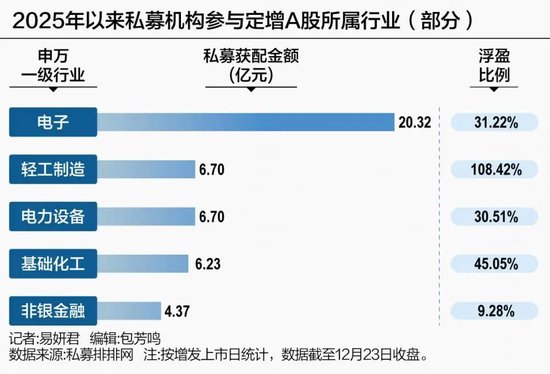
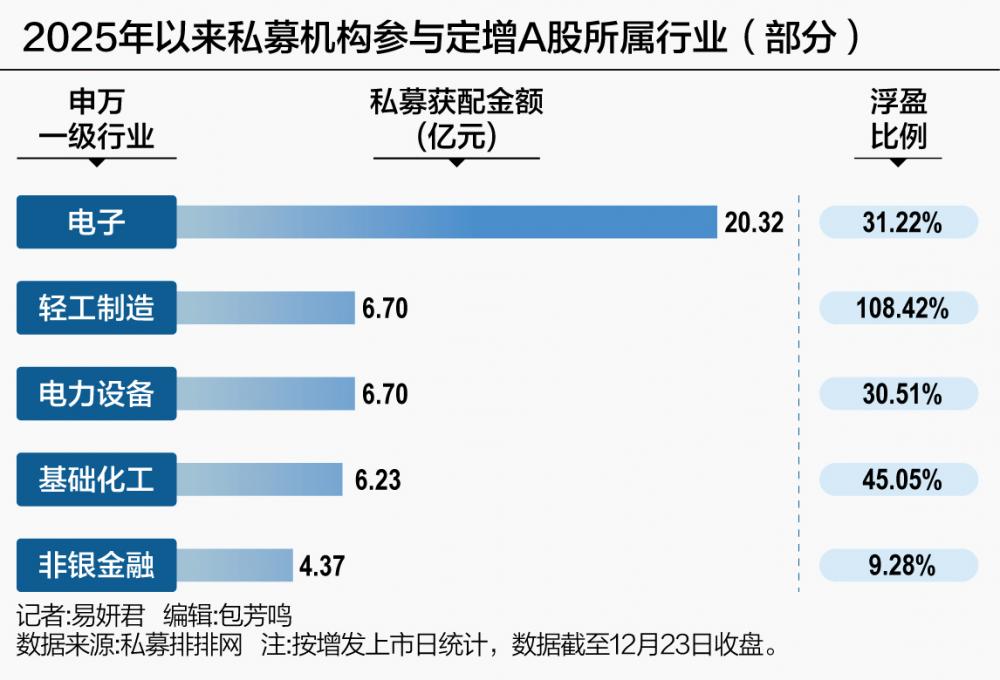
Core Insights - The A-share private placement market has shown significant profitability since 2025, with 52 private equity firms investing nearly 6 billion yuan and achieving a floating profit of over 2.7 billion yuan [1][3][9]. Group 1: Market Overview - In 2025, the A-share private placement market rebounded significantly, with 158 companies conducting private placements, raising over 850 billion yuan, a year-on-year increase of more than 400% [3]. - The majority of companies that conducted private placements this year have seen their stock prices rise post-listing, with over 40% of these companies experiencing price increases exceeding 50% [3]. Group 2: Private Equity Participation - A total of 52 private equity firms participated in private placements this year, with a total allocation amounting to 5.98 billion yuan, representing a 23.48% increase from the previous year [3][4]. - The electronic industry was the most favored sector, with private equity firms allocating 2.03 billion yuan across 10 electronic stocks, accounting for 33.98% of total allocations [4][5]. Group 3: Investment Strategies - Private equity firms have adopted diverse strategies, with smaller firms achieving over 100% floating profits through high-risk investments, while larger firms prefer stable allocations to ensure safety margins [1][9]. - The electronic sector benefits from ongoing domestic innovation and global competitiveness, with private placements primarily aimed at capacity expansion, technology research, and industry chain integration [5][12]. Group 4: Performance Metrics - As of December 23, 2025, the overall floating profit from private equity participation in private placements reached 2.72 billion yuan, with a floating profit ratio of 45.55% [6][10]. - Among the 58 stocks involved in private placements, 54 are currently in a floating profit state, with 9 stocks showing floating profit ratios exceeding 100% [6][10]. Group 5: Sector-Specific Insights - The electronic industry, along with power equipment and light manufacturing sectors, attracted significant private equity investments, each receiving around 670 million yuan [5][8]. - Notable individual placements included companies like Lexin Technology and TCL Technology, which attracted over 200 million yuan each from private equity firms [6].
9只定增股翻倍,最高赚274%
21世纪经济报道· 2025-12-26 06:16
Core Viewpoint - The A-share private placement market has shown significant profitability since 2025, with 52 private equity firms investing nearly 6 billion yuan and achieving a floating profit of over 2.7 billion yuan, driven by precise stock selection [3][7]. Group 1: Market Overview - In 2025, the A-share private placement market experienced a notable recovery, with 158 companies conducting private placements, raising over 850 billion yuan, a year-on-year increase of more than 400% [7]. - Over 40% of companies that conducted private placements saw their stock prices rise by more than 50% after the shares were listed [7]. - Private equity firms participated enthusiastically, with a total allocation of 5.98 billion yuan, a 23.48% increase from the previous year [7]. Group 2: Sector Preferences - The electronics sector emerged as the most favored by private equity firms, with 10 electronic companies attracting a total of 2.03 billion yuan, accounting for 33.98% of total allocations [7][8]. - Other sectors such as power equipment and light industry also received significant attention, with each attracting 670 million yuan [8]. Group 3: Investment Performance - As of December 23, 2025, private equity firms achieved a total floating profit of 2.72 billion yuan, with an overall floating profit ratio of 45.55% [9]. - Among the 58 stocks involved in private placements, 54 are currently in a floating profit state, with 9 stocks having a floating profit ratio exceeding 100% [9]. - Notably, Demingli's floating profit ratio reached 274.19%, contributing nearly 441 million yuan to private equity firms [9][10]. Group 4: Private Equity Firm Strategies - Large private equity firms adopted a more conservative investment style, while smaller firms favored growth strategies, achieving higher floating profits [12][13]. - Smaller private equity firms with assets under 5 billion yuan reported floating profit ratios exceeding 100%, while mid-sized firms also performed well, with some achieving floating profit ratios above 50% [13][14]. - The overall trend indicates that 50 out of 52 private equity firms involved in private placements reported floating profits, highlighting the effectiveness of their investment strategies [14].

浮盈超27亿 52家私募豪掷60亿掘金定增 电子行业最受青睐
2 1 Shi Ji Jing Ji Bao Dao· 2025-12-25 23:11
Core Insights - The A-share private placement market has shown significant profitability since 2025, with 52 private equity firms investing nearly 6 billion yuan and achieving a floating profit of over 2.7 billion yuan [1][4][7] - The electronic industry is the most favored sector for private placements, with substantial investments and high floating profits observed [4][5][8] Investment Trends - In 2025, the A-share private placement market rebounded significantly, with 158 companies conducting private placements, raising over 850 billion yuan, a year-on-year increase of more than 400% [4] - Private equity firms have shown high enthusiasm for participating in private placements, with a total allocation amounting to 5.98 billion yuan, a 23.48% increase from the previous year [4][5] - The electronic sector attracted the most investment, with private equity firms allocating 2.03 billion yuan across 10 electronic companies, accounting for 33.98% of total allocations [4][5] Profitability Analysis - As of December 23, 2025, the overall floating profit from private placements reached 2.72 billion yuan, with a floating profit ratio of 45.55% [7] - Among the 58 stocks involved in private placements, 54 are currently in a floating profit state, with 9 stocks showing a floating profit ratio exceeding 100% [8] - Notable performers include Demingli, with a floating profit ratio of 274.19%, contributing nearly 441 million yuan in floating profit [8] Private Equity Firm Performance - Large private equity firms have adopted a more conservative investment style, while smaller firms have favored growth-oriented strategies, achieving higher floating profits [9][10] - Smaller private equity firms, particularly those managing between 5 billion and 20 billion yuan, have reported floating profit ratios exceeding 100% [10][11] - Overall, 50 out of 52 private equity firms involved in private placements have achieved floating profits, with over 30% of firms reporting floating profit ratios above 50% [11] Market Dynamics - The surge in private placement investments is attributed to a combination of market stabilization, policy benefits, and the inherent discount advantages of private placement projects [13][14] - Private equity firms leverage their stock selection capabilities and negotiation advantages to secure excess returns in structural market conditions, further driving their participation in the private placement market [14]
浮盈超27亿!52家私募豪掷60亿掘金定增 电子行业最受青睐
2 1 Shi Ji Jing Ji Bao Dao· 2025-12-25 14:18
Core Insights - The A-share private placement market has shown significant profitability since 2025, with 52 private equity firms investing nearly 6 billion yuan and achieving a floating profit of over 2.7 billion yuan [1][2]. Group 1: Market Overview - In 2025, the A-share private placement market experienced a notable recovery, with 158 companies conducting private placements, raising over 850 billion yuan, a year-on-year increase of more than four times [1]. - Over 40% of companies that conducted private placements this year saw their stock prices rise by more than 50% after the shares were listed [1]. Group 2: Investment Strategies - Private equity firms have adopted differentiated investment strategies, with smaller firms achieving over 100% floating profits through high-risk strategies, while larger firms prefer stable investments to build safety margins [1][6]. - The electronic industry is the most favored sector for private placements, with 33.98% of total allocations going to 10 electronic companies, amounting to 2.03 billion yuan [3]. Group 3: Sector Performance - The electronic sector benefits from ongoing domestic innovation and shows competitive advantages in global markets, with significant growth expected due to AI and robotics hardware advancements [3]. - Other sectors attracting private equity investments include power equipment and light industry manufacturing, each receiving 670 million yuan [3]. Group 4: Individual Project Highlights - Several private placement projects attracted over 200 million yuan from private equity firms, including projects from companies like Lexin Technology and TCL Technology [4]. - The overall floating profit from private placements reached 2.72 billion yuan, with a floating profit ratio of 45.55% [4]. Group 5: Performance of Private Equity Firms - Among the 52 private equity firms participating in private placements, 50 achieved floating profits, with over 30% of firms seeing profits exceeding 50% [7]. - Smaller private equity firms have reported higher floating profits, with some achieving over 270% returns on specific investments [7]. Group 6: Market Dynamics - The enthusiasm for private placements is driven by a combination of market stabilization, policy benefits, and the inherent discount advantages of private placement projects [9]. - Private equity firms leverage their stock-picking skills and negotiation advantages to secure excess returns in a structural market [9].
浮盈超27亿!52家私募豪掷60亿掘金定增,电子行业最受青睐
2 1 Shi Ji Jing Ji Bao Dao· 2025-12-25 13:08
Group 1 - The A-share private placement market has shown significant profitability since 2025, with 52 private equity firms investing nearly 6 billion yuan and currently holding a floating profit of over 2.7 billion yuan [1][3] - Among the 58 stocks involved in private placements, 54 are currently in a floating profit state, with 9 stocks having a floating profit ratio exceeding 100% [1][6] - The electronic industry is the most favored sector by private equity firms, with significant investments also flowing into the power equipment sector, indicating a trend of capital gathering towards technological innovation and domestic autonomy [1][4] Group 2 - In 2025, the A-share private placement market has rebounded significantly, with 158 listed companies conducting private placements, raising over 850 billion yuan, a year-on-year increase of more than 4 times [3] - The majority of private placement projects have yielded substantial floating profits, with over 40% of companies seeing their stock prices rise by more than 50% since the issuance of new shares [3][4] - Private equity firms have participated in 58 stocks across 17 primary industries, with the electronic sector receiving the highest allocation of 2.03 billion yuan, accounting for 33.98% of the total allocation [3][4] Group 3 - The electronic industry benefits from ongoing domestic autonomy and shows competitive advantages in global markets, with increased profitability and growth certainty expected in 2025 due to accelerating hardware iterations and supportive policies [4] - Private placements in the electronic sector are primarily used for capacity expansion, technological research and development, and industry chain integration, aligning with the long-term value investment philosophy of private equity firms [4][6] - Other favored sectors include power equipment and light industry manufacturing, each attracting 670 million yuan in private placement investments [4] Group 4 - Smaller private equity firms have achieved higher floating profits, with some firms reporting floating profit ratios exceeding 100%, while larger firms have adopted a more conservative investment style [7][8] - Among the 52 private equity firms involved in private placements, 50 have realized floating profits, with over 30% of firms achieving floating profit ratios above 50% [9][10] - The enthusiasm for private placements is driven by the stability of the A-share market and the advantages of discounted pricing, providing a natural safety net for private equity firms [11][12]


外资重点加仓A股高端制造业
2 1 Shi Ji Jing Ji Bao Dao· 2025-10-29 11:49
Core Insights - QFII continues to favor A-share core assets, particularly in high-end manufacturing and defensive sectors, reflecting a strategic shift towards tactical accumulation under domestic autonomy logic [1][7][11] - As of the end of Q3, nearly 40 QFII institutions held approximately 119.4 billion yuan in A-shares, indicating a significant foreign interest in the Chinese market [1][10] QFII Investment Trends - QFII has increased holdings in over 500 A-share companies, with notable investments in banking, electrical equipment, building materials, chemicals, software services, machinery, and hardware [2][3] - Major QFII purchases include 124 million shares of Nanjing Bank by BNP Paribas and 72.85 million shares of China West Electric by JPMorgan Securities, highlighting a focus on financial stability and growth potential [2][3] Key Stocks and Sectors - Significant QFII increases were observed in stocks such as Oriental Yuhong, Baofeng Energy, and Huasheng Tiancheng, with multiple QFII institutions accumulating shares [4][5] - The most heavily accumulated stocks include Nanjing Bank, China West Electric, and Shengyi Technology, with QFII holdings in these companies reaching substantial market values [11][12] Sector Analysis - The banking sector saw a total increase of 124 million shares, while electrical equipment and computer sectors also received notable QFII investments, driven by stable dividends and growth prospects [7][11] - QFII's diversified approach includes investments across various industries, such as machinery, food and beverage, and biopharmaceuticals, while maintaining a focus on leading companies and core assets [11][12] Future Outlook - Analysts suggest that QFII's continued interest in Chinese assets reflects confidence in the market's upward trajectory, despite potential short-term fluctuations [13][14] - High-profile institutions like Goldman Sachs and UBS maintain a positive outlook on Chinese equities, advocating for a diversified investment strategy that includes growth stocks and high cash yield portfolios [13][14]

新华财经|从“无”到“优” 科德数控以创新利刃破除高端工业母机壁垒
Xin Hua She· 2025-10-13 11:39
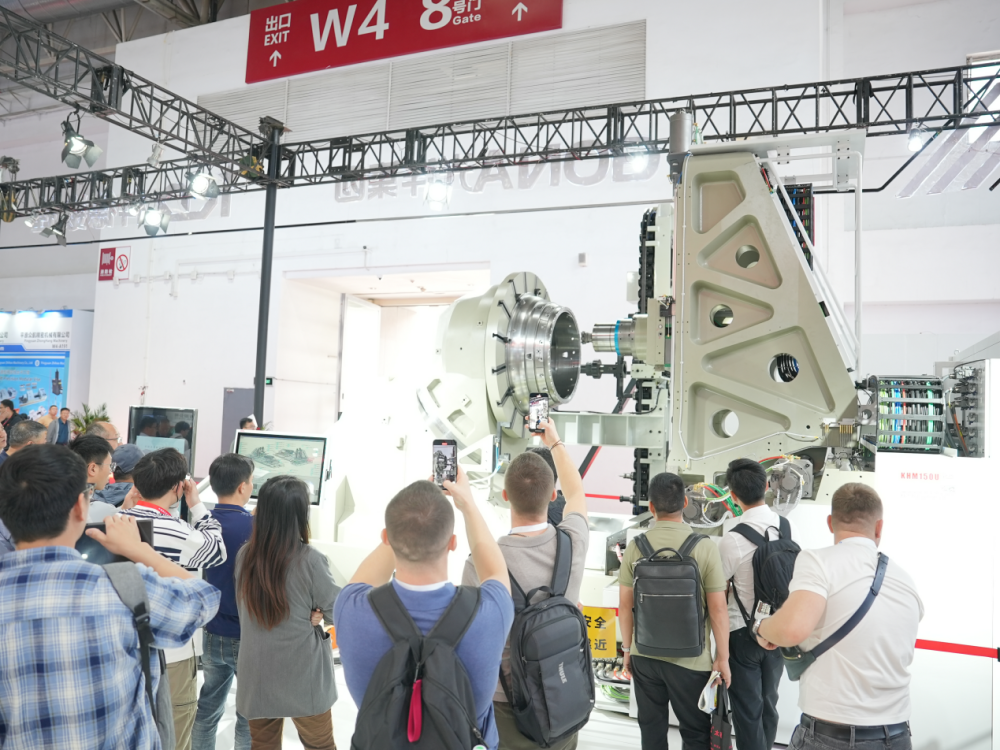
Core Viewpoint - The development of high-quality manufacturing in China relies on domestic high-end industrial mother machines, with Kede CNC Co., Ltd. emerging as a key player in this transformation through independent innovation and technology breakthroughs [1][2]. Group 1: Technological Breakthroughs - Kede CNC has achieved a full-chain technological breakthrough from the "brain" to the "body" of industrial mother machines, with its GNC60 open high-end CNC system being the only one in China to have all source code independently mastered [2]. - The company has invested an average of 32.09% of its revenue in R&D over the past three years, significantly exceeding the industry average, and has built a complete technology chain comprising CNC systems, key functional components, and high-end five-axis machine tools [2][3]. - Kede CNC has achieved an 85% self-manufacturing rate for core components and over 90% for domestic autonomy, addressing the industry's reliance on imported components [2]. Group 2: Market Applications and Growth - Kede CNC has expanded its product structure to serve various sectors, including aerospace, new energy vehicles, and precision molds, demonstrating its versatility in high-end equipment manufacturing [4]. - In 2024, Kede CNC secured new orders worth 78.08 million yuan, a year-on-year increase of approximately 24%, and its annual production capacity for high-end five-axis machine tools has surged from over 10 units a decade ago to 500 units currently [8]. - By mid-2025, Kede CNC's developed high-end five-axis machine tools have been applied in over 1,600 units across key domestic sectors, showcasing its successful market penetration [8]. Group 3: Collaborative Innovation - Kede CNC emphasizes the importance of collaboration in its strategic planning, engaging in partnerships with universities such as Tsinghua, Harbin Institute of Technology, and Beihang University to create an innovation system that spans basic research, technology breakthroughs, and industrial transformation [9]. - The company has established a test base for processing verification of key structural components for domestic large aircraft, collaborating with Shenyang Aerospace Industry Group and AVIC [9]. - Kede CNC aims to enhance its market capabilities by increasing R&D investment, upgrading production systems, and improving supply chain and service capabilities to contribute to the high-quality development of China's equipment manufacturing industry [9].