国企信仰

Search documents
永煤冲击难再现,债市难以复刻2020年末行情
Hua Er Jie Jian Wen· 2025-12-02 07:25
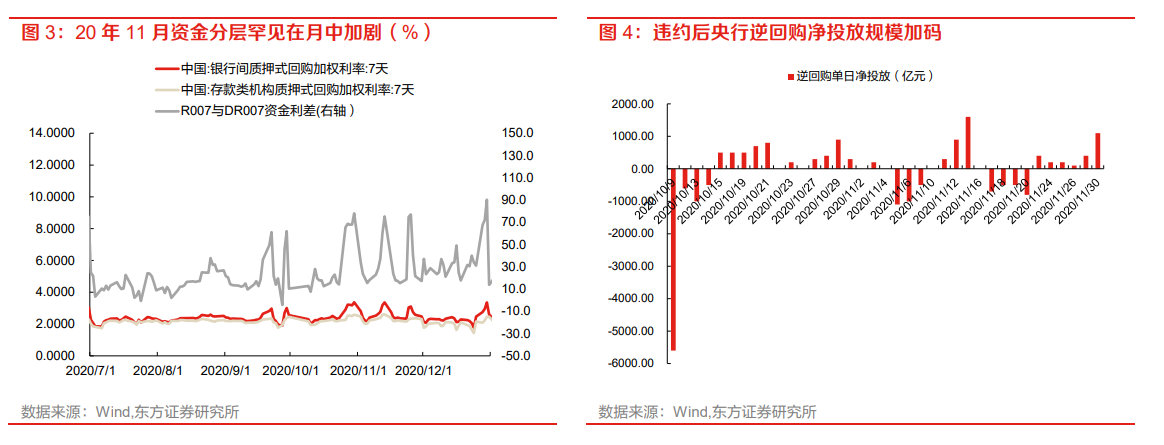
Core Viewpoint - The recent extension of Vanke's debt has drawn comparisons to the 2020 Yongmei default event, raising concerns about a potential repeat of significant adjustments in the bond market. However, Dongfang Securities argues that the current situation differs fundamentally from that of late 2020, suggesting that Vanke's extension will have a limited impact on market fundamentals and is unlikely to trigger systemic risks [1][2]. Group 1: Comparison with Yongmei Default - The market's tendency to draw parallels between Vanke's extension and the Yongmei default lacks a solid foundation, as the latter caused a collapse of "faith" in AAA-rated provincial state-owned enterprises, leading to a severe emotional shock and subsequent negative feedback from fund redemptions [2][3]. - The Yongmei default resulted in a rapid increase in yields for AAA and AA+ rated medium-term notes, with one-year yields rising by 14.4 and 17.4 basis points respectively during the week of the default, and reaching maximum increases of 28 and 54 basis points for the month [3]. - The central bank's swift response to the Yongmei event, including significant liquidity injections, helped stabilize the market quickly, contrasting with the current situation where the risk spread is minimal and does not necessitate similar interventions [8][9]. Group 2: Current Market Conditions - The weakening trend in the real estate sector is already a market consensus, and while Vanke's extension may have surprised some investors, it has not shattered any prevailing "faith," resulting in lower panic levels compared to the Yongmei event [9]. - The current credit risk diffusion is limited, and the negative feedback pressure on the funding and bond markets is manageable, meaning there is no need for large-scale central bank interventions [9][10]. - Looking ahead to December, the funding pressure is expected to remain controllable, with a decrease in the issuance scale of interest rate bonds and seasonal fluctuations in the funding market anticipated [10].


固定收益市场周观察:债市难以复刻2020年末行情
Orient Securities· 2025-12-02 02:42
Report Industry Investment Rating No information about the report industry investment rating is provided in the content. Core Viewpoints - The bond market is unlikely to replicate the situation at the end of 2020. The current credit risk event is unlikely to significantly change market expectations or prompt institutions such as banks and insurance companies to accelerate their entry into the bond market, and it may not change the main trading line of interest rate bonds [6][9][16]. - In December, the pressure on the capital market is expected to be controllable, but the overall trading opportunities in the bond market are still limited. The supply pressure of government bonds is controllable, and fiscal spending tends to increase at the end of the year. The bond market may continue its weak and volatile pattern, and the trading space is narrow [6][16]. Summary by Directory 1. Bond Market Weekly Viewpoint - Some investors compare Vanke's debt extension to Yongmei's default, believing that the bond market will replicate the situation at the end of 2020. However, the impact of Yongmei's default was mainly due to the panic after the collapse of the "state - owned enterprise belief" and the negative feedback of fund products, which is less likely to happen now. The central bank responds quickly to credit risk events, and this event is unlikely to change market expectations significantly [6][9][16]. - In 2020, after Yongmei's default, the credit bond market was sold off, leading to a marginal tightening of the capital market and a significant adjustment of interest rate bonds. There was a negative feedback in the fund product market. The central bank increased liquidity injection, and the market gradually stabilized after the financial regulatory authorities' statement [10][11][15]. - In contrast, Vanke's debt - extension has a lower panic - causing effect, and the probability of credit risk spreading to the interest rate and capital markets is weak. The capital market pressure in December is expected to be controllable, but the bond market trading opportunities are limited [16]. 2. This Week's Focus Points in the Fixed - Income Market 2.1 Next Week's Overseas Data - This week, important data will be released, including China's November foreign exchange reserves, the US November PMI, November ADP employment figures, and the Eurozone's November PMI and October PPI monthly rate [17][19]. 2.2 This Week's Interest Rate Bond Issuance - This week, the interest rate bond issuance scale is expected to be 456.7 billion yuan, which is at a medium level compared to the same period. Among them, the issuance scale of treasury bonds is expected to be about 218 billion yuan, local bonds are planned to be issued at 108.7 billion yuan, and policy - financial bonds are expected to be issued at about 130 billion yuan [19][20][21]. 3. Interest Rate Bond Review and Outlook 3.1 Reverse Repurchase Net Withdrawal - This week, the reverse repurchase net withdrawal was 16.42 billion yuan. The MLF was injected with 1 trillion yuan and 900 billion yuan matured. The treasury deposit was increased by 12 billion yuan, and the central bank bills were offset. The total net injection of open - market operations was 5.58 billion yuan. The capital interest rate showed a structural differentiation, and the repurchase trading volume decreased [26][27]. - The certificate of deposit issuance increased slightly, the net financing was negative, the short - term issuance interest rate increased, and the long - term secondary yield was relatively stable [33]. 3.2 Interest Rates of All Maturities Rose - Last week, due to the unstable liability side of fixed - income products and market concerns about the new fund regulations, the interest rate market adjusted. In the second half of the week, long - term bonds led the marginal repair of spot bonds. The yields of 10 - year treasury bonds and CDB bonds increased by 1.7bp and 2.5bp respectively. The yields of treasury bonds of all maturities increased, with the 7 - year treasury bond yield rising the most, by about 3.8bp [42][45]. 4. High - Frequency Data - On the production side, most operating rates declined. The blast furnace operating rate, semi - steel tire operating rate, and PTA operating rate decreased, while the asphalt operating rate increased. The average daily crude steel output in mid - November had a negative year - on - year growth rate of - 12.5% [6][54]. - On the demand side, the year - on - year growth rates of passenger car wholesale and retail improved. The year - on - year decline in commercial housing transaction area slightly narrowed. The SCFI and CCFI comprehensive indices changed by 0.7% and - 0.1% respectively [6][54][57]. - In terms of prices, crude oil, copper, and aluminum prices increased. The coking coal price decreased by 4.4%. The building materials comprehensive price index, cement index, and glass index increased. The rebar output decreased, and the inventory continued to decline to 3.85 million tons. The prices of vegetables, fruits, and pork changed by 1.9%, 1.8%, and - 0.4% respectively [6][57].
企业都好起来啦?不是AAA发债都拿不出手
3 6 Ke· 2025-09-15 05:17
Core Insights - The AAA-rated bonds dominate the new issuance market, with over 90% of new credit bonds issued in 2025 being AAA-rated, a significant increase of nearly 97% compared to 2016 [1][5] - The decline in market default data has reinforced the "state-owned enterprise belief," with a 73% year-on-year decrease in bond market defaults in the first half of 2025, primarily concentrated in a few bankruptcy restructuring cases [2][9] - The intense competition within the industry has led to a situation where rating agencies feel pressured to provide higher ratings, resulting in a dilution of rating standards [3][11] Market Dynamics - In the first eight months of 2025, 94.22% of new credit bonds issued were AAA-rated, compared to only 47.78% in the same period in 2016, indicating a significant shift in the bond issuance landscape [2][5] - The number of private enterprises issuing bonds has drastically decreased, with only 1% of bond issuers being private companies in 2025, down from 37% in 2016 [2][7] - The market's risk appetite has shifted, with institutional investors primarily favoring high-rated bonds, making it increasingly difficult for lower-rated issuers to access the market [8] Rating Agency Challenges - Rating agencies are facing pressure to maintain their long-term viability, as the low fees for rating services have led to a focus on immediate survival rather than building reputation [4][14] - The competitive landscape has intensified, with many agencies resorting to price wars and rating competitions, which undermines industry standards [11][12] - Regulatory scrutiny has increased, with several agencies facing penalties for non-compliance, highlighting the need for improved governance and adherence to standards [15][16] Future Outlook - Industry leaders emphasize the importance of enhancing compliance and building long-term credibility, suggesting that agencies should invest in talent development and focus on quality over quantity [14][16] - Recommendations for addressing the inflated ratings issue include improving the rating fee model, creating a balanced competitive structure, optimizing regulatory frameworks, and strengthening reputation constraints [16]
企业都好起来啦?不是AAA发债都拿不出手
经济观察报· 2025-09-14 04:34
Core Viewpoint - The article discusses the transformation of the credit rating industry in China, highlighting the overwhelming dominance of AAA-rated bonds in the market, driven by factors such as "state-owned enterprise faith," changes in issuer structure, intense competition, and regulatory reforms [1][6][13]. Group 1: Market Trends - In 2025, AAA-rated bonds accounted for over 90% of new credit bond issuances, a significant increase of nearly 97% compared to 2016 [3][9]. - The proportion of AAA-rated bonds among newly issued corporate bonds reached 85% in the first eight months of 2025, up from 40% in the same period in 2016 [5][10]. - The share of private enterprises in bond issuance has drastically decreased, with only 1% of issuers being private in 2025, down from 37% in 2016 [6][14]. Group 2: Investor Behavior - The decline in market defaults has reinforced the "state-owned enterprise faith," with a 73% year-on-year decrease in bond market defaults in the first half of 2025 [15]. - Investors are increasingly relying on internal rating systems rather than external ratings due to concerns over inflated ratings [11][13]. Group 3: Rating Agency Dynamics - The competitive landscape among rating agencies has intensified, with issuers pressuring agencies to provide AAA ratings, leading to a dilution of rating standards [16][19]. - The number of rating agencies has increased, resulting in a price and rating competition that undermines industry standards [19][20]. - Regulatory scrutiny has intensified since 2021, with multiple agencies facing penalties for non-compliance, highlighting the need for improved governance and compliance within the industry [23][24]. Group 4: Future Outlook - Industry leaders emphasize the importance of maintaining long-term survival and reputation, suggesting that agencies should focus on quality over quantity in their ratings [22][26]. - Recommendations for addressing the inflation of credit ratings include improving the rating fee model, creating a balanced competitive structure, and enhancing regulatory frameworks [26].

【金融头条】企业都好起来了?不是AAA发债都拿不出手
Jing Ji Guan Cha Wang· 2025-09-14 03:48
Core Insights - The bond rating industry in China is experiencing significant pressure, with a notable increase in the issuance of AAA-rated bonds, leading to concerns about the credibility of ratings [4][6][10] - The shift in the issuer landscape, with a decline in lower-rated private enterprises and a rise in state-owned enterprises, is contributing to the inflation of ratings [9][10][15] - Regulatory scrutiny has intensified, prompting rating agencies to reassess their practices and focus on compliance [5][17][18] Industry Trends - As of 2025, 94.22% of newly issued bonds in China's credit market are rated AAA, a significant increase from 47.78% in 2016 [4][7] - The proportion of AAA-rated corporate bonds has risen from 40% in 2016 to 85% in 2025, indicating a concentration of high ratings [4][7] - The number of private enterprises successfully issuing bonds has drastically decreased, with only 3 companies achieving AA+ ratings or higher in 2025 compared to 63 in 2016 [9][10] Rating Agency Dynamics - Rating agencies are facing increased competition, leading to a dilution of rating standards as agencies compete for business from issuers seeking higher ratings [12][14] - The internal pressure on rating agencies to provide higher ratings is exacerbated by issuers' demands for AAA ratings to lower financing costs [15][18] - The industry is witnessing a trend where external ratings are becoming less influential in investment decisions, with firms relying more on internal rating systems [8][10] Regulatory Environment - Since August 2025, regulatory bodies have imposed strict measures on rating agencies, highlighting issues of inflated ratings and compliance failures [5][17] - Recent penalties against agencies for non-compliance indicate a shift towards stricter oversight and a call for improved industry standards [17][18] - The industry is urged to enhance its reputation and focus on long-term sustainability rather than short-term gains [16][18]