
外汇互换协议

Search documents
直线拉升,韩国宣布救市
Zhong Guo Ji Jin Bao· 2025-12-15 13:57
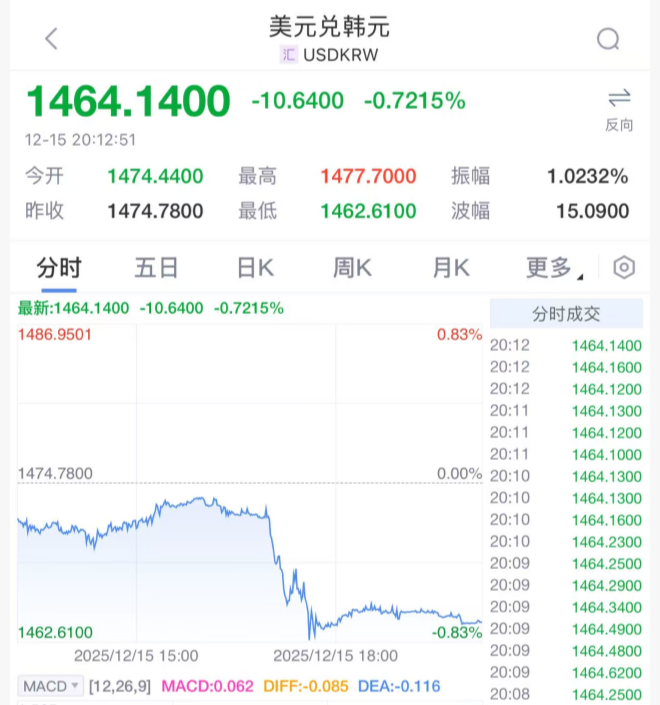
Group 1 - The National Pension Service (NPS) of South Korea announced a more flexible approach to strategic foreign exchange hedging to support the weakening Korean won [1] - The NPS manages approximately 136.1 trillion KRW (about 92.4 billion USD) and has set a strategic hedging limit of 10% for its overseas investment portfolio [1] - The Korean won has depreciated over 8% against the US dollar in the second half of the year, making it the worst-performing currency in Asia, leading to increased pressure on currency stabilization [1] Group 2 - Following the announcement, the Korean won strengthened, with a rise of 0.9% against the US dollar [2] - Shaun Lim, a forex strategist at Maybank, indicated that the announcement would deter short-sellers of the won, emphasizing the importance of aligning with the central bank and major institutional investors like NPS [3] - The NPS has previously utilized hedging and foreign exchange operations to alleviate pressure on the won, including selling USD and buying KRW from January to May this year [3] Group 3 - The Ministry of Health and Welfare, which oversees the NPS, announced an extension of the foreign exchange swap agreement with the Bank of Korea (BOK) until the end of 2026 [3] - The swap limit has been increased from 10 billion USD in 2022 to 65 billion USD [3]

国际金融市场早知道:11月27日
Xin Hua Cai Jing· 2025-11-26 23:56
Economic Overview - The Federal Reserve's Beige Book indicates that economic activity is generally stable, with most of the 12 districts reporting flat conditions, two showing slight declines, and only one district experiencing slight growth. However, some respondents warned of increased risks of economic slowdown in the coming months [1][2] UK Fiscal Developments - The UK's Office for Budget Responsibility unexpectedly leaked the autumn fiscal report, revealing that fiscal buffer space has doubled to £22 billion. The report confirms the freezing of the personal tax threshold, an increase in dividend tax, and plans to introduce a "mansion tax" and an electric vehicle "mileage tax," sparking widespread discussion [1] Canadian Trade Policy - Canadian Prime Minister Carney announced a significant reduction in steel import quotas from 50% to 20% for non-free trade partner countries starting in 2024, along with a 25% global tariff on specific steel derivatives to protect domestic industries [1] Japanese Monetary Policy - Reports suggest that the Bank of Japan is preparing for a potential interest rate hike as early as December, driven by increasing pressure from yen depreciation and diminishing political resistance, leading to a resurgence of hawkish rhetoric [1] South Korean Currency Market - South Korean Finance Minister Kyungho emphasized a strict approach to speculative activities in the currency market and ruled out the possibility of restarting a foreign exchange swap agreement with the U.S. to maintain market stability [2] U.S. Economic Indicators - U.S. durable goods orders increased by 0.5% month-on-month in September, a slowdown from the previous 3% growth. However, core capital goods orders, excluding defense and aircraft, surged by 0.9%, significantly exceeding the market expectation of 0.3%, indicating strong business investment sentiment [2] - As of the week ending November 23, initial jobless claims in the U.S. decreased by 6,000 to 216,000, the lowest level since mid-April, and below the expected 225,000. Continuing claims rose slightly to 1.96 million, still at historical lows, reflecting resilience in the labor market [2] Australian Inflation Data - Australia's October Consumer Price Index (CPI) rose by 3.8% year-on-year, surpassing the expected 3.6%. The trimmed mean inflation rate increased to 3.3%, remaining above the Reserve Bank of Australia's target range of 2%-3%, intensifying pressure for potential interest rate hikes [2]
韩国:与美国关税谈判取得“实质性进展”
Hua Er Jie Jian Wen· 2025-10-20 09:41
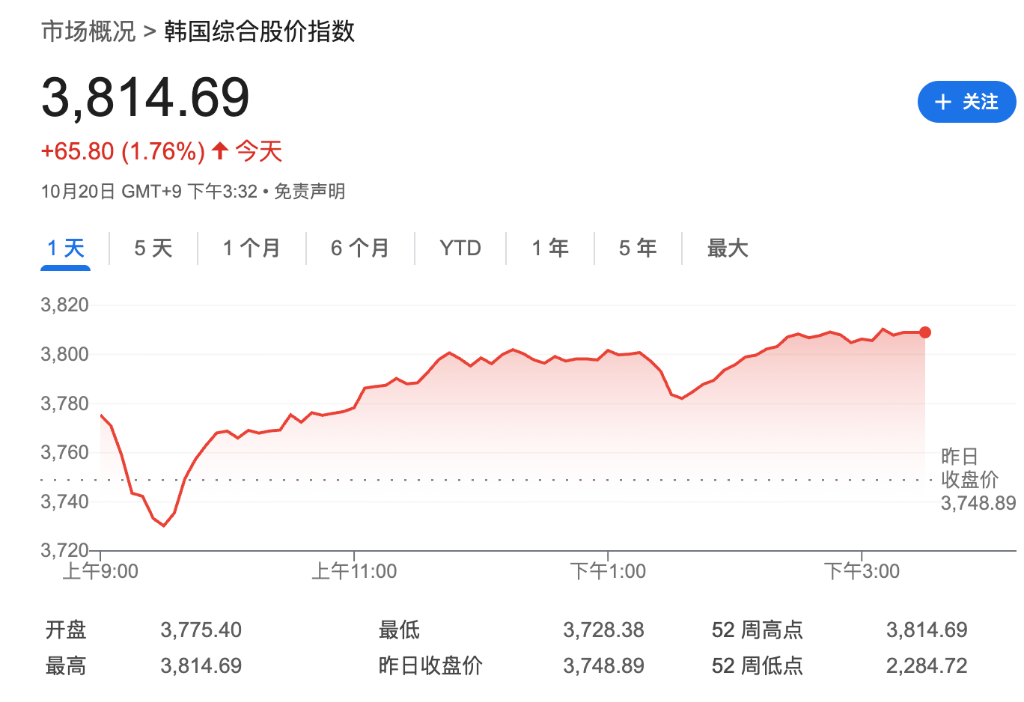
Group 1 - South Korea has made "substantial progress" in tariff negotiations with the United States on most key issues, although there are still disagreements regarding the structure of a $350 billion investment fund, which is central to the agreement that sets a 15% tariff cap on South Korean goods [1] - Kim Yong-beom, the head of the South Korean presidential office's policy room, indicated that there is a broad consensus on many issues, but several matters still require further negotiation, with an increased likelihood of reaching an agreement at the upcoming APEC summit [1] - Following informal discussions at Mar-a-Lago involving South Korean business leaders and U.S. President Trump, the South Korean benchmark stock index, Kospi, reached a new high, surpassing the 3,800-point level [1] Group 2 - In July, a trade agreement framework was reached between South Korea and the U.S., where the U.S. would lower tariffs on South Korean goods in exchange for a $350 billion investment from South Korea; however, there are disputes on how to handle the investment, preventing the agreement from being implemented [4] - Concerns were raised by Lee Jae-myung regarding the potential economic risks if South Korea were to withdraw $350 billion in cash for investment in the U.S., likening it to the financial crisis of 1997 [4] - President Trump has repeatedly requested that South Korea "prepay" the $350 billion investment, while South Korea is advocating for a currency swap agreement to support its investment commitments in the tariff negotiations, noting that the proposed amount would account for over 80% of its foreign exchange reserves [4]
韩国:已与美国就外汇问题达成一致
Hua Er Jie Jian Wen· 2025-09-28 06:19
Group 1 - The core point of the article is that the U.S. has agreed that South Korea is not manipulating its currency for trade advantages, which clears the way for South Korea to be removed from the U.S. Treasury's currency manipulation monitoring list [1] - This agreement alleviates pressure on South Korea in bilateral trade negotiations, although officials emphasize it is not directly related to ongoing currency swap discussions [2] - The U.S. had previously monitored South Korea's foreign exchange policies due to concerns over a large current account surplus and trade surplus with the U.S., leading to its inclusion on the monitoring list [2] Group 2 - South Korean officials indicated that the currency agreement is separate from discussions regarding a $350 billion investment commitment related to tariff negotiations [3] - There is a discrepancy in understanding between South Korea and the U.S. regarding the nature of the $350 billion investment, with South Korea viewing it primarily as loans rather than direct investments [3] - Analysts note that the resolution of the currency manipulation dispute creates better conditions for cooperation on other issues between the U.S. and South Korea [4]