
负利率政策

Search documents
难怪高市嚣张!GDP跌出世界前三也不慌,原来日本资产遍布全球
Sou Hu Cai Jing· 2026-02-19 18:47
Group 1 - The core viewpoint of the article is that despite perceptions of Japan's economic stagnation and aging population, global capital is increasingly attracted to Japan due to the undervaluation and quality of its assets, driven by a combination of currency depreciation and proactive government policies to invite foreign investment [1][3][5] - Japan's net overseas assets have reached a historical high of 533 trillion yen by the end of 2024, indicating that Japan has significant financial resources, but much of it is invested abroad rather than domestically [5] - The depreciation of the yen has made Japanese companies and assets cheaper for foreign investors, allowing them to acquire high-quality assets at lower prices, which is perceived as an opportunity rather than a sign of weakness [7][9] Group 2 - Three key changes expected around 2026 are driving foreign capital interest in Japan: a shift in monetary policy away from negative interest rates, a stabilization of the yen, and a push for corporate reform in Japan [9][11] - The Tokyo Stock Exchange has implemented regulations requiring underperforming companies to present improvement plans, which is prompting Japanese firms to innovate and seek foreign investment, creating new opportunities for capital [13][14] - Foreign capital is particularly interested in Japan's core assets that are difficult to replicate, such as essential technologies in semiconductor materials, as well as industries related to aging populations, including healthcare robots and medical devices [16][18] Group 3 - Prime urban land and infrastructure in major Japanese cities like Tokyo and Osaka are becoming increasingly valuable due to population density, despite an overall decline in Japan's population [20] - The article emphasizes the importance of maintaining currency stability for national wealth, contrasting Japan's situation with the stability of the Chinese yuan, which provides a safety net for ordinary citizens [22][24] - The global capital movement towards Japan serves as a reminder of the necessity for countries to strengthen their own technological capabilities and maintain control over their wealth to navigate the complexities of global investment [24]

外汇市场剧烈波动:美元跌至三个月低点与日本央行干预疑云
Di Yi Cai Jing· 2026-01-25 13:06
Group 1: Currency Market Dynamics - The US dollar index (DXY) has dropped to around 97.7, marking a three-month low and a decrease of approximately 1.5% since the end of the previous year, influenced by easing geopolitical tensions, adjustments in Federal Reserve policy expectations, and movements in the Bank of Japan's monetary policy [1] - The USD/JPY exchange rate has seen significant fluctuations, falling from a high of 159 to the 156-158 range, raising speculation about potential intervention by Japanese authorities [1][4] - The volatility in the currency market has led to an increase in overall market volatility, with the volatility rate rising to over 8.5%, reflecting policy divergences and geopolitical risks [5] Group 2: Japanese Economic Context - Japan's economy has faced structural challenges for over two decades, with negative GDP growth and deflation, prompting the Bank of Japan to implement negative interest rates and yield curve control to stimulate growth [2] - The GDP growth forecast for Japan has been revised upward to 0.9% for FY2025 and 1.0% for FY2026, supported by overseas economic recovery and government stimulus measures [2] - Following the election of Prime Minister Suga, there are concerns about a shift to dovish policies, despite rising inflation, which has led to increased long-term interest rates [2][3] Group 3: Precious Metals Market - Silver prices have surged past $100 per ounce, a 40% increase since the end of the previous year, while gold prices have approached $5,000 per ounce, reflecting a 79% annual increase due to global uncertainty [6][7] - The Shanghai silver price has reached a record premium of $13 per ounce over COMEX futures, indicating a physical silver shortage in China, with domestic inventories at their lowest since 2016 [7] - The upward trend in precious metals prices is linked to increased demand for safe-haven assets amid geopolitical tensions, which may lead to a re-evaluation of global silver prices [6][7] Group 4: Global Economic Implications - The depreciation of the US dollar is beneficial for emerging markets, alleviating debt pressures, but continued intervention by Japan could lead to rising US Treasury yields, increasing global borrowing costs [8] - The fluctuations in the currency market may trigger adjustments in risk models, leading to widespread deleveraging in the financial system, which is already exhibiting significant leverage levels [8] - The outlook for global growth remains stable at 3.3%, but risks include potential further rate cuts by the Federal Reserve and uncertainties surrounding trade negotiations [8]
政策正常化迈出关键一步!传日本央行最早下月开始出售ETF持仓
Zhi Tong Cai Jing· 2025-12-15 06:29
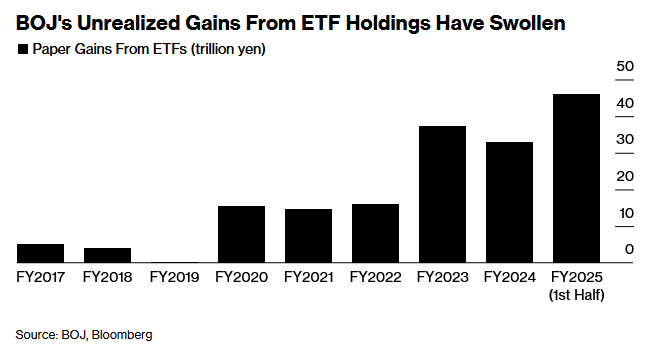
Core Viewpoint - The Bank of Japan (BOJ) is expected to begin selling its holdings of exchange-traded funds (ETFs) as early as next month, a process projected to take decades to complete, with current ETF holdings valued at approximately 83 trillion yen (about 534 billion USD) as of the end of September [1][4]. Group 1: ETF Sale Plans - The BOJ announced a plan to sell its ETF and Japanese Real Estate Investment Trusts (J-REITs) at a rate of approximately 3.3 trillion yen annually for ETFs and 5 billion yen for J-REITs, marking the first specific mention of such a plan [4]. - BOJ Governor Kazuo Ueda stated that the decision to sell ETFs is not related to stock market levels and that the planned sales could take over 100 years if executed at the specified pace [4]. - The BOJ aims to maintain a stable monthly pace of ETF sales while avoiding market disruptions, with the flexibility to halt sales in case of significant market volatility [5]. Group 2: Monetary Policy Context - The sale of ETFs and J-REITs is viewed as a significant step towards normalizing the long-standing ultra-loose monetary policy of the BOJ, with symbolic importance [5]. - The BOJ is also preparing to raise interest rates by 25 basis points, bringing the benchmark rate to 0.75%, the highest level since 1995 [5]. - Market participants are keen to understand how the BOJ will signal further interest rate hikes and are looking for indications regarding the neutral interest rate, estimated to be between 1% and 2.5% [5]. Group 3: Historical Context of ETF Purchases - The BOJ began purchasing ETFs in 2010 to stimulate the corporate sector by increasing the supply of funds and encouraging risk investment activities [7]. - Initially, the BOJ invested heavily in Nikkei 225 index ETFs but shifted to broader Topix index ETFs in 2021 [7]. - The scale of asset purchases expanded significantly under former Governor Haruhiko Kuroda, leading to a substantial rise in the Japanese stock market, although the effectiveness of these measures has diminished over time [7]. Group 4: Criticism of ETF Holdings - The BOJ's initial purchase of Nikkei 225 index ETFs faced criticism due to the price-weighted nature of the index, which disproportionately favored a few high-priced stocks [8]. - Critics argue that the BOJ's large ETF holdings distort the market and can lead to excessive volatility during policy adjustments [8]. - The substantial holdings by the BOJ have reduced the availability of tradable shares in the market and weakened shareholder influence on corporate governance [8].
这家央行,距负利率仅一步之遥
Jin Rong Shi Bao· 2025-12-12 06:38
Core Points - The Swiss National Bank (SNB) decided to maintain the key policy interest rate at 0%, marking the second consecutive time it has kept rates unchanged [1][2] - Inflation remains a critical factor influencing the SNB's monetary policy, with recent inflation rates slightly below expectations, but medium-term inflation pressure showing little change compared to the last assessment [1] - The SNB projects average annual inflation rates for Switzerland at 0.2%, 0.3%, and 0.6% for the years 2025, 2026, and 2027, respectively [1] - Economic growth outlook for Switzerland has slightly improved due to reduced U.S. tariffs and a modest recovery in the global economy, with GDP growth expected to be just below 1.5% in 2025 and around 1% in 2026 [2] - The SNB has shifted from a period of rate cuts to a more cautious monetary policy stance, having previously implemented a negative interest rate policy for seven years [2] - The possibility of returning to negative interest rates is not completely ruled out, but the current situation requires careful consideration before making such a decision [2]
瑞士央行连续两次维持利率不变 重申必要时可重启负利率政策
Xin Hua Cai Jing· 2025-12-11 14:02
Core Viewpoint - The Swiss National Bank (SNB) has maintained its key policy interest rate at 0% for the second consecutive time, indicating a willingness to consider further rate cuts if persistent price declines pose a deflation threat [1] Group 1: Monetary Policy - The SNB stated it will continue to monitor the situation and adjust monetary policy as necessary to ensure price stability [1] - The decision follows a cautious stance after a six-quarter cycle of rate cuts that ended in September [1] - The annual Consumer Price Index (CPI) in Switzerland reached the lower limit of the SNB's target range of 0% to 2% in November [1] Group 2: Inflation Expectations - The SNB has revised its inflation expectations for 2026 down from 0.5% to 0.3% and for 2027 from 0.7% to 0.6% based on the current 0% interest rate assumption [1] - The central bank emphasized that medium-term inflation pressures have "changed little" since the September meeting and will not overly rely on single-month inflation readings for policy decisions [1] Group 3: Global Monetary Policy Context - The SNB's decision comes in the context of diverging global monetary policies, following the Federal Reserve's recent rate cut due to labor market concerns, while indicating a potential pause in future rate changes due to stagnant inflation progress [1] - The European Central Bank is expected to maintain its rates unchanged until 2026, as its inflation levels have stabilized around the 2% target [1] Group 4: Negative Interest Rate Considerations - The SNB Chairman, Martin Schlegel, noted that the threshold for lowering rates into negative territory is higher than for cutting rates in a positive interest rate environment, considering potential impacts on savers, bank profits, and pension funds [2] - Switzerland previously implemented a negative interest rate policy from January 2015 to September 2022, lasting over seven years [2]
国际金融市场早知道:11月27日
Xin Hua Cai Jing· 2025-11-26 23:56
Economic Overview - The Federal Reserve's Beige Book indicates that economic activity is generally stable, with most of the 12 districts reporting flat conditions, two showing slight declines, and only one district experiencing slight growth. However, some respondents warned of increased risks of economic slowdown in the coming months [1][2] UK Fiscal Developments - The UK's Office for Budget Responsibility unexpectedly leaked the autumn fiscal report, revealing that fiscal buffer space has doubled to £22 billion. The report confirms the freezing of the personal tax threshold, an increase in dividend tax, and plans to introduce a "mansion tax" and an electric vehicle "mileage tax," sparking widespread discussion [1] Canadian Trade Policy - Canadian Prime Minister Carney announced a significant reduction in steel import quotas from 50% to 20% for non-free trade partner countries starting in 2024, along with a 25% global tariff on specific steel derivatives to protect domestic industries [1] Japanese Monetary Policy - Reports suggest that the Bank of Japan is preparing for a potential interest rate hike as early as December, driven by increasing pressure from yen depreciation and diminishing political resistance, leading to a resurgence of hawkish rhetoric [1] South Korean Currency Market - South Korean Finance Minister Kyungho emphasized a strict approach to speculative activities in the currency market and ruled out the possibility of restarting a foreign exchange swap agreement with the U.S. to maintain market stability [2] U.S. Economic Indicators - U.S. durable goods orders increased by 0.5% month-on-month in September, a slowdown from the previous 3% growth. However, core capital goods orders, excluding defense and aircraft, surged by 0.9%, significantly exceeding the market expectation of 0.3%, indicating strong business investment sentiment [2] - As of the week ending November 23, initial jobless claims in the U.S. decreased by 6,000 to 216,000, the lowest level since mid-April, and below the expected 225,000. Continuing claims rose slightly to 1.96 million, still at historical lows, reflecting resilience in the labor market [2] Australian Inflation Data - Australia's October Consumer Price Index (CPI) rose by 3.8% year-on-year, surpassing the expected 3.6%. The trimmed mean inflation rate increased to 3.3%, remaining above the Reserve Bank of Australia's target range of 2%-3%, intensifying pressure for potential interest rate hikes [2]
瑞士央行行长:通胀料温和回升,重推负利率门槛极高
Sou Hu Cai Jing· 2025-11-24 00:35
Core Viewpoint - The Swiss National Bank (SNB) President, Thomas Jordan, indicated that while current inflation remains stable within the bank's defined price stability range, Switzerland's very low inflation rate is expected to rise moderately in the coming quarters [1] Group 1: Inflation Outlook - The current inflation rate is at the lower limit of the SNB's target range of 0%-2% [1] - A slight increase in inflation is anticipated over the next few quarters [1] Group 2: Monetary Policy - Jordan emphasized that a high threshold must be met to restart the negative interest rate policy implemented from 2015 to 2022 [1] - The current expansionary monetary policy supports both inflation and economic vitality [1] Group 3: Trade Agreement Implications - The newly announced preliminary trade agreement with the United States is expected to significantly reduce tariffs on Swiss export goods [1] - However, Jordan warned that tariffs are just one factor contributing to the overall uncertainty, which he described as "poison for the economy" [1]
全球避险资金涌入 瑞郎连涨逼近干预区间
智通财经网· 2025-10-24 11:37
Core Viewpoint - The Swiss Franc has significantly appreciated recently, driven by safe-haven demand, leading to speculation that the Swiss National Bank (SNB) may have intervened to curb its strength [1][2]. Group 1: Swiss Franc Performance - The Swiss Franc has experienced its ninth consecutive weekly increase, marking its best performance in two years [1]. - The exchange rate of the Swiss Franc against the Euro surged to a near ten-year high, approaching the critical level of 0.92 [1]. - Despite the Swiss policy rate remaining at zero, the Swiss Franc has seen the highest appreciation against the US Dollar among major developed currencies over the past month [1]. Group 2: Market Sentiment and Investor Behavior - Risk-averse investors are increasingly seeking alternatives to the US Dollar and Japanese Yen, with the Swiss Franc being a primary choice due to its stable economy and good governance [2]. - Analysts from Societe Generale noted that the risk of intervention by the Swiss National Bank is at its highest level [2]. - UBS analysts believe that the SNB may have already begun market intervention to lower the Swiss Franc's exchange rate [2]. Group 3: Swiss National Bank's Position - The Swiss National Bank does not comment on whether it intervenes in the currency market, and data proving intervention will be released later [3]. - The recent US-Swiss agreement not to manipulate exchange rates allows the SNB to focus on price stability while potentially using intervention to address deflationary pressures [3]. - The options market indicates that the SNB's unilateral actions may slow the appreciation of the Swiss Franc rather than reverse its upward trend [3]. Group 4: Inflation and Economic Outlook - The SNB's meeting minutes suggest that deflation is not a threat, with inflation expected to rise moderately in the coming months [4]. - Despite the Swiss Franc's strength against the US Dollar, it remains relatively stable against the Euro, with geopolitical shocks potentially driving funds into the Franc [4]. - Analysts expect the SNB to continue intervening in the 0.90-0.92 range to manage the Swiss Franc's strength [4].
每日机构分析:10月20日
Xin Hua Cai Jing· 2025-10-20 16:18
Group 1: Eurozone and US Economic Outlook - Monex Europe analysts indicate that the weak growth and fiscal concerns in the Eurozone will limit the euro's appreciation potential, suggesting that the euro may only see slight increases if market risk appetite remains strong and interest rate differentials favor the euro [1] - Societe Generale strategist Kit Juckes warns that the US economy faces risks of a mild recession, which could lead to significant rate cuts and a weaker dollar, drawing parallels to the 2001-2003 period when the Fed drastically reduced rates from 6.5% to 1.0% [2] - Kudotrade analysts highlight that the upcoming US inflation data will be crucial for assessing future interest rate prospects, with expectations that if the data meets or falls below forecasts, it could reinforce market expectations for deeper policy easing in 2025-2026 [1][2] Group 2: Credit Market and Bond Ratings - Concerns over the stability of US regional banks persist, keeping the cost of credit default swaps for US bank bonds at elevated levels, as two banks recently disclosed exposure to bad loans [2] - Danske Bank notes that S&P's downgrade of France's credit rating may increase pressure on French government bonds, with expectations that Moody's will also revise France's outlook from stable to negative [2] Group 3: Gold and Swiss Monetary Policy - ANZ analysts report that investors are increasingly seeking refuge in gold amid rising trade tensions and economic uncertainties, with gold experiencing its largest weekly gain in five years due to the collapse of the US credit market [3] - Capital Economics economists predict that the Swiss National Bank may reintroduce negative interest rates due to near-zero inflation levels and ongoing geopolitical risks, potentially lowering the key rate from 0% to -0.25% [3]
瑞士央行重启负利率“门槛更高” 预测负利率机构从七家锐减至两家
智通财经网· 2025-10-13 06:53
Core Viewpoint - Economists have largely abandoned predictions of the Swiss National Bank (SNB) lowering interest rates into negative territory, with only Barclays and Bloomberg Economics forecasting a 25 basis point cut to -0.25% at the December 11 policy meeting [1] Group 1: Current Predictions - Only two institutions, Barclays and Bloomberg Economics, predict a rate cut by the SNB in December [1] - Capital Economics anticipates that any potential rate cut will occur in June of the following year [1] - Goldman Sachs and Pantheon Macroeconomics have shifted their views, now aligning with 15 other analysts who believe that zero interest rates will be the final level [1] Group 2: Historical Context - In June, the SNB's benchmark interest rate was lowered to zero, leading to seven institutions predicting a return to negative rates [1] - Prior to the September rate decision, five institutions also expected the SNB to implement negative rates [1] Group 3: SNB's Stance - SNB President Martin Schlegel emphasized that the threshold for reintroducing negative rates is significantly higher than for conventional rate cuts [1] - Schlegel noted the negative impact of the previous negative rate policy (2015-2022) on the financial system [1] Group 4: Market Influences - Analyst Jean Dalbard indicated that the foreign exchange market may ultimately compel the SNB to take action [1] - The strengthening of the Swiss franc and the impact of higher-than-expected tariffs from the U.S. on economic growth are key risks facing the SNB [1] - Dalbard predicts that if the Swiss franc continues to strengthen, the SNB may lower rates in December [1]