
多晶硅市场供需平衡

Search documents
硅业峰会:供需共同制约多晶硅市场持续僵局
Xin Hua Cai Jing· 2026-01-28 06:04
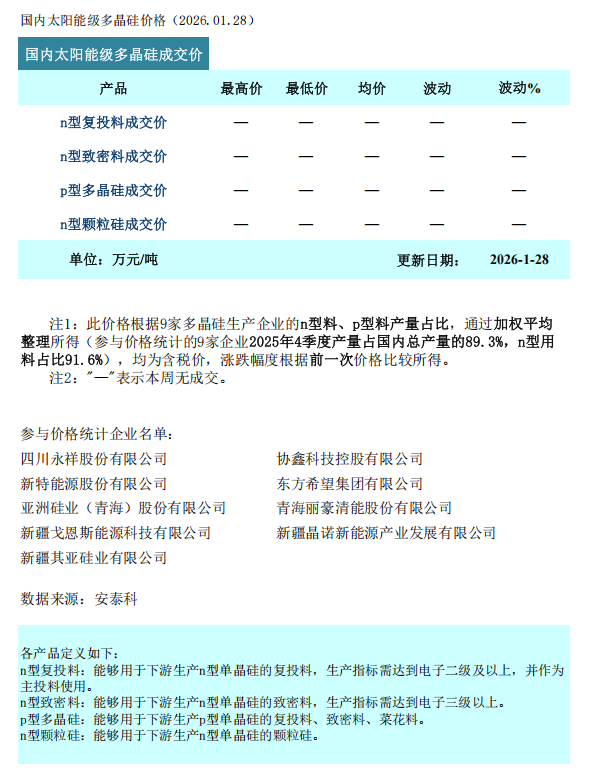
Core Viewpoint - The polysilicon market is currently in a stalemate, with minimal transactions and a prevailing wait-and-see sentiment among market participants, leading to a significant slowdown in new order signings [1] Group 1: Market Conditions - The main polysilicon products have seen no transactions this week, with only a few small exploratory orders being placed [1] - Downstream purchasing intentions remain low, primarily focused on inventory digestion rather than restocking, despite some companies lowering prices to test the market [1] - The upcoming Chinese New Year is increasing uncertainty in production plans for silicon and battery companies, further suppressing short-term demand [1] Group 2: Supply and Demand Dynamics - Major companies have significantly reduced or halted production, leading to a continued contraction in polysilicon supply, which has somewhat alleviated supply-demand conflicts and weakened the incentive for companies to lower prices [1] - A leading company has fully suspended production, and two others have implemented production cuts, resulting in a projected 15% month-on-month decrease in polysilicon output for January [1] - The production plan for February indicates a further reduction in polysilicon output to 82,000-85,000 tons, continuing the trend of supply contraction [1] Group 3: Future Outlook - With the Chinese New Year approaching and the first quarter being a traditional off-season, domestic terminal demand and overseas component orders lack strong support [2] - High prices of auxiliary materials like silver paste continue to exert pressure on battery cell production costs [2] - Despite supply contraction providing some price support, high inventory levels remain unaddressed, continuing to suppress upward price movement [2]
安泰科:本周多晶硅报价松动难引成交 供需弱平衡持续巩固
智通财经网· 2026-01-28 06:01
Group 1 - The core viewpoint of the articles indicates that the polysilicon market is currently in a stalemate, with almost no significant transactions occurring this week due to prevailing market sentiment and low purchasing willingness from downstream buyers [1][2] - The demand side is constrained by high prices of key auxiliary materials like silver paste, which keeps battery production costs elevated, and insufficient overseas orders for modules, leading to a lack of purchasing intent [1][2] - On the supply side, major companies have significantly reduced or halted production, which has led to a continuous contraction in polysilicon supply, somewhat alleviating supply-demand conflicts and reducing the willingness of companies to lower prices [1][2] Group 2 - As of this week, one major company has completely halted production, and two others have implemented production cuts, resulting in an expected 15% month-on-month decrease in polysilicon output for January, aligning with the production schedules of silicon wafer companies [1] - The production plan for February indicates a further reduction in polysilicon output to 82,000 to 85,000 tons, continuing the trend of supply contraction [1] - The upcoming Chinese New Year and the traditional off-season in the first quarter are expected to weaken domestic terminal demand and overseas module orders, while high prices of auxiliary materials will maintain cost pressures on battery cells [2]

硅业分会:市场观望态势未改 本周多晶硅供需弱平衡格局渐显
智通财经网· 2026-01-21 05:42
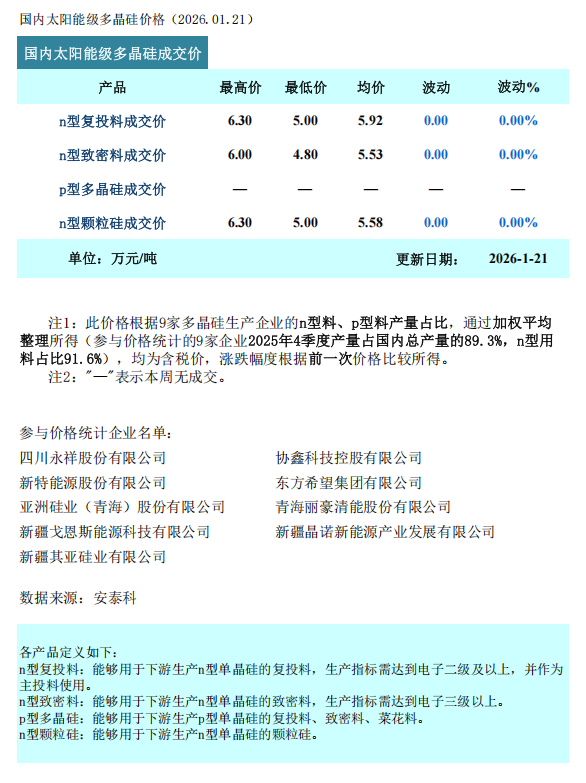
Core Viewpoint - The silicon market is experiencing a stalemate, with stable prices despite slight fluctuations in some companies' quotes, primarily due to preemptive demand and rising production costs from silver prices [1][2]. Group 1: Market Conditions - The overall trading atmosphere in the market is subdued, with new orders being scarce and transactions mainly consisting of tentative deals [1]. - The current market deadlock is attributed to two main factors: the preemptive demand for photovoltaic products and the reluctance of downstream silicon wafer companies to increase production rates [1][2]. - The average transaction price for n-type recycled silicon is reported at 59,200 yuan/ton, while n-type granular silicon is at 55,800 yuan/ton, both remaining stable week-on-week [1][3]. Group 2: Supply and Demand Dynamics - Several leading companies are expected to implement production cuts or halts in January, leading to an anticipated average monthly production of polysilicon around 80,000 tons in the first quarter [2]. - Despite the lack of substantial recovery in terminal demand, the significant reduction in supply is gradually leading to a weak balance in supply and demand [2]. - Key variables affecting price trends include changes in downstream operating rates and the sustainability of inventory reduction, with high inventory levels potentially suppressing prices if demand does not recover promptly [2]. Group 3: Price Statistics - The price statistics for domestic solar-grade polysilicon as of January 21, 2026, show the following: - n-type recycled silicon price range: 50,000 - 63,000 yuan/ton, average price: 59,200 yuan/ton [3]. - n-type granular silicon price range: 50,000 - 63,000 yuan/ton, average price: 55,800 yuan/ton [3]. - The prices are based on a weighted average from nine polysilicon production companies, which account for 89.3% of domestic production in Q4 2025 [3][4].
[安泰科]多晶硅周评-市场观望态势未改 供需弱平衡格局渐显(2026年1月21日)
中国有色金属工业协会硅业分会· 2026-01-21 05:13
Group 1 - The core viewpoint of the article indicates that the market for polysilicon, particularly n-type materials, is currently stable with transaction prices holding steady despite slight fluctuations in individual company quotes. The average transaction price for n-type recycled material is 59,200 yuan/ton, while n-type granular silicon is at 55,800 yuan/ton, both showing no change compared to the previous period [1][2]. - The market atmosphere is described as quiet, with new orders being scarce and transactions primarily consisting of small, tentative deals. This stalemate is attributed to two main factors: first, some demand has been preemptively fulfilled by 2025, leading to a lack of urgency in procurement from downstream silicon wafer manufacturers; second, rising silver prices have significantly increased production costs for battery cells and modules, limiting the impact of slight price reductions in polysilicon on downstream costs [1][2]. - A significant reduction in polysilicon production is anticipated, with major companies planning to halt or reduce output in January, leading to an expected average monthly production of around 80,000 tons in the first quarter. Although terminal demand has not shown substantial recovery, the drastic supply contraction is expected to gradually lead to a weak balance in supply and demand [2][3]. Group 2 - The key variables influencing price trends in the polysilicon market include: first, any substantial changes in downstream operating rates, particularly the effective transmission of order demand from the battery and module sectors to the silicon wafer sector; second, the sustainability of inventory reduction, as high inventory levels could suppress prices if demand does not recover in a timely manner [2][3]. - The transaction price data for domestic solar-grade polysilicon indicates that the highest price for n-type recycled material is 63,000 yuan/ton, while the lowest is 50,000 yuan/ton, with an average price of 59,200 yuan/ton showing no fluctuation [3].
安泰科:多晶硅市场延续供需双弱格局 短期内或维持弱势平稳运行
智通财经网· 2025-11-26 10:31
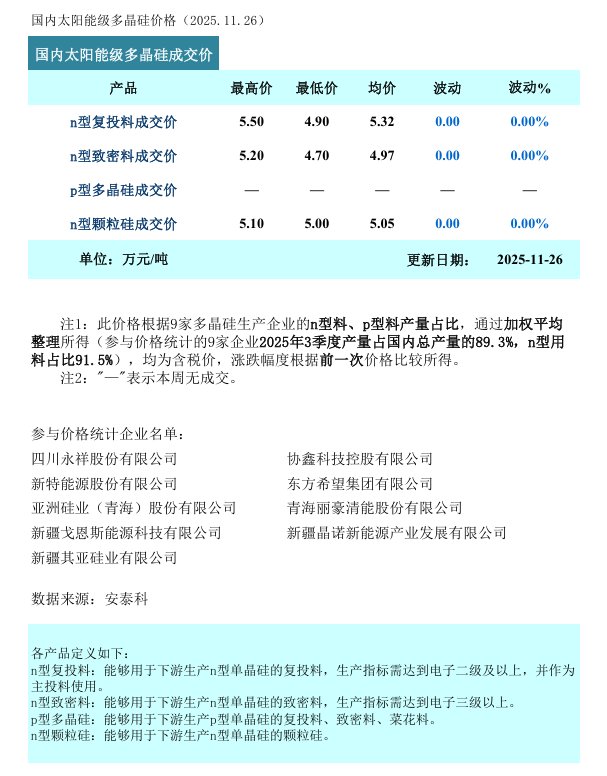
Core Viewpoint - The polysilicon market continues to exhibit a weak supply and demand dynamic, with expectations of maintaining a stable but weak operational trend in the short term [1][2]. Supply and Demand Analysis - The transaction price range for n-type recycled polysilicon is between 49,000 to 55,000 CNY/ton, with an average price of 53,200 CNY/ton, remaining flat compared to the previous period [1]. - The transaction price range for n-type granular silicon is between 50,000 to 51,000 CNY/ton, with an average price of 50,500 CNY/ton, also unchanged from the previous period [1]. - The number of mainstream signing enterprises remains at 4-5, with a decrease in signing volume for rod silicon, while granular silicon shows resilience due to its improved quality recognition and cost-effectiveness [1]. Market Stability Factors - The stability in market prices is supported by both supply and demand sides. On the supply side, polysilicon companies are determined to maintain price stability, with two leading companies implementing significant production cuts this month [1]. - There is a clear consensus across the industry chain that price instability could harm the entire chain, contributing to price stability [2]. - Despite production cuts in the silicon wafer segment, downstream companies maintain their procurement plans, particularly for granular silicon, providing a bottom support for prices [1][2]. Price Statistics - The highest and lowest prices for n-type recycled polysilicon are 55,000 CNY/ton and 49,000 CNY/ton, respectively, with no price fluctuation [3]. - The average price for n-type dense material is 49,700 CNY/ton, with no fluctuation reported [3]. - The average price for p-type polysilicon is not specified, indicating no transactions occurred this week [3]. Participating Companies - The price statistics are based on data from nine polysilicon production companies, which account for 89.3% of the domestic total production in Q3 2025 [4].
[安泰科]多晶硅周评-供需双弱格局延续 价格持稳共识坚定(2025年11月26日)
中国有色金属工业协会硅业分会· 2025-11-26 10:17
Group 1 - The core viewpoint of the article indicates that the polysilicon market is experiencing a weak supply and demand situation, with stable pricing despite reduced purchasing needs from downstream silicon wafer producers [1][2]. - The average transaction price for n-type polysilicon is reported at 53,200 yuan/ton, with a price range of 49,000 to 55,000 yuan/ton, showing no change from the previous week [1][3]. - The transaction price for n-type granular silicon is reported at 50,500 yuan/ton, with a range of 50,000 to 51,000 yuan/ton, also remaining stable week-on-week [1][3]. Group 2 - The supply side is characterized by a significant reduction in production from leading companies, which has led to a contraction in supply, thereby supporting price stability [2][1]. - Despite the reduction in production from the silicon wafer segment, downstream companies maintain their purchasing plans, particularly for granular silicon, which provides a bottom support for prices [1][2]. - The consensus within the industry is that price instability could harm the entire supply chain, leading to a collective effort to maintain stable pricing [2][1].

安泰科:当前多晶硅市场需求较弱、稳价意愿较强 短期内或维持弱势平稳运行格局
Xin Hua Cai Jing· 2025-11-19 08:03
Core Viewpoint - The domestic polysilicon market is currently exhibiting a weak and stable trend, with prices remaining steady despite a decline in downstream prices and production cuts by some silicon wafer companies due to weak demand [1][2]. Group 1: Price Trends - The transaction price range for n-type polysilicon is between 49,000 to 55,000 yuan per ton, with an average transaction price of 53,200 yuan per ton, remaining flat week-on-week [1]. - The transaction price range for n-type granular silicon is between 50,000 to 51,000 yuan per ton, with an average transaction price of 50,500 yuan per ton, also remaining flat week-on-week [1]. Group 2: Supply and Demand Dynamics - The supply side has contracted significantly, with expectations that domestic polysilicon production will drop to below 120,000 tons in November, representing a month-on-month decrease of approximately 14% [1][2]. - Despite recent production cuts in downstream sectors, the overall tolerance for supply-demand changes among upstream and downstream companies remains high due to already high social inventory levels [2]. Group 3: Market Outlook - The strong willingness to maintain prices among polysilicon companies is a significant factor, as price declines could disrupt the stabilization expectations that have been gradually established since July [1][2]. - It is anticipated that polysilicon prices will continue to maintain a weak and stable operational pattern in the short term, supported by supply contraction and a consensus on maintaining overall stability in the industry chain [2].
[安泰科]多晶硅周评-下游压力传导有限 价格持稳基调未改(2025年11月12日)
中国有色金属工业协会硅业分会· 2025-11-19 07:32
Core Viewpoint - The domestic polysilicon market is currently exhibiting a weak and stable trend, with prices remaining steady despite a decline in downstream prices and production cuts by some silicon wafer manufacturers due to weak demand [1][2]. Group 1: Market Prices - The transaction price range for n-type re-investment material is between 49,000 to 55,000 CNY/ton, with an average price of 53,200 CNY/ton, remaining unchanged week-on-week [1]. - The transaction price range for n-type granular silicon is between 50,000 to 51,000 CNY/ton, with an average price of 50,500 CNY/ton, also stable week-on-week [1]. - The overall transaction prices for polysilicon products have shown no fluctuations, indicating a stable market environment [3]. Group 2: Supply and Demand Dynamics - Despite a reduction in downstream production, which is expected to weaken short-term demand for polysilicon, supply has also tightened, leading to a higher tolerance for supply-demand changes among upstream and downstream enterprises [2]. - The expected polysilicon production for December is around 120,000 tons, with an annual total production of approximately 1.33 million tons, reflecting a year-on-year decrease of 27.8% [2]. - The supply contraction is anticipated to support the maintenance of price stability in the polysilicon market, with a strong willingness among producers to keep prices steady [2]. Group 3: Industry Consensus - There is a consensus among the industry chain participants that a price drop in polysilicon would not effectively stimulate demand but could disrupt the stabilization expectations that have been gradually established since July [1]. - The willingness of polysilicon companies to maintain price stability is strong, as they aim to prevent a potential collapse of the entire pricing system within the industry [1].
安泰科:本周多晶硅市场情绪波动 弱稳格局延续
Zhi Tong Cai Jing· 2025-11-12 07:37
Core Viewpoint - The domestic polysilicon market is maintaining a weak and stable pattern, with prices remaining steady despite fluctuations caused by declining prices in downstream silicon wafers and battery cells [1][2] Group 1: Price Trends - The transaction price range for n-type polysilicon is between 49,000 to 55,000 CNY per ton, with an average transaction price of 53,200 CNY per ton, showing no change from the previous week [1] - The transaction price range for n-type granular silicon is between 50,000 to 51,000 CNY per ton, with an average transaction price of 50,500 CNY per ton, also remaining stable week-on-week [1] Group 2: Market Dynamics - The overall market condition remains characterized by an oversupply, with high inventory pressure persisting [2] - Although price reductions and production cuts in downstream sectors may weaken short-term demand for polysilicon, companies are not in a hurry to lower prices to clear inventory due to already high social inventory levels [2] - Despite the prevailing pessimistic sentiment in the market, actual operations are expected to remain stable, with low likelihood of significant price fluctuations due to ongoing production cuts and policy support from suppliers [2]
[安泰科]多晶硅周评-市场情绪波动 弱稳格局延续(2025年11月12日)
中国有色金属工业协会硅业分会· 2025-11-12 07:02
Core Viewpoint - The domestic polysilicon market is maintaining a weak and stable pattern, with prices remaining steady despite fluctuations caused by declining prices in downstream sectors [1][2]. Price Trends - The transaction price range for n-type re-investment material is between 49,000 to 55,000 yuan per ton, with an average price of 53,200 yuan per ton, showing no change week-on-week [1]. - The transaction price range for n-type granular silicon is between 50,000 to 51,000 yuan per ton, with an average price of 50,500 yuan per ton, also stable compared to the previous week [1]. - The price data for various polysilicon products indicates no fluctuations, with n-type re-investment material and n-type granular silicon both showing a 0% change [3]. Supply and Demand Dynamics - The overall state of supply exceeding demand in the polysilicon market remains unchanged, with high inventory pressure persisting [2]. - Downstream price reductions and production cuts may weaken short-term demand for polysilicon, but companies are not in a hurry to lower prices to clear inventory due to high social inventory levels [2]. - Despite pessimistic market sentiment, actual operations are expected to remain stable, with low likelihood of significant price fluctuations due to ongoing production cuts and policy support from suppliers [2].
