
天然气价格波动

Search documents
天然气专家交流-地缘冲突下天然气贸易格局变化
2026-03-16 02:20
Summary of Key Points from LNG Market Conference Call Industry Overview - The conference call discusses the global liquefied natural gas (LNG) trade dynamics amid geopolitical conflicts, particularly focusing on the impact of the situation in the Strait of Hormuz on LNG prices and supply chains [1][2][3]. Core Insights and Arguments - **Geopolitical Impact**: The conflict in the Strait of Hormuz has led to a significant increase in Northeast Asia's spot LNG prices, rising from approximately $12 to $18-19 per million British thermal units (MMBtu) [1][2]. - **Supply Dependency**: Qatar and the UAE account for 20% of global LNG supply, with Qatar's imports to China projected to be only 6% of total consumption by 2025, indicating limited impact on China [1][3]. - **Storage Capacity**: China's underground gas storage capacity of 8 billion cubic meters can theoretically cover a supply gap for about 200 days, given the current consumption rates [3][4]. - **Price Expectations**: Anticipated price corrections are expected as demand decreases in March, with projections suggesting a drop to around $15 per MMBtu, and potentially below $10 if the conflict resolves quickly [3][4]. - **Alternative Supply Routes**: Increased supply from the East Siberian pipeline and new projects in Australia (Darwin and Protos) are expected to provide additional LNG to Asia, helping to balance supply and demand [1][5][9]. - **Regional Variations**: Countries like Japan and South Korea, which rely heavily on LNG imports, may face significant supply challenges, with dependence on Qatar reaching up to 90% in some cases [8][9]. - **Market Dynamics**: The market is expected to adjust with higher prices leading to demand reductions or shifts to alternative energy sources, such as LPG, especially in response to high LNG prices [7][12]. Additional Important Content - **Long-term Supply Stability**: The stability of LNG supply from Central Asia remains uncertain due to investment and production challenges, with no significant new pipeline projects currently in progress [6]. - **Domestic Pricing Policies**: China's domestic gas pricing policies may remain stable or see slight increases due to the geopolitical situation, but overall supply remains adequate [7]. - **Market Reforms**: Ongoing reforms in China's natural gas market aim to enhance competition and efficiency, which could lead to more stable pricing in the long term despite short-term fluctuations due to geopolitical events [13]. This summary encapsulates the key points discussed in the conference call regarding the LNG market's response to geopolitical tensions, supply dynamics, and pricing expectations.
美伊局势升级如何影响能源及油运行业
2026-03-04 14:17
Summary of Key Points from Conference Call Records Industry Overview - The records focus on the **energy and oil transportation industry**, particularly in the context of escalating geopolitical tensions between the U.S. and Iran, and its implications for oil prices and supply dynamics. Core Insights and Arguments 1. **Oil Price Expectations**: The Brent crude oil price is expected to rise from a bottom of $60 to $70, with a short-term target range of $80-85 due to geopolitical tensions affecting supply and demand dynamics [1][5][8]. 2. **Iranian Oil Production**: Iran's oil production is approximately 3.3 million barrels per day, accounting for 3% of global supply. Any disruption in this supply could negate the anticipated surplus of 2.55 million barrels per day in the first half of 2026, significantly altering market expectations [1][5]. 3. **OPEC Production Increase**: OPEC has decided to increase production by 206,000 barrels per day starting April 2026, following a pause in production increases. This decision aligns with prior production trends and reflects a cautious approach to market conditions [4]. 4. **Geopolitical Risks**: The situation in the Strait of Hormuz, which accounts for 20% of global oil demand and 25% of trade volume, poses a significant risk. Any extreme disruption could lead to oil price spikes similar to those seen during the early stages of the Russia-Ukraine conflict [1][7]. 5. **Natural Gas Market Volatility**: Qatar, which supplies 19% of global LNG, faces supply risks that have already led to a 38% increase in spot prices in Europe and Asia. The volatility in natural gas prices is expected to be higher than that of oil [9][10]. 6. **Oil Transportation Dynamics**: The oil transportation market is shifting from a focus on "sanctioned oil" to a growing demand for "compliant fleets." The exit of shadow fleets and rigid constraints on shipbuilding capacity are driving up second-hand ship prices and charter rates, indicating sustained industry prosperity [1][12][13]. 7. **Impact of Houthi Threats**: The threat from Houthi forces has delayed the expected reopening of the Red Sea for shipping, which, while not leading to significant performance elasticity, provides valuation recovery and high dividend yield opportunities for leading companies in the sector [1][12]. Additional Important Insights 1. **Market Sentiment**: The current market sentiment reflects a cautious approach to pricing in geopolitical risks, with significant buffers in trade and inventory structures providing a temporary cushion against supply shocks [6]. 2. **Insurance and Operational Costs**: The geopolitical situation has led to increased insurance costs and operational challenges for shipping companies, as many insurers have withdrawn coverage for war risks in affected areas [11]. 3. **Long-term Supply Dynamics**: The likelihood of a long-term supply disruption leading to "no cargo to transport" scenarios is considered low. Instead, ongoing disruptions are expected to support freight rates and demand for compliant shipping [12]. 4. **Collective Market Trends**: The oil transportation market is experiencing a structural shift due to sanctions and OPEC's production adjustments, which may lead to a reversal of the previous demand suppression caused by shadow fleets [12][13]. This summary encapsulates the critical insights and data points from the conference call records, providing a comprehensive overview of the current state and future outlook of the energy and oil transportation industry.
液化天然气价格跳涨 专家分析约提高国内天然气成本0.07元至0.25元/方
经济观察报· 2026-03-04 12:45
Group 1 - The ongoing US-Iran conflict is primarily affecting LNG export volumes from Qatar and the UAE, with Qatar expected to account for approximately 19% of global LNG exports by 2025, and the UAE about 1%, totaling around 86 million tons [1][2] - Global LNG prices have surged due to the conflict, with TTF natural gas prices reaching approximately €54.29/MWh, reflecting a 22% increase [2] - Qatar Energy, the largest LNG producer, has faced production halts due to military attacks, impacting its export capacity significantly [2] Group 2 - Domestic LNG long-term contracts amount to about 100 million tons annually, with approximately 13 million tons coming from Qatar and the UAE, indicating a certain redundancy in long-term orders [3] - The impact of the US-Iran conflict on domestic gas prices is expected to be limited due to existing supply channels and inventory levels [3][4] - If international oil prices average between $70 and $80 per barrel over three months, the overall cost for domestic natural gas users may increase by approximately ¥0.07 to ¥0.25 per cubic meter [3] Group 3 - Current domestic LNG inventories are significantly higher than last year's seasonal low of 5.4 million tons, providing a buffer for about 3 to 4 weeks of supply [4] - As the conflict continues, domestic gas companies may adopt more conservative purchasing strategies, prioritizing supplies from national oil companies rather than seeking international resources [4]

德商银行:欧洲天然气价格飙升风险依然存在
Jin Rong Jie· 2026-02-17 14:20
Core Viewpoint - The natural gas market remains tight, with risks of short-term price spikes if colder weather occurs, despite current inventory levels not having reached seasonal lows [1] Group 1: Market Conditions - The benchmark Dutch TTF natural gas futures contract fell by 1% to €30.61 per megawatt hour, influenced by forecasts of milder weather and a significant drop in prices at the US Henry Hub [1] - EU natural gas storage levels are significantly below seasonal averages, but sufficient liquefied natural gas (LNG) supply is expected to help avoid a complete supply shortage for the remainder of winter [1] Group 2: Inventory and Supply Dynamics - Inventory withdrawals are expected to continue for several weeks, leaving the market susceptible to fluctuations due to potential cold weather [1]
欧洲天然气价格下跌,尽管库存耗竭
Jin Rong Jie· 2026-02-17 10:05
Core Viewpoint - Despite low gas storage levels across the region, European natural gas prices continue to hover around €30 per megawatt-hour, influenced by warmer weather forecasts and the nearing end of the heating season [1] Group 1: Market Conditions - Analysts from ANZ Research indicate that the forecast of warmer weather suggests a relief in demand pressure [1] - The current gas storage level in the EU is below 34% of capacity, significantly lower than the five-year average [1] - The benchmark Dutch TTF natural gas futures contract has decreased by 2.3%, settling at €30.20 per megawatt-hour [1] Group 2: Supply Risks - Depleted inventories make prices susceptible to any supply disruptions [1]
石油石化行业:欧美天然气库存下降,英美天然气期货价涨
Dongxing Securities· 2026-02-06 11:07
Investment Rating - The report maintains a "Positive" outlook for the oil and petrochemical industry [3] Core Insights - As of January 30, 2026, domestic LNG ex-factory prices increased by 5.0% month-on-month, while U.S. natural gas futures prices rose by 19.0% month-on-month [2][8] - China's natural gas production in January 2026 increased by 11.67% month-on-month, indicating a positive trend in supply [2][16] - European natural gas inventories decreased by 22.75% month-on-month, reflecting tightening supply conditions [2][19] Price Summary - Domestic LNG ex-factory price reached 4045.00 CNY/ton, up 186.00 CNY/ton from the previous month [8] - LNG import price in China was 12.10 USD/MMBtu, a month-on-month increase of 26.62% [8] - U.S. NYMEX natural gas futures closed at 4.42 USD/MMBtu, reflecting a 19.00% month-on-month increase [8][11] Supply and Demand - China's natural gas production in January 2026 was 549,920 tons, an increase of 11.67% month-on-month [16] - China's apparent natural gas consumption rose to 40.812 billion cubic meters, an increase of 8.69% month-on-month [16] Inventory - U.S. LNG/LPG inventory as of January 23, 2026, was 164,365 thousand barrels, down 6.66% month-on-month [19] - European natural gas inventory was 47.514 billion kWh, a decrease of 32.89% month-on-month [19][23] Import and Export - European natural gas imports for the first three weeks of January 2026 totaled 18,278 million cubic meters, a decrease of 24.82% month-on-month [24] - Imports of natural gas from Russia to Europe also declined, with a month-on-month decrease of 26.10% [24][29]
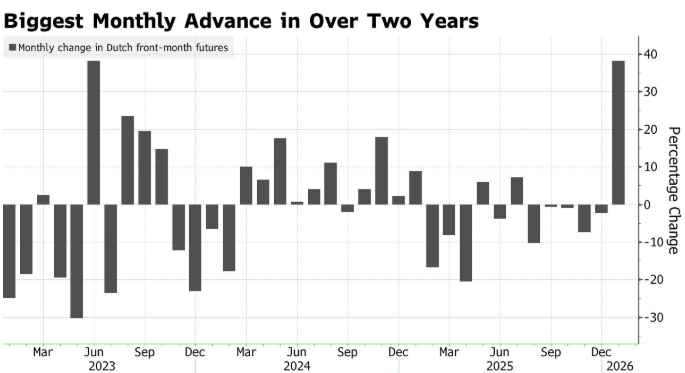
一月狂飙38%!寒潮与库存下降共振,欧洲天然气价格势将创下2年多来最大月度涨幅
Zhi Tong Cai Jing· 2026-01-30 09:17
Group 1 - The core viewpoint of the articles highlights the significant increase in European natural gas prices, which are expected to reach the largest monthly gain in at least two years due to cold weather and rapidly depleting fuel inventories [1][4] - As of the report, the Dutch benchmark natural gas futures for March delivery rose slightly by 0.5% to €38.77 per megawatt-hour, with a cumulative increase of approximately 38% for the month, marking the largest rise since the summer of 2023 [1] - Concerns over supply have eased somewhat with a rebound in U.S. exports, but expectations of severe cold weather in parts of Europe in early February are likely to increase demand [1] Group 2 - Energy analysis firm Energy Aspects noted that due to abnormally low inventories, price risks remain skewed to the upside, and unstable weather models have contributed to increased volatility in natural gas prices [4] - Traders are closely monitoring the situation in Iran, as escalating threats from U.S. President Trump have kept the energy market tense [4] - Additionally, Trump announced an agreement with Russia to pause airstrikes in Ukraine for a week, coinciding with the impending extreme cold weather [4]
乐山电力(600644.SH):外围天然气价格波动对公司天然气成本有一定影响
Ge Long Hui A P P· 2026-01-28 07:55
Core Viewpoint - The company acknowledges that fluctuations in external natural gas prices have a certain impact on its natural gas costs [1] Group 1 - The company stated that it will comply with legal regulations regarding information disclosure and will fulfill its obligations in a timely and fair manner if any disclosure matters arise [1]

美国天然气价格突破7美元大关 寒冷地区价格突破200美元
Ge Long Hui A P P· 2026-01-26 23:16
Core Viewpoint - The article highlights a significant increase in natural gas prices in the U.S. due to severe winter weather, which has led to a surge in heating demand and supply disruptions [1] Group 1: Price Movements - Natural gas near-month contracts surpassed $7 per million British thermal units (MMBtu) for the first time since 2022, marking a 40% increase from the previous Friday's closing price [1] - Spot prices for natural gas delivered at Henry Hub in Louisiana reached as high as $53 per MMBtu [1] - In the northeastern U.S., spot prices at the Iroquois Zone 2 hub exceeded $200 per MMBtu [1] Group 2: Supply Disruptions - The winter storm is estimated to have caused a disruption of 12% in U.S. natural gas production [1] - Traders are closely monitoring the duration of the production interruptions caused by the winter storm [1]
极寒天气来袭,美国天然气价格一度飙升近20%
Feng Huang Wang· 2026-01-26 22:08
Group 1 - The core viewpoint of the articles highlights a significant surge in U.S. natural gas prices due to extreme winter weather, with prices rising nearly 20% and reaching over $6 per million British thermal units for the first time since 2022 [1][2] - A winter storm has caused over 10% of U.S. natural gas production to temporarily shut down, coinciding with a sharp increase in demand for heating and electricity generation [1] - The extreme cold has put immense pressure on the electrical grid and severely disrupted transportation, leading to thousands of flight cancellations [1] Group 2 - The U.S. LNG export facilities have seen natural gas delivery volumes drop to their lowest levels in a year due to the winter storm [2] - Analysts predict that fluctuations in U.S. natural gas prices will become increasingly important for the value and risk of the LNG market over the next five years [2] - The volatility in near-month contract prices is also influenced by the upcoming expiration of the February contract, which is expected to reduce market liquidity [2][3]