存储成本上涨

Search documents
净利腰斩 “非洲之王”传音失速
Bei Jing Shang Bao· 2026-02-01 15:55
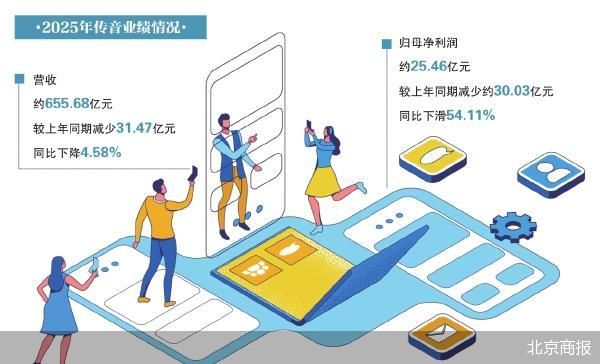
Core Viewpoint - Transsion Holdings, known as the "King of Africa" in the mobile phone industry, reported disappointing annual results for 2025, with significant declines in revenue and net profit due to rising supply chain costs and intensified competition in emerging markets [1][3]. Financial Performance - The company expects to achieve approximately 65.568 billion yuan in revenue for 2025, a decrease of 4.58% year-on-year [1]. - Net profit attributable to shareholders is projected to be around 2.546 billion yuan, down 54.11% compared to the previous year [1]. - The first quarter saw a revenue decline of 25.45% and a net profit drop of 69.87% [3]. - By mid-year, revenue had decreased by 15.86%, with net profit down 57.48% [3]. - Despite a 22.6% revenue increase in the third quarter, cumulative revenue for the first three quarters still fell by 3.33% [3]. Market Position and Competition - In the third quarter, Transsion achieved a 13.6% year-on-year increase in shipments, reaching 29.2 million units, making it one of the top five global smartphone manufacturers [5]. - However, the company did not appear in the global top five rankings in other quarters, indicating instability in its market presence [5]. - In Africa, Transsion maintained a leading position with a 51% market share, but growth has slowed, with competitors like Xiaomi and Honor rapidly increasing their market presence [6][7]. Industry Challenges - Rising storage costs have become a common challenge in the smartphone industry, significantly impacting Transsion's operations in price-sensitive emerging markets [8]. - The increase in DRAM prices has raised production costs across all price segments, with low-end models experiencing the most significant cost hikes [8][9]. - The company faces pressure to maintain market share while exploring new growth avenues, making its future uncertain [9].

存储等核心元器件成本上涨 手机行业竞争格局重构
Mei Ri Jing Ji Xin Wen· 2026-01-22 15:28
Core Insights - Honor has launched three new smartphone models targeting different consumer segments, indicating a strategic shift to attract younger and female users under new management [1] - The global smartphone market is facing dual pressures from rising component costs and limited domestic market growth, necessitating a search for new growth opportunities [1] - Omdia predicts that by 2026, the smartphone market will enter a new phase dominated by "cost pressure" and "value creation," with a clear trend of market differentiation [2] Industry Overview - The global smartphone shipment is expected to reach 1.26 billion units in 2025, with a year-on-year growth of 1.9%, primarily driven by mid-to-high-end models [3] - Apple and Samsung are projected to be the strongest performers among the top five smartphone manufacturers, with growth rates of 6.3% and 7.9% respectively, increasing their combined market share to 39% [3] - Other manufacturers like Xiaomi and OPPO are experiencing market share declines, with Xiaomi's shipments dropping significantly in Q4 2025 due to competitive pressures and a shift towards high-end products [3] Market Dynamics - The entry-level smartphone segment, once a stronghold for Chinese manufacturers in overseas markets, is now under pressure due to rising component costs, prompting a shift towards the mid-to-high-end market [4] - Honor's overseas smartphone shipments grew by approximately 55% in the first three quarters of 2025, with Europe being a key market for its high-end strategy [4] - OPPO's shipments of mid-to-high-end smartphones increased from 2.7 million units in Q2 2024 to 4 million units in Q2 2025, reflecting a similar strategic shift [5] Supply Chain Challenges - Rising prices of core components, particularly storage, are significantly impacting the smartphone market, with Omdia highlighting this as a key variable for 2026 [7] - The supply of LPDDR4 and LPDDR5 memory is constrained, leading to intense competition among manufacturers to manage costs and secure supply [7] - The price of DRAM and NAND memory surged by 386% and 207% respectively in 2025, with further increases expected in early 2026 [8] Strategic Adjustments - Manufacturers are adjusting their product strategies in response to rising costs, with many shifting focus from entry-level to mid-range products to maintain profitability [4][9] - The industry is expected to face challenges in maintaining healthy inventory levels, with a recommended storage inventory of 8 to 10 weeks [9]
厂商撑不住了,集体涨价!“两天涨了400多元”,有人干脆不买了,还有厂商取消新品上市
Mei Ri Jing Ji Xin Wen· 2026-01-12 09:47
Group 1 - The rapid development of AI has led to significant price increases in memory, hard drives, and graphics cards, with memory prices soaring to the extent that a box of 100 memory sticks was compared to the price of a house in Shanghai, valued at 4 million yuan [1] - Major PC manufacturers, including HP, Acer, and Asus, have announced price hikes for laptops and PCs due to the ongoing surge in memory costs, with Dell increasing commercial computer prices by 10% to 30% [2][3] - Lenovo has adjusted prices for several laptop models, with mid-to-high-end models seeing increases of 500 to 1500 yuan, reflecting a broader trend of rising consumer electronics prices [3] Group 2 - Smartphone manufacturers, including Xiaomi and iQOO, have also raised prices for new models, with some mid-range and flagship devices experiencing price increases of up to 20% due to rising memory costs [4] - IDC predicts that the average selling price of smartphones will reach $465 by 2026, with total market revenue expected to hit $578.9 billion, driven by the rising cost of memory semiconductors, which now account for over 20% of smartphone costs [6] - In contrast, the AI glasses segment has not seen widespread price increases, with some models even experiencing price reductions, as the storage requirements for these products are not as high as for smartphones [7]

群智咨询:第三季度全球智能手机出货量约为3.1亿部 同比增长2.4%
智通财经网· 2025-10-30 09:33
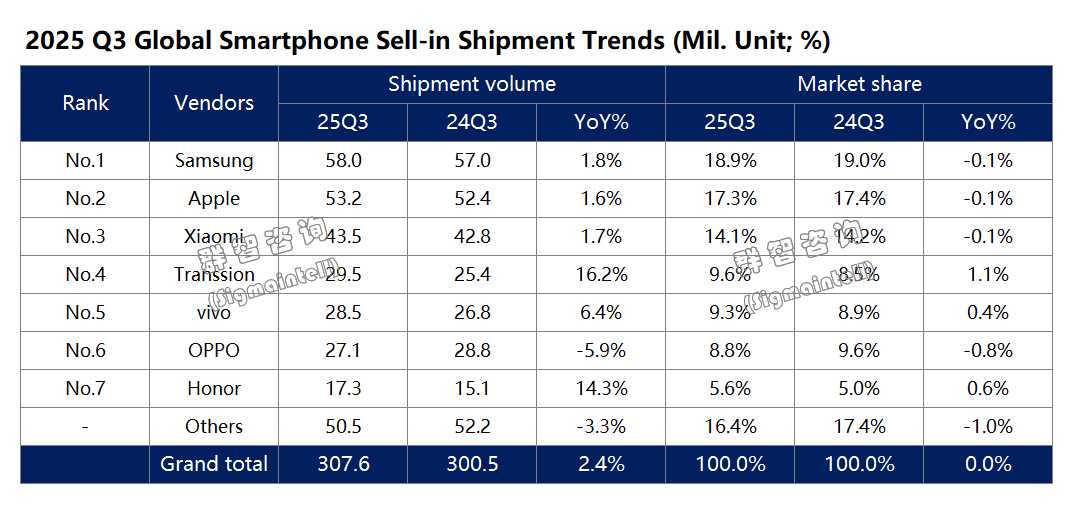
Global Market Overview - In Q3 2025, global smartphone shipments are projected to reach approximately 310 million units, reflecting a year-on-year growth of 2.4% [1] - Key growth markets include India and the Middle East, with mid-range models like Samsung's A0/A1 series and Xiaomi's REDMI A series performing particularly well due to their cost-effectiveness [2] - Samsung's global shipments in Q3 2025 are estimated at 58 million units, up 1.8% year-on-year, while Apple's shipments are around 53.2 million units, increasing by 1.6% [3] Domestic Market Insights - In the domestic market, smartphone shipments are expected to decline by 1.0% year-on-year in Q3 2025, totaling approximately 68 million units [4] - Apple is the only top-five brand to achieve growth in the domestic market, with shipments of about 10.6 million units, driven by the iPhone 17's competitive pricing and upgrades [5] - Vivo's domestic shipments are around 11.8 million units, showing a decrease of 7.8% year-on-year, while Huawei's shipments are approximately 10.5 million units, also reflecting a decline [5] Future Market Outlook - Rising storage costs are expected to impact smartphone demand and configurations, leading to extended replacement cycles for consumers [6] - The global smartphone shipment forecast for 2025 is approximately 1.194 billion units, representing a slight increase of 0.8% year-on-year, while domestic shipments are projected at 282.4 million units, a 0.3% increase [7]



红米K90被指各版差价过大,雷军回应
21世纪经济报道· 2025-10-24 07:29
Core Viewpoint - The pricing strategy for the REDMI K90 series has faced criticism due to significant price differences between versions, particularly for the 12GB+512GB model, which has led to a price adjustment to address customer concerns [1][3][5]. Pricing and Product Details - The REDMI K90 series includes two models: K90 and K90 Pro Max, with initial prices set at 2599 yuan and 3999 yuan respectively [5]. - The pricing breakdown for the K90 series is as follows: - 12GB+256GB version: 2599 yuan - 16GB+256GB version: 2899 yuan - 12GB+512GB version: 3199 yuan - 16GB+512GB version: 3499 yuan - 16GB+1TB version: 3999 yuan - The price difference between the 12GB+256GB and 12GB+512GB versions is 600 yuan, which has raised concerns among users regarding the value proposition of the higher storage option [5]. Company Response - Xiaomi's President, Lu Weibing, acknowledged the disappointment from users regarding the pricing and attributed the high costs to increased upstream supply chain pressures, particularly in memory storage [3][5]. - In response to customer feedback, Xiaomi decided to reduce the price of the 12GB+512GB version by 300 yuan during its first month of sales, bringing the price down to 2899 yuan [3][5]. - Xiaomi's founder, Lei Jun, also supported this explanation, linking the pricing issues to rising memory costs [3].

雷军回应红米K90价格争议:内存涨价太多,希望大家能理解
Sou Hu Cai Jing· 2025-10-24 04:55
Core Points - The Redmi K90 series was launched on October 23, with the 12+256GB version priced at 2599 yuan and the 12+512GB version at 3199 yuan, leading to discussions about the high price difference for the additional storage [1][4] - Xiaomi's smartphone division president, Lu Weibing, acknowledged customer disappointment regarding the pricing and announced a price reduction of 300 yuan for the 12GB+512GB version during its first month of sales, bringing the price down to 2899 yuan [1][4] - CEO Lei Jun emphasized the impact of rising memory costs on pricing and expressed hope for consumer understanding regarding the company's pricing strategy [1][3][4] Pricing Strategy - The initial pricing for the Redmi K90 series has sparked significant consumer feedback, particularly regarding the 12+512GB version's price [1][4] - The decision to reduce the price of the 12GB+512GB version reflects the company's responsiveness to consumer demand and feedback [1][4] - The company cited global supply chain pressures and increased storage costs as factors influencing the pricing strategy [1][4]