
宏观资产配置三维金字塔

Search documents
财信证券:2026年度宏观策略展望 破局谋新,迈向新平衡
Xin Lang Cai Jing· 2025-12-22 07:14
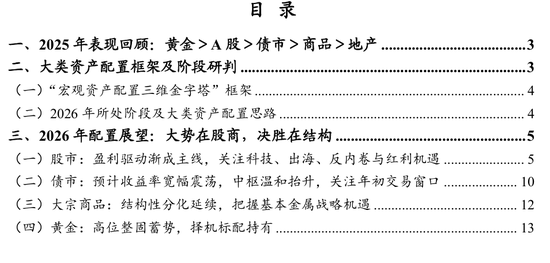
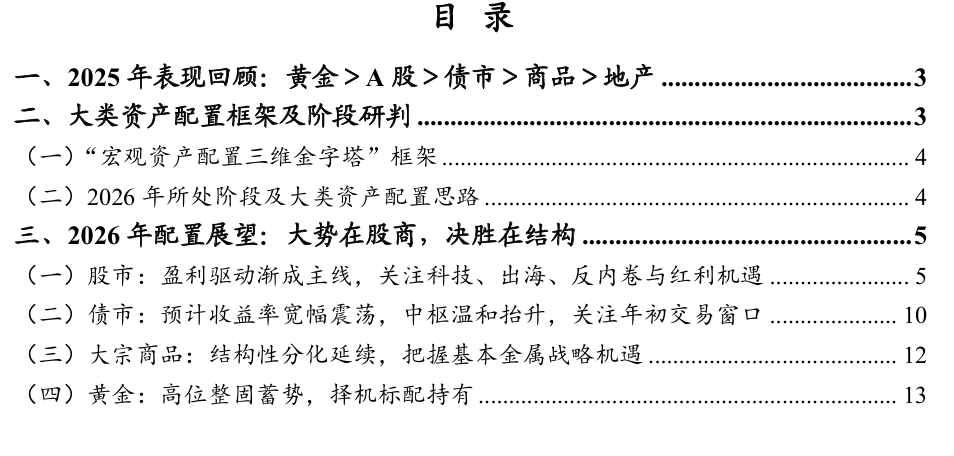
Group 1 - In 2025, major asset performance showed significant differentiation driven by three forces: financial cycle downturn, global order restructuring, and deepening industrial revolution. Gold prices surged over 60%, A-shares entered a structural bull market, while the bond market faced fluctuations and real estate prices continued to adjust [1][75]. Group 2 - The macro asset allocation framework for 2026 indicates a complex transition period. The strategic layer suggests maintaining a defensive stance due to the ongoing financial cycle downturn. The tactical layer anticipates a combination of economic recovery and financial easing, providing opportunities in commodities and equities [2][76]. Group 3 - The outlook for 2026 suggests that the stock market may experience a profit-driven rally supported by improved economic fundamentals and ample liquidity. Key focus areas include technology sectors like AI and semiconductors, high-quality export sectors, and renewable energy benefiting from anti-involution policies [3][77]. Group 4 - The bond market is expected to see a wide range of fluctuations with a moderate upward trend in yields, projected to be between 1.6% and 2.1%. The key factors influencing this include a rebound in PPI and alleviation of the "asset shortage" issue, with potential trading opportunities arising from small rate cuts early in the year [3][43][77]. Group 5 - In the commodities market, structural differentiation is expected to continue, with basic metals like copper and aluminum benefiting from global fiscal expansion and liquidity easing. Traditional energy sources like oil may perform relatively poorly due to the financial cycle downturn and supply pressures [3][59][77]. Group 6 - Gold is anticipated to enter a phase of high-level consolidation, with long-term support from weakened dollar credit and central bank gold purchases. However, short-term volatility may arise from price corrections and geopolitical factors [3][68][77].

宏观策略 | 破局谋新,迈向新平衡——2026年度宏观策略展望(策略篇)
Sou Hu Cai Jing· 2025-12-22 06:59
Group 1 - In 2025, major asset performance showed significant differentiation, with gold prices rising over 60%, A-shares experiencing a structural bull market, and the bond market entering a phase of volatility [1][6] - The driving forces behind these trends include a domestic financial cycle downturn, a restructuring of the global economic order, and a deepening industrial revolution led by AI [6][7] - The bond market faced challenges due to the "asset shortage" logic weakening and economic rebalancing policies entering a phase of turbulence [6][7] Group 2 - For 2026, the market is expected to be in a complex transitional phase, with a strategic focus on defensive positioning while tactically seeking structural opportunities in commodities and equities [2][10] - The stock market is anticipated to see a profit-driven rally supported by improved economic fundamentals, ample liquidity, and reasonable valuations, particularly in sectors like AI and semiconductors [3][15] - The bond market is projected to experience a wide fluctuation in yields, with the ten-year government bond yield expected to range between 1.6% and 2.1% [3][47] Group 3 - The commodity market is expected to continue structural differentiation, with basic metals like copper and aluminum benefiting from global fiscal expansion and industrial upgrade demands [3][63] - Gold is anticipated to undergo a phase of high-level consolidation, supported by weakened dollar credit and central bank purchases, while facing short-term volatility [3][74] - The investment logic for commodities is shifting from traditional economic cycles to a focus on strategic scarcity and essential resources, particularly in the context of global security and industrial needs [3][64][66]
宏观解读丨宏观资产配置三维金字塔:一个新框架的构建——大类资产配置研究(上篇)
Sou Hu Cai Jing· 2025-12-04 11:07
Core Viewpoints - The traditional asset allocation frameworks, such as the Merrill Lynch Investment Clock and Pring Cycle, have limitations that necessitate the development of a new analytical framework [2][3] - The new framework, termed the "Macroeconomic Asset Allocation Three-Dimensional Pyramid," integrates strategic, tactical, and disturbance layers to enhance asset allocation decisions in a complex macroeconomic environment [3][20] Traditional Frameworks - The Merrill Lynch Investment Clock categorizes economic cycles into four stages: recovery, overheating, stagflation, and recession, providing a clear asset allocation strategy for each stage [6][8] - The Pring Cycle offers a more nuanced six-stage model that captures economic transitions more accurately, incorporating leading, coincident, and lagging indicators [12][13] - Both frameworks share the idealized assumption that economic cycles follow a fixed order, which can lead to inaccuracies in rapidly changing environments [10][15] Need for a New Framework - Geopolitical factors have become a fundamental logic influencing asset prices, necessitating their inclusion in asset allocation models [16] - Traditional frameworks rely on lagging data, limiting their predictive capabilities regarding asset price movements and economic turning points [17] - A modern framework must consider both short-term business cycles and long-term financial cycles, integrating observable economic and financial indicators [18][19] New Framework Structure - The "Macroeconomic Asset Allocation Three-Dimensional Pyramid" consists of three interrelated layers: strategic, tactical, and disturbance [20][24] - The strategic layer focuses on long-term financial cycles, using indicators like credit/GDP gaps and real estate prices to identify systemic risks [24] - The tactical layer combines real economy cycle indices and financial conditions indices to dynamically capture mid-term asset rotation opportunities [25][31] - The disturbance layer incorporates geopolitical risk indices to adjust for significant external shocks, enhancing the framework's robustness [26][33] Asset Allocation Decisions - The allocation process follows a structured approach: strategic direction setting, tactical rotation capturing, and disturbance hedging [4][35] - Strategic decisions are based on the financial cycle's position, determining long-term allocations across major asset classes [37] - Tactical decisions utilize an eight-state matrix derived from the interaction of economic and financial conditions to guide asset prioritization [41] - The disturbance layer mandates a global hedging strategy during heightened geopolitical risks, ensuring portfolio resilience [42][44]
