
实体经济和数字经济深度融合

Search documents
因地制宜发展新质生产力 为高质量发展提供强大动能
Jing Ji Ri Bao· 2025-12-23 22:13
Core Viewpoint - High-quality development is the primary task for building a modern socialist country, and developing new quality productivity is an essential requirement and important focus for promoting high-quality development [1][2]. Group 1: New Quality Productivity Theory - The theory of new quality productivity reveals the characteristics and laws of social productivity development in the new era, representing the latest achievement of the localization and modernization of Marxist productivity theory [1][3]. - New quality productivity is characterized by high technology, high efficiency, and high quality, emphasizing innovation as its core feature [3][4]. Group 2: Importance of Innovation - Innovation is the key to developing new quality productivity, encompassing technological, business model, management, and institutional innovations [4]. - Five key tasks for accelerating the development of new quality productivity include promoting technological innovation, advancing industrial innovation, and enhancing talent resource supply [4][5]. Group 3: Regional Development Strategies - The development of new quality productivity must adhere to a region-specific approach, respecting regional differences and industrial development laws [5][11]. - Each region should explore specific paths for developing new quality productivity based on its resource endowments and industrial foundations [5][12]. Group 4: Balancing Relationships - It is crucial to balance the relationships between productivity and production relations, government and market, new and old driving forces, and technology and industry to foster an environment conducive to developing new quality productivity [6][8][9][10]. - The relationship between the overall strategy and local characteristics must be managed to ensure that development aligns with national modernization goals while considering local conditions [11][12]. Group 5: Institutional Mechanisms - Establishing effective institutional mechanisms is essential for promoting the development of new quality productivity, including enhancing the integration of advanced production factors and fostering the deep integration of the real economy and digital economy [15][16]. - A modern industrial system is necessary as a foundation for developing new quality productivity, requiring the optimization of traditional industries and the cultivation of emerging industries [14][17].
推动数字产业集群创新发展
Ren Min Ri Bao· 2025-12-16 22:30
Group 1 - The core viewpoint emphasizes the importance of accelerating the development of the digital economy and creating internationally competitive digital industry clusters as a crucial measure for developing new productive forces [1][5] - The integration of digital economy and real economy is highlighted as a key strategy, with the aim of fostering deep collaboration between these two sectors [1][5] - Digital industry clusters are characterized by their ability to drive innovation and create new industrial ecosystems through the integration of digital technologies and data elements [2][3] Group 2 - Digital industry clusters represent a new organizational form that promotes cross-industry integration, collaborative innovation, and value co-creation [2] - The development of digital industry clusters is marked by the emergence of new industries driven by data as a key production factor and digital technology as a significant driving force [2] - Traditional industry clusters are also undergoing transformation through the application of digital technologies, leading to comprehensive upgrades and improvements in efficiency and innovation [2][4] Group 3 - The innovation vitality of digital industry clusters is crucial for the progress and effectiveness of the integration between the real economy and the digital economy [3] - There is a need to enhance digital technology innovation and deepen the integration of digital technologies with specific application scenarios to stimulate the multiplier effect of data elements [3][4] - Encouraging collaboration among digital operation service providers and data service suppliers is essential for developing market-applicable digital products and services [3] Group 4 - Digital industry clusters serve as the main battleground for the transformation and upgrading of the real economy, leveraging digital technologies to address traditional industry challenges [4] - The penetration, mobility, and reusability of data elements are highlighted as key factors in generating new data resources during the integration with traditional production factors [4] - The innovation within these clusters relies on advancements in core technologies such as products, processes, and materials, facilitated by digital tools [4] Group 5 - Promoting the deep integration of the real economy and digital economy, along with driving innovation in digital industry clusters, is recognized as a systematic project [5] - It is essential to leverage the advantages of a new type of national system and understand the inherent laws of digital industry cluster development [5] - A dual-driven approach is necessary to fully unleash the synergistic and multiplicative effects of the integration between the real economy and digital economy [5]
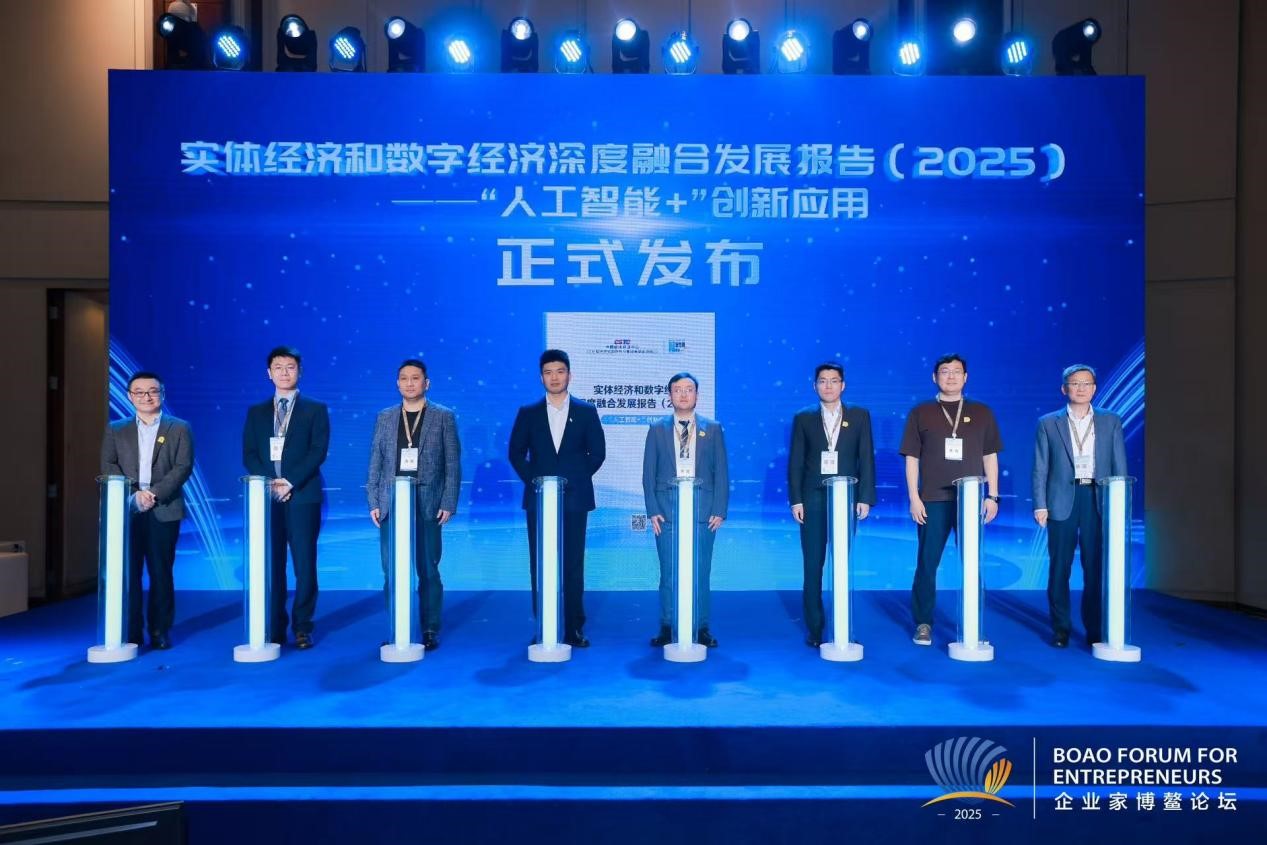
《实体经济和数字经济深度融合发展报告(2025)——“人工智能+”创新应用》发布
Xin Hua Wang· 2025-12-05 05:36
Core Insights - The report titled "Integration of Real Economy and Digital Economy Development Report (2025) - 'Artificial Intelligence +' Innovation Applications" was released during the 2025 Digital Technology Innovation Development Conference, focusing on the practical applications of digital empowerment in various industries [1][2][3] Group 1: AI Empowerment in Manufacturing - Accelerating the application of artificial intelligence in the manufacturing sector is deemed significant, as it enhances data collaboration and reuse, improves operational efficiency, and promotes intelligent manufacturing [5] - The report emphasizes the importance of creating a "people-centered" intelligent society, where AI advancements benefit the public, particularly in education, transforming traditional teaching methods into task-driven and intelligent support systems [5] Group 2: AI's Impact on Consumption - Artificial intelligence is reshaping the consumer market by optimizing production, circulation, and recommendation processes, leading to improved quality of digital consumption [5] - AI is also diversifying consumption models, particularly in traditional labor-intensive sectors like cultural tourism and local services, pushing them towards knowledge-intensive "intelligent-driven services" [5] Group 3: AI in Government and Public Services - In the realm of government and public services, AI is driving significant governance changes, enhancing service efficiency through applications like "one-stop service" and intelligent approval processes [6] - The report highlights a shift from passive service responses to proactive and precise service delivery, significantly improving user experience [6] Group 4: Future Pathways and Recommendations - The report suggests that the integration of AI with the real economy will accelerate industrial transformation and economic growth, supported by a series of policy implementations aimed at enhancing digital infrastructure [6][7] - Recommendations for promoting high-quality development of "AI +" include advancing digital infrastructure, constructing a data factor market system, and strengthening the supply of technology, talent, and scenarios to foster a new ecosystem for integration [7]

聚力制造业“固本强基” 推动泰州海陵冲击“千亿主城”
Yang Zi Wan Bao Wang· 2025-11-12 07:19
Core Viewpoint - The news highlights the achievements and future plans of the Hailing District in Taizhou, focusing on the implementation of the "Industrial Strong District" strategy during the 14th Five-Year Plan and the ambition to become a "Thousand Billion Main City" in the upcoming 15th Five-Year Plan [1]. Group 1: Industrial Development - The Hailing District aims to achieve an industrial output value of 61 billion yuan and an industrial added value of 9.05 billion yuan in 2024, showcasing the resilience and vitality of its industrial economy [1]. - The district has strengthened its industrial capabilities by aligning with the provincial "1650" industrial system and focusing on advanced manufacturing clusters [1]. Group 2: Key Industries - The "New" sector includes new energy and new materials, with a focus on seizing opportunities from the "dual carbon" strategy, exemplified by the introduction of key enterprises like TaiZhou Longi [2]. - The automotive and motorcycle parts industry has over 100 related enterprises, with a scale nearing 10 billion yuan, indicating a vibrant sector with traditional companies exploring new transformation directions [2]. - The smart home and appliance industry is represented by LG Electronics, which has become the largest refrigerator production base for LG outside Korea, fostering a cluster of over 30 supporting enterprises [2]. - The digital economy is evolving from technology research and development to application scenarios, attracting quality projects and nurturing benchmark companies like YunYong Electronics [2]. Group 3: Innovation and Transformation - The Hailing District is committed to building a robust innovation ecosystem by integrating technology and industrial innovation, focusing on a "cultivation-transformation-upgrade" model [3]. - The district emphasizes the importance of infrastructure development, result transformation, and innovation to stimulate growth and enhance the capabilities of enterprises [3].
做好建设现代化经济体系这篇大文章——学习《习近平经济文选》第一卷
Jing Ji Ri Bao· 2025-06-10 00:15
Group 1: Modern Economic System - The modern economic system is an organic whole composed of various interconnected social and economic activities, involving multiple aspects such as industrial development, technological innovation, regional coordination, green development, and market system construction [1][2] - The construction of a modern economic system is both a significant theoretical proposition and a major practical task, as discussed in multiple writings in the first volume of "Xi Jinping's Economic Works" [1][2] Group 2: Green Development - Accelerating the green transformation of economic and social development is a crucial strategy for addressing resource and environmental issues in China, with significant achievements in recent years [2][3] - The concept of "lucid waters and lush mountains are invaluable assets" has become deeply ingrained in society, forming a resource-saving and environmentally friendly green development system as part of the modern economic framework [2][3] Group 3: Development Philosophy - The need for a new development philosophy is emphasized, particularly the importance of green development in achieving harmony between humanity and nature, which is essential for sustainable economic growth [3][4] - The integration of economic growth with environmental protection is highlighted as a key requirement for modern construction, promoting a harmonious coexistence between human development and natural ecosystems [4][5] Group 4: Technological Innovation - Technological innovation is positioned as the primary driving force for development and a strategic support for building a modern economic system, with a focus on advancing green productivity [11][12] - The importance of aligning the innovation chain with the industrial chain is stressed, particularly in tackling key core technologies to enhance national competitiveness [13][19] Group 5: Regional Coordination - The significance of regional coordinated development is underscored as a vital component of the modern economic system, addressing the long-standing issue of regional disparities in resource endowments and development levels [15][16] - Recent strategies have led to noticeable improvements in regional coordination, with specific initiatives aimed at enhancing economic competitiveness and promoting balanced development across different areas [16][18] Group 6: Integration of Digital and Real Economies - The deep integration of the real economy and digital economy is identified as an essential requirement for high-quality economic development, with a focus on enhancing the intelligence and digitalization of the real economy [19][20] - Emphasis is placed on fostering advanced manufacturing clusters and promoting technological platform construction to support the integration of digital and real economies [21][22]
工信部副部长:中国建成全球技术领先、规模最大的信息通信网络
news flash· 2025-05-17 10:32
Group 1 - The event for the 2025 World Telecommunication and Information Society Day and the 160th anniversary of the International Telecommunication Union was held in Nanchang, Jiangxi Province [1] - The Vice Minister of Industry and Information Technology, Zhang Yunming, highlighted that China has built the world's largest and technologically advanced information and communication network [1] - 5G applications have been integrated into 86 out of 97 categories of the national economy, demonstrating significant penetration [1] - The industrial internet has achieved full coverage across 41 industrial categories, indicating extensive adoption [1] - The development of artificial intelligence and low-altitude economy is accelerating, effectively promoting the deep integration of the real economy and the digital economy [1]