客户尽职调查

Search documents
“取款超5万元不再登记”兼顾安全与便利
Bei Jing Qing Nian Bao· 2025-12-05 07:32
Core Viewpoint - The People's Bank of China has released new regulations emphasizing risk-based customer due diligence for financial institutions, balancing anti-money laundering efforts with improved financial services. The regulation, effective from January 1, 2026, removes the requirement for customers to declare the source of funds for cash withdrawals exceeding 50,000 yuan, reflecting a more nuanced approach to risk management [1][2][3]. Group 1: Regulatory Changes - The new regulation cancels the requirement for customers to register the source of funds for cash withdrawals over 50,000 yuan, which has been a point of public concern and discussion [1][2]. - Financial institutions are now required to conduct customer due diligence based on risk assessments rather than a one-size-fits-all approach, allowing for a more tailored investigation process [2][3]. Group 2: Impact on Customer Experience - Customers have previously expressed frustration with intrusive inquiries regarding the source and purpose of funds during transactions, leading to a poor banking experience [2]. - The updated regulations aim to simplify the process for low-risk customers, enhancing their experience while maintaining necessary security measures for high-risk transactions [2][3]. Group 3: Enhanced Risk Management - Financial institutions must develop a more sophisticated risk assessment system that utilizes various data points, including customer identity and transaction history, to identify potential risks accurately [3]. - The ongoing prevalence of financial crimes necessitates that banks not only maintain but enhance their due diligence practices, ensuring a balance between customer convenience and financial security [3].
银行取款超5万元不再需要登记!哪些情况取钱还可能被银行问询?
Xin Lang Cai Jing· 2025-12-02 00:50
Core Viewpoint - The recent reform in the financial sector allows for the cancellation of the requirement for individuals to register the source of funds for cash withdrawals exceeding 50,000 yuan, effective January 1, 2026, transitioning to a risk-based management approach [1][3][12]. Summary by Sections Regulatory Changes - The People's Bank of China, along with the National Financial Regulatory Administration and the China Securities Regulatory Commission, issued the "Measures for Customer Due Diligence and Customer Identity Information and Transaction Record Management" [3]. - The new measures eliminate the previous requirement for individuals to register the source of funds for cash withdrawals over 50,000 yuan, aligning with public feedback and maintaining a focus on anti-money laundering and counter-terrorism financing [1][3][12]. Risk-Based Approach - Financial institutions are required to identify and verify customer identities based on risk levels, implementing enhanced due diligence for high-risk scenarios while simplifying procedures for low-risk situations [3][4]. - The measures emphasize a risk-based due diligence principle, balancing the need for financial security with service convenience [4][5][12]. Implementation and Compliance - Financial institutions must continuously monitor and assess customer risk profiles and transaction activities, with annual reviews for the highest risk clients [4][9]. - The measures apply to various financial entities, including banks, securities firms, insurance companies, and non-bank payment institutions, ensuring a comprehensive approach to customer due diligence [4][5]. Public Response and Impact - The reform aims to improve customer experience by reducing unnecessary inquiries for low-risk transactions, while still allowing for scrutiny in cases of suspicious activities [8][11]. - The changes are seen as a significant shift from a one-size-fits-all approach to a more nuanced, risk-sensitive framework, potentially leading to a more efficient allocation of resources and reduced operational costs for financial institutions [12][13].
客户尽职调查新规兼顾安全与便利
Jin Rong Shi Bao· 2025-12-01 02:03
Core Viewpoint - The newly released "Management Measures for Customer Due Diligence and Customer Identity Information and Transaction Record Retention" aims to effectively implement the revised Anti-Money Laundering Law by the end of 2024, emphasizing a balance between anti-money laundering measures and optimizing financial services [1][2][4]. Group 1: Purpose and Principles - The purpose of the "Management Measures" is to enhance customer due diligence while adhering to the "risk-based" principle, ensuring a balance between risk management and service optimization [1][5]. - The "risk-based" approach requires financial institutions to conduct thorough risk assessments and tailor their measures accordingly, moving beyond mere compliance with rules [2][3]. Group 2: Implementation and Compliance - The revised measures are designed to align with the new Anti-Money Laundering Law, which emphasizes the need for a detailed legal framework for customer due diligence to guide practical implementation [2][4]. - Financial institutions are encouraged to continuously conduct customer due diligence and transaction monitoring to effectively manage risks [4][5]. Group 3: Balancing Risk Management and Service Optimization - The revised "Management Measures" aim to balance anti-money laundering efforts with the need for efficient financial services, avoiding unnecessary burdens on compliant businesses and the public [5][9]. - Adjustments have been made to ensure that due diligence measures correspond to actual risk levels, allowing for simplified procedures in low-risk situations while enhancing scrutiny in high-risk scenarios [6][7]. Group 4: Real-World Applications and Challenges - Real-life examples illustrate the challenges of balancing security and convenience in anti-money laundering efforts, highlighting the need for effective risk assessment and customer verification [7][8]. - The revised measures seek to address the dual demands of the public for both efficient service and financial security, aiming to find a balance that prevents illegal activities while facilitating legitimate transactions [9].
央行等三部门发布新规,银行取钱不再“一刀切”式询问
蓝色柳林财税室· 2025-11-30 05:30
Core Points - The new regulation issued by the People's Bank of China, the National Financial Regulatory Administration, and the China Securities Regulatory Commission aims to prevent money laundering and terrorist financing by allowing financial institutions to tailor their customer due diligence based on specific risk levels rather than applying a blanket approach [2][4][5] Group 1: General Provisions - The regulation is designed to standardize customer due diligence, customer identity information, and transaction record management to maintain national security and financial order [4] - Financial institutions are required to adopt a risk-based approach, conducting enhanced due diligence for high-risk situations and simplified measures for low-risk scenarios [4][5] Group 2: Customer Due Diligence - Financial institutions must conduct customer due diligence when establishing business relationships or providing significant one-time financial services, particularly when there are reasonable suspicions of money laundering or terrorist financing [9][10] - Institutions are prohibited from providing services to unidentified customers or opening anonymous accounts [10][11] Group 3: Record Keeping - Financial institutions are mandated to maintain customer identity information and transaction records for at least ten years after the end of the business relationship or one-time service [37][38] - The records must be stored securely to ensure they can be reproduced and provided to regulatory authorities when necessary [37] Group 4: Legal Responsibilities - Violations of the regulation may result in penalties imposed by the People's Bank of China or relevant financial management departments [41] - The regulation will come into effect on January 1, 2026, replacing previous regulations [47][52]


个人存取款超5万将告别“一刀切”式登记
Bei Ke Cai Jing· 2025-11-29 15:04
Core Viewpoint - The new regulatory framework eliminates the blanket requirement for customers to declare the source of funds for cash withdrawals exceeding 50,000 yuan, shifting to a risk-based approach for customer due diligence [1][2][4] Group 1: Regulatory Changes - The new regulation cancels the requirement for customers to register the source of funds for cash withdrawals over 50,000 yuan, aiming to optimize financial services while maintaining anti-money laundering standards [2][5] - Financial institutions are now required to conduct customer due diligence based on risk, allowing for simplified measures for lower-risk transactions and enhanced scrutiny for higher-risk situations [2][5] Group 2: Customer Due Diligence - Customer due diligence remains essential for financial institutions to fulfill their anti-money laundering obligations and to identify suspicious activities [4][5] - In cases of higher money laundering risk, such as unusual transaction patterns, financial institutions will need to ask more questions and verify the transaction background [3][4] Group 3: Privacy and Information Protection - The new regulation emphasizes the protection of personal information and commercial secrets, requiring financial institutions to implement necessary measures to safeguard customer data [6] - Customer due diligence is framed as a public interest necessity, which does not conflict with individual privacy protection [5][6]
“凭啥告诉你?”曾遭不少网友吐槽!这一规定,即将取消
Nan Fang Du Shi Bao· 2025-11-29 14:14
Core Viewpoint - The People's Bank of China, along with the National Financial Regulatory Administration and the China Securities Regulatory Commission, has announced a new regulation that eliminates the requirement for individuals to disclose the source of cash deposits or withdrawals exceeding 50,000 yuan, effective January 1, 2026. This change aims to streamline banking processes and reduce unnecessary inquiries for customers with clear and stable income sources [5][10]. Group 1: Regulatory Changes - The new regulation cancels the previous requirement for banks to register the source of funds for cash transactions over 50,000 yuan or equivalent foreign currency [5][10]. - The new rule will replace the earlier regulation that was set to take effect in March 2022 but was postponed due to technical reasons [8][10]. - Financial institutions are now required to conduct enhanced investigations only in cases of high money laundering risk, while low-risk situations can be handled with simplified measures [10]. Group 2: Customer Impact - Customers with clear income sources, such as pensioners or small business owners, will no longer need to explain the purpose of their cash transactions, making banking more efficient [8][10]. - For example, a pensioner withdrawing a fixed amount monthly will only need to verify their identity without further inquiries about the funds [8]. - In contrast, unusual transactions, such as sudden large transfers, will still trigger mandatory investigations to ensure compliance with anti-money laundering regulations [10].

取款超5万,不用登记了!
Zhong Guo Ji Jin Bao· 2025-11-29 11:55
Core Points - The new regulation, titled "Measures for Customer Due Diligence and Customer Identity Information and Transaction Record Management by Financial Institutions," will take effect on January 1, 2026, after being approved by the People's Bank of China and other regulatory bodies [1][4][10] - The regulation eliminates the previous requirement for individuals to register the source of funds for cash withdrawals exceeding 50,000 yuan, aligning with the feedback received during the public consultation phase [4][6][10] - Financial institutions are now required to adopt a risk-based approach in customer due diligence, allowing them to simplify procedures for low-risk transactions while enhancing scrutiny for high-risk cases [5][10][11] Summary by Sections Regulation Overview - The regulation aims to prevent money laundering and terrorist financing, establishing guidelines for customer due diligence and record-keeping for various financial institutions, including banks, securities firms, and insurance companies [10][13][14] Customer Due Diligence - Financial institutions must identify and verify the identity of customers and their beneficial owners, taking into account the nature and risk of transactions [5][10][19] - Enhanced due diligence measures are required for high-risk situations, while simplified measures can be applied for low-risk scenarios [5][10][33] Record Keeping - Financial institutions are mandated to securely store customer identity information and transaction records for a minimum of 10 years after the end of the business relationship or transaction [45][46] - The regulation emphasizes the importance of maintaining accurate and complete records to facilitate monitoring and investigation of suspicious activities [45][46] Cross-Border Transactions - For cross-border remittances, financial institutions must verify the accuracy of remitter information for transactions exceeding 5,000 yuan or the equivalent of 1,000 USD [11][38] - This requirement reinforces existing international standards for remittance transactions [11][38] Implementation and Compliance - The regulation is seen as a practical measure to streamline processes for financial institutions while enhancing customer experience and compliance with anti-money laundering laws [6][10] - Financial institutions are expected to develop internal controls and regularly audit their compliance with the new requirements [15][16]
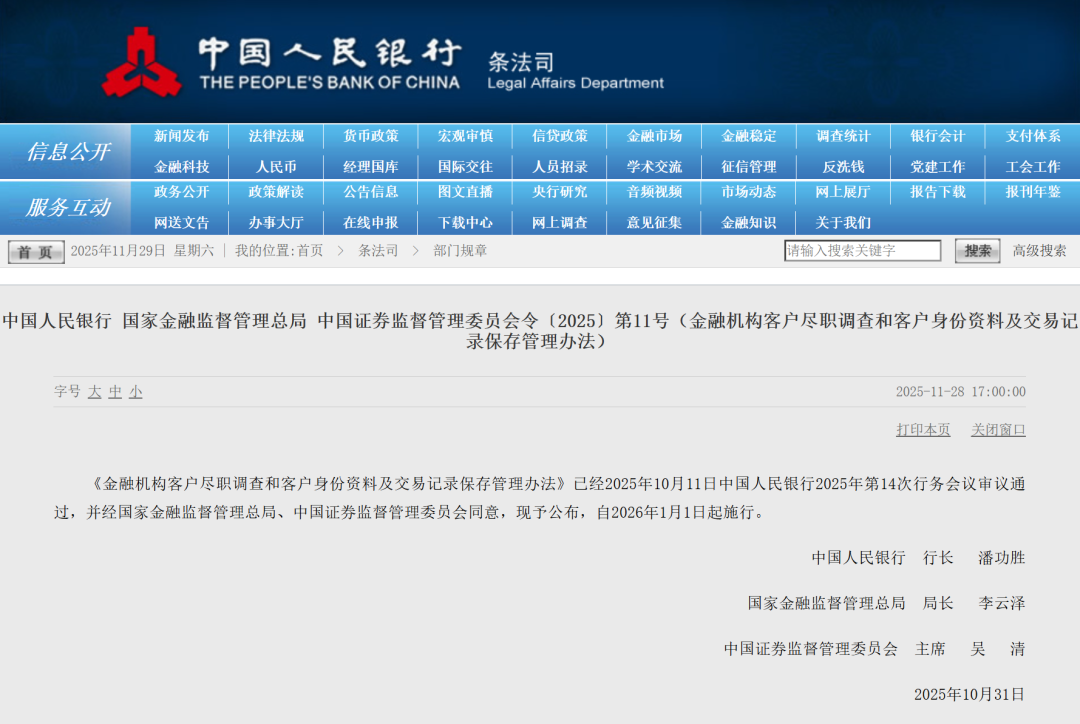
取款超5万将不再需要登记
财联社· 2025-11-29 11:37
Core Viewpoint - The new regulations aim to enhance financial security while balancing convenience for customers, particularly in the context of anti-money laundering efforts [2]. Group 1: Regulatory Framework - The People's Bank of China, along with financial regulatory authorities, has introduced a new management method for customer due diligence and transaction record retention, effective from January 1, 2026 [1]. - Financial institutions are required to securely maintain customer identity information and transaction records, ensuring the ability to reproduce each transaction for necessary investigations [1]. Group 2: Changes in Cash Withdrawal Regulations - The requirement for individuals to register the source of funds for cash withdrawals exceeding 50,000 yuan has been removed, aligning with previous drafts [2]. - Banks will no longer apply a blanket inquiry for all customers during withdrawals; instead, they will assess risk levels to determine the necessity of further questioning [2]. - For customers with low money laundering risk, such as many elderly clients, banks will primarily conduct basic identity verification without requiring additional documentation [2]. Group 3: Risk Management Measures - Financial institutions are mandated to implement enhanced due diligence measures for transactions associated with higher risks of money laundering and terrorist financing [2]. - The regulations emphasize that anti-money laundering efforts should focus on preventing misuse of the financial system rather than hindering legitimate financial activities of the public [2].

取款超5万不再需要登记,2026年1月1日起施行
Sou Hu Cai Jing· 2025-11-29 08:32
Core Viewpoint - The People's Bank of China has released the "Management Measures for Customer Due Diligence and Customer Identity Information and Transaction Record Retention" which emphasizes a risk-based approach to customer due diligence, balancing anti-money laundering risk prevention and optimizing financial services [1][5] Summary by Relevant Sections Customer Due Diligence - Financial institutions are required to conduct customer due diligence based on risk, with the principle of "Know Your Customer" guiding the identification and verification of customer identities and their beneficial owners [3][4] - The regulation cancels the previous requirement for cash withdrawals over 50,000 yuan to register the source of funds, aligning with the draft opinion [1][5] Risk Assessment - Banks will no longer uniformly inquire about the purpose of withdrawals; instead, they will assess the risk level and decide whether to conduct further inquiries based on the identified risks [3][4] - For higher money laundering and terrorist financing risks, enhanced due diligence measures must be taken, while lower-risk situations can follow simplified procedures [3][4] Cross-Border Transactions - The regulation specifies that for cross-border remittances, financial institutions must verify the accuracy of the remitter's information for amounts over 5,000 yuan or equivalent to 1,000 USD [4] - If there are reasonable grounds to suspect money laundering or terrorist financing, verification is required regardless of the amount [4] Industry Context - The introduction of these measures responds to the need for financial services to be efficient while addressing the rising threats of telecommunication fraud and online gambling [4] - The regulation aims to strike a balance between security and convenience in financial services, allowing for a more tailored approach to customer due diligence [5]
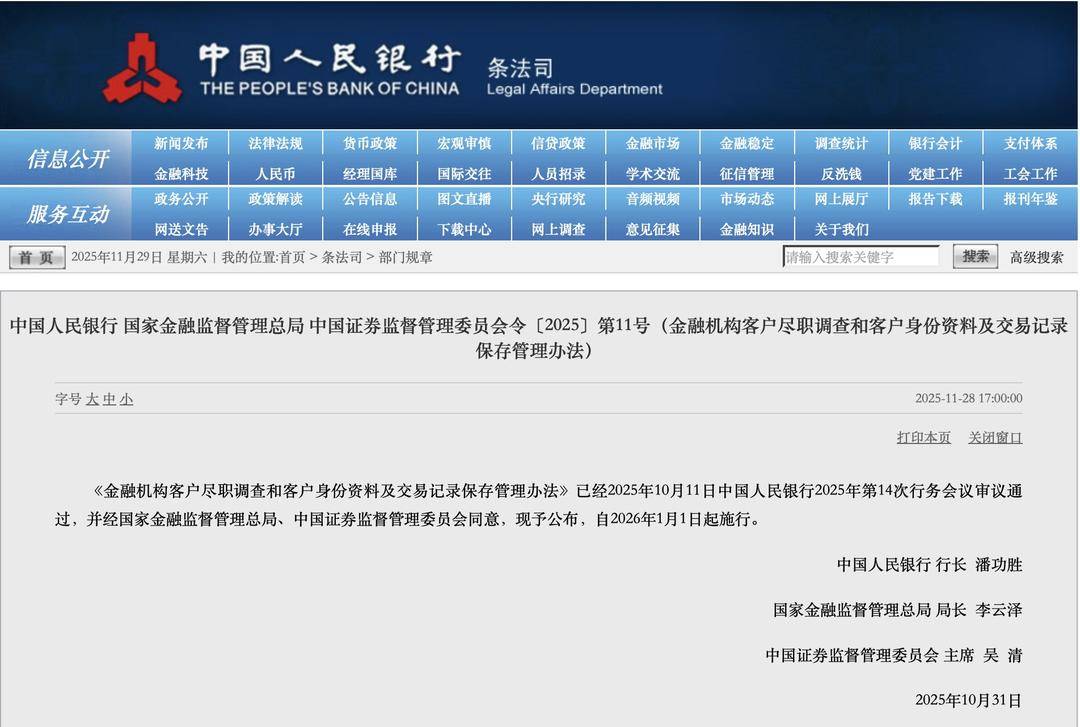
取款超5万,不用登记了!
中国基金报· 2025-11-29 06:34
Core Viewpoint - The new regulation, effective from January 1, 2026, eliminates the requirement for individuals to register the source of funds for cash withdrawals exceeding 50,000 yuan, aligning with risk-based principles in customer due diligence [2][4][6]. Group 1: Regulatory Changes - The regulation cancels the previous requirement for individuals to register the source of funds for cash withdrawals over 50,000 yuan, which had raised concerns about privacy and operational complexity [4][6]. - Financial institutions are now required to adopt a risk-based approach in customer due diligence, allowing for simplified measures in low-risk scenarios while enhancing scrutiny in high-risk situations [6][7][12]. Group 2: Implementation and Impact - The new regulation is expected to improve customer experience by reducing unnecessary inquiries during cash withdrawals, while still maintaining a focus on risk management [7][8]. - The regulation applies not only to banks but also to securities, insurance, trust, and non-bank payment institutions, ensuring a comprehensive approach to customer due diligence across the financial sector [12][14]. Group 3: Compliance and Monitoring - Financial institutions must ensure the accurate retention of customer identity information and transaction records, facilitating effective monitoring and investigation of suspicious activities [12][45]. - The regulation emphasizes the importance of ongoing risk assessment and monitoring of customer transactions to adapt to any changes in risk status [29][30].