家电企业出海

Search documents
家电行业2025年年报前瞻:黎明前夕,沉潜以待
Guolian Minsheng Securities· 2026-01-14 08:22
Investment Rating - The report maintains a "Recommend" rating for the home appliance industry [1] Core Insights - The industry is at a turning point, with expectations for improved performance in 2026 as domestic demand stabilizes and export orders recover [35] - The report highlights the resilience of leading companies in the white goods sector, with a focus on their ability to navigate through challenging market conditions [7][10] - The overall market dynamics indicate a potential for growth in emerging markets, alongside innovation and product expansion in domestic markets [35] Summary by Sections 1. White Goods - External sales are recovering steadily, while internal sales are expected to remain stable in Q4 2025. Leading companies are well-positioned to benefit from favorable demand and cost environments [7][10] - Q4 2025 internal sales for air conditioners, refrigerators, and washing machines are projected to decline by 31%, 11%, and 6% respectively, due to high base effects from the previous year [10] - External sales for refrigerators and washing machines are expected to show modest growth, with a 3% increase for refrigerators and a 9% increase for washing machines [10] 2. Black Goods - The report indicates that the color TV market is under pressure, with internal sales declining significantly due to high base effects from previous subsidies [15] - External sales remain relatively stable, with a slight decline of 2% expected in Q4 2025 [15][16] - Leading brands are expected to improve their profitability through product innovation and market share gains [15] 3. Cleaning Appliances - External sales continue to grow, while internal sales face challenges due to high base effects from previous subsidies [19] - The report notes a decline in retail sales for floor cleaning machines and washing machines, with internal sales dropping by 25% and 8% respectively [20] - The external market shows strong growth, particularly in Europe and Asia-Pacific, although competition remains intense [21] 4. Small Appliances - Domestic prices are rising, but external demand remains weak, with overall growth in retail sales expected to be between 0-10% [30] - The report highlights structural improvements in pricing and product upgrades, which may support profit margins in the domestic market [30] - External sales are under pressure due to overall weak demand in international markets [30] 5. Post-Cycle - The report indicates a downturn in demand for major kitchen appliances, with significant declines in retail sales across various categories [33] - The real estate market remains sluggish, impacting demand for kitchen appliances, and the report anticipates continued pressure on sales [33] - The upcoming subsidy policies are expected to have limited coverage, which may further affect market dynamics [33] 6. Industry Views and Investment Recommendations - The report suggests that the home appliance sector is poised for recovery in 2026, with expectations for improved fundamentals and potential surprises in export performance [35] - Recommended stocks include leading white goods manufacturers such as Midea Group, Haier Smart Home, Gree Electric, and Hisense Home Appliances, as well as TV manufacturers like Hisense Visual and TCL Electronics [35]






扎根“桥头堡”泰国升级扩产,中国家电重构东南亚支点
2 1 Shi Ji Jing Ji Bao Dao· 2025-12-26 13:41
Core Viewpoint - Chinese home appliance brands are increasingly establishing manufacturing bases in Thailand, leveraging its favorable political environment, supply chain infrastructure, and market potential to enhance their international presence and competitiveness [6][12][16]. Group 1: Company Performance and Strategy - Midea's overseas revenue has significantly increased, with OBM (Own Brand Manufacturing) revenue rising to over 45% of its TO C business in the first three quarters of 2025, contributing to a total revenue of 363.06 billion yuan [3]. - Haier's overseas market revenue reached 79.08 billion yuan in the first half of 2025, marking an 11.7% growth [3]. - Midea has established its largest overseas manufacturing base in Thailand and aims to make it its "second home market" after China [5][6]. Group 2: Market Dynamics in Thailand - The Thai market is experiencing a consumption upgrade, with consumers increasingly favoring high-end appliances, as evidenced by a shift from semi-automatic washing machines to fully automatic models [7][12]. - Chinese brands are gaining market share in Thailand, with Haier leading in air conditioning and Midea achieving top positions in refrigerators and microwaves [10][12]. - The strategic location of manufacturing facilities in Thailand allows companies to efficiently serve both local and international markets, including the U.S. and Europe [6][12]. Group 3: Competitive Advantages - Chinese home appliance companies are noted for their rapid product iteration and responsiveness to market demands, which contrasts with the slower innovation cycles of traditional Japanese and Korean brands [11][12]. - The ability to offer high-quality products at competitive prices is a significant advantage for Chinese brands, as they adapt quickly to local consumer preferences [12][13]. - A multi-brand strategy is emphasized as crucial for capturing both high-end and mid-range markets, allowing companies to maintain a balance between premium pricing and value offerings [13]. Group 4: Challenges and Opportunities - Despite the growth, there is still room for improvement in brand recognition and market penetration, as some consumers still prefer established Japanese brands [14]. - After-sales service is recognized as equally important as product quality, with companies investing significantly in service networks to enhance customer satisfaction [15]. - The ongoing global trade environment, including tariff issues, poses challenges, but localized production in Thailand helps mitigate these risks [16][17].

关税压力下,苏泊尔、小熊电器们如何守住出海基本盘?
3 6 Ke· 2025-04-17 02:35
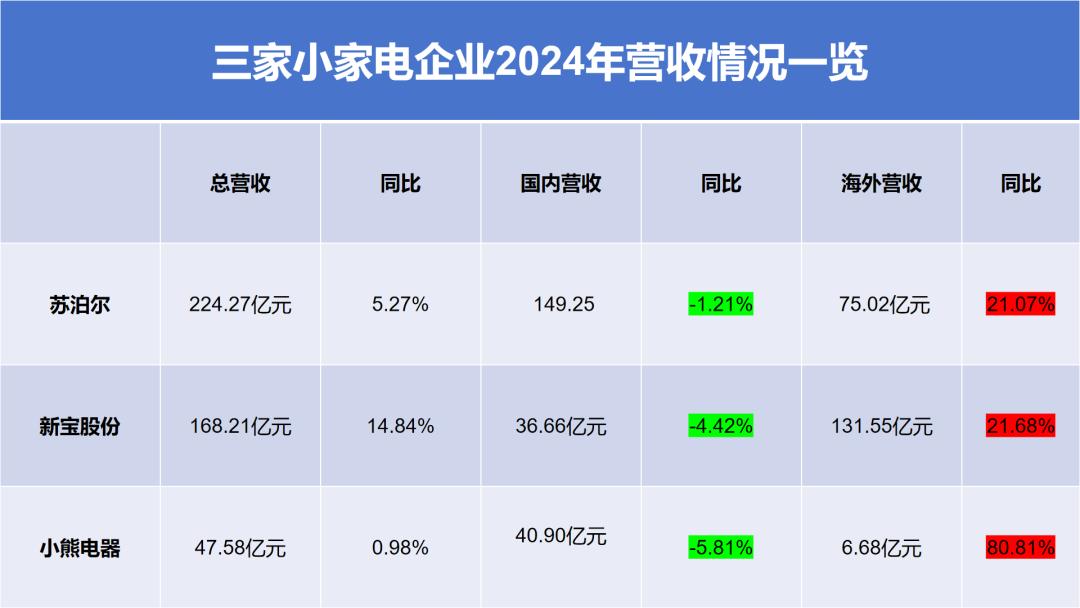
Core Insights - The core insight of the articles is that small home appliance companies such as Supor, Xinbao, and Bear Electric have reported positive revenue growth for 2024, primarily driven by significant increases in overseas sales despite facing challenges from U.S. tariffs [1][5][6]. Group 1: Revenue Performance - Supor reported total revenue of 22.427 billion yuan, a year-on-year increase of 5.27%, with domestic revenue declining by 1.21% to 14.925 billion yuan and overseas revenue increasing by 21.07% to 7.502 billion yuan [5][6]. - Xinbao achieved total revenue of 16.821 billion yuan, up 14.84%, with domestic revenue down 4.42% to 3.666 billion yuan and overseas revenue up 21.68% to 13.155 billion yuan [5][6]. - Bear Electric's total revenue reached 4.758 billion yuan, a slight increase of 0.98%, with domestic sales down 5.81% to 4.090 billion yuan and overseas sales soaring by 80.81% to 668 million yuan [5][6]. Group 2: Overseas Growth - All three companies experienced robust growth in overseas markets, with overseas revenue growth rates exceeding 20%, and Bear Electric's overseas revenue growth reaching over 80% [1][6]. - The demand for small home appliances in emerging markets such as Southeast Asia, the Middle East, and Latin America has been increasing, allowing these companies to leverage their cost advantages and occupy market share [6][8]. Group 3: Impact of Tariffs - The U.S. government implemented "reciprocal tariffs" on April 9, 2024, raising the cumulative tariff rate on all Chinese goods to 104%, with further increases announced shortly after [7][8]. - Companies like Supor and Bear Electric indicated that their exposure to the North American market is relatively low, and they can adapt through overseas production bases, minimizing the overall impact of tariffs [8][9]. - Xinbao, however, has a significant portion of its exports (30-40%) directed towards the North American market and is actively seeking strategies to mitigate the potential impacts of tariffs [9][10]. Group 4: Strategic Responses - Industry analysts suggest that small appliance companies should enhance supply chain security, reduce reliance on OEM models, and diversify overseas channels to mitigate the effects of changing policies [10][11]. - The consensus among industry experts is that despite current uncertainties, globalization remains essential for the long-term growth of Chinese enterprises [11].