
对华加征关税

Search documents
法国有意对中方加征关税,马克龙要出尔反尔了?中欧关系很快转型
Sou Hu Cai Jing· 2026-02-15 03:42
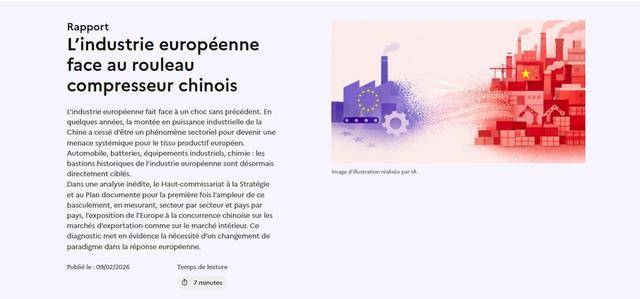
Core Viewpoint - Europe is currently in a complex situation, facing the escalating threat of the Russia-Ukraine conflict and the pressures from the US trade tariff war, making it challenging to manage its stance towards China [1] Group 1: Economic Impact and Competition - A report from France's High Council for Strategic Planning indicates that Chinese products, benefiting from a 30% to 40% cost advantage, are gradually penetrating traditional European industries such as automotive, batteries, machine tools, and chemicals [1] - The report warns that without significant policy adjustments, the industrial sector in France could face a survival crisis, with one-quarter of French exports and two-thirds of German industrial output under strong competitive pressure from China [1] - Germany's trade with China is expected to reach €253 billion by 2025, with a shift from low-end to mid-range products in imports, indicating a pragmatic approach to economic interests rather than ideological constraints [5] Group 2: Policy Recommendations and Internal Debate - The report suggests extreme measures such as imposing a 30% tariff on Chinese goods or devaluing the euro against the yuan by 30%, which has garnered some domestic support but faces significant opposition due to potential inflation and economic growth suppression [3] - French Minister of Economy and Finance, Bruno Le Maire, emphasizes that there is no one-size-fits-all solution and advocates for increasing savings rates and innovation to compete with China [3] - The proposal for large-scale tariffs lacks practical operational basis and is seen as a reaction to current anxieties rather than a well-considered strategy [7] Group 3: Future of China-Europe Relations - Europe is increasingly viewing China as a systemic competitor, while also desiring Chinese investment and technology transfer to boost local industries [7] - The ongoing conflict between the desire for economic cooperation and the need to address ideological concerns, such as human rights and geopolitical issues, complicates the relationship [7] - A stable and coherent policy framework towards China is urgently needed to avoid uncertainty in China-Europe relations, which could burden both parties, especially Europe [12]

对华加500%关税,收到钱都给乌克兰,特朗普见泽连斯基前喝多了?
Sou Hu Cai Jing· 2025-10-21 19:35
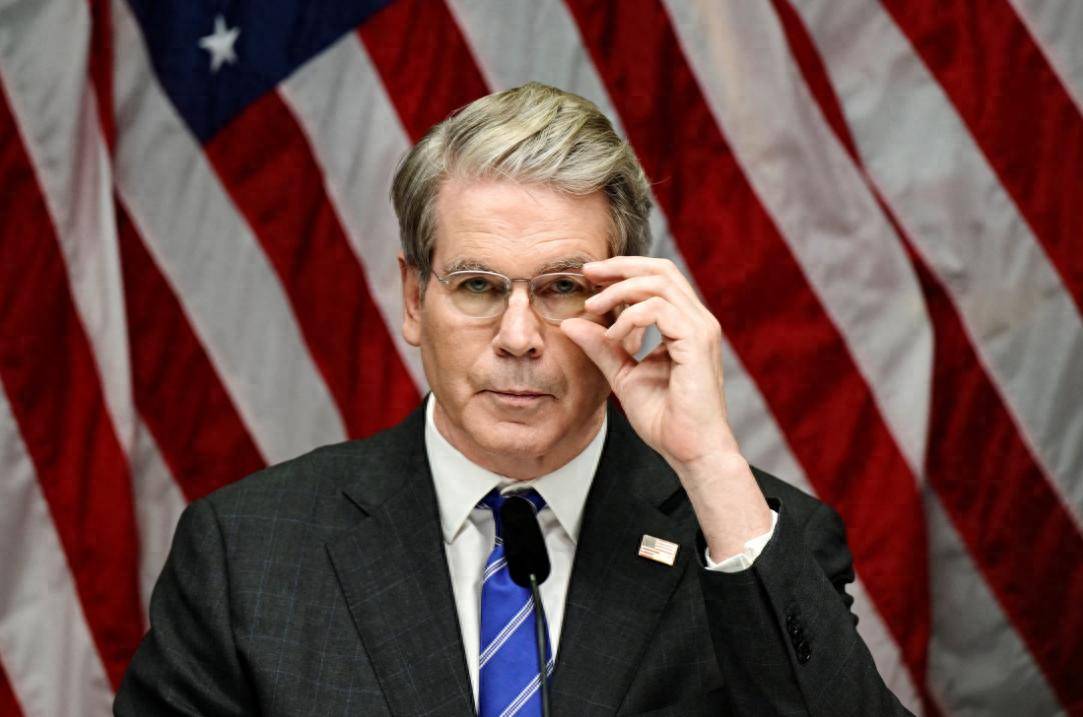
Core Viewpoint - The article discusses Trump's proposal to establish a "Ukraine Victory Fund" funded by imposing tariffs of up to 500% on Chinese goods, with the intention of using the revenue for military aid to Ukraine. This proposal has been met with skepticism and rejection from European allies [3][5][10]. Group 1: Proposal Details - Trump plans to impose tariffs of up to 500% on Chinese goods, with all proceeds directed towards military assistance for Ukraine [3]. - The proposal is framed as a way to support Ukraine while also encouraging European allies to adopt similar measures against China [5][10]. Group 2: Reactions and Implications - The European Parliament has rejected the idea of imposing tariffs on China, indicating that Europe is unwilling to be drawn into a trade conflict with China based on U.S. proposals [8][10]. - Trump's approach is seen as an attempt to leverage European concerns over the Russia-Ukraine conflict to gain support for a broader anti-China stance, but it underestimates Europe's strategic autonomy [10]. - The suggestion of a 500% tariff is viewed as a political stunt rather than a feasible policy, highlighting the unpredictability of U.S. foreign policy under Trump's leadership [10].
考虑“生产回归美国”在华美企为0
日经中文网· 2025-06-11 07:47
Core Insights - The survey conducted by the American Chamber of Commerce in China reveals that U.S. companies operating in China are cautious about relocating production back to the U.S. despite potential increases in tariffs [1][2]. Group 1: Impact of Tariffs - 13% of surveyed companies indicated they would consider relocating production to countries outside of China and the U.S. if tariffs were raised again [1]. - 9% of companies stated they would reduce exports to the U.S. in response to potential tariff increases [1]. - Zero companies expressed intentions to move production back to the U.S., highlighting a significant reluctance to shift operations domestically [1]. Group 2: Business Strategy and Effects - Only 21% of companies reported that their business strategies were unaffected by the tariffs, while 44% experienced some level of impact, 25% reported significant impact, and 11% indicated extreme impact [2]. - A manufacturer in Suzhou noted that various constraints beyond costs, such as client specifications for components, make it difficult to easily relocate production [2]. - The survey included responses from 112 companies across various sectors, including manufacturing, consumer goods, and services, indicating a broad impact of tariffs [2].
商务部回应稀土出口管制问题
news flash· 2025-05-15 09:36
Core Viewpoint - The Ministry of Commerce responded to the issue of rare earth export controls, indicating adjustments in response to the U.S. actions regarding tariffs [1] Group 1 - The spokesperson for the Ministry of Commerce, He Yongqian, stated that China is considering the cancellation or suspension of export controls on rare earths [1] - The adjustments are in line with the U.S. decision to withdraw or modify additional tariffs on China based on the consensus reached during high-level economic talks [1] - China will correspondingly adjust its tariff and non-tariff countermeasures against the U.S. [1]