
居民储蓄向投资转化

Search documents
公募基金新发前两月规模超2100亿元 规模及数量均创近4年同期新高
Cai Jing Wang· 2026-02-27 06:09
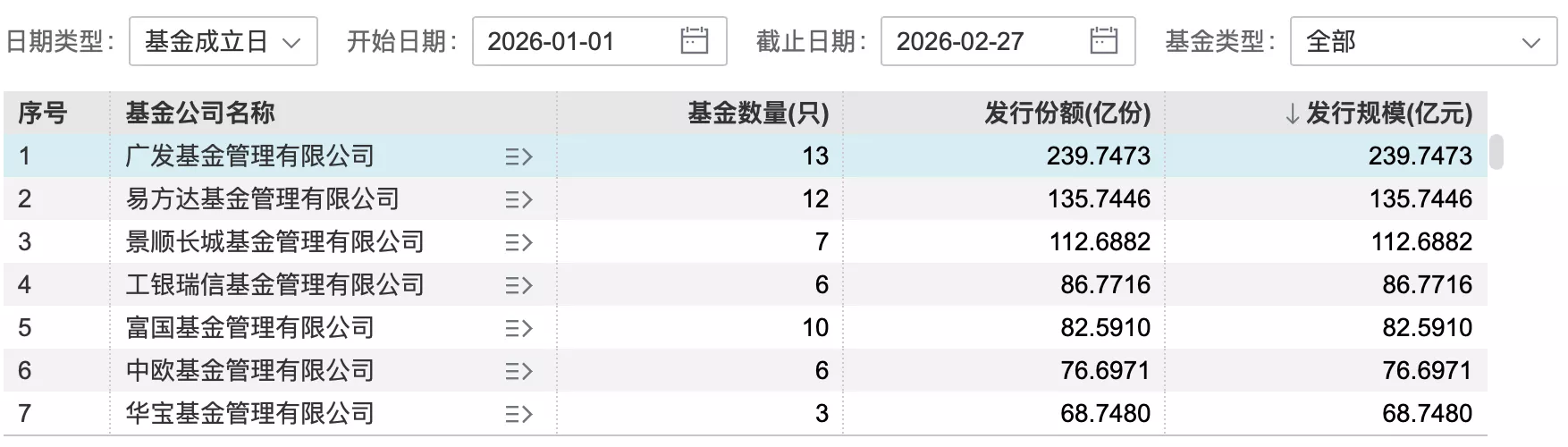
Group 1 - The public fund issuance market has seen a strong start in 2026, with 230 new funds launched and a total issuance scale exceeding 210 billion yuan, marking a historical high for the same period in the past four years [1][6] - The increase in new fund issuance is attributed to the positive performance of equity markets, which has boosted investor risk appetite and accelerated the shift of funds from savings to equity assets [1][9] - The market is experiencing structural changes, with a significant shift from bond-dominated new funds to equity-dominated ones, and a notable rise in the proportion of passive index products and ETFs [1][5] Group 2 - In the first two months of 2026, the number of new funds increased by 29.94% compared to the same period in 2025, and by 21.69% compared to 2023 [2] - The post-Spring Festival period saw a surge in new fund launches, with 18 new funds starting subscription on the first trading day and 36 new funds planned for issuance in the first week after the holiday [3] - Equity products (both stock and mixed funds) accounted for 71.37% of the new fund issuance, with passive investments gaining traction, particularly in sectors like non-ferrous metals and battery technology [3][7] Group 3 - The top fund companies have shown significant advantages in the current issuance landscape, with GF Fund leading with 13 products and nearly 24 billion yuan in issuance [4][5] - The total issuance scale for new funds in 2026 has reached 210.2 billion yuan, nearly doubling compared to the same period in previous years [6] - The active equity funds launched in 2026 totaled 78, with a combined fundraising scale of approximately 75.23 billion yuan, indicating strong investor interest [7][8] Group 4 - The market is expected to continue favoring equity funds, with the issuance pace closely tied to market performance, suggesting a sustained "slow bull" market [9] - The industry is moving towards a high-quality development phase, with increased emphasis on performance and investor experience, while smaller firms are encouraged to adopt differentiated strategies [5][9]

A股节后怎么投资?多家券商发“干货”
证券时报· 2026-02-18 09:50
Core Viewpoint - The article emphasizes the investment opportunities in the AI application industry, highlighting the potential for significant growth and profitability by 2026, as well as the importance of diversified asset allocation in the current market environment [4][7][8]. Group 1: AI Application Industry - The AI application industry is expected to establish a strong trend, with a potential "double hit" in 2026, as companies see AI orders and revenue constituting 10% or more of their overall income [4]. - Four key directions for investment in AI applications are identified: 1. Super entry points with large models acting as dual hubs for traffic and commercialization 2. AI infrastructure that defines software-driven computing power, ensuring stable returns 3. High growth areas where AI technology enhances marketing and content creation 4. High barriers in sectors like healthcare and manufacturing due to data and workflow integration [5][6]. Group 2: Market Analysis and Asset Allocation - The A-share market is currently at a historically low valuation, presenting a cost-effective investment opportunity compared to global markets [4][8]. - Various asset classes are analyzed: - Cash assets are under pressure from low interest rates but provide liquidity advantages, with money market funds and short-term deposits yielding around 1.5%-2% annually [8]. - Bond assets are reasonably valued, but long-term bonds may face pressure, while high-grade bonds offer stable yields [8]. - Stock assets, particularly high-dividend sectors like utilities, are seen as reasonably valued, while tech growth stocks are entering a favorable allocation zone after adjustments [8]. - Gold is supported by declining real interest rates and the dynamics of U.S. dollar credit, although short-term volatility may occur [8]. Group 3: Investment Strategy Recommendations - The article suggests a pyramid model for asset allocation, adjusting weights dynamically based on 2026 characteristics: - Base layer (40%-50% of investable assets) should focus on high-grade bonds and stable income products - Growth layer (30%-40%) should prioritize utility and consumer goods leaders, emphasizing "AI empowerment" and "domestic substitution" themes - Opportunity layer (10%-20%) should involve moderate participation in industrial metals and frontier sectors like commercial aerospace and AI applications through thematic funds, with strict loss control measures [8].




今日视点:多元“长钱”构建A股资金新生态
Zheng Quan Ri Bao· 2026-01-12 23:27
Core Viewpoint - In 2026, China's capital market is experiencing a significant influx of diverse funds, driven by three main engines: public funds, insurance capital, and foreign investment [1][2][3] Group 1: Public Funds - The public fund issuance market has notably rebounded, with over 6.3 billion yuan in stock ETFs issued since January 12, 2026, and 14 equity funds established with a total issuance of 0.961 billion yuan [1] - The shift in market funding structure indicates a recovery in residents' risk appetite, with low-fee, high-transparency ETF products becoming key entry points for individual investors [1] Group 2: Insurance Capital - Insurance capital is steadily increasing its market presence, with a total investment in stocks and securities funds reaching 5.59 trillion yuan by the end of Q3 2025, accounting for 14.92% of the total investment balance, a new high since 2022 [2] - Regulatory support, such as the reduction of risk factors for stock investments by the National Financial Regulatory Administration, encourages insurance funds to increase equity investments [2] Group 3: Foreign Investment - There is a confirmed trend of continuous foreign capital inflow, with 50.6 billion USD entering the Chinese stock market in the first ten months of 2025, significantly surpassing the total of 11.4 billion USD for the entire year of 2024 [3] - Major foreign institutions, including Morgan Stanley and UBS, express optimism about China's economy and capital market, indicating a sustained inflow of foreign capital based on valuation attractiveness and structural growth opportunities [3] Group 4: Channels for Market Growth - The acceleration of residents' savings conversion into investments is expected to bring an additional 5.4 trillion to 12 trillion yuan to the A-share market by 2030 [4] - The long-term layout of the pension system is establishing a core channel for "long money" to enter the market, enhancing the stability of capital allocation [4] - Improved return capabilities of listed companies are increasing the market's attractiveness for long-term funds, contributing to a new funding ecosystem characterized by more long-term capital and better returns [4]
多元“长钱”构建A股资金新生态
Zheng Quan Ri Bao· 2026-01-12 17:19
Core Viewpoint - In 2026, China's capital market is experiencing a significant influx of diverse funds, driven by three main engines: public funds, insurance capital, and foreign investment [1][2][3] Group 1: Public Funds - The public fund market has shown a notable recovery, with over 6.3 billion yuan raised from stock ETFs since January 12, 2026, and 14 equity funds established with a total issuance of 0.961 billion yuan [1] - The shift in market funding structure indicates a growing risk appetite among residents, with low-fee, high-transparency ETF products becoming a key entry point for individual investors [1] Group 2: Insurance Capital - Insurance funds are steadily increasing their market presence, with a total investment in stocks and securities funds reaching 5.59 trillion yuan by the end of Q3 2025, accounting for 14.92% of the total assets under management, a new high since 2022 [2] - Regulatory support, such as the reduction of risk factors for stock investments, is encouraging insurance companies to enhance their equity investment [2] Group 3: Foreign Investment - There is a confirmed trend of continuous foreign capital inflow, with 50.6 billion USD entering the Chinese stock market in the first ten months of 2025, significantly surpassing the total of 11.4 billion USD for the entire year of 2024 [3] - Major foreign institutions express optimism about China's economy and capital market, indicating that foreign capital is likely to continue flowing into the market due to attractive valuations and structural growth opportunities [3] Group 4: Channels for Fund Inflow - The acceleration of household savings conversion into investments is expected to bring an additional 5.4 trillion to 12 trillion yuan to the A-share market by 2030 [3] - The long-term layout of the pension system is establishing a core channel for "long money" to enter the market, enhancing the appeal of long-term capital [3] - Improved return capabilities of listed companies are fundamentally increasing the market's attractiveness for long-term funds [3] Group 5: Future Outlook - A new funding ecosystem in the A-share market is emerging, characterized by more long-term capital, longer investment horizons, and better returns [4] - Increased participation of long-term capital is expected to stabilize irrational market fluctuations and enhance resource allocation efficiency [4] - The shift towards long-term investment logic will support technological innovation and industrial upgrades, benefiting the market, enterprises, and investors [4]
中信证券总经理邹迎光:居民储蓄向投资转化趋势显著 权益资产配置仍有较大提升空间
Xin Lang Cai Jing· 2025-11-11 02:27
Core Insights - The core viewpoint emphasizes the improvement of the institutional environment in China's capital market, focusing on supporting technological innovation and enhancing wealth effects [1] Group 1: Institutional Environment - The capital market's risk appetite is increasingly compatible with new productive forces, indicating a shift towards direct financing methods such as equity and bonds to support high-quality enterprises in their listings [1] - Future reforms will aim to cultivate a market ecosystem characterized by orderly entry and exit, promoting a competitive environment for high-quality development of listed companies [1] Group 2: Investment Trends - There is a significant trend of converting household savings into investments, with the proportion of equity asset allocation having considerable room for growth compared to developed markets [1] - Future reforms will focus on creating a "long money, long investment" institutional environment, enhancing the supply of quality financial products, and guiding listed companies to strengthen investor returns, thereby promoting a virtuous cycle of financing and investment [1]
