结构性修复

Search documents
重大工程、城市更新,上海楼市还有一堆“隐形利好”
Di Yi Cai Jing· 2026-02-26 11:30
Group 1 - Shanghai has introduced new housing policies, known as "沪七条," aimed at lowering home purchase thresholds and optimizing mortgage loans and property tax regulations, signaling a release of potential buying power in the market [1] - The 2026 Shanghai Major Engineering Project List has been published, with an annual investment plan of 255 billion yuan, marking a historical high, covering various sectors including technology, social welfare, and urban infrastructure [2] - The infrastructure investment includes 68 urban infrastructure projects, with significant projects like Shanghai East Station and the fourth phase of Pudong International Airport, which are expected to enhance commuting efficiency and property value in outer urban areas [2] Group 2 - District-level initiatives are also active, with Huangpu District planning 65 major projects for 2026, totaling an investment of 485 billion yuan, focusing on high-quality residential and commercial developments [3] - Urban renewal funding in Jing'an District is set at 16.4 billion yuan, targeting the renovation of substandard housing, while Xuhui District allocates 13.03 billion yuan for urban renewal projects [3] - The outer regions, such as Jiading District, have announced 67 major projects with a total investment exceeding 39 billion yuan, aiming to enhance housing security and infrastructure in new urban areas [3] Group 3 - The market outlook for 2026 is becoming more rational, with expectations of a "structural repair" in the housing market driven by infrastructure investments and urban renewal efforts [4] - The China Index Academy suggests that 2026 will be a critical year for stabilizing the real estate market in Shanghai, with recent policies indicating a potential short-term market recovery [4] - The 58 Anjuke Research Institute indicates that Shanghai's targeted policy measures are expected to stabilize the market while promoting high-quality development in the real estate sector, potentially setting a benchmark for recovery among first-tier cities [4]
A股节后怎么投资?多家券商发“干货”
证券时报· 2026-02-18 09:50
Core Viewpoint - The article emphasizes the investment opportunities in the AI application industry, highlighting the potential for significant growth and profitability by 2026, as well as the importance of diversified asset allocation in the current market environment [4][7][8]. Group 1: AI Application Industry - The AI application industry is expected to establish a strong trend, with a potential "double hit" in 2026, as companies see AI orders and revenue constituting 10% or more of their overall income [4]. - Four key directions for investment in AI applications are identified: 1. Super entry points with large models acting as dual hubs for traffic and commercialization 2. AI infrastructure that defines software-driven computing power, ensuring stable returns 3. High growth areas where AI technology enhances marketing and content creation 4. High barriers in sectors like healthcare and manufacturing due to data and workflow integration [5][6]. Group 2: Market Analysis and Asset Allocation - The A-share market is currently at a historically low valuation, presenting a cost-effective investment opportunity compared to global markets [4][8]. - Various asset classes are analyzed: - Cash assets are under pressure from low interest rates but provide liquidity advantages, with money market funds and short-term deposits yielding around 1.5%-2% annually [8]. - Bond assets are reasonably valued, but long-term bonds may face pressure, while high-grade bonds offer stable yields [8]. - Stock assets, particularly high-dividend sectors like utilities, are seen as reasonably valued, while tech growth stocks are entering a favorable allocation zone after adjustments [8]. - Gold is supported by declining real interest rates and the dynamics of U.S. dollar credit, although short-term volatility may occur [8]. Group 3: Investment Strategy Recommendations - The article suggests a pyramid model for asset allocation, adjusting weights dynamically based on 2026 characteristics: - Base layer (40%-50% of investable assets) should focus on high-grade bonds and stable income products - Growth layer (30%-40%) should prioritize utility and consumer goods leaders, emphasizing "AI empowerment" and "domestic substitution" themes - Opportunity layer (10%-20%) should involve moderate participation in industrial metals and frontier sectors like commercial aerospace and AI applications through thematic funds, with strict loss control measures [8].





A股节后怎么投资?多家券商发“干货”!
天天基金网· 2026-02-18 07:30
Core Viewpoint - The article emphasizes the ongoing investment opportunities in the A-share market, particularly in AI applications and various asset classes, despite the market being closed during the Spring Festival [4][5][6][7]. Group 1: AI Applications - The AI application industry is expected to establish a trend, with a potential "double hit" by 2026, as some companies have over 10% of their revenue from AI orders [5]. - Four key directions for investment in AI applications are identified: super entry points, AI infrastructure, high growth sectors, and high barrier industries [5]. - The production paradigm of animated dramas is being restructured by AI, marking a "golden window period" for this sector [6]. Group 2: Asset Class Analysis - Cash assets are under pressure due to low interest rates, with annual returns around 1.5%-2%, but they provide liquidity advantages [6]. - Bond assets are reasonably valued, but there is pressure on long-term yields; high-grade bonds can offer stable returns [6]. - A-shares are currently at historically low valuations, making them attractive compared to global markets, while high-dividend sectors are also seen as reasonable [6][7]. Group 3: Investment Strategy - The trend of converting household savings into investments continues, with a conservative risk appetite favoring high-dividend and stable bonds [7]. - A pyramid model for asset allocation is suggested, with 40%-50% in stable assets, 30%-40% in growth assets focusing on utility and consumer leaders, and 10%-20% in opportunities like industrial metals and frontier sectors [7]. - The article encourages dynamic adjustment of asset weights based on the characteristics of 2026 [7].

A股节后怎么投资?多家券商发“干货”!
Xin Lang Cai Jing· 2026-02-18 03:39
Group 1 - The core viewpoint of the articles emphasizes that A-shares are currently undervalued compared to historical levels, presenting a global comparative advantage [1][2][6] - Guotai Junan Securities predicts that the AI application industry will establish a trend, with a potential "double hit" expected in 2026, as some companies see AI orders/revenue/ARR constituting over 10% of total revenue [1][6] - The report identifies four key directions for AI applications: super entry points, AI infrastructure, high growth sectors, and high barrier industries [1][6] Group 2 - The analysis from Dongfang Caifu Securities indicates that 2026 will be a phase of "structural repair" and "new momentum cultivation," necessitating asset diversification to manage uncertainties [2][7] - The report discusses various asset classes: cash assets are under pressure in a low-interest environment but provide liquidity; bond assets are reasonably valued but face pressure on long-term yields; stock assets are seen as undervalued, particularly in high-dividend sectors [2][7][8] - The recommendation includes a pyramid model for asset allocation, with a focus on high-grade bonds and utility stocks, while also suggesting participation in industrial metals and frontier sectors like commercial aerospace and AI applications [8]
CXO行情回暖才开始上半场
新财富· 2026-02-09 08:12
Core Viewpoint - The recent rebound in the CXO sector is not indicative of a comprehensive recovery but rather a reaction to easily confirmable short-term improvements, particularly among domestic demand-driven CRO and experimental service companies, while leading CDMO companies focused on external demand have underperformed [3][4][5]. Market Dynamics - The market is currently trading based on short-term rebounds rather than a long-term recovery in the CXO industry, with a notable divergence in performance between domestic-focused companies and those reliant on global demand [4][5]. - Despite an overall positive sentiment in the industry, caution remains regarding CDMO companies, which are facing complex pricing environments and geopolitical uncertainties that could impact long-term growth [5][12]. Financial Performance - WuXi AppTec's 2025 performance forecast indicates a revenue of approximately 454.56 billion RMB, a year-on-year increase of about 15.84%, and a net profit of around 191.51 billion RMB, reflecting a significant growth of 102.65% [7]. - The company's revenue growth trajectory has shown consistent improvement throughout the year, with a core business revenue increase of approximately 21.40%, indicating enhanced growth momentum post-divestiture of certain business segments [9][10]. Market Sentiment and Valuation - The market's cautious stance towards CDMO companies is driven by uncertainties regarding future growth, particularly in relation to geopolitical risks and the sustainability of demand for emerging business lines like TIDES [12][13]. - The valuation of CDMO companies reflects a conservative outlook on long-term growth potential rather than immediate revenue uncertainties, leading to a disconnect between fundamental recovery and stock price performance [10][28]. Structural Changes in the Industry - The growth in WuXi AppTec's small molecule D&M business is attributed to an expansion in order structure and capabilities, moving beyond traditional roles to encompass more complex production processes [20][22]. - The acquisition of Dongyao Pharmaceutical by WuXi AppTec highlights a strategic move to secure capacity in a high-demand sector, emphasizing the importance of time as a critical resource in the competitive landscape [24][26]. Conclusion - The current rebound in the CXO sector appears to be driven by emotional and anticipatory factors rather than a full reassessment of long-term industry value, with a clear distinction between domestic and external demand dynamics [28][29].


求是定调一次性给足、利率下探至2字头,核心城市成交升温,全国普涨还是理性小阳春?
Sou Hu Cai Jing· 2026-02-07 01:34
Core Viewpoint - The real estate market is gradually transitioning from a "cold" to a "warm" state, driven by policy support and market adjustments, although the recovery is not uniform across all segments [3][11]. Policy and Market Dynamics - The article emphasizes the need for strong and clear policy measures, stating that policies should meet market expectations and be implemented decisively [3]. - The Ministry of Housing and Urban-Rural Development continues to focus on controlling new supply, reducing inventory, and improving quality, indicating a systematic approach to stabilize the market [3]. - Over 60 cities have optimized real estate policies, with first-time home loan interest rates dropping to 3.5%-4%, and some cities even seeing rates in the "2s" [3][4]. Market Data and Trends - In January, the average price of new residential properties in 100 cities was 17,114 yuan per square meter, showing a month-on-month increase of 0.18% and a year-on-year increase of 2.52% [4]. - The average price of second-hand residential properties was 12,905 yuan per square meter, reflecting a month-on-month decrease of 0.85% and a year-on-year decrease of 8.67% [4]. - The transaction volume in key cities for second-hand homes increased significantly, with a 16% month-on-month rise and a 33% year-on-year increase in 13 major cities [7]. Consumer Behavior and Market Sentiment - There is a noticeable increase in consumer inquiries about housing, particularly regarding tax incentives for upgrading homes, indicating a shift in market sentiment [3][5]. - The demand for quality housing is rising, with properties meeting new standards commanding a premium of 10%-20% in the same location [7]. - The article notes a change in consumer focus towards the quality of housing and community amenities, reflecting a trend towards consumption upgrades [7]. Financial Environment - The monetary environment remains supportive, with M2 continuing to expand and household savings exceeding 160 trillion yuan, alongside a reduction in loan rates [7]. - Developers are expected to resume land acquisitions, emphasizing delivery capabilities and quality in their projects, contrasting with previous market behaviors [7]. Market Outlook - The article suggests that while there is potential for recovery, it is essential to approach the market with caution, focusing on quality properties rather than broad price increases [11][12]. - The upcoming weeks will be critical in determining whether the current upward trend in transactions will continue, particularly after the Spring Festival [13].
东海证券:炼化行业正处于“结构性修复”阶段 建议关注我国民营炼化代表龙头
智通财经网· 2026-01-20 07:01
Core Viewpoint - The report from Donghai Securities indicates that the refining industry is currently in a "structural repair" phase, with leading private refining companies showing low price-to-earnings (PE) ratios compared to the past decade, suggesting potential for significant valuation recovery if return on equity (ROE) improves [1] Group 1: Refining Industry Analysis - The cyclical nature of the petrochemical industry leads to significant performance volatility, making PE ratios often misleading [1] - The report highlights three main conditions for an upward cycle in the petrochemical sector: rising oil prices, supply-side capacity reduction, and demand-side stimulus through monetary easing [1] - The report anticipates that if ROE breaks through its central tendency and enters a new growth phase, there could be a valuation increase of approximately 1-3 times for leading companies [1] Group 2: Policy and Market Dynamics - The government has set a cap on refining capacity at 1 billion tons, effectively ending the expansion cycle, and is implementing "anti-involution" policies to improve industry competition [2] - The "anti-involution" measures include shutting down small capacities, limiting new additions, and guiding industry self-discipline, which are expected to stabilize product prices [2] - The report notes that the price spread for naphtha cracking ethylene has recently dropped to its lowest annual level but is expected to recover, indicating a positive price transmission mechanism in the industry [2] Group 3: Oil Price Outlook - Oil prices are identified as a key variable for cyclical assessment, with expectations for Brent crude oil prices to fluctuate between $55 and $75 per barrel in 2026 as global supply and demand recover [3] - The report suggests that a stable oil price environment could lead to improved profitability in the refining sector as the global economy rebounds [3] Group 4: International Perspective - The high energy prices in Europe have led to significant capacity reductions among Western chemical companies, creating a trend of "Western retreat and Eastern advance" in chemical production [4] - Chinese private refining companies are positioned to enhance their market power due to their large asset bases and diversified industrial chains, which support long-term growth [4] - The report expresses optimism regarding the strengthening of China's refining discourse and the potential for asset revaluation opportunities in the current market environment [4]
建材建筑新材料结构性亮点,高质量转型 | 投研报告
Zhong Guo Neng Yuan Wang· 2025-12-30 02:04
Core Viewpoint - The construction materials and new materials industry is expected to maintain high investment attractiveness in 2025, despite continued pressure from traditional domestic demand in real estate and infrastructure [2]. Group 1: Cement Industry - Cement demand is projected to be under pressure, with structural adjustments expected. The anticipated demand distribution for 2025 is 30% from real estate, 50% from infrastructure, and 20% from rural areas [2][3]. - The industry is expected to experience a low point around April-May 2024, with a gradual improvement in supply-demand relationships as supply exits in an orderly manner [2][3]. Group 2: Glass Fiber Industry - The glass fiber sector is expected to benefit from the release of profits in AI electronic cloth by 2026, with a focus on high-end fabric price elasticity [3]. - The industry has undergone domestic substitution, establishing China as a global supplier, making both domestic and international demand crucial [3]. Group 3: Glass Industry - The glass sector is facing demand pressure and a slowdown in cold repairs, with a net reduction of approximately 4,000 tons per day as of December 21, 2025, which is a deceleration compared to 2024 [4]. - The overall glass prices are under pressure due to weak downstream demand, with a projected decline in construction completions by 18% year-on-year from January to November 2025 [4]. Group 4: Consumer Building Materials - The consumer building materials sector has shown signs of stabilization since Q3 2025, with narrowing revenue declines and reduced price competition, indicating that the most challenging phase has passed [5]. - Despite ongoing pressures in new housing demand, the release of second-hand housing and renovation projects is expected to provide strong support, leading to structural opportunities [5].
3A系列指数触底反弹涨超1%,全市场近4400股飘红 | 华宝3A日报(2025.12.5)
Xin Lang Cai Jing· 2025-12-05 09:16
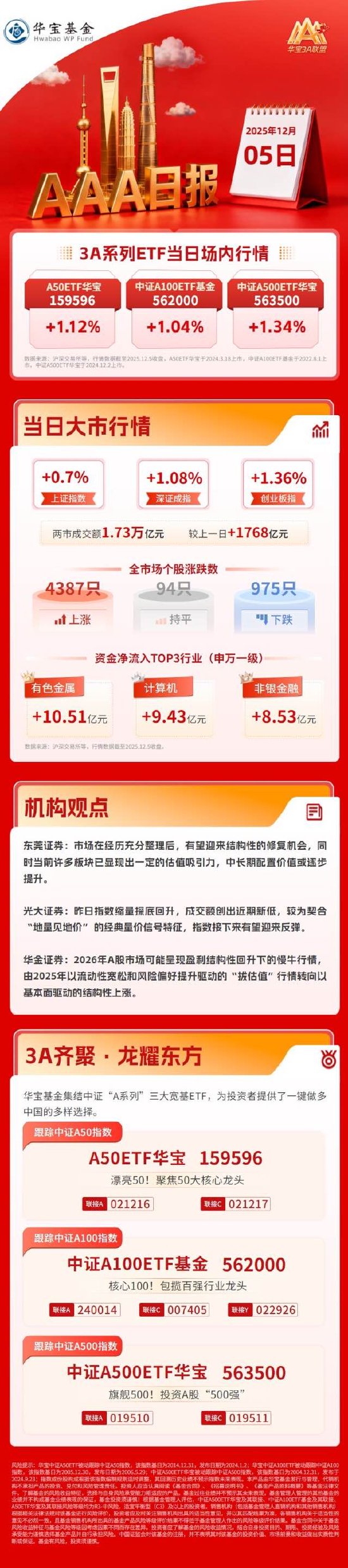
Core Viewpoint - The market is expected to experience structural recovery opportunities after a period of consolidation, with many sectors showing valuation attractiveness for medium to long-term investment [2][6]. Market Performance - The total trading volume in the market reached 1.73 trillion yuan, an increase of 176.8 billion yuan compared to the previous day [6]. - The Shanghai Composite Index rose by 0.7%, the ChiNext Index increased by 1.08%, and the Shenzhen Component Index saw a rise of 1.36% [6]. Institutional Insights - Dongguan Securities suggests that the market is likely to see structural recovery opportunities, with many sectors showing valuation attractiveness, which may enhance medium to long-term investment value [2][6]. - Everbright Securities notes that the index experienced a volume contraction and a rebound, indicating a potential for a market rebound based on classic volume-price signals [2][6]. - Huajin Securities predicts that the A-share market in 2026 may present a slow bull market driven by structural profit recovery, shifting from a valuation-driven market in 2025 to one driven by fundamentals [2][6]. Fund Offerings - Huabao Fund has launched three major broad-based ETFs tracking the CSI A50, A100, and A500 indices, providing investors with diverse options to invest in China's market [2].
近4400只个股上涨
第一财经· 2025-12-05 07:37
Market Overview - A-shares experienced a rebound with the Shanghai Composite Index rising by 0.7%, the Shenzhen Component Index increasing by 1.08%, and the ChiNext Index up by 1.36% [3][4]. Sector Performance - The financial sector saw significant gains, particularly in insurance, brokerage, and fintech, with notable stocks like China Pacific Insurance rising nearly 7% [5]. - The computing hardware supply chain also showed strength, especially in CPO and high-speed copper connection sectors [4]. - Commercial aerospace stocks surged, leading to a wave of limit-up stocks [4]. Notable Stocks - Major gainers in the financial sector included: - Bank of China Securities: +10.02% [6] - Industrial Securities: +5.57% [6] - Dongfang Wealth: +4.11% [6] - In the Fujian local stocks, nearly 20 stocks hit the daily limit-up, including: - Hongxiang Co.: +20.00% [7] - Qianzhao Optoelectronics: +13.93% [7] Trading Volume - The total trading volume in the Shanghai and Shenzhen markets reached 1.73 trillion yuan, an increase of 176.8 billion yuan compared to the previous trading day, with nearly 4,400 stocks rising [8]. Capital Flow - Main capital inflows were observed in sectors such as securities, non-ferrous metals, and telecommunications, while outflows were noted in banking, real estate, and consumer electronics [10]. - Specific stocks with significant net inflows included: - N-Mole-U: +2.495 billion yuan [10] - China Ping An: +1.075 billion yuan [10] - Conversely, stocks like Heertai and Sanhua Intelligent Control faced substantial net outflows [10]. Market Outlook - Analysts suggest that after a period of consolidation, the market may see structural recovery opportunities, with many sectors showing valuation attractiveness for medium to long-term investments [11]. - Predictions for 2026 indicate a potential slow bull market driven by structural earnings recovery, transitioning from a liquidity-driven valuation expansion in 2025 [11].