工程师思维

Search documents
小米集团CEO雷军:小米2026年有望在一款终端上实现自研芯片、OS、AI大模型会师,机器人业务也会有新进展
Sou Hu Cai Jing· 2026-01-08 04:05
Core Insights - Xiaomi's self-developed chip "Xuanjie O1" won the highest award at the 2025 "Ten Million Technology Award" [1] - CEO Lei Jun emphasized the importance of core technology and continuous innovation for Xiaomi's success [3][8] - Xiaomi plans to invest 200 billion yuan in R&D over the next five years, building on the 105 billion yuan spent in the past five years [3][8] Investment and R&D Strategy - Xiaomi has committed to investing 200 billion yuan in R&D to tackle core technologies such as chips, AI, and operating systems [3][8] - The company has already invested approximately 105 billion yuan against a previous commitment of 100 billion yuan over the last five years [3][8] - The goal is to create a comprehensive ecosystem encompassing "people, vehicles, and homes" [3][8] Future Innovations - By 2026, Xiaomi anticipates significant breakthroughs in technology, including the integration of self-developed chips, operating systems, and AI models in a single product [3][9] - The company is also expected to make advancements in its robotics business [9] Awards and Recognition - The "Ten Million Technology Award" recognizes outstanding engineers and teams within Xiaomi, with a total of 75 million yuan awarded since its inception in 2019 [5][6] - This year's competition saw participation from over 150 projects across 10 departments, highlighting the focus on core technologies [6]



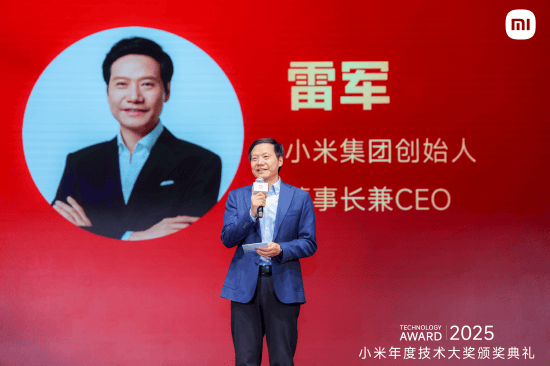
雷军:2026年有望在一款终端上实现自研芯片、OS、AI大模型“会师”,机器人业务也会有新进展
Xin Lang Cai Jing· 2026-01-08 03:39
Core Insights - Xiaomi's self-developed chip "Xuanjie O1" won the highest award at the 2025 "Million Technology Award" [1][11] - CEO Lei Jun emphasized the importance of core technology and continuous innovation for Xiaomi's success [3][8] Investment in R&D - Over the past five years, Xiaomi committed to invest 100 billion yuan in core technology R&D, with actual spending around 105 billion yuan [3][17] - Starting this year, Xiaomi plans to invest 200 billion yuan in R&D over the next five years, focusing on chips, AI, and operating systems [3][17] Future Innovations - By 2026, Xiaomi aims to achieve a breakthrough in technology innovation, potentially integrating self-developed chips, operating systems, and AI models in a single product [3][9] - The company is also expected to make advancements in its robotics business [9][18] Awards and Recognition - The "Million Technology Award" has been awarded since 2019, with a total of 75 million yuan distributed to outstanding engineers and teams [5][15] - This year's competition saw participation from over 150 projects across 10 departments, highlighting significant achievements in core technologies [6][15]
微软中国CTO韦青:AI时代,你不需要是工程师,但必须像工程师一样思考|文末赠书
AI前线· 2025-12-23 07:29
Core Viewpoint - The article emphasizes the need for humans to evolve from mere knowledge accumulators to "wisdom entities" capable of applying knowledge to solve problems, especially in the context of an AI-driven world where machines can learn and process information [3][10]. Group 1: Challenges in the AI Era - The emergence of AI learning capabilities presents three main challenges: the necessity for continuous learning to survive, the ability to manage learning machines, and the existential question of human relevance when machines can perform tasks traditionally done by humans [8][10]. - The traditional notion of "knowledge is power" is being challenged as machines can acquire vast amounts of information, making mere knowledge accumulation less valuable [9][10]. Group 2: Importance of Engineer Thinking - Engineer thinking is crucial for navigating the complexities of the modern world, as it focuses on problem-solving and the application of knowledge rather than just knowledge acquisition [3][11]. - The article argues that understanding and practicing engineer thinking will become essential for everyone in the AI era, as it equips individuals with the skills to identify and solve problems effectively [11][12]. Group 3: System Thinking and Engineering - System thinking is highlighted as a core aspect of engineer thinking, emphasizing the interconnectedness of various elements and the importance of addressing systemic issues rather than isolated problems [14][17]. - The definitions of systems and system engineering are explored, indicating that a comprehensive understanding of systems is vital for effective problem-solving in engineering contexts [15][16]. Group 4: Practical Application of Engineer Thinking - The article suggests that real-world engineering practice should focus on applying theoretical concepts to tangible problems, using concrete examples to illustrate the principles of engineer thinking [18]. - The series of books mentioned aims to provide readers with practical tools and frameworks to enhance their problem-solving capabilities and transition from problem solvers to system mediators [19].

美国“AI曼哈顿计划”的背后,站着这群人
3 6 Ke· 2025-12-19 03:54
Core Argument - The article discusses the contrasting approaches of tech companies towards government contracts, particularly focusing on Palantir and its CEO Alexander Karp, who advocates for a deeper integration of technology companies with national defense and government initiatives [1][3][24]. Group 1: Palantir's Background and Philosophy - Palantir was founded in 2003 with the aim of serving government and military clients, in stark contrast to other Silicon Valley companies that focus on consumer markets [5][6]. - The name "Palantir" is derived from "seeing stones" in "The Lord of the Rings," symbolizing the company's mission to provide insights and intelligence [3][5]. - Karp's background as a law and philosophy graduate, along with his connection to influential figures like Peter Thiel, shapes his unique perspective on the role of technology in society [3][4]. Group 2: Historical Context and Shift in Focus - The article highlights a historical shift where Silicon Valley, once a hub for military and defense technology, has increasingly focused on consumer products and services [8][11]. - Karp notes that in the past, engineers played a crucial role in national decision-making, but their presence in political spheres has diminished significantly [10][12]. - The article cites a survey indicating that only 1.3% of state legislators in the U.S. are scientists or engineers, reflecting a broader trend of talented individuals moving away from public service [10][11]. Group 3: Critique of Current Trends - Karp criticizes the current tech landscape for prioritizing consumer-oriented innovations over significant societal contributions, such as advancements in defense technology [14][20]. - He argues that many of today's innovations are trivial and lack meaningful impact, as they focus on optimizing user engagement rather than addressing pressing global challenges [14][34]. - The article references Karp's call for a new "Manhattan Project" for AI, emphasizing the need for a national commitment to technological advancement in defense [21][22][24]. Group 4: Cultural and Ethical Considerations - Karp expresses concern over the lack of genuine belief and conviction among contemporary American elites, suggesting that this cultural shift undermines the ability to make impactful decisions [27][28]. - The article discusses the implications of this cultural shift, where expressing strong beliefs is often discouraged, leading to a lack of direction in leadership [27][28]. - Karp's critique extends to the tech industry's tendency to dismiss consumer technology as trivial, failing to recognize its potential contributions to broader societal goals [32][34].

藏不住了,这位非典型基金经理小试牛刀反响良好!
Sou Hu Cai Jing· 2025-09-11 07:02
Core Insights - The article highlights the rising value of smaller funds in the current market, particularly in the context of the AI-driven technology sector, where smaller funds can adapt more quickly to market changes [2] - The Hui'an Growth Preferred Mixed Fund, managed by Dan Bailin, has shown exceptional performance, with a year-to-date return of 99.48% and a one-year return of 167.96%, ranking among the top five in its category [3][11] Fund Performance - As of June 30, 2023, the Hui'an Growth Preferred Mixed Fund had a total asset size of less than 300 million yuan, yet it achieved significant returns across various time frames: - 1-month return: 25.02% - 3-month return: 70.49% - 1-year return: 167.96% - Since inception return: 105.90% [2][11] Manager's Background - Dan Bailin, the fund manager, has a unique background as a former systems development engineer, which provides him with a distinct perspective on technology investments [4] - His engineering mindset allows him to analyze industries from a technical and data-driven perspective, focusing on the core drivers of growth [4][9] Investment Strategy - Bailin categorizes industry growth into three phases, focusing primarily on the "replacement growth" phase, which is characterized by performance-driven opportunities [7] - Since taking over the fund on June 19, 2023, Bailin has achieved a return of 58.98%, outperforming the benchmark return of 46.30% during the same period [4][7] Portfolio Composition - The fund maintains a concentrated portfolio, with over 60% of its net asset value in the top ten holdings, primarily in sectors like communication equipment and semiconductors [9][11] - As of mid-2025, the fund held only 22 stocks, reflecting a strategy of concentrating resources on high-potential investments [11][12] Institutional Interest - The Hui'an Growth Preferred Fund has attracted institutional investors, with their holdings increasing from 0% at the end of the previous year to 30.42% by mid-2025 [13]