差异化体验

Search documents
三年首次!银行网点关停7871家但净增超600家!
Zhong Guo Jing Ying Bao· 2026-01-13 08:38
Core Insights - The article highlights a strategic restructuring in the banking sector, where despite the closure of 7,871 offline branches, there is a net increase of 623 branches in 2025, marking the first positive growth in three years [1][2]. Group 1: Branch Closures - The closed branches typically exhibit characteristics of "three lows and one high": low customer density, low daily productivity, low value business ratio, and high operational costs due to factors like lease expiration and aging properties [2]. - A significant portion of branch closures is attributed to passive shutdowns resulting from institutional consolidations, with 377 banks closing due to mergers or dissolutions, including 218 village banks and 79 rural commercial banks [2]. - The decision to close branches is a strategic response to the pressures of narrowing net interest margins and the acceleration of digital transformation, aiming to eliminate inefficiencies and redirect resources to more valuable areas [2]. Group 2: New Branch Openings - The increase in new branches reflects a structural re-evaluation of the value of offline channels, emphasizing that online services cannot fully replace the warmth and precision of in-person interactions [3]. - New branches are designed to meet specific customer needs and situational contexts, focusing on underserved areas and creating specialized branches for themes like elderly finance and technology finance [3][4]. - The growth in new branches is driven by regulatory requirements and regional rebalancing, with 63% of new branches located in rural areas, and the expansion of consumer finance licenses necessitating physical storefronts [4]. Group 3: Branch Transformation - The new generation of branches has undergone comprehensive upgrades in form, function, and technology, transitioning from "transaction counters" to "scene plugins" [5]. - New branches average 186 square meters, equipped with advanced technology such as 8.4 smart screens and 3.2 cash recycling machines, while staffing has been reduced from 9 to 3.5 employees [6]. - The selection logic for new branches has shifted to a "15-minute community living circle," enhancing customer flow conversion rates by 2.6 times, indicating a focus on integrating banking services into daily life [6].
“土豆+番茄”的经典王炸组合:乐事如何用联名玩转零食新体验?
Zhong Guo Shi Pin Wang· 2025-10-11 10:26
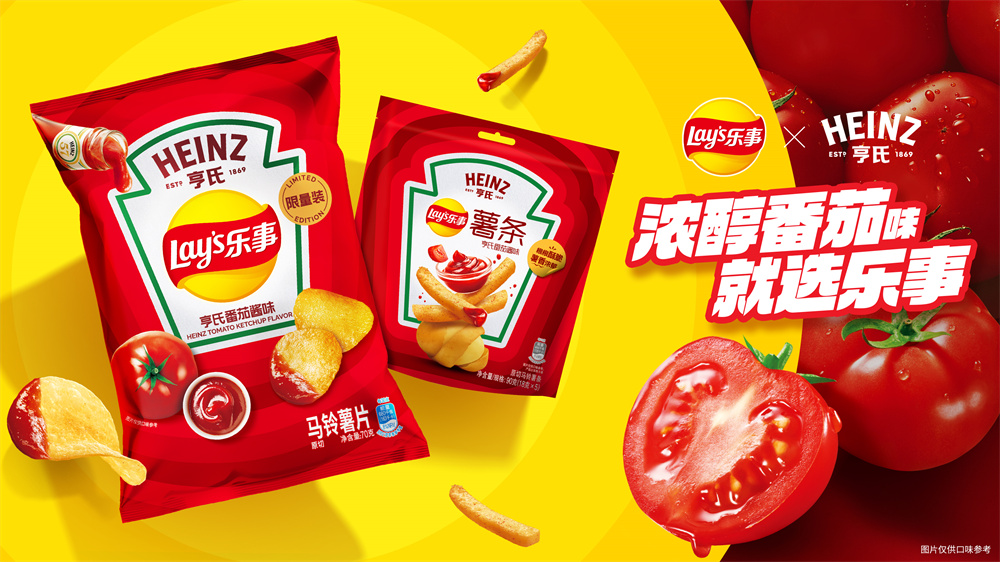
Core Insights - The collaboration between Lays and Heinz has resulted in the launch of limited-edition Lays Heinz Tomato Ketchup-flavored chips and fries, which combines classic flavors that resonate with consumers' taste memories [1][3][6] - The marketing strategy focuses on engaging younger consumers through relatable language and social media integration, enhancing brand appeal and consumer connection [3][10] Product Innovation - The new product features a blend of Heinz's rich tomato flavor and Lays' signature potato crispiness, creating a unique taste experience that balances acidity and sweetness [5][6][8] - Market data indicates a 37% increase in new tomato-flavored food and beverage products, highlighting the strong consumer demand for this flavor profile [3] Consumer Engagement - Lays has effectively captured consumer preferences by integrating popular culture and social elements into its branding, making the product more relatable and shareable [11][16] - The collaboration is seen as a strategic move to create a memorable snacking experience that goes beyond mere flavor replication, establishing a strong emotional connection with consumers [8][16] Market Trends - The tomato processing industry in China is growing at an annual rate of 10%-15%, indicating a robust market for tomato-flavored products [3] - Lays continues to innovate with new flavors that resonate with current consumer trends, such as spicy flavors that appeal to younger demographics seeking excitement and emotional release [13][15]


两次考研失败后,她靠"反套路北欧游"年入百万
Hu Xiu· 2025-07-11 10:32
Core Insights - The article discusses a successful business venture in the Nordic tourism market, initiated by an individual who identified a gap for in-depth cultural travel experiences after studying anthropology in Sweden [1][2]. Group 1: Business Model and Market Opportunity - The company offers three types of travel experiences: immersive farm experiences, themed travel groups, and personalized itineraries [3]. - The service model is based on the "Host" concept, where hosts accompany tourists as friends, providing deep local experiences and arranging stays with local families [4]. - The differentiated experience has garnered market interest, achieving revenue of over one million within the first year of operation [5]. Group 2: Market Research Strategies - The company conducted a six-month market research using three strategies: gathering feedback on social media, networking with local residents, and practical testing of small-scale experience projects [6][9]. - Initial social media posts attracted four groups of potential customers and over 50 job inquiries, indicating strong interest in the business concept [7][8]. - Networking led to partnerships with local investors and resources, enhancing the company's operational capabilities [11][13]. Group 3: Competitive Landscape - The Nordic tourism market is competitive, with 6,621 travel agencies, but many offer similar, tightly scheduled sightseeing tours, leading to a lack of unique experiences [16][19]. - The company focuses on providing cultural depth and flexibility, contrasting with the prevalent "checklist" tourism approach [19][21]. Group 4: Challenges and Solutions - The company faces challenges such as cultural differences, high operational costs, and low profit margins due to initial pricing strategies [30][34]. - High labor costs in the Nordic region necessitate adjustments, including reducing group sizes and increasing pricing to improve profitability [36][39]. - The company plans to expand its travel routes, particularly to Iceland and Norway, to meet customer demand and enhance offerings [40][41]. Group 5: Future Plans and Collaborations - The company aims to develop 5-6 new travel routes in the next year, focusing on partnerships with NGOs and local brands for collaborative marketing [42][44]. - Current collaborations include discussions with a startup organization in Shenzhen to create entrepreneurial-themed travel experiences [43].
从“规模扩张”转向“品质升级”——“五一”文旅消费观察
Shang Hai Zheng Quan Bao· 2025-05-05 18:18
Core Insights - The domestic cultural tourism market is experiencing a strong recovery during the "May Day" holiday, shifting from "scale expansion" to "quality upgrade" in consumer demand [1][5] - There is a notable increase in demand for personalized and diverse travel experiences, with long-distance travel destinations seeing significant growth in ticket sales [2][3] Group 1: Market Trends - The "May Day" holiday has seen a surge in travel demand, with many tourists opting for long-distance trips, leading to a 1 to 2 times increase in ticket sales for destinations like Qinghai, Xinjiang, Ningxia, and Gansu compared to last year [2][3] - The trend of "customized travel" is gaining traction, with bookings for tailored tours increasing by over 80%, particularly in regions rich in tourism resources [3][5] Group 2: Consumer Preferences - Consumers are increasingly valuing diverse and engaging experiences, with activities such as island vacations, rainforest trekking, and stargazing camping becoming popular [3][5] - Family-oriented travel is on the rise, with significant increases in group purchases for family dining and accommodations, indicating a shift towards quality experiences for parents and children [5] Group 3: Innovative Offerings - Various regions are innovating their tourism offerings, such as the integration of cultural performances and themed events, which have led to increased visitor numbers and hotel bookings [4][5] - The combination of different entertainment elements, such as non-heritage performances and interactive experiences, is attracting more visitors and enhancing overall consumer satisfaction [4][5]