
市场稳定性

Search documents
日本40年期国债拍卖送出“定心丸” 但财政隐忧与大选迷雾仍悬顶
Zhi Tong Cai Jing· 2026-01-28 06:49
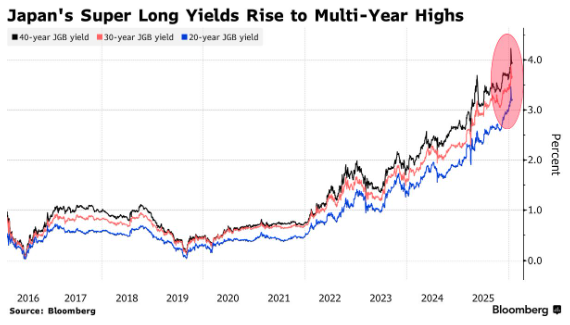
Core Viewpoint - Japanese government bond prices rose on Wednesday due to strong demand in the 40-year bond auction, easing concerns about long-term debt despite rising fiscal worries ahead of the election [1] Group 1: Auction Results and Market Reactions - The yield on the 40-year bond fell by 2 basis points to 3.915%, retreating from a historical high of 4.215% reached a week earlier [1] - The auction results showed an increase in the bid-to-cover ratio, indicating strong demand, with the bid-to-cover ratio at 2.76, higher than the previous auction's 2.585 and the 12-month average of 2.53 [3] - Mizuho Securities' chief strategist noted that the successful absorption of the 40-year bond supply and strong follow-up buying helped stabilize sentiment in the ultra-long bond sector [1][3] Group 2: Political Uncertainty and Market Impact - The Japanese government is concerned about avoiding market turmoil during the election period, as recent polls indicate a slight decline in the Prime Minister's approval ratings [3] - The largest opposition party has committed to a permanent reduction in food taxes, raising concerns about potential weakening of fiscal discipline regardless of the election outcome [5] - Analysts suggest that the political landscape's uncertainty may lead to continued market instability until after the election [4][6] Group 3: Currency Market Dynamics - The Japanese yen reached its strongest level against the US dollar since October, influenced by comments from Japanese officials suggesting potential government intervention to prevent further yen depreciation [6] - The Finance Minister's remarks followed the Prime Minister's warning about taking action against yen weakness and rising bond yields, although specifics were not provided [6] - The volatility in the ultra-long bond sector is expected to persist until after the election [6]

山海:黄金继续走极限大涨,但周二谨防调整回落!
Sou Hu Cai Jing· 2025-10-07 01:45
Group 1 - The core viewpoint is that gold is experiencing a significant upward trend, driven by various market factors such as geopolitical tensions, U.S. government shutdown, and central banks' increased gold purchases [2][4]. - Gold has shown extreme price movements, with a notable increase from 3880 to 3976, nearing the 4000 mark, indicating a strong bullish sentiment [4]. - Caution is advised regarding potential corrections, as previous patterns suggest that after significant gains, a pullback may occur, particularly if key support levels are breached [4]. Group 2 - Silver has risen to 48.7, with expectations of reaching 49 or 50, but caution is warranted as it approaches resistance levels [5]. - The current price of silver is around 48.3, and a pullback is anticipated if it fails to maintain above 48.8 [5]. - Crude oil has shown volatility, with a recent high near 62, but it closed at 61.8, indicating a rebound demand despite some downward movement [5].

欧盟电池法延期两年落地
Jing Ji Guan Cha Bao· 2025-05-23 02:48
Core Points - The European Commission has proposed to delay the implementation of the due diligence obligations for battery supply chains from August 18, 2025, to August 18, 2027, to provide businesses and regulators with more preparation time [1][2] - The delay aims to address challenges such as supply chain adjustments, insufficient third-party certification mechanisms, and the need for coordination with new regulations [1] - The current geopolitical landscape has created difficulties in sourcing battery raw materials, particularly cobalt, natural graphite, lithium, and nickel, necessitating more time for companies to optimize their procurement chains [1] Summary by Sections Regulatory Changes - The deadline for the European Commission to publish due diligence guidelines has been adjusted from February 18, 2025, to July 26, 2026, to align with the CSDD directive guidelines [2] - The Commission emphasizes that the delay is not about lowering standards but ensuring effective implementation of regulations [2] Industry Impact - Battery manufacturers and related companies will gain an additional two years to establish compliant supply chain management systems and participate in industry certification programs [2] - The proposal must be approved by the European Parliament and the Council of the EU before it can take effect, which may alleviate short-term compliance pressures for businesses [2] Long-term Considerations - Despite the temporary relief, the EU's high standards for sustainability in the battery supply chain are expected to remain unchanged in the long run [2]