
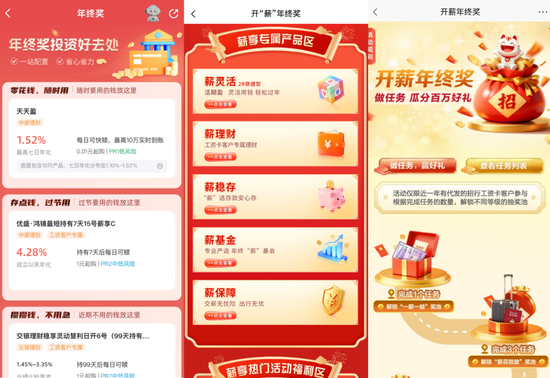
天天盈

Search documents
开年“抢负债”大战升温!多家银行密集推出年终奖专属理财
Nan Fang Du Shi Bao· 2026-02-25 12:44
Core Viewpoint - The influx of year-end bonuses into the financial market is seen as a significant opportunity for banks to attract stable retail liabilities and optimize their funding structure [2][6]. Group 1: Bank Strategies for Year-End Bonus Funds - Commercial banks and their wealth management subsidiaries have launched a series of exclusive financial products targeting year-end bonuses, focusing on flexible terms, risk levels, and low investment thresholds [3][4]. - Banks are moving beyond simply competing on expected returns, instead offering comprehensive asset allocation solutions that combine wealth management, deposits, funds, and insurance [3][7]. - The design of these products emphasizes low entry barriers and stable risk profiles, with some banks offering products with minimum investment amounts as low as 1 yuan [3][4]. Group 2: Product Offerings and Features - Postal Savings Bank has introduced various products catering to different liquidity needs, including low-risk options with daily redemption and moderate-risk products with specific holding periods [4]. - Shanghai Pudong Development Bank has implemented a tiered strategy for product offerings, combining deposit and wealth management products with varying terms and interest rates [4][5]. - Dalian Bank has launched a series of exclusive net value-based financial products with investment periods ranging from 185 to 382 days, with corresponding increases in expected returns [5]. Group 3: Underlying Logic and Market Dynamics - The competition for year-end bonus funds is driven by the need for banks to optimize their liability structures and reduce reliance on high-cost interbank funding, especially in a low-interest-rate environment [6][7]. - The shift in banking strategies reflects a broader transition from product-centric to customer-centric approaches, aiming to meet diverse wealth management needs and build long-term customer relationships [7]. - Analysts emphasize that the focus on year-end bonuses is a strategic choice for banks to stabilize their funding sources and enhance customer retention in a challenging market [6][7].


银行上新春节专属产品 稳健理财成香饽饽
Bei Jing Shang Bao· 2026-02-12 16:06
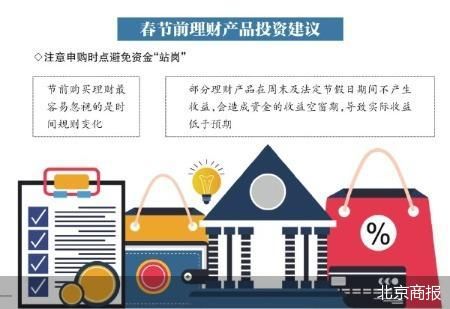
Group 1 - The core viewpoint of the articles highlights the increasing demand for wealth management products as the Chinese New Year approaches, with various financial institutions launching special products aimed at different risk appetites [1][3][4] - Financial companies and banks are focusing on low-risk, stable-return products, with cash management and fixed-income products being the most popular among investors [5][6][7] - Investment strategies are being tailored to different risk profiles, with recommendations for conservative investors to focus on cash management and pure fixed-income products, while moderate risk investors are encouraged to consider "fixed income plus" products for enhanced returns [6][10] Group 2 - The articles emphasize the importance of timing in purchasing financial products before the holiday to avoid funds being idle, with specific deadlines set for different product types to ensure returns during the holiday period [8][9] - Data from the banking industry indicates a significant growth in the wealth management market, with a total scale of 33.29 trillion yuan by the end of 2025, reflecting an 11.15% increase from the beginning of the year [5] - Financial advisors are recommending a balanced asset allocation strategy, suggesting a mix of 80% stable investments and 20% equity investments for optimal risk management [6][7]

你的“年终奖”到账了吗?银行打响理财市场“抢收”大战
Xin Lang Cai Jing· 2026-01-30 00:54
Core Viewpoint - Multiple banks are targeting the year-end bonuses of workers by launching exclusive financial products and promotional activities to attract customers [2][5][10]. Group 1: Year-End Bonus Financial Products - Several banks, including Postal Savings Bank, Bank of Communications, and China Merchants Bank, have introduced dedicated sections in their mobile banking apps for year-end bonus financial products [5][6][7]. - For example, Postal Savings Bank offers products like "Daily Earnings" with a maximum annualized rate of 1.52% and a low-risk product with an annualized rate of 4.28% [6]. - China Merchants Bank has a "Year-End Bonus" section that includes tasks for customers to unlock rewards, specifically targeting customers with salary accounts [7]. Group 2: Asset Allocation Strategies - Some banks are providing asset allocation strategies for year-end bonuses, suggesting a breakdown of funds into categories such as daily expenses, safety nets, stable investments, and growth investments [8]. - For instance, the Guangdong branch of China Construction Bank recommends allocating 10%-20% for daily expenses, 5%-10% for safety, 40%-60% for stable investments, and 10%-20% for growth [8]. Group 3: Market Trends and Data - As of the end of 2025, the total scale of the bank wealth management market reached 33.29 trillion yuan, an increase of 11.15% from the beginning of the year, with the number of investors growing by 14.37% [12][13]. - The report indicates that low-risk and medium-low-risk products dominate the market, with 95.73% of the total wealth management products falling into these categories [14]. - In 2025, wealth management products generated a total return of 730.3 billion yuan for investors, with an average yield of 1.98% [14].



“买股票怕追高,放存款又觉得赚得太少?”专家:年终奖理财正转向配置导向
Di Yi Cai Jing Zi Xun· 2026-01-28 15:27
Core Insights - The article discusses the challenges faced by individual investors in allocating their year-end bonuses amidst rising stock and gold prices, while traditional financial products offer less attractive returns [2] - Banks are responding to this situation by launching specialized financial products and activities aimed at year-end bonuses, expanding beyond traditional offerings to include deposits, funds, insurance, and customer incentives [2] Group 1: Product Offerings - Major state-owned banks have introduced year-end bonus financial products characterized by R2 stable risk levels, short to medium terms, and low minimum investments [3] - Bank of Communications launched a themed year-end bonus product with a near 3-month annualized return exceeding 4%, providing options for short-term allocation of year-end funds [3] - Postal Savings Bank offers various products catering to different risk appetites, including low-risk options with daily liquidity and medium-risk products for stable growth [4] - Industrial and Commercial Bank of China promotes a series of salary management products with low minimum investments and diverse strategies, with one product offering an annualized return of about 3% [4] - China Construction Bank emphasizes asset allocation guidance, suggesting a diversified approach to managing year-end bonuses across various financial products [4] Group 2: Marketing Strategies - Banks are enhancing the retention of year-end bonus funds through incentive mechanisms, such as cash rewards for increasing average monthly assets [5] - Shanghai Pudong Development Bank combines deposit and investment products in a structured manner to attract year-end bonus funds [5] - City commercial banks have launched specialized net value financial products for year-end bonuses, with varying investment terms and performance benchmarks [5] Group 3: Market Trends - The marketing of year-end bonus financial products has shifted towards a configuration-oriented approach, focusing on low minimum investments and flexible terms [6] - The trend reflects a response to a low-interest-rate environment, where banks aim to attract low-cost funds and quality customer assets [6] - The overall financial market is seeing increased interest in wealth management products, with the total scale of the wealth management market reaching 33.29 trillion yuan by the end of 2025, a growth of over 3 trillion yuan from the beginning of the year [7] - Various asset classes have shown strong performance, influencing investor expectations and leading them to prefer stable and predictable product combinations for their year-end bonuses [7]
“买股票怕追高,放存款又觉得赚得太少?”专家:年终奖理财正转向配置导向
第一财经· 2026-01-28 15:19
Core Viewpoint - The article discusses the challenges faced by individual investors in allocating their year-end bonuses amidst rising market volatility and the performance of various investment products, highlighting the shift in banks' strategies to offer diversified financial products to attract these funds [3][8]. Group 1: Market Environment and Trends - Since the beginning of 2026, gold prices have surged significantly, with spot gold exceeding $5,220 per ounce, reflecting a year-to-date increase of approximately 20%. The Shanghai Composite Index and Hang Seng Index have also shown gains of 4.82% and 8.17%, respectively [9]. - The total scale of the national wealth management market reached 33.29 trillion yuan by the end of 2025, an increase of over 3 trillion yuan from the beginning of the year, with the number of investors holding wealth management products growing by 14.37% year-on-year to 143 million [9]. Group 2: Bank Strategies and Product Offerings - Major state-owned banks have launched year-end bonus financial products characterized by low investment thresholds and stable returns, aiming to lower the entry barrier for individual investors [4][8]. - The products offered include flexible terms, covering demand for liquidity and varying investment horizons, with a focus on a combination of financial tools such as deposits, wealth management, funds, and insurance [8]. - Specific offerings include the "Lingdong Tianli 6" product from the Bank of Communications with an annualized yield exceeding 4% for short-term investments, and the Postal Savings Bank's "Tian Tian Ying" product, which allows for daily redemption with a minimum investment of 0.01 yuan [4][5]. Group 3: Marketing and Customer Engagement - Banks are employing incentive mechanisms to enhance the retention of year-end bonus funds, such as offering cash rewards for increasing average monthly assets [6]. - The marketing approach has shifted from a product-centric focus to a configuration-oriented strategy, emphasizing comprehensive asset management to meet diverse customer needs [8]. - The article notes that the success of year-end bonus financial marketing in translating into actual asset under management (AUM) growth will depend on the performance of the products, transparency in information disclosure, and the quality of post-investment services [9].

从卖产品到配资产,银行年终奖理财热度升温
Di Yi Cai Jing Zi Xun· 2026-01-28 12:53
Core Viewpoint - The article discusses the challenges faced by individual investors in allocating their year-end bonuses amidst rising stock and gold prices, while banks are actively launching specialized financial products to attract these funds [1] Group 1: Market Trends - Since 2026, gold prices have significantly increased, with the Shanghai Composite Index rising by 4.82% and the Hang Seng Index by 8.17% within the year [6] - The total scale of the national wealth management market reached 33.29 trillion yuan by the end of 2025, growing by over 3 trillion yuan from the beginning of the year [6] Group 2: Bank Initiatives - Major state-owned banks and various commercial banks have launched year-end bonus exclusive financial products, focusing on low-risk, flexible-term options to cater to investors' needs [2][3] - The products include short-term and medium-term options, with some banks offering annualized returns exceeding 4% for short-term investments [2][3] Group 3: Product Features - Banks are emphasizing low initial investment amounts and a variety of strategies, with many products starting at 1 yuan and offering annualized returns around 3% to 4% [3][5] - The marketing strategies have shifted from product-centric to configuration-oriented, integrating various financial tools to better meet customer needs [5] Group 4: Customer Engagement - Some banks are implementing incentive mechanisms to enhance the retention of year-end bonus funds, such as cash rewards for increasing average monthly assets [4] - The focus is on providing a one-stop management solution for year-end bonuses, combining wealth management, insurance, and investment products [5]
年末银行揽储升温,存款冲量暗流再起
第一财经· 2025-12-23 04:08
Core Viewpoint - The article discusses the aggressive deposit acquisition strategies employed by small and medium-sized banks as they approach the end of the year, highlighting both legitimate marketing tactics and the resurgence of questionable practices to meet performance targets [3][4][5]. Group 1: Deposit Acquisition Strategies - As the end of 2025 approaches, banks are entering a "sprint mode" for deposit acquisition, utilizing methods such as raising deposit interest rates, offering gifts, and promoting wealth management products to attract new customers and funds [5][6]. - For instance, Jiangsu Bank has raised the annual interest rate on a three-year fixed deposit product to 1.9%, a 15 basis point increase from the standard rate, while Jilin Bank has increased its three-year fixed deposit rate from 1.75% to 2% [5][6]. - Additionally, banks like Yilian Bank are implementing limited-time offers and gift incentives to draw in customers, with some banks offering gifts for deposits above certain thresholds [6]. Group 2: Market Dynamics and Risks - Industry insiders indicate that the year-end deposit acquisition not only plays a crucial role in banks' strategies but also reflects the challenges faced by small banks in a limited interest rate environment, prompting them to adopt refined operational strategies to attract customers and increase funds [7]. - The phenomenon of "deposit rushing" has re-emerged, where banks attempt to meet performance metrics by rapidly increasing deposits at the end of reporting periods, often facilitated by intermediaries advertising low-cost deposit options [8][9]. - This practice raises concerns about compliance with regulations and the potential risks to depositors' funds, as these operations may violate banking regulations and create market disturbances [11][12]. Group 3: Internal Pressures and Ethical Concerns - The pressure on bank employees to meet performance targets has led to the normalization of purchasing performance indicators through online platforms, with employees spending money to complete deposit and fund purchase tasks to avoid penalties [10]. - Such practices not only expose banks to regulatory risks but also create internal competition issues and could damage the bank's reputation and customer trust [12]. - Experts warn that these practices can lead to long-term negative consequences if not managed properly, emphasizing the need for customers to be aware of the risks associated with participating in such deposit operations [12].





年末银行揽储升温,存款冲量暗流再起
Di Yi Cai Jing· 2025-12-22 12:54
Core Insights - The article highlights the increasing pressure on banks, particularly small and medium-sized banks, to attract deposits as the year-end approaches, leading to various promotional strategies and potential compliance risks [1][2][3]. Group 1: Deposit Strategies - Banks are employing strategies such as raising deposit interest rates, offering gifts, and promoting wealth management products to attract new customers and funds [2][3]. - For instance, Jiangsu Bank has raised the annual interest rate on a three-year fixed deposit product to 1.9%, a 15 basis points increase from the standard rate [2]. - Other banks, including Jilin Bank and Hangzhou Bank, have also increased their deposit rates, with Jilin Bank's three-year fixed deposit rate rising from 1.75% to 2% [2]. Group 2: Wealth Management Focus - Many banks are shifting their focus towards wealth management products as part of their year-end strategies, launching fixed-income products and promotional activities [3]. - For example, China Post Life has introduced three products targeting year-end bonuses, with one offering a maximum annualized yield of 1.52% [3]. - This shift is seen as a way for banks to stabilize liabilities and attract new funds while also increasing non-interest income [3]. Group 3: Compliance Risks - The phenomenon of "deposit rush" has resurfaced, where banks engage in practices to meet performance targets, potentially leading to compliance risks and market disturbances [4][6]. - There are reports of intermediaries advertising "end-of-year deposit rush" services, where funds are concentrated to meet performance metrics, raising concerns about regulatory compliance [4]. - Such practices may violate regulations and could expose banks to legal risks, as well as jeopardize customer funds [6]. Group 4: Internal Pressure and Ethical Concerns - The pressure on bank employees to meet performance targets has led to the normalization of purchasing performance indicators through online platforms [5]. - Employees may resort to these practices to avoid penalties and secure bonuses, indicating a culture of performance-driven behavior that could harm the bank's reputation [5][6]. - The reliance on such practices raises ethical concerns and could lead to internal corruption and a loss of customer trust [6].
银行理财年末蓄势待发
Bei Jing Ri Bao Ke Hu Duan· 2025-12-21 16:34
Core Viewpoint - The year-end bonus has become a focal point for banks' marketing strategies, with various banks launching specialized financial products to attract customers looking to invest their bonuses [1][6]. Group 1: Bank Marketing Strategies - Multiple banks have initiated year-end bonus exclusive financial activities through online channels, offering a range of products including wealth management, funds, and precious metals [1][3]. - Postal Savings Bank has launched a campaign featuring low-risk financial products with attractive yields, such as "天天盈" with a maximum annualized yield of 1.52% and "优盛·鸿锦" with a yield of 4.76% [3]. - Traffic Bank's promotional activities cover a wide array of products, emphasizing low-risk financial products with annualized yields above 4.9% for certain offerings [4]. Group 2: Product Characteristics - The core focus of the promoted financial products is on low to medium risk, aligning with the general market trend towards stable investment options [6][7]. - The financial products are primarily invested in fixed-income assets such as government bonds, financial bonds, and corporate bonds, with some higher-risk products including stocks and funds for enhanced returns [6][7]. - Banks are encouraging a tiered asset allocation strategy, suggesting a mix of conservative, stable, and aggressive investments based on individual risk tolerance [5][6]. Group 3: Investor Guidance - Investors are advised to assess their risk tolerance and investment goals before selecting financial products, with recommendations for low-risk options if the bonus is needed for short-term expenses [7]. - The importance of understanding the performance benchmarks of financial products is emphasized, as actual returns may vary due to market conditions [7].

银行发力年终奖专属理财
Bei Jing Shang Bao· 2025-12-21 15:55
Core Insights - Year-end bonuses are a key focus for banks, leading to the launch of specialized financial products aimed at maximizing returns for employees expecting these bonuses [1][4] - Banks are promoting low to medium-risk financial products, aligning with the conservative investment preferences of the general public [1][4] Product Offerings - Several banks, including Postal Savings Bank, have introduced specific financial products for year-end bonuses, such as "天天盈" with a maximum annualized yield of 1.52% and "优盛·鸿锦最短持有" with a yield of 4.76% [2] - The products are designed to cater to different investment timelines and risk appetites, with options ranging from low-risk daily redeemable products to those with longer holding periods [3] Marketing Strategies - Banks are intensifying their marketing efforts around year-end bonuses to boost their wealth management, fund, and insurance services, enhancing customer loyalty and overall contribution [4] - The marketing strategies include a variety of products such as deposits, wealth management, funds, and insurance, with a focus on low-risk options [3][4] Investment Recommendations - Analysts suggest that investors should assess their risk tolerance and investment needs before selecting financial products, recommending low-risk options for short-term needs and higher-yield products for long-term investments [5] - The importance of understanding the performance benchmarks of financial products is emphasized, as actual returns may vary due to market conditions [5]