恐惧与贪婪指数

Search documents
Nasdaq Gains 100 Points Ahead Of Fed Decision: Fear & Greed Index Remains In 'Extreme Fear' Zone
Benzinga· 2026-03-18 06:37
Market Sentiment - The CNN Money Fear and Greed index showed a slight decrease to 21.5, remaining in the "Extreme Fear" zone, compared to a previous reading of 21.6 [5][6] - The index indicates that higher fear levels can exert downward pressure on stock prices, while higher greed can have the opposite effect [6] Stock Market Performance - U.S. stocks mostly closed higher, with the Dow Jones increasing by approximately 47 points to 46,993.26, the S&P 500 gaining 0.25% to 6,716.09, and the Nasdaq Composite rising by 0.47% to 22,479.53 [4] - Most sectors on the S&P 500 ended positively, particularly energy, consumer discretionary, and communication services, while consumer staples and health care sectors closed lower [4] Economic Indicators - Private employers in the U.S. added an average of 9,000 jobs per week during the four weeks ending February 28, a decrease from the revised average of 14,750 jobs per week in the previous period [3] - The Federal Reserve Bank of New York's general business activity index improved to -22.6 in March from -25.7 in the prior month [3]

一夜突发!比特币闪崩,58万投资者集体爆仓,金额高达26.65亿美元,背后三个可怕信号
Sou Hu Cai Jing· 2026-02-06 21:47
Core Viewpoint - The cryptocurrency market experienced a significant crash on February 6, 2026, with Bitcoin's price dropping from nearly $67,000 to around $60,000, marking a decline of over 10% within hours. This decline affected nearly all major cryptocurrencies, leading to a rapid evaporation of market capitalization [1][3]. Market Dynamics - The crash triggered a wave of forced liquidations, with 586,219 investors being liquidated within 24 hours, resulting in a total liquidation amount of $2.665 billion. Most of these liquidations were from long positions, amounting to $2.314 billion, indicating that investors betting on price increases suffered the most [3][10]. - The "Fear and Greed Index" dropped to 10, indicating extreme fear in the market, a level not seen since earlier bear market cycles. Investors shifted their focus from which cryptocurrencies to buy to concerns about how low prices could go and whether it was too late to cut losses [3]. Causes of the Crash - The first key pressure point was a reversal in macro policy expectations, with the new Federal Reserve chair nominee's stance interpreted as a continuation or intensification of monetary tightening, leading to prolonged high-interest rates. This shift undermined the rationale for institutional investors to hold cryptocurrencies [4]. - The second pressure was a significant outflow of funds, with over $740 million exiting from more than 140 cryptocurrency-themed ETFs on February 5 alone, and nearly $4 billion in total over the past three months. This indicated a withdrawal of institutional long-term capital from the market [8]. - The third pressure stemmed from the disillusionment with regulatory intervention, as U.S. Treasury Secretary Janet Yellen stated that the Treasury had neither the power nor the intention to intervene in the natural fluctuations of the crypto market, exacerbating feelings of helplessness among market participants [8]. - The fourth pressure was the inherent fragility of the market structure due to excessive leverage, with many investors using high leverage to amplify returns. This led to a vicious cycle of price declines triggering forced liquidations, further driving down prices [9]. Market Impact - The crash had repercussions beyond the cryptocurrency sector, impacting publicly traded companies holding Bitcoin. For instance, Strategy Inc. saw its stock price plummet over 17% on February 5, following a reported net loss of $12.4 billion in Q4 2025 due to the decline in Bitcoin asset values [10]. - The average cost for investors who purchased Bitcoin through U.S. spot Bitcoin ETFs was approximately $84,100, while Bitcoin's price hovered around $64,000, indicating that many ETF investors were facing significant unrealized losses [12]. - Analysts expressed concerns about the potential for a self-reinforcing "death spiral" in Bitcoin prices, with some suggesting that Bitcoin has proven to be a speculative asset rather than a reliable hedge against economic uncertainty [11][13].

OEXN:比特币突破引爆5亿清算
Xin Lang Cai Jing· 2026-01-14 10:30
Core Insights - The cryptocurrency market is experiencing a strong structural breakthrough, with Bitcoin successfully surpassing $96,240, marking a two-month high. This surge is primarily driven by a concentrated short position covering, triggered by Bitcoin breaking through the critical resistance level of $94,500, which had previously failed three times [1][2][4] Market Dynamics - Over the past four hours, the total liquidation amount in the futures market exceeded $500 million, which has not only cleansed market leverage but also provided momentum for subsequent upward movements [1][2] - The Bitcoin futures open interest has decreased from $31.5 billion to $30.6 billion, indicating a rapid covering of short positions in the derivatives market, while the spot market shows strong buying interest [3][4] Altcoin Performance - The altcoin market has seen a collective surge, with tokens like DASH reaching 2021 highs and others such as OP and TIA experiencing double-digit percentage increases, signaling a departure from the previous deep correction phase and a notable recovery in traders' risk appetite [3][4] Valuation Recovery - The recent market rally is largely attributed to a valuation correction following a period of extreme "overselling." The "Fear and Greed Index" for the crypto market has lingered in the extreme fear zone, which often signals potential reversal opportunities [2][4] - Bitcoin's market share has decreased from 59.3% to 58.6%, indicating a shift of capital from a single asset to a more diversified ecosystem, reflecting an increase in market health [2][4] Short-term Outlook - The $94,500 level has transitioned from a resistance to a new key support level. If this level can be effectively retested and held, Bitcoin's next target will be $99,000, which has served as a significant support level from June to November of the previous year [2][4] - If the market fails to maintain the $94,500 level, it may undergo deeper consolidation within the range of $85,000 to $94,500 [2][4]

2026年FOMC票委转向鸽派:特朗普会如愿实现降息吗?
Sou Hu Cai Jing· 2026-01-12 08:51
Core Viewpoint - The article discusses the potential shifts in the Federal Reserve's stance and market expectations for interest rate changes in 2026, influenced by new appointments and the economic environment [3][4][5][6]. Group 1: Federal Reserve Changes - Four Federal Open Market Committee (FOMC) members will leave in the new year, with their replacements being more balanced in terms of hawkish and dovish views [3]. - The upcoming leadership change, particularly the potential appointment of a more dovish successor to Chairman Powell, could alter market expectations for interest rate cuts [4][6]. - The FOMC is expected to consider economic data over ideological leanings, which may lead to a more dovish or neutral stance in 2026 [3][5]. Group 2: Market Reactions - The Nasdaq 100 index has shown strong performance at the beginning of the year, with a cumulative increase of over 2% due to improved market confidence and reduced attractiveness of alternative assets [7]. - The decline in the 10-year U.S. Treasury yield from around 4.2% to the 4.0% range has contributed to the capital flow towards high-risk assets like the Nasdaq index [7]. - Seasonal effects, such as the "January effect," are driving strong demand for Nasdaq components as institutional portfolios are being rebalanced for the new year [7]. Group 3: Technical Analysis - The Nasdaq index is currently trading within a defined range, with resistance at approximately 26,054 points and support at around 24,112 points [8][10]. - The Relative Strength Index (RSI) indicates that buying momentum is beginning to dominate, which could lead to bullish pressure on the Nasdaq index if the trend continues [9]. - The MACD histogram remains around the neutral zero line, suggesting that short-term price movements may remain volatile unless significant changes occur [10].
Dow Surges Over 1% Amid Fed Dovish Remarks: Investor Fear Eases, Greed Index Remains In 'Extreme Fear' Zone - Agilent Technologies (NYSE:A), BJ's Wholesale Club Hldgs (NYSE:BJ)
Benzinga· 2025-11-24 10:07
Market Sentiment - The CNN Money Fear and Greed index showed some easing in the overall fear level, remaining in the "Extreme Fear" zone with a current reading of 10.5, up from a prior reading of 7.2 [1][5]. Stock Market Performance - U.S. stocks settled higher on Friday, with the Dow Jones index gaining more than 1%, closing higher by around 493 points to 46,245.41. The S&P 500 gained 0.98% to 6,602.99, while the Nasdaq Composite gained 0.88% to 22,273.08 [1][4]. - Despite the gains on Friday, all three major indices recorded significant losses last week, with the S&P 500 and Dow falling around 2% each [2]. Company Earnings - Shares of Elastic N.V. (NYSE:ESTC) dipped 15% after posting second-quarter earnings. In contrast, BJ's Wholesale Club Holdings, Inc. (NYSE:BJ) reported better-than-expected earnings for the third quarter [3]. - Investors are awaiting earnings results from Zoom Communications Inc (NASDAQ:ZM), Keysight Technologies Inc (NYSE:KEYS), and Agilent Technologies Inc (NYSE:A) [4]. Economic Indicators - The University of Michigan's consumer sentiment index increased to 51.0 in November from a preliminary reading of 50.3. The S&P Global composite PMI rose to 54.8 in November from 54.6 in October, exceeding market estimates of 54.5 [3].


BNB Chain News: Sector Outperforms Bitcoin as Fear Grips the Market
Yahoo Finance· 2025-11-19 13:08
Market Overview - The CMC Crypto Fear & Greed Index has dropped to 16, indicating extreme fear in the market, nearing its lowest recorded value [1] - Despite the overall downtrend, the cryptocurrency market is experiencing a shift with Bitcoin losing dominance to altcoins [1][4] - The BNB Chain sector has seen a decline of 5% this week, with its market capitalization falling to $221.3 billion, reversing four months of growth [2] BNB Chain Performance - BNB Chain is outperforming most altcoin sectors, even as altcoins collectively show better performance than Bitcoin [2] - Among the top 10 largest BNB Chain tokens, only three managed to maintain positive performance this week [2] - BNB Chain native perpetual DEXs Aster and MYX Finance are demonstrating strength due to low float token dynamics and sustained on-chain trading demand [3] Token Variance - Significant variance exists within the $100 million market capitalization category, with some tokens achieving gains of over 30% this week [3] - Tokens in the sub-$100 million market capitalization category are showing particularly weak performance, representing the biggest losers of the week [3] Market Sentiment and Strategy - The current market volatility suggests a need for prioritizing strong investment theses, hedging shorts, and avoiding excessive leverage [4] - New developments in the BNB Chain ecosystem include DeFi launches, a push for real-world assets (RWA), a hackathon, and Aster's Machi Mode [4]
大涨之际警钟敲响?指标显示美股风险情绪“极度贪婪”
Hua Er Jie Jian Wen· 2025-07-10 04:15
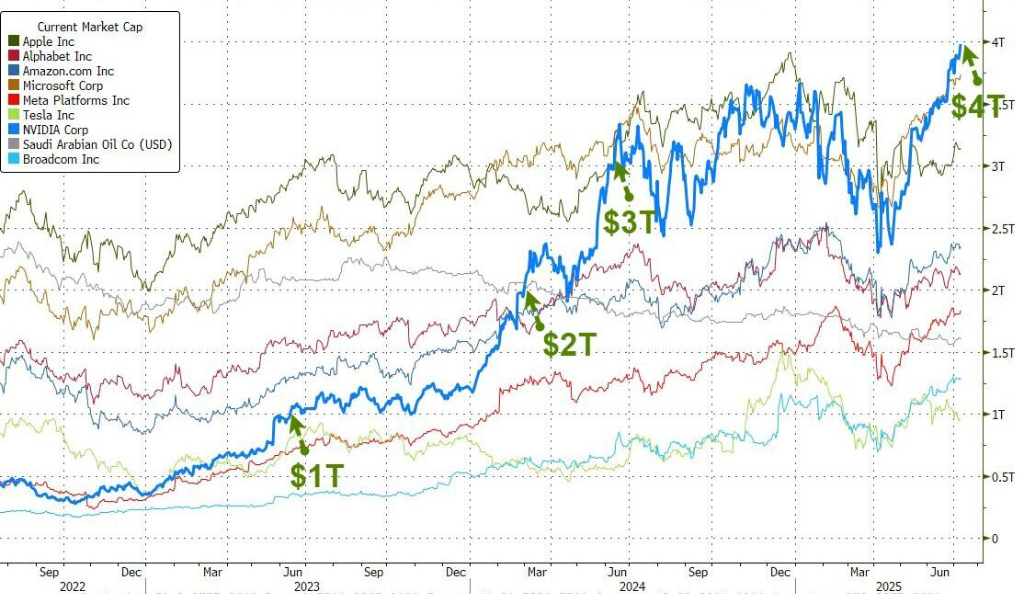
Group 1 - The U.S. stock market is experiencing a strong rebound driven by technology stocks, with the S&P 500 index nearing historical highs, while the Fear and Greed Index indicates "extreme greed," reflecting heightened market risk sentiment [1][3] - Major technology stocks, particularly Nvidia, have shown robust performance, with Nvidia briefly surpassing a market capitalization of $4 trillion, marking a significant recovery from earlier concerns related to spending and trade tensions [10][9] - Analysts suggest that as the earnings season approaches, market focus will shift from tariff news to corporate earnings performance, with high investor expectations potentially leading to increased volatility [8][13] Group 2 - Goldman Sachs strategists have raised their outlook for U.S. stocks, citing the continued strength of major companies as a reason for potential further gains, while Piper Sandler expresses an optimistic view despite new trade war concerns [5] - The market's reaction to ongoing trade news has become muted, indicating a transition period where the next catalyst for movement will likely be the upcoming earnings reports [13] - The return of risk appetite is also evident in other asset classes, such as Bitcoin, which has surpassed $112,000, further confirming investor interest in high-risk assets [10]