
一月效应

Search documents
关税传导与"一月效应"或推高美国1月CPI?
Hua Er Jie Jian Wen· 2026-02-09 12:34
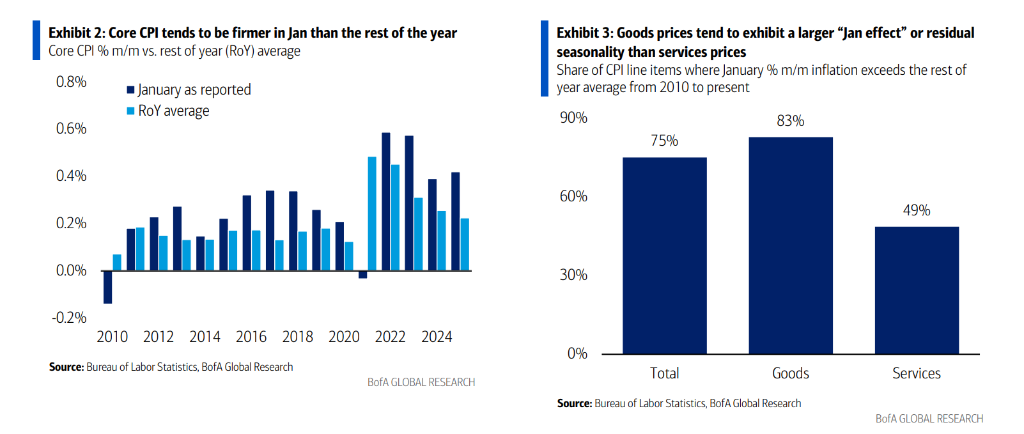
Core Insights - Wall Street is closely monitoring the upcoming January Consumer Price Index (CPI) release, with several investment banks predicting a rebound in core inflation due to the "January effect" and tariff cost transmission [1][3] - The consensus forecast for January's core CPI month-over-month growth is around 0.3%, with Bank of America and Citigroup both predicting a 0.3% increase, while UBS has a more aggressive forecast of 0.38% [1][3][5] - The divergence between goods prices and service sector inflation is a focal point, with rising goods prices driven by tariff cost pass-through, while service prices may show seasonal weakness, potentially signaling easing inflationary pressures [1][3][8] Goods Price Trends - The "January effect" and tariff cost pass-through are expected to drive strong performance in goods prices, with Bank of America forecasting a 0.40% month-over-month increase in core goods prices, while Citigroup anticipates a 0.31% rise [3][5] - Specific categories such as furniture (+0.35%), auto parts (+0.75%), and medical goods (+0.8%) are expected to reflect sellers' actions to pass on tariff costs [3][5] - UBS warns of measurement disruptions due to delayed data collection from November, which may impact January's core goods prices and airline ticket prices by approximately 5 basis points [5] Service Sector Inflation - There is significant divergence in expectations for service sector inflation, which will influence the overall CPI data's impact on Federal Reserve policy [8][10] - Citigroup predicts a 0.39% month-over-month increase in core services prices (excluding housing), which is lower than the typical 0.7% seen in January over the past two years [8] - Bank of America expects a slight cooling in service sector inflation compared to December, primarily due to anticipated declines in accommodation and airfare prices [10] Housing Inflation - Consensus among institutions suggests a moderate increase in housing prices, with Citigroup forecasting a 0.23% rise and UBS predicting a 0.26% increase in Owners' Equivalent Rent (OER) [10] - Bank of America notes that service sector inflation may cool slightly compared to December, influenced by the previous month's strong increases in accommodation and airfare prices [10] Policy Implications - Different interpretations exist regarding how the upcoming data will affect Federal Reserve policy, with Bank of America suggesting the current inflation environment is "neither too hot nor too cold" [11] - Citigroup maintains that if inflation data remains below expectations during the typically strong seasonal period at the beginning of the year, it could convince hawkish officials that persistent inflation is no longer a primary concern [11]

小盘股春天来了!连续七天跑赢标普500 创七年最长纪录
智通财经网· 2026-01-12 23:30
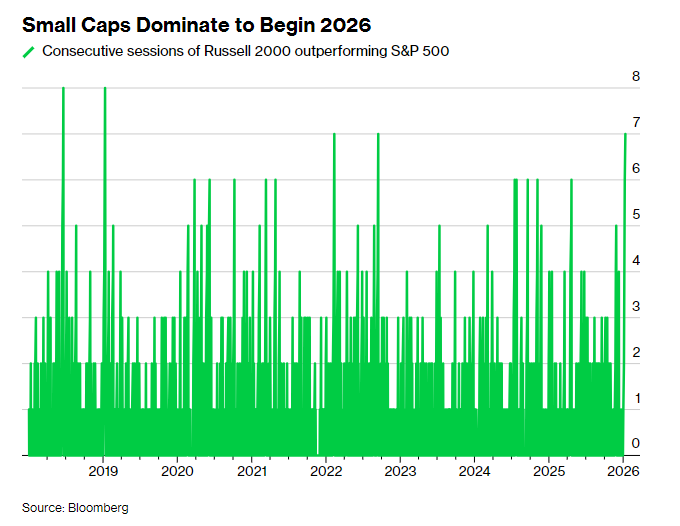
Group 1 - The Russell 2000 small-cap index has achieved its longest winning streak against the S&P 500 in seven years, closing at a historical high [1] - The last time the Russell 2000 index had a longer leading period was in January 2019, following a significant market downturn [1] - Small-cap stocks have outperformed large-cap stocks significantly in the new year, with the Russell 2000 index rising over 6% this month [3] Group 2 - Analysts attribute the strong performance of small-cap stocks to the "January effect," where these stocks typically perform well at the beginning of the year [3] - The Russell 2000 and S&P 600 small-cap indices have lagged behind large-cap indices for several years, with expectations for a reversal in 2026 due to lower interest rates and economic resilience [3] - The current valuation of small-cap stocks is more favorable compared to blue-chip stocks, with the S&P 600 small-cap index trading at a price-to-earnings ratio of approximately 15.6 times, which is 31% lower than the S&P 500's 22.6 times [3] Group 3 - Small companies are expected to see profit growth slightly outpacing that of the S&P 500, with projected earnings growth of 15.4% for the S&P 600 compared to 14.8% for the S&P 500 [4] - Investment firms are beginning to increase their allocations to small-cap stocks, particularly value stocks, as the market breadth is expanding [4] - Analysts are optimistic about the performance of non-tech small-cap stocks, particularly in the industrial and healthcare sectors [4] Group 4 - M&A activity is seen as a potential boon for small-cap stocks, with companies like Casella Waste Systems being potential acquisition targets [5] - Regional banks, such as Glacier Bancorp, are also viewed as potential acquisition candidates in the current favorable interest rate environment [5] - The combination of a stable U.S. economy and a favorable interest rate environment may benefit small-cap stocks, suggesting a shift in investor focus back to these companies [5]
2026年FOMC票委转向鸽派:特朗普会如愿实现降息吗?
Sou Hu Cai Jing· 2026-01-12 08:51
Core Viewpoint - The article discusses the potential shifts in the Federal Reserve's stance and market expectations for interest rate changes in 2026, influenced by new appointments and the economic environment [3][4][5][6]. Group 1: Federal Reserve Changes - Four Federal Open Market Committee (FOMC) members will leave in the new year, with their replacements being more balanced in terms of hawkish and dovish views [3]. - The upcoming leadership change, particularly the potential appointment of a more dovish successor to Chairman Powell, could alter market expectations for interest rate cuts [4][6]. - The FOMC is expected to consider economic data over ideological leanings, which may lead to a more dovish or neutral stance in 2026 [3][5]. Group 2: Market Reactions - The Nasdaq 100 index has shown strong performance at the beginning of the year, with a cumulative increase of over 2% due to improved market confidence and reduced attractiveness of alternative assets [7]. - The decline in the 10-year U.S. Treasury yield from around 4.2% to the 4.0% range has contributed to the capital flow towards high-risk assets like the Nasdaq index [7]. - Seasonal effects, such as the "January effect," are driving strong demand for Nasdaq components as institutional portfolios are being rebalanced for the new year [7]. Group 3: Technical Analysis - The Nasdaq index is currently trading within a defined range, with resistance at approximately 26,054 points and support at around 24,112 points [8][10]. - The Relative Strength Index (RSI) indicates that buying momentum is beginning to dominate, which could lead to bullish pressure on the Nasdaq index if the trend continues [9]. - The MACD histogram remains around the neutral zero line, suggesting that short-term price movements may remain volatile unless significant changes occur [10].

聚焦数据波动性风险国际银回涨
Jin Tou Wang· 2026-01-09 07:03
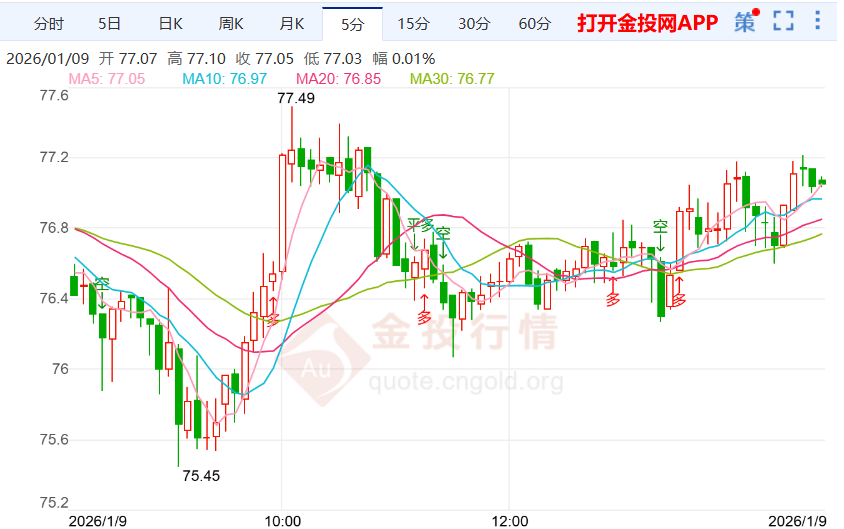
Group 1 - International silver is currently trading above $76.96, with a reported price of $77.07, reflecting a 0.14% increase, and has seen a high of $77.49 and a low of $75.45 during the session [1] - The next upward price target for silver bulls is to break through the key technical resistance level at the historical high of $82.67 per ounce [4] - A significant drop below current levels could trigger technical selling, potentially accelerating a decline towards the psychological level of $75.00, with further corrections possibly extending to the next support level near $74.00, which may serve as a short-term bottom for the commodity [4] Group 2 - The volatility of the upcoming U.S. non-farm payroll data remains a primary risk factor, with the impact of the 2025 government shutdown overshadowing the true hiring trends [3] - The significant downward revisions of data from October and November 2025 may obscure the positive performance of December data, painting a bleaker picture of growth momentum for the quarter [3] - Market participants are cautious of the potential "January effect," where rebalancing and New Year optimism collide with high-risk data [3]
【环球财经】德国法兰克福股市DAX指数首次突破25000点
Xin Hua Cai Jing· 2026-01-07 09:18
Core Viewpoint - The DAX index in Frankfurt, Germany, has surpassed 25,000 points for the first time, reaching a historic high of 25,030.76 points, driven by improved economic outlook, government spending plans, and a strong global stock market [1] Economic Outlook - The German economic outlook is improving, supported by government infrastructure and military investment plans, which are seen as key drivers of economic vitality [1] - The recent recovery in risk appetite in European and global markets has positively influenced the performance of risk assets [1] Market Dynamics - Geopolitical risks have increased uncertainty regarding energy supply and oil price trends; however, this has not significantly disturbed market sentiment [1] - A decline in oil prices has led to expectations of easing inflationary pressures, providing further momentum for stock market gains [1] Sector Performance - The technology, industrial, and export-oriented sectors have shown strong performance, contributing to the overall rise of the DAX index [1] - Investor interest in European stocks has been rekindled, further solidifying the upward trend of the DAX, aided by the traditional "January effect" which typically supports stock markets [1] Global Market Influence - The U.S. stock market has also performed strongly, with the Dow Jones Industrial Average moving towards new highs, providing external support for global market performance [1]
资金配置窗口期开启!美股“1月效应”应验?
Jin Shi Shu Ju· 2026-01-07 03:56
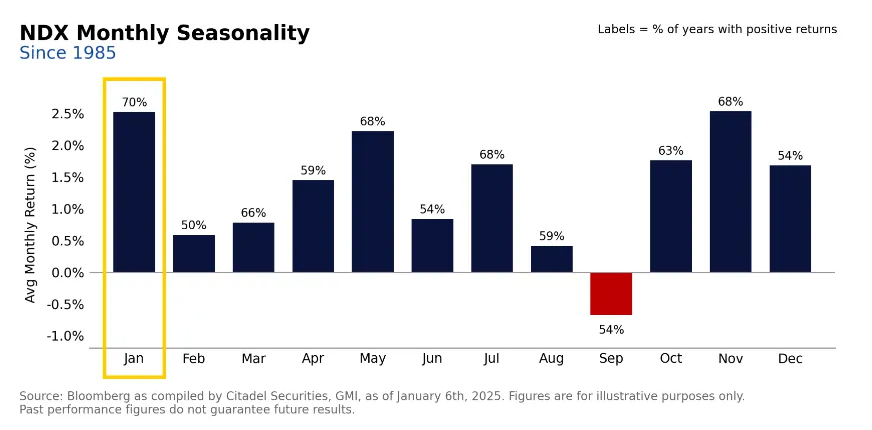
Group 1 - The S&P 500 index experienced a three-day rally at the beginning of January, indicating potential upward momentum for U.S. stocks for the remainder of the month [1] - Historical data shows that January is the most active month for new capital inflows into the stock market, with an average monthly purchase ratio of stock mutual funds being the highest each January since 1984 [1] - The probability of the S&P 500 index rising in January is 62% since 1928, while the Nasdaq 100 index has a 70% probability of rising in January since 1985 [1] Group 2 - The S&P 500 index reached a historical high, and the Dow Jones Industrial Average closed above 49,000 for the first time, with the Dow gaining approximately 3% since the beginning of the month [2] - Market volatility remains low, with the Chicago Board Options Exchange Volatility Index (VIX) slightly above 14, having dropped below 14 before the Christmas holiday [2] - Retail investor enthusiasm is contributing to the expectation of billions of dollars in new capital inflows into the stock market this month, with corporate earnings growth momentum spreading beyond the "seven giants" [2]
城堡证券:早期资本流入+反弹范围扩大 “一月效应”有望为美股全面上涨筑牢基础
Zhi Tong Cai Jing· 2026-01-07 02:51
Core Viewpoint - The "January Effect" appears particularly strong this year, with early capital inflows and an expanding market rebound laying the foundation for a broad rise in U.S. stocks [1] Group 1: Market Dynamics - The balance in money markets has reached a record high of $7.6 trillion, supporting the theory that U.S. stocks tend to rise more easily in January compared to other months [1] - Since 1985, the Nasdaq 100 index has risen in about 70% of years in January, with an average increase of 2.5%, and nearly 6% in years when it ultimately closes higher [3] - Market volatility remains suppressed despite a series of catalyst events this month, with capital flows shifting from crowded trades to a broader market [3] Group 2: Retail and Institutional Participation - Retail activity remains robust, with retail traders accounting for approximately 60% of total client volume at options clearinghouses, indicating their significant influence on market outcomes [3] - Retail investors have generated over $20 billion in profits through options trading in 2025 and are entering January with new disposable funds, particularly in themes like quantum computing, robotics, and space [3] - Institutional clients are also increasing their exposure to risk assets, with recent options flows favoring sectors such as energy, utilities, real estate, and materials [4] Group 3: Market Structure and Future Outlook - The current positioning reflects a shift towards lagging sectors to diversify away from over-concentration in index leaders, indicating a healthier market structure [4] - Cross-asset correlations are converging to a one-year low, providing greater space for specific returns [4] - While a normalization of asset allocation and volatility repricing may lead to some "healthy digestion adjustments" in February, any pullback could be viewed as an opportunity to reallocate to risk assets at more attractive levels [4]
美股点金丨圣诞行情或缺席,新年行情如何演绎
Di Yi Cai Jing· 2026-01-04 05:01
Group 1 - The U.S. stock market has achieved double-digit growth for the third consecutive year, a trend last seen from 2019 to 2021, although the year-end performance has been disappointing [1] - Investors are actively seeking direction in the market, with strong corporate earnings and ongoing investments in artificial intelligence expected to boost the stock market, despite macroeconomic uncertainties and changes in Federal Reserve leadership [1] - The S&P Global U.S. Manufacturing PMI for December was reported at 51.8, slightly above the market expectation of 51.7, indicating a positive outlook for manufacturing [2] Group 2 - The Federal Open Market Committee (FOMC) recently voted 9-3 to lower the federal funds rate by 25 basis points, but internal divisions among committee members persist regarding future monetary policy [3] - Market expectations for further rate cuts by the Federal Reserve have cooled, with probabilities for rate cuts in upcoming meetings decreasing [3] - Economic indicators suggest a stable labor market, with initial jobless claims decreasing for three consecutive weeks, signaling relative stability despite seasonal fluctuations [2][4] Group 3 - The manufacturing sector's outlook is improving as trade policy uncertainties diminish, with expected growth in production across various sectors, particularly in electrical equipment driven by AI investments [4] - The automotive manufacturing sector's negative impact is expected to gradually lessen, contributing to a more favorable manufacturing environment [4] - The stock market's performance in the new year may be affected by low trading volumes and a lack of a traditional holiday rally, with significant declines in non-essential consumer goods and technology sectors [5] Group 4 - Long-term U.S. Treasury yields are gradually rising, with the 10-year yield just below 4.20% and the 30-year yield reaching 4.872%, which could increase market volatility, particularly for interest-sensitive sectors [7] - Upcoming economic data releases, including the ADP employment report and non-farm payrolls, are anticipated to provide insights into the labor market and may influence market fluctuations [7] - The stock market's resilience in the face of rising yields remains uncertain, with potential implications for future trading dynamics as investors navigate various factors, including the "January effect" and capital gains selling [7]
贵金属狂欢嗨翻天!金银铂钯狂飙,新年第一周恐遭强制抛售清仓?
Sou Hu Cai Jing· 2025-12-28 14:14
Core Viewpoint - The recent surge in precious metals prices, including gold and silver, is accompanied by significant risks of a forced sell-off as the new year approaches, which investors should be cautious about [1][21]. Group 1: Precious Metals Performance - Gold has seen a nearly 70% increase over the year, reaching over $4,000 per ounce and setting over 50 new highs [3]. - Silver has experienced a remarkable rise of nearly 140%, with prices approaching $70 per ounce [3]. - Platinum has reached a 16-year high with an annual increase of nearly 130%, marking its best performance since records began in 1990 [5]. - Palladium has also surged to a near four-year high, with an annual increase exceeding 95% [5]. Group 2: Factors Driving Price Increases - The anticipated interest rate cuts by the Federal Reserve have weakened the dollar's attractiveness, prompting investors to seek safe-haven assets like precious metals [7]. - Global geopolitical tensions, such as U.S. military actions near Venezuela, have heightened the appeal of gold and silver as safe-haven investments [9]. - The introduction of platinum and palladium futures on the Guangzhou Futures Exchange has led to explosive trading volumes, further fueling market enthusiasm [9]. Group 3: Silver's Industrial Demand and Risks - Silver's price surge has significantly increased its cost share in solar panels, rising from a few percent to nearly 20%, posing challenges for solar companies [11]. - Companies are developing technologies to reduce silver usage, which could lead to a decrease in silver demand by 50 million to 60 million ounces in the coming years [13]. - The industrial demand for silver may become a hindrance to its price growth if companies continue to seek alternatives [13]. Group 4: Upcoming Forced Sell-off - The Bloomberg Commodity Index (BCOM) will require significant adjustments in January, leading to forced selling of gold and silver futures by large funds to rebalance their portfolios [15]. - This forced sell-off could result in a 9% pressure on silver and a 3% pressure on gold in the futures market [17]. Group 5: January Effect and Investor Caution - The historical "January Effect," where gold typically performs well, may be challenged this year due to the anticipated forced sell-off [19]. - Investors should remain cautious and not solely focus on the attractive price increases, as underlying risks could lead to market volatility [21].

美股前瞻|三大股指期货齐跌,市场静待GDP和消费者数据公布
智通财经网· 2025-12-23 13:24
Market Overview - US stock index futures are all down, with Dow futures down 0.05%, S&P 500 futures down 0.04%, and Nasdaq futures down 0.03% as of the report [1] - European indices show mixed performance, with Germany's DAX up 0.07%, UK's FTSE 100 up 0.02%, France's CAC40 down 0.22%, and the Euro Stoxx 50 down 0.13% [1] Commodity Prices - WTI crude oil is up 0.17% at $58.11 per barrel, while Brent crude oil is up 0.21% at $62.20 per barrel [2] Economic Data and Forecasts - The US GDP for Q3 is expected to show a growth rate of 3.3% annualized, down from 3.8% in Q2, influenced by rising living costs and recent government shutdowns [3] - The Congressional Budget Office (CBO) estimates that the recent government shutdown could reduce Q4 GDP by 1.0% to 2.0%, with an expected loss of $7 billion to $14 billion that may not be recoverable [3] - Consumer confidence has significantly declined, which traders will monitor closely alongside the upcoming GDP data [3] Company News - Bank of America CEO Brian Moynihan stated that the surge in AI investment this year could significantly impact the US economy, projecting a 2.4% growth for next year, up from about 2% in 2025 [4] - Oppenheimer reports that the "Santa Claus Rally" is expected, with the S&P 500 historically averaging a 1.6% increase during this period from December 24 to January 5 [5] - A Bank of America survey indicates that fund managers' cash levels have dropped to a historical low of 3.3%, reflecting high confidence in economic growth and asset performance [5] Individual Stocks - Novo Nordisk's oral weight loss drug has received FDA approval, leading to a 7.5% increase in its stock price, positioning the company competitively in the obesity treatment market [6] - Amazon's Zoox is recalling 332 vehicles due to software issues in its autonomous driving system, raising safety concerns [7][8] - Larry Ellison is providing over $40 billion in personal guarantees for Warner Bros. Discovery's acquisition, which may impact his Oracle holdings and wealth structure [8] - JPMorgan is considering offering cryptocurrency trading services to institutional clients, indicating a growing interest in digital assets [9] - ZIM Integrated Shipping Services is up nearly 9% in pre-market trading after receiving multiple acquisition proposals [9]


