
房地产发展模式转型

Search documents
求是重磅发声!改善稳定楼市预期,释放三大核心信号
Xin Lang Cai Jing· 2026-01-02 14:20
Core Insights - The article emphasizes the need for a comprehensive approach to stabilize and improve expectations in the real estate market, highlighting the importance of top-level design in ensuring a healthy development trajectory for the sector [1][3]. Group 1: Policy Signals - The first core signal indicates that policies should be implemented in a decisive manner, moving away from incremental approaches to avoid endless market-policy conflicts. This reflects a strong commitment to stabilize the market [5]. - The article suggests that future policies will be more systematic and coherent, ensuring that new and existing policies work together effectively to restore market confidence [5]. - It also highlights the importance of aligning real estate policies with broader macroeconomic strategies to prevent fragmentation [5]. Group 2: Development Model Transformation - The second core signal points to a fundamental shift in the real estate development model from "development and sales" to an integrated approach of "product-service-operation," marking the end of the previous growth cycle focused on scale [7]. - This transformation will change the competitive landscape, with a focus on product quality, operational capabilities, and service excellence rather than land acquisition and financial leverage [7]. - The article notes that policies will encourage real estate companies to hold properties and provide high-quality living services, aligning supply with evolving consumer demands [7]. Group 3: Demand Potential - The third core signal identifies two main areas for demand growth: the housing needs of new urban residents and the renovation of existing housing stock, countering the notion of dwindling demand in the real estate sector [8]. - It provides data indicating that a significant portion of urban households have inadequate living space, suggesting substantial room for improvement in housing quality [8]. - The article estimates that approximately 700 million square meters of housing will require updates annually due to depreciation, indicating a robust market for renovation and improvement [8]. Group 4: Market Outlook - The insights from the article not only clarify the short-term policy path for stabilizing the market but also establish a long-term framework for transformation, guiding various stakeholders in the real estate sector [9]. - The article suggests that while the "era of high profits" in real estate may be over, the sector still holds value as a stable income asset, particularly in areas like urban renewal and housing rentals [9]. - It concludes that the real estate industry will continue to play a crucial role in supporting the national economy and improving living standards, despite potential short-term fluctuations during the transition [10].


利好来了 证监会大动作 就重要新规征求意见
2 1 Shi Ji Jing Ji Bao Dao· 2025-11-29 02:34
Core Viewpoint - The announcement of the pilot program for Commercial Real Estate Investment Trusts (REITs) marks a significant innovation in China's capital market, aiming to connect commercial real estate with the capital market and provide standardized solutions for revitalizing trillions of yuan in existing assets [1][5]. Group 1: Institutional Design - The pilot program establishes a comprehensive market-oriented operational system, defining commercial real estate REITs as public funds that invest in real estate asset-backed securities to obtain ownership or operational rights, emphasizing the importance of active management [2][3]. - The announcement requires that the commercial real estate assets must have clear ownership and generate stable cash flows, ensuring asset quality for investors [2]. - Fund managers are mandated to actively manage and operate the assets, moving away from passive management to enhance asset value through professional operations [2][3]. Group 2: Market Impact - The introduction of commercial real estate REITs provides a new financing channel for companies holding substantial commercial properties, allowing them to convert illiquid assets into liquid capital without losing operational control [5][6]. - REITs are expected to transform the operational logic of commercial real estate, compelling managers to improve operational capabilities and enhance property value through refined management practices [6]. - The REITs model is anticipated to inject new vitality into the capital market, appealing to long-term investors and providing ordinary investors with access to quality commercial real estate investments [6][7]. Group 3: Future Outlook - The development of commercial real estate REITs is based on five years of experience with infrastructure REITs, aligning with international practices and market trends [7][8]. - The market is prepared for implementation, with exchanges revising rules and fund companies forming specialized teams to support the initiative [7]. - Successful pilot implementation will require supportive policies, including tax and state-owned asset transfer regulations, to create a conducive environment for the growth of the REITs market [8][9].
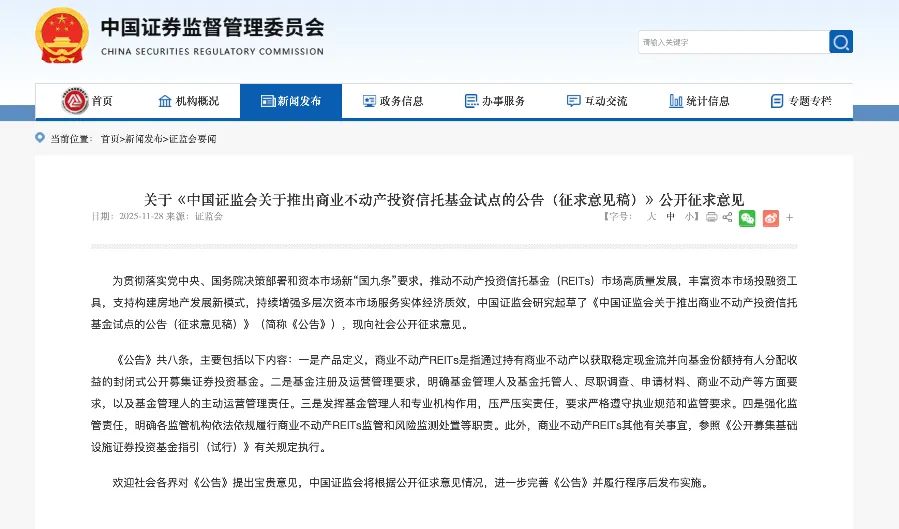
利好来了,证监会大动作,就重要新规征求意见
2 1 Shi Ji Jing Ji Bao Dao· 2025-11-29 02:21
Core Viewpoint - The announcement of the pilot program for Commercial Real Estate Investment Trusts (REITs) marks a significant innovation in China's capital market, aiming to connect commercial real estate with the capital market and provide standardized solutions for revitalizing trillions of yuan in existing assets [3][4]. Group 1: Pilot Program Overview - The pilot program is a key transition from infrastructure REITs to commercial real estate, aligning with the new "National Nine Articles" to promote high-quality development of the REITs market [3]. - The program aims to provide a new equity financing channel for the commercial real estate sector and transform the operational model of real estate development [3][6]. Group 2: Institutional Design - The pilot program features a comprehensive institutional design that establishes a market-oriented and standardized operational system, emphasizing the active management of REITs [4][5]. - The definition of commercial real estate REITs highlights their equity nature and the requirement for professional management to create value through operations [4]. - The program sets clear asset quality standards, ensuring that only properties with stable cash flows and clear ownership can be included [4]. Group 3: Market Impact - The introduction of commercial real estate REITs is expected to unlock dormant assets in prime urban areas, providing a new financing avenue for companies holding substantial commercial properties [6][7]. - REITs will shift the operational logic of commercial real estate from a focus on sales to a focus on management, enhancing property value through improved operational capabilities [7]. - The REITs model is anticipated to inject new vitality into the capital market, appealing to long-term investors such as insurance funds and pension funds due to its stable returns [7][8]. Group 4: Future Development and Opportunities - The development of commercial real estate REITs is based on five years of experience with infrastructure REITs, following a path from infrastructure to commercial real estate [8]. - The market is prepared for implementation, with exchanges revising rules and fund companies forming specialized teams [8]. - Successful implementation of the pilot program will require supportive policies, including tax and state-owned asset transfer regulations, to create a conducive environment for REITs [9].
多地加速推进保障性住房落地 更好实现“居者有其屋”
Jing Ji Ri Bao· 2025-03-24 06:46
Core Insights - The article emphasizes the acceleration of affordable housing initiatives across various regions to achieve the goal of "housing for all" [1][2][3] Group 1: Policy and Planning - The Ministry of Housing and Urban-Rural Development has reiterated the importance of increasing the supply of affordable housing, particularly through a market and guarantee system [1] - By 2025, the focus will be on demand-driven construction and procurement of affordable housing, with a target of 1.72 million units planned for 2024 [2] - Local governments, such as in Liaoning and Tianjin, are implementing specific measures to enhance housing security, including the acquisition of existing properties to create new affordable housing units [2][3] Group 2: Financial Support - In May 2024, the central bank established a 300 billion yuan affordable housing relending facility, which is expected to be a crucial funding source for both inventory reduction and affordable housing supply [4] - Financial institutions are actively participating in funding initiatives, with the Agricultural Bank of China providing significant loans to support affordable housing projects [4][5] Group 3: Meeting Diverse Housing Needs - The article highlights the need for a multi-tiered housing supply system to cater to various demographic groups, including new citizens and young people [6] - In Liaoning, the acquisition of existing properties for affordable housing will serve multiple purposes, including public rental housing and elderly care facilities [6] - Projects in cities like Qingdao are incorporating advanced technologies and flexible designs to meet diverse living requirements [7]