
商业不动产投资信托基金(REITs)

Search documents
沪市债券新语|行业龙头携REITs破局 助力不动产与资本市场深度融合
Xin Hua Cai Jing· 2026-02-13 17:07
Core Insights - The first batch of commercial real estate investment trusts (REITs) has been submitted and accepted by the exchange, marking a significant milestone in the development of China's public REITs market [1] - The launch of commercial real estate REITs by the China Securities Regulatory Commission signifies a new phase in the REITs market, enhancing the depth and breadth of capital market services for the real economy [1] Industry Overview - REITs play a crucial role in revitalizing existing assets and broadening investment channels for residents, contributing to the stable operation of the public REITs market over the past five years [1] - The essence of REITs is asset listing, allowing asset holders to share stable operating cash flows and capital gains with a broader range of institutional and individual investors [1][2] - The management and capital management of REITs are core values, enabling continuous sharing of stable investment returns for investors [2] Company Developments - Leading companies like Jinjiang and Shazhu have actively applied for the first batch of commercial real estate REITs, aiming to leverage their "assets, asset management, and capital" advantages for both internal and external development [3] - Jinjiang's REIT project, which includes 21 hotels across 18 cities, aims to diversify risk while meeting stable demand in core cities and growth potential in emerging cities [4] - Shazhu Group, a leader in the outlet industry, plans to use its REITs to strengthen its brand and expand its scale, focusing on quality improvement in the outlet sector [5] Market Expectations - Investors have shown positive interest in the REITs issued by industry leaders, focusing on the quality of the initial assets and the potential for continuous expansion of the REITs [5] - The industry anticipates that as the commercial real estate REITs market matures, leading REITs will play a more significant role in promoting high-quality development within the sector [5]
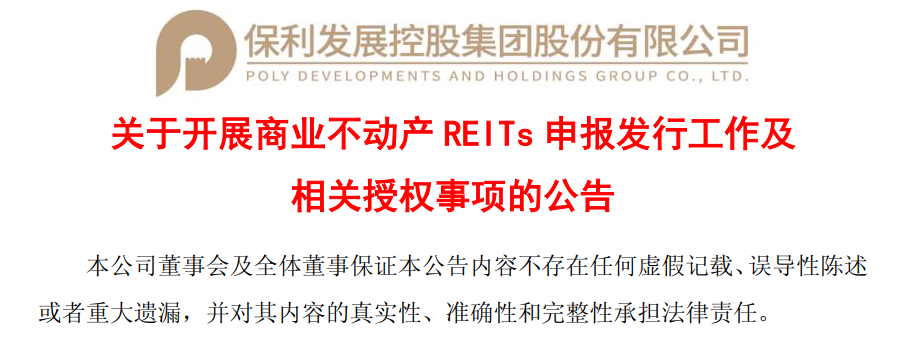
保利发展拟开展REITs申报,入池资产包含写字楼及CBD购物中心
Xin Lang Cai Jing· 2026-01-27 12:30
Core Viewpoint - Poly Developments and Holdings Group Co., Ltd. has approved the proposal to initiate the application and issuance of commercial real estate REITs to enhance its operational capabilities and optimize its capital structure in response to regulatory calls [2][4]. Group 1: Company Actions - The company plans to use its commercial real estate projects as underlying assets for the issuance of commercial real estate investment trusts (REITs) [2][4]. - The selected projects for the REITs issuance include the Guangzhou Poly Center and the Foshan Poly Water City, both held by the company's wholly-owned subsidiaries [5]. Group 2: Regulatory Context - The initiative aligns with the announcements from the China Securities Regulatory Commission regarding the pilot launch of commercial real estate investment trusts and the promotion of high-quality development in the REITs market [2][4]. - The issuance of these commercial real estate REITs does not constitute a related party transaction or a significant asset restructuring as defined by the relevant regulations [4].


【财经分析】新政领航高质量发展 商业地产REITs“破冰”助力实体转型
Xin Hua Cai Jing· 2026-01-08 05:50
Core Viewpoint - The initiation of commercial real estate REITs pilot programs marks a significant shift in China's REITs market from exploration to systematic development, providing strong financial impetus for revitalizing existing assets and constructing a new model for real estate development [1][2]. Group 1: Policy and Market Development - The new policies expand the coverage of REITs from traditional infrastructure to commercial real estate, enabling ordinary investors to participate in real estate investments [2]. - The estimated scale of commercial real estate in China is approximately 40 trillion yuan, indicating a substantial opportunity for revitalizing dormant assets through the pilot program [2]. - The new regulations aim to create a comprehensive system for REITs, enhancing market construction and regulatory optimization [1][3]. Group 2: Financial Mechanisms and Investment Opportunities - The introduction of commercial real estate REITs is expected to alleviate financial pressures on real estate companies by providing effective exit channels and improving cash flow [2][4]. - The policies encourage the entry of long-term funds, such as insurance and social security funds, into the REITs market, aiming to enhance market liquidity and investor structure [3][4]. - The REITs market is projected to grow significantly, with the potential to unlock substantial value in existing assets and provide stable capital support for the real economy [5][6]. Group 3: Market Resilience and Future Outlook - The new policies establish a three-dimensional framework for market resilience, focusing on asset supply, funding introduction, and product innovation [3]. - The REITs market is expected to evolve into a mainstream asset class, enhancing market depth and resilience through increased participation from institutional investors [3][5]. - The strategic focus for future investments in commercial real estate REITs should prioritize stable cash flow, asset appreciation, and expansion capabilities, particularly in core urban areas [6].
更加侧重“促消费、调结构” 公募REITs市场向商业不动产领域扩容
Zhong Guo Zheng Quan Bao· 2026-01-05 21:56
Core Viewpoint - The announcement by the China Securities Regulatory Commission (CSRC) regarding the pilot launch of commercial real estate investment trusts (REITs) will take effect from December 31, 2025, marking a significant expansion of China's public REITs market into the commercial real estate sector, indicating a new phase of parallel development between commercial real estate and infrastructure REITs [1][4]. Group 1: Regulatory Framework - The CSRC has established a "1+3+N" policy framework for the commercial real estate REITs system, which includes one announcement, one notice, two working regulations, and 17 supporting rules from various institutions [2]. - The new rules aim to adaptively optimize management while maintaining strict oversight, enhancing the inclusiveness and adaptability of the system, and reflecting targeted arrangements for different types of REITs [2]. - The announcement outlines eight key provisions that clarify the core institutional arrangements for commercial real estate REITs, including product definitions, fund registration, operational management requirements, and regulatory responsibilities [2]. Group 2: Market Development - The introduction of commercial real estate REITs signifies a shift towards a mature market that encompasses all categories and assets, moving towards a dual development model alongside infrastructure REITs [4]. - The regulatory approach will focus on enhancing the breadth and depth of REITs' service to the real economy, with a strategy to advance both commercial real estate and infrastructure REITs in parallel [4][5]. - The commercial real estate REITs are expected to promote consumption and structural adjustments, being more closely linked to macroeconomic cycles and consumer sentiment, while infrastructure REITs will continue to stabilize the economy and address shortfalls [5]. Group 3: Project Selection and Oversight - The regulatory authorities will prioritize the selection of high-quality projects, focusing on core urban areas and economically vibrant regions, and will support projects from listed companies, central enterprises, and reputable private and foreign firms [7]. - There will be a strong emphasis on the responsibilities of intermediary institutions, ensuring they adhere to strict standards in due diligence, material preparation, pricing, and information disclosure [8]. - The regulatory framework will include comprehensive monitoring and risk management to maintain market order and stability, with a commitment to transparency and public oversight in the REITs registration and regulatory processes [8].
中国股市取得2026年“开门红”;国家外汇管理局副局长、新闻发言人李斌:我国外债形势总体平稳|每周金融评论(2025.12.29-2026.1.4)
清华金融评论· 2026-01-05 10:36
Group 1: Stock Market Performance - The Chinese stock market achieved a "good start" for 2026, with all three major indices rising. The Shanghai Composite Index returned to the 4000-point mark, closing at 4023.42, up 1.38%. The Shenzhen Component rose by 2.24%, and the ChiNext Index increased by 2.85%, with over 4000 stocks rising and a trading volume of approximately 2.57 trillion yuan [7]. - Key factors driving the A-share market's performance include strengthened policy expectations, with a positive macro policy tone and the implementation of industry policies, particularly in commercial aerospace and semiconductor support, boosting market confidence [8]. - The influx of capital played a significant role, with foreign capital returning and the RMB appreciating, attracting over 10 billion yuan in northbound capital. Domestic long-term funds, including insurance and public funds, accelerated their entry, with margin trading balances exceeding 1.8 trillion yuan [8]. Group 2: Tourism Market - The New Year's tourism market also experienced a "good start," with 142 million domestic trips taken during the three-day holiday, generating a total expenditure of 84.789 billion yuan, averaging 597.11 yuan per person. Ticket bookings for domestic scenic spots increased by over four times year-on-year [8]. - The tourism sector is seen as a vital component of service consumption and a reflection of national consumer sentiment, with a strong start in tourism igniting confidence for economic development in 2026 [9]. Group 3: Foreign Debt Situation - The overall foreign debt situation in China is stable, with the total foreign debt balance as of September 30, 2025, being 16.8287 trillion yuan (approximately 2.3684 trillion USD), a decrease of 2.8% from June 2025 [9][10]. - The structure of foreign debt remains stable, with domestic currency debt accounting for 51.9% and medium to long-term foreign debt making up 42.5% of the total, indicating that key indicators are within internationally recognized safety lines [10]. Group 4: Regulatory Developments - The China Securities Regulatory Commission (CSRC) released the "Implementation Measures for Supervision and Management of Securities and Futures Markets" to further standardize the implementation procedures of market supervision, effective from June 30, 2026 [11]. - The China Banking and Insurance Asset Management Association published the "Data Classification and Grading Guidelines for the Insurance Asset Management Industry," effective January 1, 2026, aimed at enhancing data management standards in the industry [12][13]. - The CSRC announced the pilot program for Real Estate Investment Trusts (REITs) in commercial real estate, which is expected to provide new financing channels for real estate companies and enhance the stability of the REITs market [14]. Group 5: Low-altitude Economy in Shanghai - Shanghai aims to achieve a core industry scale of approximately 80 billion yuan in the low-altitude economy by 2028, establishing a complete industrial chain for new low-altitude aircraft and creating a national advanced manufacturing cluster [15][16].

【微头条】中国证监会印发《中国证监会关于推出商业不动产投资信托基金试点的公告》
Xin Lang Cai Jing· 2026-01-04 01:18
Core Viewpoint - The China Securities Regulatory Commission (CSRC) has announced the implementation of a pilot program for commercial real estate investment trusts (REITs) to enhance the quality of the REITs market and support a new model of real estate development, effective from December 31, 2025 [1][3]. Group 1: Announcement Details - The announcement consists of eight articles outlining the definition of commercial real estate REITs as closed-end publicly raised securities investment funds that generate stable cash flow from holding commercial real estate and distribute profits to fund shareholders [1][3]. - It specifies requirements for fund registration and operational management, including the responsibilities of fund managers and custodians, due diligence, application materials, and active management responsibilities of fund managers [1][3]. - The announcement emphasizes the role of fund managers and professional institutions, mandating strict adherence to professional standards and regulatory requirements [1][3]. - It reinforces regulatory responsibilities, clarifying the duties of regulatory bodies in overseeing commercial real estate REITs and monitoring risks [1][3]. - Other matters related to commercial real estate REITs will follow the guidelines set forth in the "Guidelines for Publicly Raised Infrastructure Securities Investment Funds (Trial)" [1][3]. Group 2: Public Feedback and Implementation - Prior to the announcement, the CSRC solicited public opinions on the draft, receiving overall positive feedback on the basic ideas and main content of the announcement [2][4]. - The CSRC has carefully reviewed the feedback and incorporated reasonable suggestions into the final announcement [2][4]. - The CSRC will ensure effective implementation of the announcement in the future [2][4].
商业不动产REITs开闸,万亿资产“活”了!投资新选择到来
2 1 Shi Ji Jing Ji Bao Dao· 2025-12-31 14:19
Group 1 - The core viewpoint is that the official release of the REITs pilot rules by the China Securities Regulatory Commission (CSRC) on December 31 allows commercial real estate such as shopping centers, office buildings, and hotels to be financed through public REITs, thus unlocking significant capital from the existing commercial real estate market [2][3] - The introduction of REITs transforms the approach for real estate companies from "development-sales" to "development-operation," enabling them to create long-term value through professional management [3] - REITs offer investors stable cash flow, providing new investment options for long-term funds such as insurance and pension funds [4] Group 2 - The regulatory authorities emphasize a cautious approach, focusing on quality rather than quantity, with the first batch of projects targeting mature commercial properties in first-tier cities to ensure a high-quality start [5] - The activation of trillions of yuan in commercial assets is anticipated, indicating a significant shift in the market landscape [6]
商业不动产投资信托基金试点落地
Bei Jing Shang Bao· 2025-12-31 11:08
Core Viewpoint - The China Securities Regulatory Commission (CSRC) has issued an announcement to promote the high-quality development of the commercial real estate investment trust (REITs) market, aiming to enhance the capital market's service to the real economy and support a new model of real estate development [1] Group 1: Announcement Details - The announcement consists of eight articles focusing on four main areas: product definition, fund registration and operational management requirements, the role of fund managers and professional institutions, and strengthening regulatory responsibilities [1] - Commercial real estate REITs are defined as closed-end publicly raised securities investment funds that hold commercial real estate to obtain stable cash flows and distribute profits to fund shareholders [1] - The announcement specifies requirements for fund managers, custodians, due diligence, application materials, and commercial real estate, along with the active operational management responsibilities of fund managers [1] Group 2: Regulatory Framework - The announcement emphasizes the importance of fund managers and professional institutions adhering to professional norms and regulatory requirements, thereby ensuring accountability [1] - It clarifies the responsibilities of various regulatory bodies in monitoring and managing risks associated with commercial real estate REITs [1] - Other matters related to commercial real estate REITs will follow the guidelines set forth in the "Guidelines for Publicly Raised Infrastructure Securities Investment Funds (Trial)" [1]
证监会印发《关于推出商业不动产投资信托基金试点的公告》
Sou Hu Cai Jing· 2025-12-31 09:45
Core Viewpoint - The China Securities Regulatory Commission (CSRC) has announced the implementation of a pilot program for commercial real estate investment trusts (REITs) to promote high-quality development in the REITs market and enhance the service efficiency of multi-level capital markets for the real economy, effective from December 31, 2025 [1][3]. Group 1: Announcement Details - The announcement defines commercial real estate REITs as closed-end publicly raised securities investment funds that acquire stable cash flow through holding commercial real estate and distribute profits to fund shareholders [1][3]. - The announcement outlines requirements for fund registration and operational management, including the responsibilities of fund managers and custodians, due diligence, application materials, and commercial real estate standards [1][4]. - It emphasizes the role of fund managers and professional institutions in ensuring compliance with professional standards and regulatory requirements [1][5]. Group 2: Regulatory Framework - The CSRC will enforce regulatory responsibilities, including risk monitoring and management for commercial real estate REITs, and other regulatory bodies will also have self-regulatory responsibilities [1][5]. - The announcement states that commercial real estate assets must align with national strategies, development plans, and industry policies, ensuring clear ownership and compliance with relevant regulations [1][5]. - The operational management of commercial real estate REITs must adhere to legal and regulatory requirements, with fund managers actively fulfilling their management responsibilities [1][5].
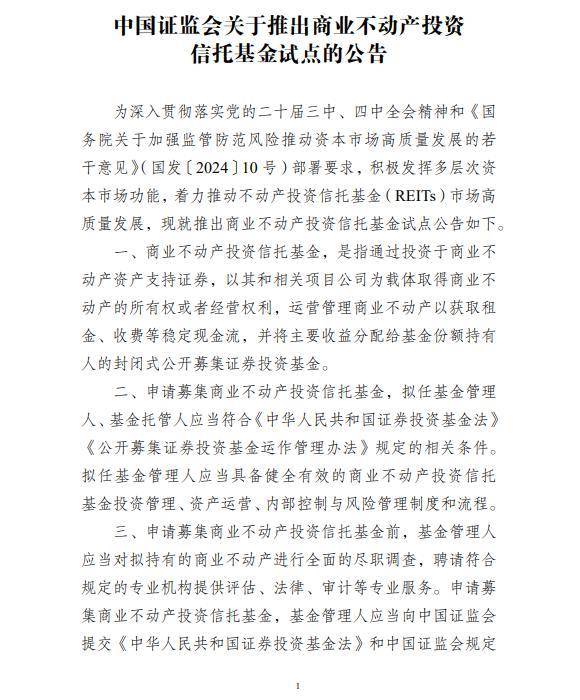
证监会:推出商业不动产投资信托基金试点
智通财经网· 2025-12-31 09:15
Core Viewpoint - The China Securities Regulatory Commission (CSRC) has issued an announcement regarding the pilot program for Commercial Real Estate Investment Trusts (REITs), aimed at promoting high-quality development in the REITs market and enhancing the capital market's service to the real economy [2][3]. Group 1: Product Definition and Requirements - Commercial real estate REITs are defined as closed-end publicly raised securities investment funds that acquire stable cash flow through holding commercial real estate and distribute profits to fund shareholders [2][3]. - The announcement outlines registration and operational management requirements for the funds, including the responsibilities of fund managers and custodians, due diligence, application materials, and the active management responsibilities of fund managers [2][3]. Group 2: Regulatory and Compliance Measures - The announcement emphasizes the role of fund managers and professional institutions, mandating strict adherence to professional norms and regulatory requirements [2][3]. - It reinforces regulatory responsibilities, clarifying that regulatory bodies must fulfill their duties in overseeing commercial real estate REITs and monitoring risks [2][3]. Group 3: Implementation and Feedback - Prior to the announcement, the CSRC sought public opinions on the draft, receiving overall recognition for its basic ideas and main content [3]. - The CSRC has committed to carefully considering feedback and will ensure the effective implementation of the announcement [3].