手眼协同

Search documents
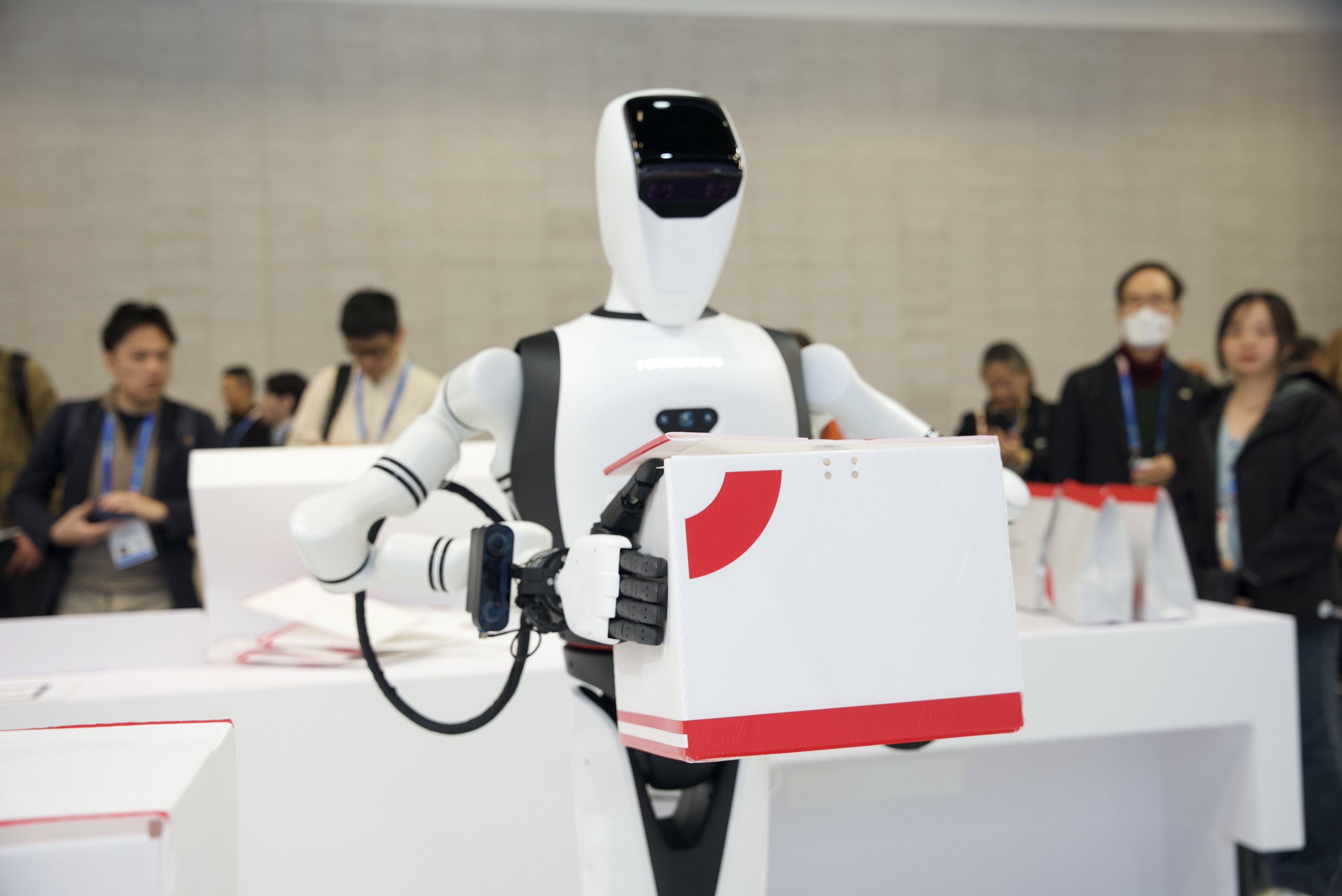
速腾聚创展出全球首款AI机器人“配送小哥”,现场演示自主打包拆包操作|最前线
3 6 Ke· 2026-01-07 05:43
Core Insights - The article discusses the transition of AI from the digital realm to physical entities, emphasizing the importance of endowing machines with human-like perception and execution capabilities as a core industry challenge [1] - The 2026 International Consumer Electronics Show (CES) highlights the global technological race entering the era of "embodied intelligence" [1] Group 1: RoboSense's Innovations - RoboSense showcased its groundbreaking AI robot "Delivery Guy" at CES 2026, capable of autonomously performing nearly 20 complex operational steps without human intervention, including gift packing, shelving, delivery, and box recycling [1][4] - The robot's capabilities are underpinned by RoboSense's proprietary "hand-eye coordination" technology, which integrates the industry-first VTLA-3D operational model, combining force tactile modalities with 3D point cloud information [4][5] - The system employs a task-planning AI that decomposes complex tasks into atomic sub-tasks, facilitating a "fast-slow dual system" that balances high-level task planning with low-level precise control [5] Group 2: Hardware and Product Development - The Active Camera series sensors serve as the "robot's eyes," with AC2 focusing on close-range operations and AC1 on long-range navigation and obstacle avoidance, complemented by a multi-degree-of-freedom dexterous hand [5] - RoboSense's embodied intelligence solution has established an end-to-end technology closed loop, applicable across logistics, industrial, and service sectors [5][7] - The company introduced several new iterations, including the second-generation solid-state LiDAR E1 Gen2 and the world's first 3D safety LiDAR Safety Airy, addressing a wide range of market needs from consumer robots to smart driving [7] Group 3: Market Trends and Collaborations - According to a Yole report, global shipments of automotive LiDARs surpassed 850,000 units in 2024, projected to reach 12 million units by 2030, aligning with RoboSense's technology roadmap [8] - RoboSense announced a partnership with leading garden robot manufacturer Segway Navimow to integrate digital solid-state LiDAR into the Navimow i2 LiDAR mowing robot [8] - In the unmanned delivery sector, the new stone L4-level unmanned logistics vehicle equipped with digital high-precision LiDAR Fairy has achieved large-scale production and delivery, while the Coco Robotics delivery vehicle with solid-state digital LiDAR E1R has been widely deployed in North America [9]


灵巧手深度:心灵手“巧”,手眼协同
2025-05-12 01:48
Summary of Key Points from Conference Call Industry Overview - The conference call focuses on the development of dexterous hands in the robotics industry, particularly in the context of human-like manipulation and control technologies [1][2][4][5][6][8][30]. Core Insights and Arguments - **Dexterous Hand Structure**: Dexterous hands are designed with up to 21 degrees of freedom, closely mimicking human hand anatomy, which is essential for fine manipulation [1][3]. - **Key Components**: The main components of dexterous hands include drive modules, transmission modules, and sensors. Various technologies are being explored to optimize performance, including hollow cup motors and brushless motors [1][6][14]. - **Tesla's Innovations**: Tesla has developed a dexterous hand with 22 total degrees of freedom and approximately 17 active degrees, utilizing a tendon-driven system and various sensors to enhance intelligence [1][7]. - **Domestic Manufacturers**: Companies like Lingqiao Technology, Leisai Intelligent, and Zhiyuan are actively developing and releasing products with advanced features such as tactile sensors and 3D force sensors [1][9][10][12][32]. - **Market Trends**: The domestic market is seeing a shift towards domestic alternatives in robotics, with companies establishing deep collaborations with downstream clients for mass production [4][13]. Additional Important Content - **Technological Diversity**: The industry is characterized by a variety of technological approaches, including tendon-driven, linkage-driven, and gear-driven systems, each with its own advantages and challenges [20][21][22]. - **Sensor Integration**: The rapid integration of electronic skin technology and tactile sensors is becoming standard in dexterous hands, significantly impacting performance and cost [30][31]. - **Cost Projections**: The cost of dexterous hands is expected to account for about 10% of the total value of humanoid robots, aligning with industry expectations for sensor costs [31]. - **Future Market Potential**: The market for dexterous hands is projected to grow significantly, with potential revenues reaching hundreds of billions as production scales up [19][26]. Competitive Landscape - **Domestic vs. International Players**: Domestic companies are making strides in the robotics field, with the potential to replace international competitors despite their earlier market entry [4][13]. - **Key Players**: Companies like Leisai Intelligent and Zhiyuan are highlighted as significant players due to their comprehensive capabilities in hardware and software integration [36]. Recommendations - **Focus on Key Companies**: It is recommended to monitor the developments of companies like Leisai Intelligent, which not only manufacture hardware but also provide essential algorithms and motion control solutions, addressing industry challenges effectively [36].

对话速腾聚创CEO邱纯潮:机器人打通手眼协同就能代替人类,将是10倍于汽车的应用场景
Sou Hu Cai Jing· 2025-03-31 02:26
Core Insights - The rapid development of LiDAR technology has led to a significant price drop from approximately $80,000 to below $200, primarily driven by chip integration [2] - The CEO of Suoteng Juchuang, Qiu Chunchao, emphasizes that the future competition in the LiDAR market will focus on chips and expanding applications beyond automotive [2][5] - The company forecasts a revenue of 1.63 to 1.67 billion yuan for 2024, representing at least a 45% year-on-year growth, with losses narrowing by 88% to 90% [2] Group 1: LiDAR Technology and Market Trends - LiDAR is entering a digital era, with increasing demand expected as autonomous driving progresses towards levels L3 and L4, enhancing user experience and safety [2][3] - The automotive industry is not the only sector for LiDAR applications; robotics is identified as a significant market, potentially ten times larger than the automotive sector [2][5] - The company shipped 544,000 LiDAR units last year, with 519,800 units for ADAS and 24,400 units for robotics and other fields [5] Group 2: Safety and Industry Standards - L3 is considered a critical threshold for autonomous driving, where the inclusion of LiDAR is viewed as essential for safety, akin to an airbag in vehicles [3] - The CEO notes that while L2 focuses on user experience, L3 and above require manufacturers to invest in safety measures, which are justified from an insurance perspective [3] Group 3: Robotics and Future Applications - The company is focusing on two main areas for robotics: solutions for lower body mobility and upper body manipulation, emphasizing the importance of hand-eye coordination [6] - The integration of digital LiDAR with cameras is aimed at enhancing robotic capabilities, with plans to develop a comprehensive system that can perform tasks traditionally done by humans [6] - The relationship between automotive and robotics is seen as symbiotic, with advancements in one sector driving progress in the other [6] Group 4: Strategic Directions and Collaborations - The company is open to collaborations with automakers interested in developing their own LiDAR systems, provided there is economic viability and scale [4] - Future developments will focus on continuous chip iteration and engineering modifications tailored to various application domains [5] - The company plans to expand its presence internationally, targeting both automotive and robotics applications for LiDAR technology [6]